

Chasing Moonflowers, page 1


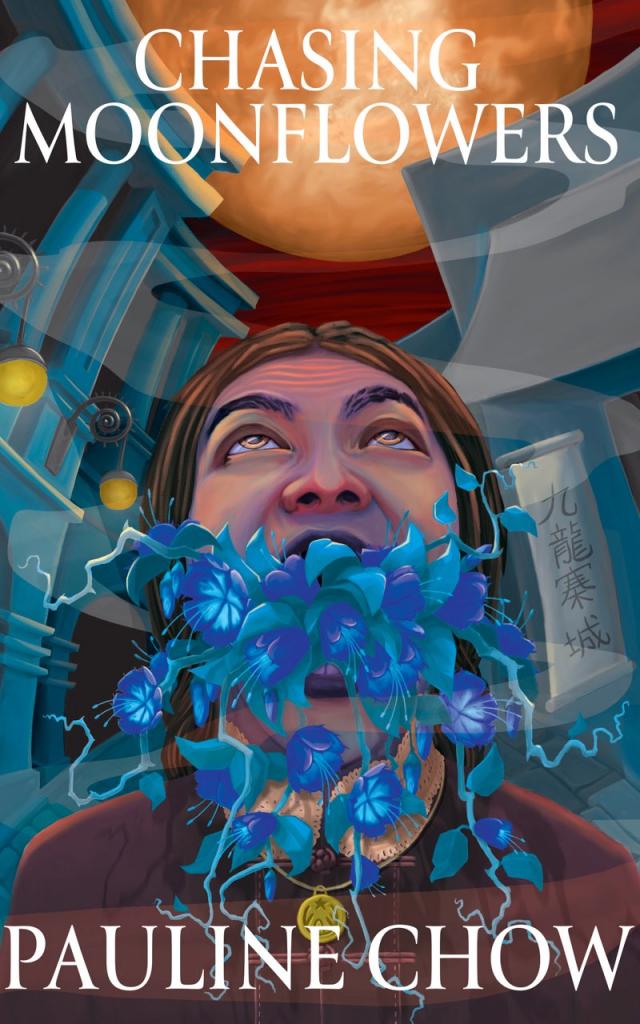
Chasing Moonflowers
Pauline Chow
Ghastly Goings-On Press
Copyright © 2025 by Pauline Chow
All rights reserved.
ISBNs: 978-1-964733-02-9 (kindle), 978-1-964733-04-3 (ebook), 978-1-964733-03-6 (paperback); LCCN: 2025908741
No part of this book may be reproduced, distributed, or transmitted in any form or by any means, including photocopying, recording, or other electronic or mechanical methods, without the prior written permission of the author, except in the case of brief quotations embodied in critical reviews.
The text of this work is expressly prohibited from being used, in whole or in part, for the training, development, or improvement of artificial intelligence (AI) systems, including but not limited to machine learning, natural language processing, or generative AI models. Any unauthorized use of this text for such purposes constitutes a violation of the author's intellectual property rights and is strictly forbidden.
This is a work of fiction. Names, characters, businesses, places, events, locales, and incidents are either the products of the author’s imagination or used in a fictitious manner. Any resemblance to actual persons or events is purely coincidental.
Cover design by Andrew Machulski
For my parents
Thanks for keeping our history alive through stories, language, and deliciously cooked meals. There are many ways home.
Praise for Chasing Moonflowers
A dazzling blend of fantasy intrigue and historical drama. Chow deftly moves from the intricacies of real events to graphic horror scenes that would feel at home in a Stephen King novel.
Kirkus Reviews (starred review)
“Chasing Moonflowers is a mysterious, cosmic, folk horror with elements of the weird nestled in a web of politics and the occult, exploring power, choice, and the way both changes our relationships to others.
Atmospheric and enticing, this is a book you'll want to read by a the dim, quivering light of a lantern in a garden."
Ai Jiang, Ignyte, Nebula, and Bram Stoker Award winning author
“Packed with unexpected twists, moments of revelation, and a tension and attraction that translate to a powerful read, Chasing Moonflowers is hard to put down and nearly impossible to predict.”
Midwest Book Review
“Ling is an unforgettable protagonist, courageous yet authentically vulnerable, demonstrating the interplay between power and humanity. Chasing Moonflowers is both chilling and enchanting, definitely a book that deserves to be read slowly and savored.”
Angela Yuriko Smith, A two-time Bram Stoker Award winner and HWA Mentor of the Year
“A once in a lifetime book.”
Librarian, NetGalley review
“A riveting novel that keeps readers looking over their shoulders while unwilling to put it down.”
Readers’ Favorite
“Chasing Moonflowers is an intriguing blend of mystery and horror, set against a backdrop of political tension and cultural transformation. A story that feels both timeless and unnervingly fresh!”
Christopher O’Halloran, Author of Pushing Daisy
“Magic. Monsters. And eyes in jars. Chasing Moonflowers is a creepy, haunting, and hopeful journey of a girl who wants to save her family. A rich and beautiful story set in a time and place I want to know more about.”
Kathleen Palm, author of Into the Gray
“Fans of Sinners seeking new stories combining the supernatural with consciousness-raising narratives would do well to add Chasing Moonflowers to their TBRs.
Chow effortlessly blends horror, adventure, history, and colonial critique, producing a life-giving elixir for anyone who wants entertainment and enlightenment in equal measure”
Patrick Barb, author of Night of the Witch-Hunter
“An exceptional read that will transport readers into 1920's Hong Kong and a world of vampires and magic.”
Jordan Francis, Poet of Sailing in Dark Waters
“If you enjoy complex female leads, folklore-laced thrillers, or tales of rebellion against monstrous systems this book’s for you.”
Literary Titan
Contents
Author’s Note
Chapter 1
Chapter 2
Chapter 3
Chapter 4
Chapter 5
Chapter 6
Chapter 7
Chapter 8
Chapter 9
Chapter 10
Chapter 11
Chapter 12
Chapter 13
Chapter 14
Chapter 15
Chapter 16
Chapter 17
Chapter 18
Chapter 19
Chapter 20
Chapter 21
Chapter 22
Chapter 23
Chapter 24
Chapter 25
Chapter 26
Chapter 27
Chapter 28
Chapter 29
Chapter 30
Chapter 31
Chapter 32
Chapter 33
Chapter 34
Chapter 35
Chapter 36
Chapter 37
Chapter 38
Chapter 39
Chapter 40
Chapter 41
Chapter 42
Epilogue
Acknowledgments
About the Author
Author’s Note
Hong Kong and the Kowloon Walled City have undergone significant transformations over time.
In 1842, following the First Opium War, Britain gained control of Hong Kong. During the peak of British trade in the 1870s and 1880s, over 6,500 tons of opium passed through the port annually. The colony’s economic growth often bypassed the local residents. On May 30, 1925, police brutality in Shanghai ignited the Canton-Hong Kong Strike, a large-scale labor movement and boycott targeting British businesses.
For 16 months, workers organized a sustained and targeted response. Approximately 250,000 workers left their jobs and returned to mainland China, bringing commerce to a halt. The pressure on business operations forced the British to negotiate, resulting in agreements to raise wages, improve working conditions, and abolish child labor. The strike concluded in October 1926. Decades later, in 1997, Hong Kong was returned to China and became a Special Administrative Region. Hong Kong’s identity continues to evolve.
The Kowloon Walled City (KWC), once home to roughly 35,000 residents on 6.4 acres of land, was demolished in 1994. Originally a Chinese military fort, the site was never ceded to the British. Both governments largely ignored it, allowing the area to grow unchecked and ungoverned. While often portrayed in media as a chaotic and lawless enclave, KWC was also a thriving community that provided affordable housing, services, jobs, education, and entrepreneurial opportunities for the local population. It stood as a symbol of resilience and resistance to colonialism. Today, the site has been rebuilt into a park featuring open spaces and remnants of the old city.
This book uses Cantonese, a regional variety of Chinese in Southern China, written out in the romanized system of Jyutping without tone numbers. It’s common in Cantonese to start and end phrases with “ah” to soften, emphasize, or alter emotional tone. This is the reason that “Ma” (媽) appears as “Ahma” (阿媽) throughout the book.
道高一尺,魔高一丈
Where good flourishes, evil can flourish even more.
- Ancient Proverb
One
June 27, 1925
Ling inventoried the containers of preserved animals in her uncle’s seaside medicine shop. Counting withered caterpillars, broken tiger teeth, and shriveled seahorses, she recited the ways death remedied maladies of the mind, body, and spirit. Life valued sacrifice.
She unfurled herbs from butcher paper as a breeze brought in the evening hour. Her uncle’s shop was wedged between three other sellers near Woyi Ping Tsun pier. Fishermen called out their summer catches from the bustling waterfront. A scattered cloud of amber flyers blew up into the air, bearing the manifesto of the workers’ strike on the wind. Sudden gusts carried the message out to sea. Dissent circulated everywhere.
Beneath the noise of passengers waiting in a queue for the ferry, voices spoke to each other. Ling tilted her head toward the thick tarp separating her from a furtive conversation nearby. What she heard made the hairs on the back of her neck stand up.
“Please print a notice in the papers that she is missing!” Desperation seeped from the woman’s words.
“I cannot.” The voice sounded like her uncle’s. Ling glanced at the front of the stand. The doctor had abandoned his post at the counter. “It’s dangerous if they trace the politics back to us.”
“But you must help Cili!” the lady cried. She spoke with a Northerner’s accent.
Ling’s stomach dropped. She knew this girl. Cili was a new student at her brothers’ primary school. She had seen her last week, pink-cheeked with red bows in her hair. This news was heartbreaking.
“We can organize a search,” her uncle said over her muffled sobs. “We must stay strong and cautious.” Ling was concerned. She trusted his judgment, but it was unlike her uncle to turn someone away. What could be more important than finding a child?
When they stepped out from behind the narrow space between the stands, Ling scurried back to her spot. She glimpsed a lady with bobbed hair, her face puffy and slick with tears. Ling diverted her eyes to the mugwort she’d been tallying. Dried, broken, and crumbled into a million pieces, these
Why was the woman asking Dabak, a traditional medicine doctor, about a newsletter? He wrote scripts, not political dissent. Did Dabak have something to do with the strike? Her uncle slipped back into his seat and began to pore over his medical texts.
Ling viewed her distorted reflection on a jar of herbs. She examined her own elongated copper eyes and high-bridged nose, faintly echoed on the curved surface. The features mapped back to her father. She wanted to love these reminders of him. However, the shape of her face made people question her lineage. To them, different brewed distrust.
Her uncle cleared his throat. “Did you catalog the new items?”
Ling turned her head, staring up with glassy eyes at her uncle. Should she ask him about the secret conversation? What fliers had the woman referenced? She wanted to talk about Cili, not the shop. Stuttering, she grabbed at the nearest item within reach. “Dabak…um…uh.”
Her uncle leaned forward. “Well?” He scrutinized her work area, which she hadn’t yet cleaned up.
“This.” She lifted the first package at the end of the counter, catching only the name written on it. “I wanted to ask you about its contents.”
Dabak stroked his chin. “It is a delivery to Lady Tun.”
“To the house on the peninsula?” She turned the bulky bag, noticing its lightness. Feeling a sense of repulsion at the sight of the patient’s alias, she covered her mouth. Lady Tun was a creepy woman who took an unsettling interest in children.
Rumors swirled about the woman, who lived alone. She’d been the wife of a lieutenant who staked a claim on his outpost. Lady Tun chose to live on the mainland even after her fellow Englishmen had relocated across the water. The ghosts, the local’s epithet for the occupiers, had all moved their homes to the island. With the influx of opium, the ghosts still haunted the village. “It says here, the patient requires it by midnight.”
Dabak frowned. “Yes. I was too caught up in…”
What was he working on? She’d already finished recording today’s sales in the ledger, a task he had trained her in last week, but he seemed occupied by something else.
He sighed. “Never mind…it shall has to wait until the morning.”
She pursed her lips. This was alarming. Never had her uncle ever been dismissive about his customers. Something was wrong. With her uncle, conversations usually flowed between English and Tangwa. Now, he was lost in thought.
“Dr. Shaw.” She addressed her uncle by his profession. Otherwise, he was Dabak, her father’s older brother. “I can deliver the package,” she blurted out, to her own surprise. The pain on her uncle’s face stirred her boldness. She wanted to help.
“No. Absolutely not.” His eyebrows flexed, deepening the wrinkles on his brow.
The sea churned behind him as a strong wind whistled across the tin roof. It sang a song of adventure.
“You said to never disappoint the customer.” Ling placed her hands on the counter.
“I did say this. However, exceptions exist. This time, we must delay.” Dabak ran his hand through his hair.
Ling was eager to make her case. “But—”
“It is not wise.” He plucked the package from Ling’s hand with finality and deposited it into a pile of herbs.
The horn sounded from the last commuter ship. It would soon be departing for the island. Ling’s eyes darted to her uncle. He had to go.
“Young lady, look at me.” His eyes darkened. “Promise me you will not go to the peninsula. It is not a place for children.”
The comment infuriated her. Her twentieth birthday was in a few weeks. She was no longer a child. “Do you think I’ll get lost like Cili?” she retorted without thinking.
His eyes widened. “Lady Tun is difficult. Stop worrying. Cili is an… unfortunate situation.” As he spoke, Dabak filled his briefcase with books and medicines for her Aunt Marcella. Some saffron colored papers had been haphazardly stuffed in between medical texts.
She couldn’t let the subject go. “What happened to Cili? She’s the twin’s classmate.”
The whole region was on edge. Locals had been fleeing the island, refusing to continue working for the ghosts. Workers were on strike, protesting unsafe conditions. Regardless of the tumult, however, a missing child should’ve risen above politics. How could this not be an emergency? As far as Ling could tell, no one was canvassing the neighborhoods, combing the marshes, or patrolling the cliffs. The seaside communities should’ve been up in arms, shouting the missing girl’s name.
Dabak pressed his mouth into a thin line, securing his case with a lock. The ship sounded another warning.
“I am sorry. I must depart for Marcella. She’s been having extra troubles. Tomorrow, I will explain. Keep an eye out for your mom and your brothers.” He pushed over a tin of salve. “Infused with the protective qualities of bay leaves.” Then he patted her on the shoulder and sprinted to board the ship.
Ling hadn’t seen her aunt in a long time, though she had made quite an impression. Aunt Marcella had stunned Ling at their first meeting with a full-hearted embrace. At the wedding banquet, Aunt Marcella’s red silk wedding dress had complimented her soft eyes and golden hair. However, after the couple returned from their European honeymoon, she had changed; Aunt Marcella spent hours staring vacantly at the gardens instead of frolicking in them as before. The trip had triggered a deep sadness. Ling didn’t know why.
“Doctor!” A crew member shouted as Dabak’s feet pounded against the wooden planks. The crew knew him well. Every night, he sailed home on the last ship without fail, and they watched for him expectantly before casting off.
Her uncle had sown seeds of curiosity in Ling. His warnings sent her spirit ablaze. She inhaled the scent of the salve. It was an herbal mixture of citrus, peppermint, and mugwort. Bay leaves added a slight bitterness to the concoction. The scent reminded her of warnings parents gave their young ones.
“Be good, little children.”
“Don’t play close to the jungle. Wicked creatures prey on the weak.”
Untamed wilderness surrounded the foothill villages of Kowloon, impenetrable to the occupying forces. While foreigners tumbled unhindered into the island ports, they did not venture far outside of them. Ancient lore persisted in these marshes, jungles, and mountains of the nine dragons—the namesake of this area. People vanished in more than one way in the countryside, but it wasn’t always because of mysterious creatures. The source of the most peril, as is often the case, was people.
Ling squeezed Lady Tun’s medicine. The shape of the package was odd, bulging and lightweight. Why did she require this at such a late hour? It was so out of place that Ling ached to discover the reason. A forbidden urge to venture into the unknown overtook her. Despite her uncle’s warnings, she made a hasty decision and stuffed the package into her bag. She respected her uncle, but hated to break promises to important patrons. And after all, what harm could come from a frail old lady who lived alone at the edge of the ocean?
Two


