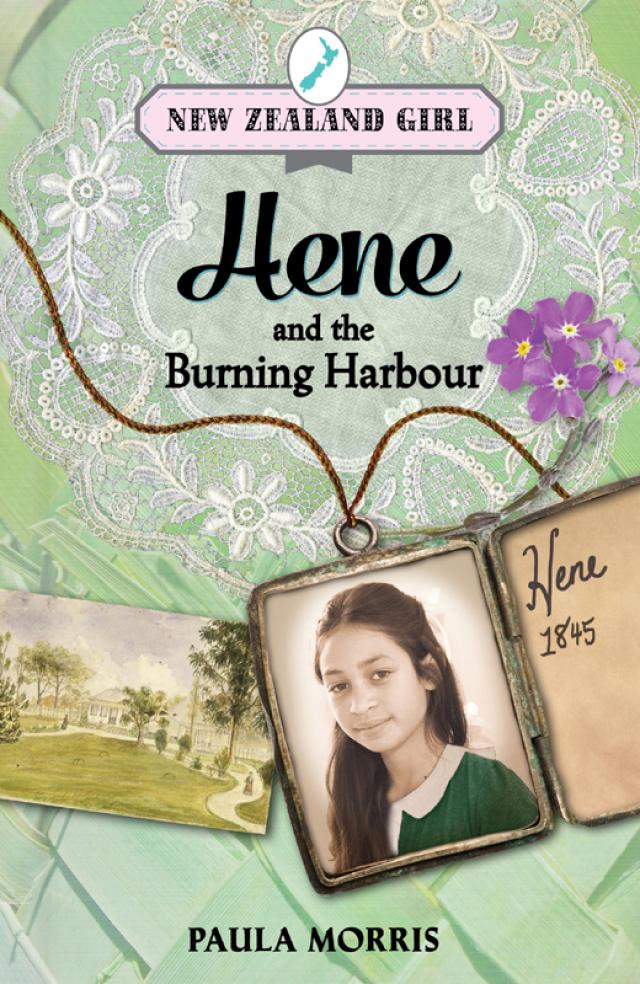
Hene and the Burning Harbour, page 1


Paula Morris
HENE AND THE BURNING HARBOUR
Hene’s Story, 1845
PUFFIN BOOKS
Contents
Prologue
1 The two boats
2 Mata Wiremu
3 The school house by the beach
4 Big trouble coming
5 Kororareka
6 The locked shed
7 Town on fire
8 Stowaway
9 Looking for Rangi
10 Escape!
11 Home again
Glossary
How I Became a New Zealand Girl
The Burning of Kororareka
Imported Illness
Mission Schools
For all the New Zealand girls,
past and present, of Ngunguru School.
Prologue
The Bay of Islands, 1845
These are uneasy times in the new colony. The mission settlement at Paihia is peaceful, but just across the water, Kororareka – the famous ‘hell-hole of the Pacific’ – is under siege.
Government soldiers try to guard the Waitangi flagpole from the warrior chief Hone Heke. But Hone Heke keeps defying the Governor by chopping it down.
A gunship sails towards the bay, ready to bombard the town …
1
The Two Boats
Hene sprinted down the path, leaping over rocks and straggly bushes. Her heart was pounding. She needed to run as fast as possible, as fast as she’d ever run before.
But she also needed to be careful. On one side of the narrow path, kumara gardens stretched in terraces up the hillside. On the other side, there was a long, sheer drop into the blue water of the bay.
Although Hene knew she was a strong swimmer, she didn’t like jumping – or, even worse, falling – into the water from such a great height. Lots of the other girls and boys at the pa thought nothing of leaping into the sea from a big rock, or from high on a hill. But Hene preferred to walk into the water, one step at a time, from the beach. She didn’t care if other children laughed at her and called her a coward. Maybe one day she could show them she could be brave in other ways.
Hene stumbled on a knobbly root, stubbing her toe.
‘Ow!’ she cried out, but there was nobody to hear her. Nobody was digging in the gardens. Nobody was carrying kete of squirming fish back from the point, or hauling dried seaweed up the ladder to the pataka where they stored supplies for the coming winter. There were big things going on at the pa, serious things. All the adults always seemed to be talking and arguing. Sometimes her parents seemed sad. Other times, they seemed angry.
‘Too many bad things all at the same time,’ her grandmother said every day, shaking her head and shooing Hene away.
Everyone was always shooing her away, Hene thought, her bare feet slapping against the cracked earth of the path. Her heart thudded along in time with every step. Well, maybe this time they’d be pleased to see her. Today she had news that everyone would want to hear.
Hene had spent much of the afternoon trying to keep out of everyone’s way. She’d followed the path from the pa all the way to the end, where the land stopped and you could see far, far away – past lumpy little islands, all the way to the blue horizon.
That’s when she saw the two boats.
The first boat was huge, as big as any boat Hene had ever seen in her life. It had masts as tall as trees, and great sails that billowed like puffy white clouds. In the bright sunshine it was hard to see clearly, but Hene was sure she spotted two things: big guns, big enough to cast a shadow on the water; and soldiers, Pakeha soldiers.
She’d never seen a soldier in person, but Hene had heard lots of stories about them. Someone told her they all wore red coats and had such long whiskers that they looked more like dogs than men.
Her twin brother, Taehi, had whispered to her that the coats were red because they were stained all over with blood, but she didn’t believe that. She didn’t believe any of Taehi’s stories or jokes. And anyway, he’d never seen a soldier either, so how would he know?
Taehi. Hene’s heart thumped even faster when she thought of him. Usually Taehi was the brave one, fast and fearless. He was the best runner of all the children in the pa. But now he was a shadow of himself, struggling to open his eyes.
He couldn’t come outside today, or yesterday, or any day. He was sick, and nobody knew why.
Lots of the children in the pa were sick, and some of the older people as well. They were cold and shivering, then they were hot and feverish. They were too tired to get up, and often they struggled to breathe. They had to stay inside, in the dark whare, sleeping or shaking and moaning.
Everyone was worried about them. All the usual remedies and prayers didn’t seem to work. Two of the younger children had already died, and now people were afraid that all the children would be lost to this strange new disease. Hene couldn’t understand why one day Taehi was racing her out to the point and back, and the next day he could barely stand up.
Now Hene had to sleep in her grandmother’s whare, to keep safe from the sickness. Each day her grandmother gave her jobs to do. She had to fetch water, collect feathers, carry flax to the weavers and lug bundles of fern and firewood. There was no time for swimming or kite-flying, and anyway there was no one to play with. Nearly all the children in the pa were ill.
Hene felt lonely spending long hours by herself. She wanted to sit with Taehi, telling him stories, trying to make him feel better. But everyone just shooed her away.
Today’s job was to watch for the boat – not the one with soldiers, but another, much smaller, boat. Hene had seen it not long after she watched the big ship sail by. As soon as she saw the little boat, she took off running along the narrow path. She had to get back to the pa to tell them the news.
Two men were rowing the boat, pulling as hard as they could against the big waves. There was a Pakeha lady in the boat, too. She wore one of those enormous hats that they called a bonnet, and on her lap she held a kete. In this kete, Hene knew, there was special medicine. The lady was the wife of a missionary in Paihia, and two men from the pa had gone to fetch her. Paihia was a long way away, further than Hene could run.
The lady’s name was Mrs Williams, but everyone in the pa called her Mata Wiremu. She was very good at helping sick people, so today they were bringing her to the pa to help Taehi and everyone else who had the fever.
‘They’re here!’ Hene shouted, although she was still too far away for anyone to hear her. Every time she shouted, her voice sounded like a squeak. ‘They’re here!’
Hene’s hair was plastered to her head with sweat. Her chest hurt from running so fast. Her breath felt trapped in her throat. She could see the spiky fences of the pa up ahead, and the thatched roofs of all the whare. She could even smell the smoke curling up from the fires.
‘The boat is here!’ she called, and this time a man standing on the ramparts heard her and took up the cry. The hubbub of the spreading news rose up from the pa. But Hene kept running. This was good news – the first good news they’d had in a long time. She wanted to be there to tell her mother and father. Maybe this time they wouldn’t shoo her away.
Maybe now Taehi would get better, Hene thought. Their lives would go back to normal. She couldn’t imagine a world without Taehi and her parents and grandparents. All Hene wanted was for them all to be together.
2
Mata Wiremu
‘Don’t be sad, my mokopuna,’ said Hene’s grandmother, stroking her hair. ‘Soon you can come home. When Taehi is well.’
‘I don’t want to leave,’ pleaded Hene, but her grandmother just looked away. Hene couldn’t believe this was happening. Today, when the missionary lady left to travel back to Paihia, Hene was going with her. Her grandmother had told her, and there was nothing Hene could do about it.
She was going to stay with the missionaries, go to their school and help them with the house and garden. Her grandmother tried to make it sound like a good thing. Hene wouldn’t get sick because she’d be safe.
But Hene didn’t care about being safe. She wanted to stay here, with her whanau, in the place she’d lived her whole life. She wanted to feel her grandmother’s hugs, and see her mother’s smile. She wanted her father to laugh and swing her in the air, the way he used to before Taehi fell so ill. She didn’t want to go and live among Pakeha strangers in a faraway settlement.
‘At the school, you can read, and write,’ her grandmother was saying to her.
‘I know how to read!’ Hene protested. She knew a few letters, enough to spell her name – and her English name, Jane, as well.
‘Shh!’ Her grandmother frowned, and gestured at the whare. Hene knew that Mata Wiremu, the missionary lady, was in there, giving Taehi something strange and horrible to drink. Through the small opening, Hene could see her mother, kneeling on the floor of dried grass, sobbing quietly.
Her father was somewhere else, talking to the other men about the war ship Hene had seen sail past. There was going to be trouble, they said. The soldiers were here to deal with Hone Heke, once and for all. If he chopped down the Governor’s waving flag one more time, there would be a battle.
It was just a flag, thought Hene – a piece of cloth like the big skirt the missionary lady wore, so long that it dusted the ground. The flag wasn’t even useful, like a sail or a fishing net. But no, her father had told her, when you disrespect the Queen’s flag, you disrespect the Queen. The Queen lived far away, across the ocean. Much
Hene tried again with her grandmother.
‘Everyone says there’s going to be a battle,’ she said. ‘So why send me away where there’s danger? I could be safe here, at home.’
Her grandmother’s face looked sad and tired.
‘It’s not safe for you here, Hene,’ she told her. ‘You don’t want to fall ill, like your brother and all the other children. And there’s no battle in Paihia. No one wants to fight the missionaries.’
Tears prickled in Hene’s eyes, but she fought them back. She didn’t want to be sent away. She’d tried to be good, and to help as much as she could. But this felt like a punishment.
She looked around wildly, hoping someone or something would come to her rescue. Her father was trudging towards the whare, his face grim. Hene ran to him, flinging herself against his legs.
‘I don’t want to go,’ she cried. ‘Please let me stay at home!’
Her father shook his head.
‘No, Hene,’ he said. She could tell by the tone of his voice that he was serious. ‘You have to be brave. Work hard for Mata Wiremu, and when the sickness has gone from this place you can come home.’
There was nothing else Hene could say or do. The afternoon sun beat down on her head until she began to feel dizzy. She wanted to be brave, but going to a strange new place felt frightening – even more frightening than jumping off a high rock into the sea.
Mata Wiremu emerged from the whare and talked, in a low voice, to Hene’s father. She was as plump as a kereru, and her white apron looked like the white feathers of the kereru’s chest. She wore a dark dress with long sleeves, her scuffed black boots peeping out at the bottom of the skirt. Whenever Pakeha visited the pa, they always wore boots like these.
Hene didn’t understand it. On a sunny day like this, wearing tight boots must be very hot and uncomfortable. And why cover your skin in the summertime? How could you feel the cool breeze when you were all wrapped up from head to toe?
Mata Wiremu smiled at her and walked away. She had another sick person to tend before it was time to go, although they couldn’t leave too late – it would take the men hours to row them back to Paihia, even though the sea this evening was calm.
Hene’s grandmother bustled about, finding things for Hene to take with her to Paihia. She’d need mats to sleep on, and a comb carved from bone to keep her hair tidy.
‘No running around all the time in Paihia,’ her grandmother told her. ‘Remember what I told you: there are times to run fast, and times to be still. When you have to learn your lessons, remember that you have to sit still and listen.’
Hene didn’t like the sound of that one bit.
When her mother crept out of the whare to say goodbye, Hene learned that she wasn’t allowed inside to see her brother.
‘Mata Wiremu says you could get sick as well,’ her mother said, holding Hene tight. ‘We need you to stay strong. For Taehi and for all of us.’
Hene nodded, biting her lip so she wouldn’t cry. She had to be brave and strong, so her whanau wouldn’t be ashamed of her. When someone called out to say the boat was ready to leave, she hung her head but said nothing. She walked down to the water, a bundle of mats under one arm, her kete bumping against her leg with every slow step. The small boat waited, bouncing in the breaking waves, and Hene waded towards it.
She was going to Paihia, whether she liked it or not.
3
The School House by the Beach
Hene sat on the hard wooden bench, trying her hardest not to wriggle. It was a sunny morning, perfect for clambering over rocks or swimming. But instead she had to sit inside the stuffy Paihia school house with ten other girls, drawing letters onto a slate. This is what she had to do every single morning now except for Sundays. On Sundays she spent most of the morning sitting on a different wooden bench – one in the little church just a few steps away.
‘A-E-I-O-U,’ chanted Katerina, one of the big girls who taught at the school. She pointed with a stick at the chalky letters on the board, and Hene did her best to copy them onto her slate. It wasn’t really her slate, because she had to share it with the girl who sat next to her, Harieta. Harieta wasn’t very friendly. When it was her turn to write on the slate, Harieta grabbed it and rubbed out all Hene’s big, careful letters.
Hene tried to get comfortable, but it was impossible. Not only was the bench hard and the room hot, but her new dress was itchy. The dress she was given when she arrived in Paihia was too big for her, and it scratched her skin. Hene was used to feeling the sun on her bare skin, and wearing as little as possible. But the missionaries didn’t like that. Here in Paihia she had to wear a dress, even if it was uncomfortable and got in the way when she was running.
The first time she carried a sack from the pantry, Hene realised that her dress was made of exactly that – an old flour sack! No wonder it itched so much. At least no one made her wear boots, she thought, drumming her bare heels against the legs of the bench.
Outside seagulls were cawing, begging her to come out and play. She imagined them swooping along the beach, or hovering in the wind. If only she could be free like a bird!
‘Hene!’ said Katerina, frowning at her. ‘Pay attention!’
Hene stopped drumming her feet and stared down at her slate, her cheeks sizzling.
‘Mine,’ said Harieta, and pulled the slate from Hene’s hands.
School was awful, mainly because she had to go every single day, even when it was sunny and there were lots more exciting things to do and see and explore outdoors. Paihia was a very strange place.
It was a much smaller settlement than the pa, with far fewer people and animals. Hene had spent all ten years of her life living in the pa, with its spiky fences, high ramparts and deep gullies, built so people could defend the pa under attack. Here in Paihia, the whare were dotted along the shoreline. Although the settlement was hemmed in by steep fern-covered hills, there was no protection from an attack by the sea.
Some of the whare had no fences at all. The only tall fences were the pens for the pigs and the chickens. Anyone could row up, haul a boat onto the beach and walk right into one of the buildings! Hene wondered why the missionaries hadn’t thought of this.
Even stranger was the colour of these houses. All the whare Hene knew back at home were the muddy shades of the forest. But here in Paihia most of the buildings were painted white. On nights when the moon shone bright, the houses loomed like ghosts.
‘Mata Wiremu says they paint them white to look like English houses,’ a big girl called Ana told her one afternoon, when Hene was helping her dig up potatoes in the garden. Ana had been living in Paihia for six months, and helped with cooking and cleaning in the house where Te Wiremu and Mata Wiremu lived. There were always lots of visitors to Paihia, so Mata Wiremu was kept very busy.
As well as lots of whare where people lived, and the school house, there was a small church here, a carpenter’s shop, and a stable where the Pakeha blacksmith, Mr Timothy – or Mr Tiaki, as the girls called him – worked. In the afternoons, when school was finished, Hene liked to slip off to watch him. Sometimes he was hammering horseshoes on a giant anvil, sweating in front of his blazing fire. Bits of fire spat every time Mr Tiaki’s hammer hit the anvil, making Hene jump.
Other times he stood bent over a horse’s hoof, tapping in sharp nails to keep the shoe from falling off. Hene wanted ask him why they needed horses here in Paihia. Horses were too big to make their way through all this dense bush. Why didn’t people just row or sail to places in boats? But Mr Tiaki only spoke a few words of Maori, and Hene didn’t know very many English words.
She couldn’t wait to tell Taehi all about this.
But most of the time Hene was too busy to watch the blacksmith, or to play on the beach. When she wasn’t in school, or helping in the garden, there was some other job to do. And the worst job of all was sewing.
Hene didn’t know how to sew, but all the girls at the mission school had to learn how to sew hems and seams. Hariata was good at it, sitting there with a smug grin on her face. But Hene kept pricking her finger. She couldn’t stop the thread from slithering out of the eye of the needle, and all her stitches were crooked. This was much harder than weaving, which her grandmother was teaching her back at the pa.