

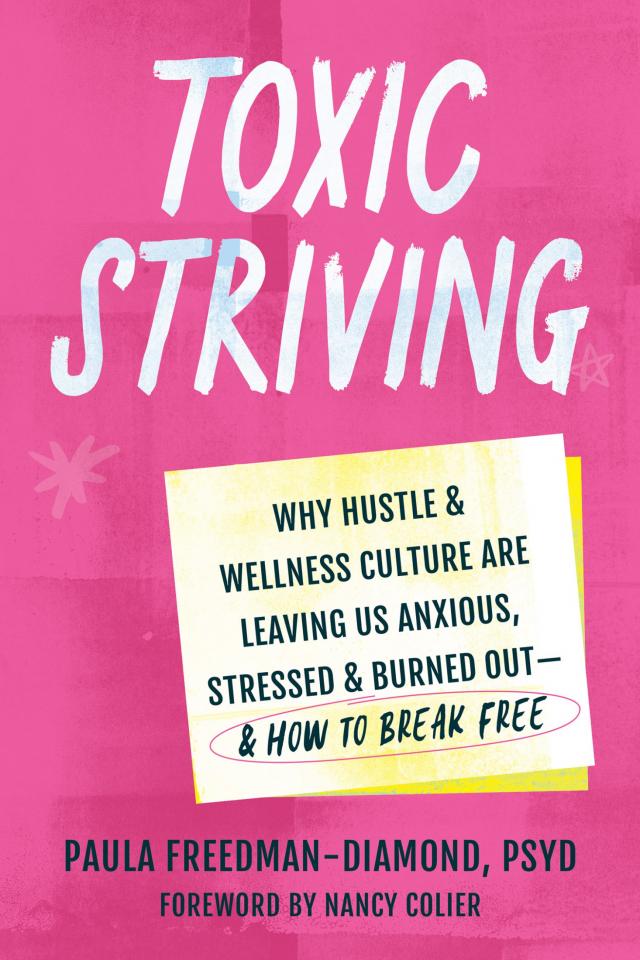
Toxic Striving, page 1


“Paula Freedman-Diamond candidly talks about how her quest for perfection was her way of quieting her inner critic. She shows us how striving for unrealistic standards rooted in racism, misogyny, ableism, and ageism are then promoted by diet, wellness, and hustle cultures. Through tools derived from acceptance and commitment therapy (ACT) and intuitive eating, this valuable book offers a way out of this all-encompassing life toward the freedom that comes with inner trust.”
—Elyse Resch, MS, RDN, CEDS-S, FAND Nutrition Therapist, coauthor of Intuitive Eating, and author of The Intuitive Eating Workbook for Teens
“In a personal, practical, and deeply empowering way, Freedman-Diamond helps readers identify the sneaky, quiet ways toxic striving has infiltrated our lives and stolen our joy and power. As she writes, ‘This book won’t give you answers; it will help you discover your own answers.’ She accomplishes her end goal of helping readers find ourselves in the midst of toxic messaging begging us to abandon ourselves in favor of perfection.”
—Lexie Kite, PhD, coauthor of More Than a Body
“Toxic Striving provides a wealth of information on how we often fall into patterns that aren’t true to who we are or what we want to be. Through relatable stories and reflection questions that spark ‘aha’ moments of self-awareness and a rekindling of the long-ignored intuition, Toxic Striving helps break unhelpful striving patterns, fosters a connection with our values, and guides us in creating an authentic life.”
—Sarah Pegrum, PhD, psychologist, and author of Break the Binds of Weight Stigma
“Paula Freedman-Diamond illuminates the connection between wellness culture and productivity culture; by making this important bridge, she is able to guide readers to regain trust in themselves and opt out of toxic striving using practical, evidence-based strategies from ACT and intuitive eating.”
—Alexis Conason, PsyD, psychologist, and author of The Diet-Free Revolution
“This is a fun book to read. It is filled with captivating anecdotes and exercises from a handful of empirically supported treatments, including ACT. Anyone struggling with clinical perfectionism, self-judgment, or body-image issues should read from this book and practice what it teaches.”
—Michael P. Twohig, PhD, professor of psychology at Utah State University, and coauthor of The Anxious Perfectionist
“In this gem of a book, Paula Freedman-Diamond weaves together the intersection of the culture of productivity and perfectionism with diet and wellness culture. Written with warmth and clarity, Toxic Striving will give you the tools to explore your true values, honor your needs, and practice self-care from a place of attunement so that you can develop a peaceful relationship with food and live a more authentic and satisfying life. Five stars!”
—Judith Matz, LCSW, coauthor of The Emotional Eating, Chronic Dieting, Binge Eating, and Body Image Workbook and Beyond a Shadow of a Diet
For my dear friend and partner in toxic-striving recovery, Sari: Everyone deserves a friend like you.
And for my clients: You have taught me so much about practicing willingness, vulnerability, and authenticity. It is an honor and privilege to be part of your journey.
Contents
Foreword
Introduction: The Target Is Always Moving
Part 1: A Job You Didn’t Sign Up For
Chapter 1. How You Were Brainwashed
Chapter 2. You Were Never the Problem
Chapter 3. How You Learned the Rules
Chapter 4. You’re Not Special for Drinking Celery Juice
Part 2: Taking Back the Steering Wheel
Chapter 5. Redefining Your Values
Chapter 6. Unconditional Permission to Be Human
Chapter 7. Tapping into Your Hunger
Chapter 8. Embracing Fullness and Satisfaction
Chapter 9. Your Emotions Carry Messages
Part 3: Your Unbreakable Inner Compass
Chapter 10. Guided by Your Gut
Chapter 11. . Building Better Boundaries
Chapter 12. Bigger Than Your Body
Chapter 13. Who Are You? Like, Really…Who Are You?
Chapter 14. Staying Connected to Your Truth
Conclusion: Thriving, Not Striving
Acknowledgments
Additional Resources
References
Foreword
My friend broke her ankle last weekend. Successful, smart, and athletic, Jane is a woman in her sixties—“successful” by all cultural standards. She was distraught that she would have to be off her feet for the foreseeable future. But it wasn’t missing her cherished daily hikes in nature, or time with her daughter who was her hiking companion, that most upset her. No, what agitated my friend about her broken ankle was simple… As she put it, “I’m going to get fat.” In a culture that glorifies only one body type and pushes women to chase an ever-narrowing beauty standard, it’s not enough to over-achieve; you have to over-achieve while also maintaining (or striving toward) a “fit” body, which we know is code for “thin.”
Today, a thirty-five-year-old client reported that she’d signed up for another self-improvement seminar. Abby listens to podcasts on the way to and from work, gets up at 4 a.m. to go to the gym, and is always, proudly, “working” on herself. She allows herself no downtime—other than the precise amount she’s been told is necessary—to get more done. She’s drunk the cultural Kool-Aid: if she’s productive enough, then she’s enough. But when I ask Abby, “Do you feel like you’re enough?” she answers without hesitation, “I can’t even imagine what that would feel like.” Despite all her productivity, she still doesn’t believe she deserves to rest, let alone live by her own wants and needs. She believes any chance at “enough-ness” would be lost if she stopped striving, pushing, and denying herself—doing better. In truth, what the constant striving allows my client to feel is a little less not enough, as long as she keeps chasing the dream of perfection which she’ll never attain and never have permission to attain.
Like my friend, my client, and the hundreds of emotionally exhausted, depleted women who’ve come through my door in the thirty years I’ve been a psychotherapist, I too grew up in the wellness and hustle cultures about which Paula writes so accurately, and heartbreakingly.
I grew up in an era when women were taught to be as small as possible—literally, to disappear; we learned to feel shame about our bodies unless they fit inside a tiny window of what was considered acceptable. I spent far too much of my life trying to outrun, starve, anesthetize, and avoid my body’s experience and the feelings it carried. A triple “Type A,” I drove myself hard to eradicate any sign that I might be “human” or be vulnerable in any way. The idea of having needs or limitations was off-the-table and shameful; there were and could be no cracks in the armor.
I’m now raising two daughters in this same toxic culture, watching as they, understandably, fall prey to the same challenges and obstacles we’ve all faced: the obsession with physical appearance and belief that their value is defined by how well they meet the standards our patriarchal culture sets for them. Despite all my understanding and encouragement, I watch them leaving home—their real home inside themselves—turning away from their truth, and relating to their bodies as objects to manage and control for the greater goal (and safety) of being likable. And I watch them suffer in the ways we all suffer as women chasing a destination to which we can never arrive.
I don’t usually write forewords, but when Paula sent me the notes for her book, I knew, schedules be damned, that I wanted to lend my voice to this much-needed project. Paula’s wisdom and guidance arise from her own lived experience of anxious perfectionism and body-image dissatisfaction, as well as her work with so many women, which is why her voice is filled with truth and compassion, and a ferocity she gathered, paradoxically, from being both a follower and escapee of the wellness and hustle cultures about which she writes.
In this book, the author teaches women to identify when we’re chasing an unattainable, culturally assigned goal and ignoring our own authentic needs and values. She lays out a path for breaking free from the mental rules, self-criticism, and elaborate internal systems we construct to succeed and survive in our “be beautiful, be productive, be perfect” culture.
Most importantly, Paula refrains from telling the reader who to be, and instead helps her develop curiosity and compassion for her own experience. She encourages her to discover her inner world and what genuinely matters—to her. This is not another book that tells us how to be a more confident and productive version of ourselves, rather, it is about learning to trust our own wisdom, come home, and be who we actually are. In other words, real freedom.
—Nancy Colier, LCSW, Rev., author of The Emotionally Exhausted Woman
Introduction:
The Target Is Always Moving
I still remember the day I got my first B. It wasn’t even a B; it was a B-plus on a history quiz. I was eleven years old, and I came home crying. Convinced it was a fluke, I begged my teacher to let me retake it. She relented, but apparently I just didn’t know the American Revolution as well as I thought I did. On the second try, I got the exact same grade.
Suddenly, my little fifth-grader sense of self was in shambles. Who was I if I didn’t get straight As? That was when I heard it—the voice in my brain. The one that chimed in anytime I made a mistake. It screamed at me, “You’re supposed to be smart! You don’t get Bs, you get As!” The only solution was to work harder. Maybe if I studied for twice as long, I could prevent this burning humiliation from ever happening again.
Throughout my life, I’ve had similar earth-shattering moments. I entered puberty and gained weight. My brain said, “No! Stop! You’re supposed to be thin.” Cue the dieting and disordered eating that ruled my life for the next few decades. I got rejected from my top-choice college. My brain said, “This wasn’t the plan. You’ve ruined everything!”
You’d think that with so much emphasis on success, my brain would praise me when I finally reached my goals. But that was the most puzzling part. Anytime I achieved something, even something I worked really hard for, my brain would say “So what? Big deal!” I’d have the occasional flash of pride when I reached a goal, but it would subside as quickly as it arrived.
I could never quiet that voice pushing me to strive harder, achieve more. The voice kept promising me that I just needed to clear that next hurdle and I could finally land in a place where I would feel eternally worthy, happy, and confident. The promises were empty though. My achievements were never enough, never worthy of more than the tiniest moment of celebration. It became almost predictable, that inner voice quoting with dead seriousness Elle Woods’s quip when she decides to go to Harvard Law School: “What, like it’s hard?!”
The thing is, it was hard. It was always hard, and the target was always moving. It wasn’t enough to excel at school or in my career; I was still failing if I didn’t wake up early and hit the gym. It wasn’t enough to pack homemade salads for lunch; I was still failing if I didn’t also keep in touch with friends. I vacillated between eating as few calories as possible and bingeing on diet snacks. I flipped between studying obsessively and procrastinating. In every area of life, I believed I was falling short. I was a crappy friend, mediocre professional, lazy, and selfish. Worst of all, it was my own fault. I was the one who couldn’t muster the discipline to stay on top of everything.
Somehow, other people didn’t have these problems. In my everyday life and online, I compared myself to everyone around me and came up short. It was like I was absent on the day in elementary school when everyone learned the secret to success. Everyone else was able to get eight hours of sleep, wake up at the alarm, hit the gym, cook a healthy breakfast, crush their to-do lists, spend quality time with loved ones, drink enough water, keep their kitchens clean, rinse and repeat it all the next day. The wellness influencers could do it. My friends and family could do it. I was the only one falling short. The only reasonable conclusion was that I was the problem.
I spent my days consumed by the false belief that I could somehow achieve enough to quiet that inner critic. In graduate school, I came to understand that I was actually dealing with a cocktail of psychological conditions rooted in control-seeking behaviors. One of my professors used to say, “All research is me-search; we pursue the things that resonate most deeply with us.” And so, it was no surprise that, when I became a psychologist, I developed a specialty in perfectionism, anxiety, and disordered eating.
At first glance, it may not seem like perfectionism and disordered eating come from the same place. But whether you’re beating yourself up for slacking off during the workday or for a late-night pizza binge, the psychological mechanics are often similar. Both are rooted in a strong desire for self-control and the belief that self-control is an indicator of whether you deserve to experience satisfaction.
Many people who struggle with self-criticism and body image are also empathetic and highly sensitive. They instinctively accommodate everyone around them, often at their own expense. They are high achieving but incredibly hard on themselves, trapped in a never-ending game of whack-a-mole. Once one part of life feels like it’s under control, their brains push them toward that next thing. They live with outside pressures telling them that they’re the problem, and an inner critic echoing that sentiment.
I wrote this book for people who:
feel intense pressure to keep up appearances, earn approval, or get things “right”;
never feel like they’re doing enough to be proud of themselves;
constantly think about what they “should” be doing when they try to rest or relax;
attach their eating, body size, and physical appearance to how they feel about themselves as a whole;
believe they lack self-control, discipline, or willpower (or flip between feeling super in control and going totally off-the-rails).
It is difficult to break free from these tendencies, especially when you live in a culture that celebrates discipline and self-punishment. The elusive hits of validation that come with “getting it right,” however momentary, can become addictive. Unfortunately, they come at a high price: you devote your time, energy, and mental real estate to the chase. You never feel like you reach any destination to truly feel proud of, as life continues to present new challenges.
In Western culture, there is a great deal of emphasis on productivity. It can be hard to recognize when we’re setting unrealistic standards because society reinforces a hustle mentality. There is also immense pressure to fit cultural standards of beauty. Thinness, fitness, and perfect health are held up as signs of achievement and, thus, signs of worthiness and acceptability. Entire industries are built on you believing that failure to achieve those standards is your own fault. They convince you that you just need to harness your attention, drink a shot of apple cider vinegar, and follow their ten-step program. So you keep striving for those goals, researching new fitness regimens, eating plans, and lifestyle changes to hack your way to “enough.”
What if you could strip away the social conditioning that taught you to care about aesthetic beauty, productivity, and discipline, and determine whether you actually care about those things? You may protest at this suggestion, especially since society rewards people who conform to its ideals. But what if you could learn to tolerate the discomfort that comes with living outside the norm so you could also experience the freedom it brings?
It may feel scary or even impossible to imagine a life where you’re not chasing unrealistic standards. However, when you stop chasing, you get the freedom to think for yourself, spend your time and money how you choose, and feel at home in your own mind and body, even when the outside world tries to make you reject yourself. After all, everyone has qualities that some will value and others will reject, and personality traits that serve as assets in some contexts and limitations in others. You weren’t born believing yourself to be lazy or selfish. You were only taught to believe these things. It doesn’t have to be this way. You can unlearn the things you’ve learned, and make space to actually enjoy your brief time on this planet.
The truth is that no matter how hard you work, you’ll never be thin enough, successful enough, or worthy enough to rest. It’s not because you’re deficient; it’s because you’re chasing a moving target that is literally designed to keep you chasing. As long as you’re turning to the outside world for instructions, you’ll inevitably get stuck. Plus, regardless of whether or not you’re matching up with those ideals, you’ll never feel like “enough” because you cannot control what you feel inside.
In fact, efforts to control your cravings and fears typically backfire and end up controlling you. What you resist persists. The more you strive to feel worthy, the more controlled you are by the desire for worthiness. The more you focus on achieving your ideal body, the more finicky your body image becomes. The more you try to avoid eating sweets, the more anxious you feel when they’re around. The more you cling to a plan, the more bothered you’ll be when that plan gets derailed.
This book will teach you how to identify when you’re wasting energy with toxic striving. It will help you figure out what you’d rather be spending that energy on—where your authentic priorities lie. Nobody knows you more intimately than you. Nobody else has been one-hundred percent privy to all of your thoughts and feelings. That means you have the most information on yourself. This book won’t give you answers; it will help you discover your own answers.


