How to Stop Fascism, page 1


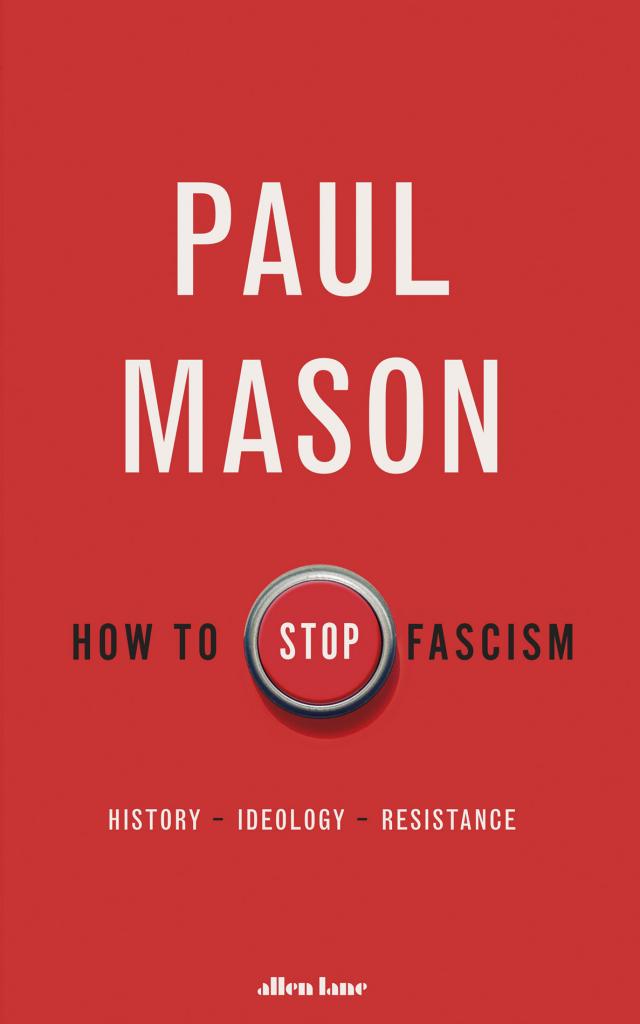
Paul Mason
* * *
HOW TO STOP FASCISM
History, Ideology, Resistance
Contents
Introduction – Nazis: They’re Back – But Why?
PART ONE
Ideology 1 Symbolic Violence: What Do Twenty-first-century Fascists Want?
2 Dreams of the Ethno-state: The Thought-architecture of Modern Fascism
3 Five Kinds of Trouble: The Forces Driving the Far Right
PART TWO
History 4 Destroy Everything: The Origins of Fascism
5 Stopping Mussolini: A Game in Five Moves
6 ‘I Am Dazed’: Why Didn’t the Left Stop Hitler?
PART THREE
Resistance 7 A Theory of Fascism: Beyond the Definition Wars
8 Militant Democracy 2.0: We Need a New Popular Front
9 Everybody Comes to Rick’s: Anti-fascism as an Ethos
Notes
Acknowledgements
Index
About the Author
Paul Mason is an award-winning writer, broadcaster, and film-maker. Previously Economics Editor of Channel 4 News, his books include PostCapitalism, Clear Bright Future: A Radical Defence of the Human Being, Why It’s Kicking Off Everywhere: The New Global Revolutions, and Rare Earth: A Novel.
To the anti-fascists – past, present and future
History teaches us the deathlessness of ideas.
Karl Loewenstein, anti-fascist lawyer, 19371
Introduction
Nazis: They’re Back – But Why?
What if the Nazis invented a time machine? And in the last weeks of the Second World War, they decided to send a crack SS team into the future, to create a Fourth Reich? What year do you think they would aim for?
Seventy-five years is a round number; most witnesses to the Holocaust would be dead by then. So, let’s do a thought experiment: suppose a group of Nazi time-travellers materializes in Europe in March 2020. They are shocked at the ultra-liberalism of Western society; they marvel at our digital technologies; they discover to their horror that black American music has conquered the world. But then …
… They watch Hindu mobs in Delhi beating left-wing students with iron bars. They see the far-right Vox party flood the Spanish media with violent rhetoric against migrants, feminists and the left, gaining 3 million votes in the process. They discover that 1 million Chinese Muslims are interned in something very like concentration camps, and that nobody cares.
Once they figure out the internet, and work out what a meme is, a cartoon frog saying ‘Honk Honkler’ makes them smile. Their smiles broaden as they read that a German army unit has been dissolved because it is irreparably infiltrated by neo-Nazis. Digging deeper, they realize that all the ideas in their own heads – racial purity, male supremacy, anti-Semitism and leader-worship – are circulating globally on Discord channels and WhatsApp groups between millions of angry people.
As they acclimatize, they realize something even bigger is brewing. There’s a disease. It is killing people. As the Covid-19 virus rips through America, they watch far-right demonstrators take to the streets, some armed with automatic rifles, protesting for the right to catch it.
George Floyd is murdered. The alt-right bulletin boards seethe with anticipation: this is it, ‘Boogaloo’, the white supremacist codeword for a second American Civil War. As tens of thousands march to protest about Floyd’s death, they are attacked by far-right militias, sometimes inter-operating with the police.1
Trump loses the election, but, being from the 1930s, our Nazis are not surprised at what happens next: he summons a racist mob to the US Capitol and incites them to storm the building. Nor are they surprised to see Republican lawmakers justifying the attack. Politicians fronting for violence is the standard operating procedure from their time.
As the far right begins a four-year insurgency against the Biden administration, what do our time-travelling Nazis do next? They relax, buy popcorn and watch the fun. Their mission was superfluous.
Fascism is back – but of its own accord. Something else got here first. But what, and what can we do about it? This book is my attempt to answer that question.
When my generation chanted ‘Never Again!’ at Nazi skinheads in the 1970s, we assumed this was a fact, not an aspiration. Fascism was history: the product of social hierarchies that could never return, triggered by a type of economic crisis that could never be repeated. We had good grounds for believing this. Ernst Nolte, the German historian who began the comparative study of international fascism in 1963, had declared the phenomenon ‘dead’. We have seen all possible variants of fascism, said Nolte: it is a finished episode.2
As the digital age arrived, breaking the monopoly over information held by states and companies, it seemed that elites could never again manipulate public opinion in the way Hitler and Mussolini had done. As late as 2008, the historian Giuseppe Finaldi could write, in a university textbook on Mussolini: ‘Fascism has little to say now and many of its obsessions seem not just absurd but incomprehensible.’3 We assumed that, because we had recorded the truth about fascism, it could never re-emerge.
It is now clear that every one of these assumptions was wrong.
Over the past decade, three political movements have flourished to the right of mainstream conservatism: far-right extremism, right-wing populism and authoritarian conservatism. A whole sub-discipline in political science is dedicated to studying the differences between them, producing numerous typologies, definitions and labels.4
Far-right extremists typically advocate race war, commit violence and openly fight for the dissolution of democracy. Right-wing populists attack human rights, victimize minorities and stage mass mobilizations, but are usually non-violent and focused on winning elections, often through new political parties. Authoritarian conservatives, meanwhile, borrow the rhetoric of populism but operate within mainstream parties, elite networks and the traditional institutions of the state.
That’s the theory. The problem is that, in reality, the three movements have begun to work in conscious synergy. Since the 1990s political scientists have assumed that right-wing populist parties would act as a firewall against real fascism. In fact, the opposite has happened. The firewall is on fire.
Since 2008, movements to the right of the mainstream have developed a shared language, a shared online space and a shared goal: to create illiberal democracies that can keep coalitions of populists and authoritarians permanently in power, erode the rule of law and torch the rules-based global order.
In the 2010s three of the most populous democracies on earth – the USA, India and Brazil – were rapidly and seriously undermined. More than half of the world’s developed countries have seen the quality of their democracy decline over the past fourteen years. ‘Functioning of government, freedom of expression and belief, and rule of law are the most common areas of decline,’ says the monitoring group Freedom House.5 This process, labelled ‘democratic decay’ has both weakened our defences against full-blown fascism and opened up a space for fascists to operate in.
The French neofascist Maurice Bardèche, who devoted his life to denying the Holocaust, predicted as early as 1961 that fascism would return in a different form:
With another name, another face, and with nothing which betrays the projection from the past, with the form of a child we do not recognize and the head of a young Medusa, the Order of Sparta will be reborn.6
It was not the stormtroopers and the torture cells that formed the essence of the fascist project, Bardèche insisted, but its concept of ‘man and freedom’. Today, whatever you are searching for on YouTube, Facebook or Twitter, the fascist concept of man and freedom is only a few clicks away.
So my generation was wrong. Fascism, it turns out, was not rooted in the specific class dynamics of Europe in the 1930s. It does not take mass unemployment to produce it. It is not reliant on defeat in war or the existence of state-run radio stations. It is a recurrent symptom of system-failure under capitalism.
And the critical failure that fascism relies on is ideological, not economical. In normal times capitalism is sustained by a belief system that is both passive and pervasive. Simply in order to live our lives we need to believe that markets work naturally; that the government is fair and just; that hard work will be rewarded; that, as technological progress happens, life will get better for ourselves and our children. These beliefs, taken together, constitute an ideology. We replicate and reinforce them through our daily experience – at work, at home and in all the spaces in between.
Fascism takes hold when our faith in this everyday ideology evaporates, and no progressive alternative takes its place. But it is an ideology of a different kind: it can only be reinforced and replicated in people’s heads by extraordinary experiences – of war, victimization and genocide.
Traditionally, historians have studied fascism from three vantage points: as an ideology, a movement and a regime. The premise of this book is that, though each of these viewpoints is valid, fascism can be fully understood only as the outcome of a process: specifically a process of socio-economic disintegration that leaves millions of people’s lives in turmoil, their self-image in doubt, longing to believe a pack of lies, and indeed to take an active part in creating and spreading the lies.
The questions I will try to answer are: what’s driving that process now? What drove it in the past? And how can we stop it?
The core of fascism’s belief system today is clear: that majority ethnic groups have become the ‘v
Every fascist believes all of this and more; every right-wing populist voter now believes some of it; every politician of the authoritarian right has used coded language to play to some part of this agenda. In fact, a good way to tell if you are dealing with an anti-fascist conservative is if they are prepared to repudiate all of it, in clear words and actions.
But what separates modern fascists from the populists and right-wing conservatives is their ultimate goal: a global race war that reshapes the world into ethnic monocultures and ends modern society.
Fascism’s current strength cannot be measured through voting figures: in most Western countries, fascists usually vote for right-wing populist parties, content to exploit the connections and the political space provided. Nor can it be judged from the size of its street mobilizations: the real mobilization is happening online. For now, fascism’s strength is best judged through the salience of its ideas, which have spread rapidly via social media.
The reason why they’re spreading is clear. Over the past decade, as the free-market economic system failed, as globalization went into reverse, as climate change demanded radical alterations to our priorities, and finally as the Covid-19 pandemic hiked economic and geopolitical tensions, the ideology that made sense of the world for many people crumbled into dust. In its place, fascism offers a new Utopia based on racism, misogyny and violence.
At its most granular, this is a process taking place at the level of individuals. In the 1940s, some claimed Nazism was the product of ‘the German character’. In fact, countered the philosopher Hannah Arendt, it was caused by the disintegration of the German character.7 Today we are facing something similar: the disintegration of a global character – the typical ‘self’ that emerged during the period of free-market globalization, which is now lost in the dark as it all implodes.
In the search for an enemy, the new far right has declared war on ‘cultural Marxism’, echoing the rhetoric of Nazism in the 1920s. But since the number of actual Marxists is small, it is feminists, people of colour, climate scientists, refugees, lawyers and LGBTQ people who have to be stigmatized, harassed and ‘doxxed’ (i.e. forced out of public life by the release of their personal information). During the pandemic, public health officials were added to the target list: in far-right folklore even masks are ‘Marxist’.
If we learn one lesson from the twentieth century it should be this: once the fascist way of thinking is adopted by millions of people, nothing satisfies them short of total destruction. In 1945, reporting from the site of the Treblinka death camp, the journalist Vasily Grossman pleaded with us, the future generations:
Every man and woman today is duty bound to his or her conscience … to their motherland and to humanity as a whole, to devote all the powers of their heart and mind to answering these questions: what is it that has given birth to racism? What can be done to prevent Nazism ever rising again?
He did not ask us to consider how bad was fascism, how great its cost, how irrational its ideas, but what caused it? His answer goes to the heart of what is happening now:
What led Hitler and his followers to construct Majdanek, Sobibor, Belzec, Auschwitz and Treblinka is the imperialist idea of exceptionalism – of racial, national and every other kind of exceptionalism.8
Another word for this exceptionalism would be supremacy – of white people over black people; of men over women; of the ‘native’ population over immigrants; of colonists over indigenous peoples of the global south. Grossman understood that inside every supremacist ideology there lurks a genocidal impulse, which – as we will see – conceals an even deeper desire for self-destruction.
Six million Jews died in the Holocaust.9 Sixty million people died in the Second World War, three quarters of them civilians.10 Though our brains struggle to comprehend these numbers, the price of a second fascist era could be higher.
In 2018 I visited Majdanek, a former concentration camp near Lublin, Poland, where at least 80,000 Jews, Poles, Russians and others were murdered. What struck me was the flimsiness of its construction: some rough concrete posts a few inches thick, a double barbed-wire fence and some watchtowers made of pine.11 Five hundred prisoners escaped from Majdanek. Nobody would escape a facility built for the same purpose today.
A twenty-first-century Majdanek would use facial recognition, biometric tags, electrified razor wire and tasers to keep its inmates under control. Its boundaries would be guarded by lethal autonomous weapons, not dogs and searchlights. It would be run as a business, with its own PR department, a certificate to offset its carbon emissions and – just like Guantanamo Bay – a gift shop for visitors and staff.
In fact, all it would need to turn a modern penitentiary or migrant detention centre into a death camp is what the Nazis brought to places like Majdanek: a pitiless logic of dehumanization.
Majdanek was liberated by the Red Army. But who would liberate a modern Majdanek? This time around the jeopardy is absolute. A second victory by fascism in a major country would be a survival-level event for humanity.
The only thing that’s going to stop it are resilient institutions and the anti-fascism of ordinary people. But what should anti-fascism mean?
From the 1970s to the 1990s I was an anti-fascist activist – first in the Anti-Nazi League and then in Anti-Fascist Action. We disrupted fascist events in ways designed to discourage future attendance. We marched with tens of thousands of people to shut down the HQ of the British National Party (BNP) in Welling, London, getting our heads kicked in by riot police in the process.12 We suffered surveillance, harassment and infiltration by undercover police. And to what end?
By forcing the fascists off the streets, we obliged them to make a detour into electoral politics, where the ideas associated with the BNP in the 1980s are now mainstream in the Conservative Party. Tory leaders openly celebrate Britain’s history as a slave power and contemplate the mass deportation of refugees to island prison camps. More than half its members think Islam is ‘a threat to Western civilization’ and to ‘the British way of life’.13
As a child in the coal-mining town of Leigh, Lancashire, I played in disused air-raid shelters whose walls were still scrawled with anti-Nazi graffiti from the war. In 2019, while campaigning there for Labour in the general election, I heard men of my age openly fantasize about the ethnic cleansing of Romanian migrants. ‘Go round to their houses at midnight, lock them in a van with their children, and drive them to Dover,’ was the demand. ‘And then what?’ I asked. Their response was an embarrassed smile.
All the bricks, bottles and abuse we hurled at skinheads in the 1970s didn’t stop the garbage of white supremacy flooding into people’s minds once the global financial crisis triggered an ideological meltdown.
To stop fascism, we need to answer the same questions that confronted progressives in the 1930s. How do we unite the left and the political centre to fight the threat? How do we defend the rule of law and the state’s monopoly of force as far-right movements undermine them? Can police forces and intelligence services designed to protect the elite against the working class ever be used effectively to protect democracy from fascism? How do we persuade people radicalized by hopelessness and the romanticism of violent action to de-escalate? How do we revive democracies that are so corrupt and decayed that they seem, in the eyes of many disillusioned people, not worth saving?
None of the answers are easy, because every one of them involves risking our own status. If you are reading this book on a train, in a café, at the beach or in a classroom, its cover has already politicized the space you are in. Thanks to Donald Trump, declaring yourself anti-fascist now carries a stigma everywhere.