

Moses Malone, page 1


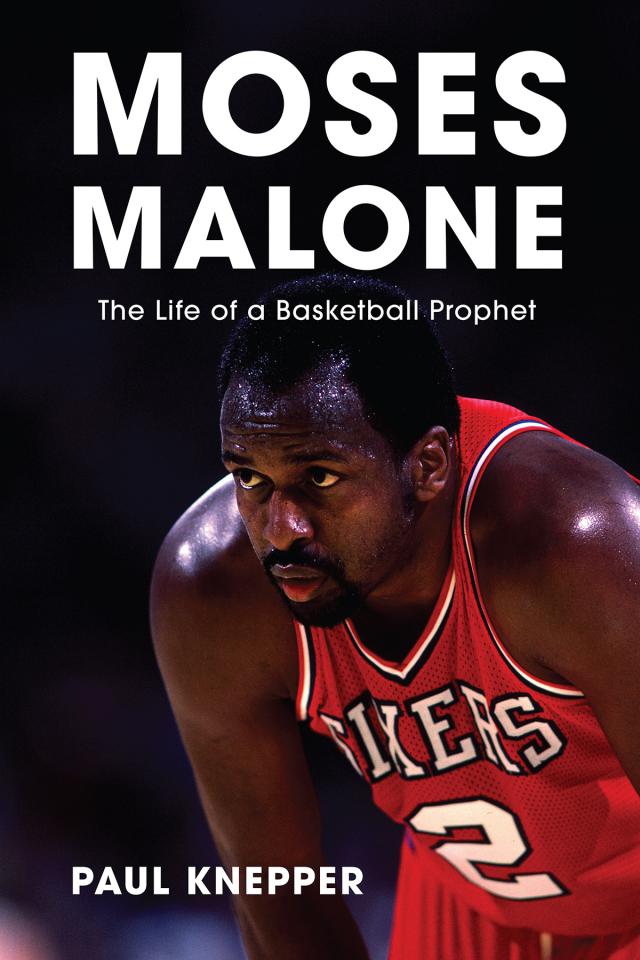
Moses Malone
The Life of a Basketball Prophet
Paul Knepper
University of Nebraska Press | Lincoln
© 2025 by the Board of Regents of the University of Nebraska
Cover designed by University of Nebraska Press; cover image: Icon Sportswire via AP Images.
Author photo courtesy of the author.
All rights reserved
The University of Nebraska Press is part of a land-grant institution with campuses and programs on the past, present, and future homelands of the Pawnee, Ponca, Otoe-Missouria, Omaha, Dakota, Lakota, Kaw, Cheyenne, and Arapaho Peoples, as well as those of the relocated Ho-Chunk, Sac and Fox, and Iowa Peoples.
For customers in the EU with safety/GPSR concerns, contact:
gpsr@mare-nostrum.co.uk
Mare Nostrum Group BV
Mauritskade 21D
1091 GC Amsterdam
The Netherlands
Library of Congress Control Number: 2025013229
The publisher does not have any control over and does not assume any responsibility for author or third-party websites or their content.
For Brodie
Forge your own path like Moses
Contents
List of Illustrations
Preface
Acknowledgments
1. The Heights
2. Chuck Taylor All-Stars
3. Visitors from the Moon
4. Five Stars
5. Lefty and the Milkman
6. The Decision
7. Stop Jivin’ Me, Coach
8. A Star Is Born
9. Bad News and the Spirits
10. Wandering Moses
11. A Launch Pad
12. Chairman of the Boards
13. Four Guys from Petersburg
14. King of Fonde
15. Straight Cash
16. Time to Go to Work
17. The Promised Land
18. Reluctant Superstar
19. Fat and Lazy
20. The Breakup
21. Come On Down!
22. Superstar in Decline
23. Endings
24. Relentless Friend
Epilogue
Notes
Bibliography
Index
Illustrations
1. Black students marching
2. Moses and two young women by their lockers
3. Yearbook photo of Moses holding a basketball
4. Moses and other boys being instructed by the coach at Five-Star Camp
5. Moses with the ball at Five-Star Camp
6. Moses seated with his mother
7. Lefty Driesell entering Cole Fieldhouse
8. Moses in a Maryland T-shirt with trophies
9. Moses wearing a bowtie and holding a basketball
10. Moses as a member of the Utah Stars
11. Moses and his automobile
12. Moses laying the ball in against the Celtics
13. Moses driving to the basket, wearing No. 24
14. Moses and Julius Erving
15. Moses as a member of the Hawks
16. Moses Malone with his friends Major Jones and Tony Dale
17. Moses and his girlfriend Leah
18. Moses and his youngest son Micah
19. The Moses Malone court at Fonde Recreation Center
20. Moses’s friends in front of a statue of Moses
21. Moses’s three boys in front of his statue
22. Charles Barkley, and Moses’s son Micah
Preface
During a morning walk around my neighborhood in Austin, Texas, in June 2023, I listened to French phenom Victor Wembanyama on The Old Man & the Three podcast a week before he was selected first in the NBA draft. I was struck by the nineteen-year-old’s maturity and sophistication as he espoused his philosophies on basketball, celebrity, and life.1 Then it hit me that Wembanyama was the same age as Moses Malone when Malone became the first modern player to jump directly from high school to professional basketball in 1974. The similarities end there.
Wembanyama moved away from home at age fourteen to play for a youth-club team, where a staff of twenty-five people oversaw his physical and emotional development. He turned professional a year later and began working daily with a weight trainer, physician, and orthopedist. By the time he declared for the NBA draft, he’d been named Most Valuable Player of the top league in France and competed with the French national team.2 Wembanyama had extensive experience with the press, watched countless hours of NBA film, and expressed himself more eloquently in English, his second language, than most native speakers his age.
Malone, by comparison, grew up in a poor African American neighborhood in Petersburg, Virginia, with little exposure to the outside world. His primary concerns were his next meal and a clean outfit for school. Moses didn’t have access to NBA film or elite coaching. He taught himself the game on the Virginia Avenue School playground. When the Utah Stars of the American Basketball Association (ABA) drafted him out of high school, no support system was in place as he adjusted to life as a professional athlete in nearly all-white Salt Lake City, nor were predecessors available to advise him as he embarked on his historic journey.
Moses endured the backlash that comes with being a pioneer. His decision to skip college was threatening to coaches and administrators, who thrived on the labor of young athletes, and the NBA, which valued the NCAA as a free farm system. Several coaches, executives, and members of the media criticized Malone’s decision, suggesting he was likely to fail. Some made ignorant remarks about his intelligence, often rooted in racist stereotypes.
Moses silenced his doubters by earning a spot on the All-Star team in his rookie season. His success prompted other prospects to consider skipping college, and ABA and NBA executives began scouring high school gyms for talented teenagers. A year after Moses joined the ABA, Darryl Dawkins and Bill Willoughby were selected out of high school in the first round of the NBA draft.
Dawkins was a hulking man-child with a colorful personality. He produced a fourteen-year NBA career highlighted by backboard-shattering dunks, though he earned a reputation as immature and undisciplined and never fulfilled his potential. Willoughby failed to find his niche while playing for six teams over eight seasons. Some coaches found him difficult to manage. Both became cautionary tales for future athletes, and NBA teams shied away from high schoolers.
Moses appeared to be an anomaly. The jump from high school to the pros was extremely difficult. It took twenty years for somebody else to try.
By the time Kevin Garnett made the leap in 1995, the basketball landscape had changed drastically. Cable television and sneaker companies infused billions of dollars into the game. Garnett, and the prep stars who followed him, were more prepared upon arrival thanks to greater exposure to the NBA, elite prep schools, and participation in national AAU and sneaker-company tournaments. Once in the league, they received financial and emotional support.
Garnett researched the careers of Malone, Dawkins, and Willoughby when contemplating his decision to turn pro and consulted with Willougby. His best friend moved to Minnesota with him when he was drafted by the Timberwolves, and numerous assistant coaches and team personnel were on hand to assist him with the transition on and off the court.3
Garnett was followed to the NBA by high schoolers Kobe Bryant and Jermaine O’Neal a year later. Kobe’s father, Joe “Jellybean” Bryant, played professionally in the NBA and Italy and guided Kobe through the process. Kobe’s agent steered him to a successful Los Angeles Lakers franchise, and his parents lived with him in L.A. Mrs. Byrant cooked her son’s meals and coordinated his social life. Bryant and O’Neal spoke regularly about their shared experience.4
Kobe signed a $10 million deal with Adidas before wearing a Lakers uniform. A year later, the sneaker company inked another prep-to-pro prospect, Tracy McGrady, to a $12 million contract.5 Nike ponied up $90 million for LeBron James when he made the leap in 2003.6 Those youngsters were set financially even if they failed. If Moses had flamed out after a few seasons, he wouldn’t have had enough money to live on or a skill to fall back on.
Malone overcame the obstacles to produce one of most distinguished careers in basketball history. In addition to his groundbreaking jump, he won three MVP awards and is widely considered the greatest offensive rebounder ever. And yet, for reasons discussed as follows, a definitive biography was not written about him until now.
There was no flash to Moses’s game. He didn’t soar to the basket like Julius Erving or Michael Jordan, showcase the wizardry of Magic Johnson, or put on dazzling shooting displays like Stephen Curry. He wasn’t known for a trademark shot like Kareem Abdul-Jabbar’s skyhook or Hakeem Olajuwon’s “Dream Shake.” Even among dominant big men, he wasn’t a behemoth who overpowered his opponents like Wilt Chamberlain and Shaquille O’Neal.
Moses’s superpower was his relentless drive. His greatest skill was the yeoman’s work of battling for offensive rebounds. Those qualities don’t make for SportsCenter highlights or generate YouTube clicks by younger generations of fans.
Malone’s legacy is hurt by the devaluation of the offensive rebound. During his prime, teams played through a big man, with the objective of shooting as close to the basket as possible. The easiest way to do that is by grabbing a rebound near the rim. Moses ranks first all-time with 7,382 offensive rebounds (ABA and NBA combined). Number two on that list is Artis Gilmore at a distant 4,816.
Basketball has since moved away from the hoop with the prolifer
Prior to the player empowerment movement of the twenty-first century, most players of Malone’s caliber spent their whole career with one or two teams. Among his contemporaries, Magic was always a Laker, Larry Bird only wore Celtic green, Erving played all eleven of his NBA seasons with the Philadelphia 76ers, and Kareem split his career between the Milwaukee Bucks and Lakers. Moses suited up for nine franchises during his twenty-one-year career and didn’t play more than six seasons with any club. Consequently, he’s not associated with one team or embraced by a fanbase as much as other superstars.
Perhaps the biggest factor in Malone’s relative anonymity is that he wanted it that way. Shy by nature and self-conscious about his speech impediment, he avoided the media. Some of the game’s fiercest competitors on the court, such as Jordan and Bryant, flashed billion-dollar smiles off it, which led to endorsement deals that made them more appealing to fans. The public only saw Moses’s scowl, resulting in misconceptions about him as a person.
Before the internet, sportswriters created the mythology around the legends of the game. Since Moses kept his distance from reporters, he was portrayed as gruff and unintelligent and didn’t receive publicity or praise commensurate with his accomplishments. Due to his death at the age of sixty, he never had the opportunity to reshape his image as a beloved elder statesman, like his rival, the once notoriously standoffish Abdul-Jabbar.
Some of the reasons Moses is underappreciated are what make him such a compelling figure. “There were plenty of players with bigger hands, faster legs, a higher leap, a more accurate shot,” said Pat Williams, former general manager of the 76ers. “By all objective standards, Moses shouldn’t have been one of the best in the game—but he was. I spent many hours watching him play, and I concluded there’s only one explanation for his greatness: Moses Malone had attitude. The man never quit. He thrived on intense competition and physical contact. The rougher it got, the better he played.” Williams concluded that “Moses Malone was the hardest-working player in the history of the sport.”7
Fans don’t fantasize about being a “blue-collar superstar,” though Malone’s unparalleled work ethic and searing intensity were more relatable than gravity-defying dunks. There’s something heroic about the humble warrior who loves to compete with no regard for fame.
As a result of Malone’s reticence, there’s much that was previously unknown about this misunderstood and complex individual, from his sharp wit to his devotion to teammates and friends. Charles Barkley refers to Malone as “singularly the greatest influence in my career,” and Erving speaks of his “brilliant basketball mind.”8
Once we gain a greater understanding of Moses the man, we can take a fresh look at the player, an indomitable force who discarded Hall of Fame centers like sparring partners. For a five-year period when icons named Kareem, Dr. J, Magic, and Bird graced the hardwood, Moses Malone was the greatest basketball player in the world.
Acknowledgments
So many people have contributed to this book in ways big and small, from sources I interviewed, to public relations employees and school information directors, to librarians who assisted with research, to those who shared photographs with me, and to friends and family who lent support. I’m grateful to all of them.
A few sources deserve special recognition. Ed Gholson and Kevin Vergara showed me around Petersburg and were there to answer any questions I had about Moses. It’s easy to see why they were two of his best friends, and I’m grateful to have them in my life. Floy Johnson gave me a tour of Fonde Recreation Center and shared many fascinating stories about Moses. Tony Dale is another dedicated friend of Moses who assisted me in numerous ways.
Shoutout to Petersburg! One of the great joys of writing this book was speaking with so many kind people from Moses’s hometown. Clinton Bufford was a great resource for life on St. Matthew Street and the Heights in general. Bernard Wilson connected me with several of Malone’s high school teammates, and Treska Wilson-Smith helped put me in touch with other sources.
I received a few no-look passes from authors Theresa Runstedtler, Bob Kuska, and Pete Croatto. Kuska introduced me to Larry O’Brien’s papers at Springfield College. The curator of that collection, Jeffrey Monseau, was a pleasure to work with. I’m grateful to Leah Nash and Sandra White for everything they do to honor Moses’s legacy and for welcoming me to the golf tournament that bears his name. Michelle Souli provided genealogical information regarding Malone’s family, and Fred Cantor was a source of encouragement early in the process.
Writing a book is a long and arduous endeavor. I appreciate all my family and friends who encouraged me and humored me with questions about how it was progressing. That starts with my wife Stacey, whose many roles in this project included cheerleader, sounding board, advisor, and editor. I’m so fortunate to have her by my side. I’m grateful for my son, Brodie, who brings me immense joy and inspires me to write, and my loving parents, Barry and Jane, who have always supported me. My brother, Gregg, is a pillar in my life and everything you could ask for in a sibling. Thank you to Sam, Jordyn, Scarlett, Elle, Margo, Robbie, Elba, and Alina for your love and support. Special thanks to Aaron Marcus for reading a draft of this book and providing valuable feedback.
Lastly, thank you to Rob Taylor for believing in this project, Taylor Martin for all of her assistance, and the rest of the people at the University of Nebraska Press who helped bring this book to life, in addition to my copyeditor, Joseph Webb.
1
The Heights
The rickety house at 241 St. Matthew Street had asphalt siding and a tin roof covered with tar. The paint on the front of the house had chipped away long ago, and the slightly sloped front porch appeared to be on the verge of collapse. The interior was equally shabby. Plumbing was spotty, and one of the bedrooms had a hole to the outside world where a window had once been. The living room consisted of an oil stove, an old couch slanted to one side where the springs sunk in, and an orange crate that served as a table. Three portraits hung on the wall: Martin Luther King Jr., President and Mrs. Kennedy, and Jesus Christ.1 This was the home of Mary and Moses Malone.
Mrs. Malone was born Mary Hudgins on July 28, 1928, in Chesterfield, Virginia, the oldest of Jannie and Oscar Hudgins’s nine children. She came up hard. Her father, who lost his right arm in a shotgun accident, was a wood worker whose annual income was $460, according to the 1940 census.2 Mary left school after fifth grade to help keep the family afloat.3
The Hudgins suffered a tragedy when Mary’s mother died at age thirty-four. Oscar didn’t have the means to care for all his children and sent the boys to live in an orphanage. Mary was sixteen years old and tended to her younger sisters. She cooked, cleaned, ironed their clothes, and sent them off to school.4 She remained the matriarch of the family in the decades that followed, caring for her father in the later years of his life and attending graduations and other special events for her nieces and nephews.5 When her brother William was murdered, she looked out for his son Mario.6
On January 22, 1955, Mary married Moses Malone in Chester, Virginia. Moses was born in nearby Drewryville in 1930 and worked a factory job at the Continental Can Company.7 On March 23, 1955, their son, Moses Eugene Malone, was born with the help of a midwife in Chesterfield County, Virginia. He weighed seven pounds.8
When Moses was about two years old, Mary kicked his father out of the house. The elder Moses was drinking too much, and she didn’t want her son to be exposed to that behavior.9 Moses’s father was not a part of his life going forward. Mary and the younger Moses moved to East Bank Street in the Blandford neighborhood of Petersburg before settling in at the house on St. Matthew St. around 1965 in a Petersburg neighborhood called the Heights.
Mary earned about $59 a week working at a home for the elderly. She later landed a job packing meat at a supermarket for $135 a week. “I always saw to it that Moses had food on the table and a shoe on his foot,” she told writer Ira Berkow. “We never had much savings, never more than $25 in the bank, and that was in case he got sick, and I’d have enough to get him to the doctor.”10 Moses had two pairs of pants for school, which Mary washed nightly.11 Holiday and birthday gifts were modest or nonexistent. One exception was an organ Mary purchased for Moses for Christmas when he was six. He cherished that organ into adulthood, and it instilled in him a lifelong love of music.12


