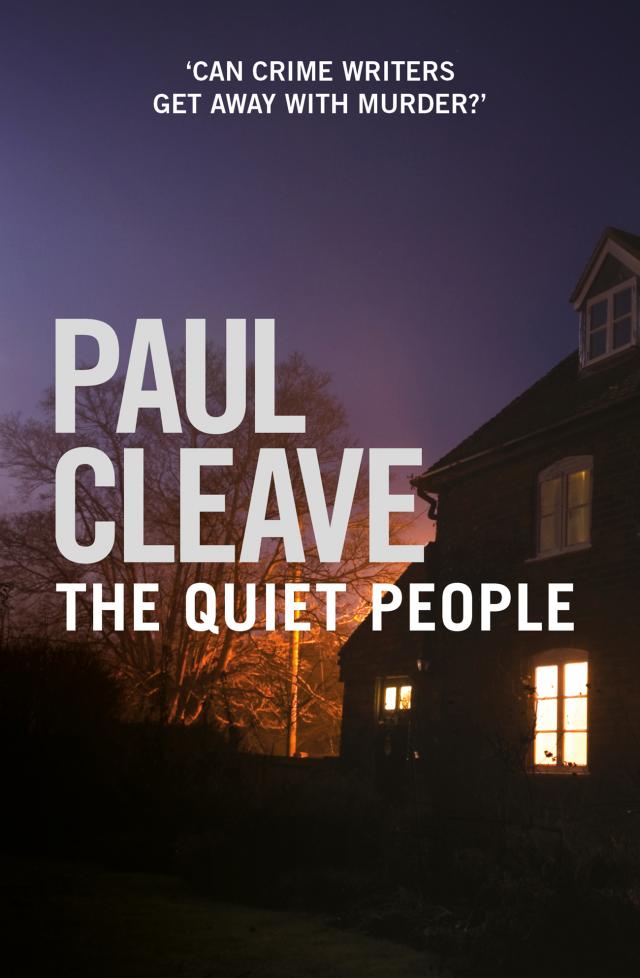
The Quiet People, page 1


To my neighbours –
Who, I learned, for years have heard me singing when I’m in the shower. I am truly sorry.
A catalogue record for this book is available from the National Library of New Zealand
ISBN e: 978-1-990003-29-5
ISBN m: 978-1-990003-30-1
An Upstart Press Book
Published in 2021 by Upstart Press Ltd
Level 6, BDO Tower, 19–21 Como St, Takapuna
Auckland, New Zealand
Text © Paul Cleave 2021
The moral rights of the author have been asserted.
Design and format © Upstart Press Ltd 2021
All rights reserved. No part of this publication may be reproduced or transmitted in any form or by any means, electronic or mechanical, including photocopying, recording, or any information storage and retrieval system, without permission in writing from the publisher.
Designed by www.CVDgraphics.nz
Prologue
Lucas Pittman has to hurry.
They have already been here asking their questions, the two detectives, the woman with the muscly arms and the man who wore a nice suit that, if Lucas worked and saved for the next ten years, he still wouldn’t be able to afford. Of course, that math is based on prison wages, where it used to take him a day of cleaning blood and shit off bathroom floors to scrape together only a dollar.
He won’t go back to prison.
He can’t.
And he doesn’t have to, if he’s quick.
The room under the house is marginally bigger than a prison cell. It has four cinderblock walls and a concrete floor, and a single well-hidden door. The police searched his house and never found it, and isn’t that the point of a hidden room? To stay hidden? His dad sure as hell thought so, and if it weren’t for the fact his father would sometimes chain him to the bed down there, along with others, even Lucas would never have known it existed.
Even so, if the police are coming, and they do manage to find the room, finding it empty is a hell of a lot different from finding it with a couple of drugged children inside. He doesn’t want this to end, but what choice does he have? Somebody knows. That couldn’t be any more obvious—but what isn’t obvious is who.
He opens the closet door in the hallway. Jackets hang on hooks and shoes litter the floor. He scoops the shoes out, then lifts away the carpet, and removes the baseboards. It always takes a little time, and in the past Lucas never minded. After all, he’s done real time, and he knows the difference between having to spend two minutes gaining access to a room, and spending ten years being confined in one. But now it’s different, because now there is Zach Murdoch, and having Zach Murdoch in his secret room has changed everything.
He hurries with his work. Once the baseboards have been slotted out, it reveals the holes in which he can slide his fingers into to pull the square piece of floor up. He lifts it and leans it against the wall. He climbs quickly down the ladder.
There is no time to hesitate.
The boy is still drugged from earlier. He’s wearing a yellow T-shirt with a picture of a bus on it. Lucas used to wear a similar one when he was that age. He can remember his mum giving it to him for Christmas one year, and his dad tearing it off him the next. He’s going to miss this boy. He’s going to miss seeing him in the clothes that remind Lucas of his childhood. He’s going to miss giving him a better life than he had growing up.
Limp, the boy is too light to be any real difficulty to carry up the ladder. He puts the floor back into place, and the baseboards, and the carpet, and then the shoes. It’s all taking too much time.
He carries the boy quickly to the car in the garage. He squeezes him into the trunk. If there were room for both boys, this would go twice as fast, but there’s not, and he never anticipated having to move two children at the same time. He can’t exactly prop one up in the front seat, and if he tried, he knows his neighbour would be the first to see—the neighbour who listens when he shouldn’t be listening, and pries when he shouldn’t be prying. When did a man’s business become everybody else’s?
He adds the short-handled spade. He can hear his dad’s voice rattling around in the back of his head, telling him there’s no need to dig two separate graves, that one larger one will get the job done.
He gets the garage door open. He reverses the car down the driveway. He glances at his neighbour’s house, and his neighbour is looking out the window at him. He’s on the phone. He’s probably calling the police.
He should have killed him months ago.
He ought to kill him when this is over.
He gets onto the street. He leaves his house behind. He takes lefts and rights, working his way north to the edge of Christchurch to go beyond it, out to where his dad showed him how to bury a body all those years ago, back before diabetes took his dad’s leg, then his sight, then his life. Every part of his body wants him to go faster, to put as much distance between himself and his house and get this over with, but he fights the urge, keeping the needle hovering on the speed limit. Last thing he needs is to be pulled over for speeding. He swears at every red light and thanks God at every green. His car is making a weird ticking sound. It’s been doing that for the last few weeks and he’s been meaning to get it looked at, and what if this is the trip where it gives up? He should have taken it to a mechanic as soon as the noise started. He breathes in deep, and breathes out slow, and tries not to make any noises in case that’s what puts the car over the edge.
There are no sirens. No police cars. But then there is. Coming up fast behind him. They’ve found him. He was hoping for more time. He puts his foot down. He breaks those speed limits a moment ago he was conscious of not breaking. The ticking gets louder, and faster, and higher pitched, but the car still feels the same. His heart is racing. He has to dry his palms on his shirt, one at a time. The patrol car is fifty metres behind him, and now forty, and now thirty. A second car swerves out from traffic and closes in on him too. A siren appears in the mirror. An unmarked patrol car. How many are there?
He can’t go back to jail.
Anything but that.
He puts his foot down and pulls away. The patrol car matches his speed. He drives faster—if you drive fast enough in New Zealand, and dangerously enough, the police are required by law to call off the chase. Which Lucas sees as a reward-based system. He swerves in and out of traffic. The patrol car stays with him, but then slows up and hangs back. Up ahead, traffic is getting thick. He needs to turn off. There is a gap in the flow of traffic coming towards him. He can squeeze behind a white van and in front of a large truck. The gap will line up with a cross-street, or at least close enough that he can make it happen. It will be tight, but he can make it.
He eases his foot off the accelerator, and turns behind the van, narrowly avoiding the bumper, then puts his foot back down. For a moment he thinks the car is going to choose that instant to die on him, that the ticking will become screaming as belts pull away from pulleys and cogs strip away teeth, but it holds on, and the engine surges, and the car surges, and even though the gap is tighter than he thought, it’s okay, the car makes it through, he’s going to—
The truck hits the car, compacting it before sending it flipping through the air. Metal twists and glass shatters and the gas tank ruptures. The first time the roof hits the ground, it’s lowered by half, hitting Lucas Pittman in the head. When it hits the second time, he gets his wish of never having to go back to jail. The car comes to a stop, the young boy in the yellow T-shirt and red shorts bouncing around in the trunk. A moment later the fire begins.
SUNDAY
One
The park is trampled grass pathways and pitched tents. There are stalls, and queues of people, and rides, and bright lights and music everywhere. Balloons slip from small hands and head for the sun. There are scraped knees and grass-stained elbows and candyfloss-induced sore stomachs. There is laughing, and crying, and yelling, and heat, and dust, and carnies are yelling to come on over, to step right up, to test your skill.
Zach laughs as the carousel operator hoists him onto the final horse. We’ve been queueing for the last ten minutes. The carousel is colourful, with bright patches of paint slapped over spots of rust on the edges, all lit up by a thousand flashing bulbs. The horses start circling, and Zach disappears and reappears, each time pulling a different face for me to photograph, his dark floppy hair covering his glasses the first time, then his fingers in his ears, or his nose, or tugging down at the bottom of his eyes, smiling, frowning, tongue out, big grin, small grin, no grin. Then the music slows, and the horses slow, and the carousel has barely stopped before Zach jumps off. He hits the ground running.
“Bouncy castle,” he yells, and takes off for the castle that’s bending and bobbing in the distance.
It’s the opening day of the fair, which will last through the rest of December and into the middle of January. There are thousands of people here, kids on rides, kids in queues, kids struggling to eat ice cream before it melts, parents following them around. The air tastes sweet, and feels charged with excitement. It makes me long to be a child again, to be the one running through the crowd exploring it rather than running through it chasing my seven-year-old son, whose blood became rocket fuel the moment we got out of the car. There’s no queue for the castle, and only half a dozen kids on it. The guy operating it has more gaps in his mouth than teeth. He’s armed with a lea
Zach climbs in. One of the children talks to him for a moment, then leaves him alone. Zach stands by himself, bouncing softly, seemingly unsure of what to do. I snap more photographs of him and send them, along with the earlier photos, through to Lisa. She’s at home working on the edits for next year’s novel. I watch the photographs as they send, then watch the dots as Lisa forms her reply, and then read the results of that reply. Looks like fun! I text her back and tell her I wish she were here, and then the dots, and then, So do I.
I tuck the phone into my pocket. Zach has disappeared deeper into the castle. The entire structure is swaying back and forth as kids trample across it, the group now joined by a pair of twin sisters dressed in identical outfits, their mum taking photos of them as they play.
I move a little closer so I can find an angle to see Zach. I need to make sure none of the kids are giving him a hard time. Only I still can’t see him. He must be up the top of the ramp in a blind spot, waiting to slide down the other side. Or he’s hiding from me. Breaking into impromptu games of hide-and-seek without telling us is one of his things. Only I don’t think he would be hiding here—we’ve had the conversation plenty of times as we laid out the ground rules for the fair. No running away. No hiding. He’s to stay in sight at all times.
There are no kids coming down the slide. No queue up the top. Is someone up there blocking him? It wouldn’t be the first time. I walk a loop of the castle, looking up and looking down. No Zach. The small voice in my head—the parenting one that always goes what if—reminds me this is the environment I’ve seen in countless movies where one moment your child is there, and the next moment they’re in the back of a stranger’s van. I stop at the front, looking in. The twin girls are jumping on the edge of the castle. One of them stops to look at me, and the other one bounces into her, and they both tumble out. They land by my feet. I reach down to help them back up, one taking my hand, the other one getting up by herself, looking at me suspiciously as she does. They jump back in.
“Zach?”
Zach doesn’t answer. But the small voice, Mr What If, who also lives on my shoulder when I’m writing, does. He says, He’s gone. Somebody has him. Somebody is smuggling him through the crowd.
“Zach?”
You need to hurry.
I climb into the castle. The floor sinks under my weight, and the kids all struggle to stay balanced. I clamber up the ramp to the top. There’s nobody up here. I clamber back down. All the kids have stopped playing. They’re staring at me.
“There was a boy in here, this high,” I say, putting my hand to my chest. “He’s wearing a Superman T-shirt. Anybody see him?”
None of them answer.
The floor sinks and sways as I walk across it, and a small boy loses his balance and falls into me. I try to help him stay upright, but he falls over, and then I trip over him, and in the process end up knocking one of the twin girls back out of the castle. She hits the ground hard, and starts crying, then gets up and limps off to her mother, who is still looking down at her phone.
Zach isn’t here.
Mr What If was right.
My son has gone.
Two
Only my son can’t be gone. Not really. That’s something that happens to other people, like car accidents, and cancer, and houses burning down.
Do something.
I’m still carrying Zach’s sandals. I’m still keeping my shit together. Of course I am. Kids don’t go missing. Not really. Except for when they do. Which this isn’t. Can’t be. Because this is a good area. This is a good city, and these are good people.
I help the boy who ended up under my feet back to his. He’s the kid I saw talking to Zach. I kneel so I can face him. “Have you seen . . .”
“Don’t hurt me,” he says.
“I’m not going to hurt you,” I say, and I reach into my pocket for my phone. He turns to go, and I grab his arm. “Please, wait,” I tell him. “Let me show you a photograph.”
“Get away from him,” a man yells, storming towards me. He’s bald, maybe thirty, angry-looking.
He isn’t the only one coming towards me. So is the mother of the twins. Also thirty, also angry-looking, with long dark hair tied back. The twin that ran to her is crying, and the one that is still in the castle is staring at me. I suddenly see it all from their perspectives. I’ve jumped in here and tossed their kids around like bowling pins. I get to my feet and climb out of the castle.
“I’m sorry,” I say, putting my hands up, still holding the sandals. “I didn’t mean to—”
That’s as far as I get. The man who yelled at me shoves me hard in the chest. I fall back against the castle.
“Wait. I—”
“What did you do to my daughter?” the woman asks, her voice high-pitched, her finger pointing at me. She is standing next to the man who shoved me. I push myself off from the castle to get back to my feet.
“I—”
“What are you? Some kind of child molester?” she asks.
“No. Of course not. I—”
“He had his hand on my son,” the man says.
“I saw,” the woman says. “He’s probably touched all the kids in here.”
“I was just trying to—”
“He hurt me,” the boy says.
I put my hands back into the air. “Wait, please, I—”
The man pivots on his feet and punches me hard in the stomach. I fall back into the castle, squashing the base of it, making the other twin spill out. Instead of getting back to my feet, I roll off the side and sit on the ground, winded. The man scoops up his son and walks away with him, but not before pointing down at me and telling me that if I ever hurt his son again he will kill me.
The woman reaches for her other daughter, who is crying loudly, while her first daughter is crying a few metres behind her. “You should be ashamed of yourself,” she says, then uses her phone to snap a photograph of me.
I don’t answer her. I look back into the castle, in the hope that somehow Zach has reappeared. He hasn’t.
He’s gone, Mr What If says, his voice louder as my fear fuels him. Gone and you’re never getting him back.
“I’m calling the police,” the woman adds.
“I didn’t mean to hurt them,” I say.
“Tell it to your lawyer, creep,” she says, and she walks away, her children following.
The operator comes over and helps me up. “You okay?”
“I can’t find my son.”
“He climbed off a minute ago,” he says, bending down to pick up my phone while I bend down to pick up Zach’s sandals. He hands me the phone. “It was when you were looking at this.”
“Why didn’t you tell me?”
“Why weren’t you watching your kid?”
I hate him for being right. The woman with the twins is on the phone, staring at me, no doubt giving my description to the police. The girl who bounced out of the castle a minute ago is still crying, but the first one seems okay.
“Did he go with somebody?”
“I don’t know. Maybe.” He points into the crowd. “He went that way.”
“What’s in that direction?”