

Marthaas.Vineyard.01.Fall.From.Grace.2012, page 1


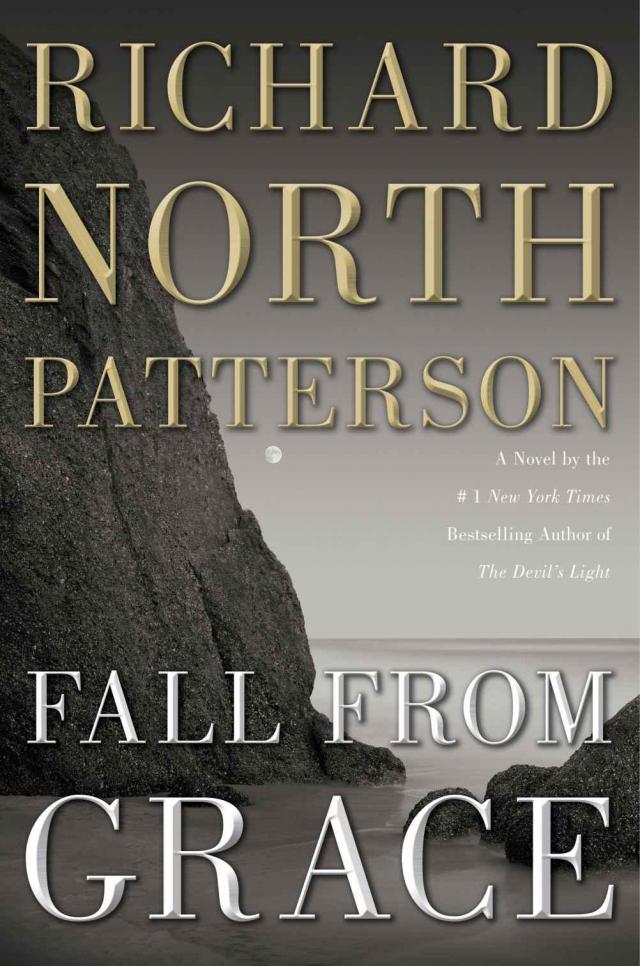
The mysterious, violent death of a prominent New England patriarch exposes a nest of dark family secrets in bestselling author Richard North Patterson’s twentieth compelling novel.
Adam Blaine arrives on the island of Martha’s Vineyard to attend the funeral of his estranged father, Ben Blaine, a famous and charismatic writer who has served as patriarch of his clan for many years. A man fond of sailboats, good wine, and women other than his wife, Ben Blaine has left behind a string of secrets in addition to an emotionally distraught widow and his strangely aloof mistress, Carla Pacelli, a beautiful television actress who once had a drug problem.
As soon as Adam arrives, he discovers that Ben has disinherited his mother, uncle, and brother in favor of his lover, and begins to wonder if his father’s death—caused by an inexplicable fall from a cliff—might be murder. Using his training as a CIA operative, Adam skillfully seeks to obscure the evidence suggesting that a family member may have killed his father, while at the same time fighting to undo the will, which favors the enigmatic Carla. As he walks this tightrope, Adam risks his freedom and perhaps his life, even as he unearths increasingly disturbing family secrets never meant to be discovered, and which cause him to question his understanding of his own life and everyone around him—his beloved mother, uncle, and brother and, not least, Carla.
Filled with tight psychological intrigue that will keep readers guessing until the very last page, Fall from Grace confirms that “Richard North Patterson is one of the best in the business” (Time).
ADVANCE PRAISE FOR FALL FROM GRACE
“Fall from Grace is a stunning tale of betrayal and love—family members torn apart as the possible murder of the patriarch, whose power and prestige have dominated for decades, unravels secrets and scandals against the dramatic backdrop of the unforgiving Vineyard landscape. Richard North Patterson delivers thrilling suspense every time.”
—LINDA FAIRSTEIN, author of Silent Mercy
PRAISE FOR RICHARD NORTH PATTERSON’S THE DEVIL’S LIGHT
“The Devil’s Light will grab you from the very first page and never let go. Patterson’s amazing storytelling is made all the better by his emotionally complex characters. I was intrigued.”
—KATHY REICHS,
#1 New York Times bestselling author of Flash and Bones
PRAISE FOR RICHARD NORTH PATTERSON
“Richard North Patterson is a terrific novelist.”
—The Washington Post
“Readers . . . will be dazzled by [Patterson’s] depth of knowledge.”
—The New York Times
“Patterson has redefined himself as a writer willing to take risks.”
—USA Today
RICHARD NORTH PATTERSON is the author of The Devil’s Light, In the Name of Honor, The Spire, and sixteen other bestselling and critically acclaimed novels. Formerly a trial lawyer, he was the SEC liaison to the Watergate special prosecutor and has served on the boards of several Washington advocacy groups. He lives in Martha’s Vineyard, San Francisco, and Cabo San Lucas with his wife.
MEET THE AUTHORS, WATCH VIDIOS AND MORE AT
SimonandSchuster.com
• THE SOURCE FOR READING GROUPS •
JACKET DESIGN BY REX BONOMELLI
JACKET PHOTOGRAPH © DAVID FOKOS/CORBIS
COPYRIGHT © 2012 SIMON & SCHUSTER
Also by Richard North Patterson
The Devil’s Light
In the Name of Honor
The Spire
Eclipse
The Race
Exile
Conviction
Balance of Power
Protect and Defend
Dark Lady
No Safe Place
Silent Witness
The Final Judgment
Eyes of a Child
Degree of Guilt
Private Screening
Escape the Night
The Outside Man
The Lasko Tangent
SCRIBNER
A Division of Simon & Schuster, Inc.
1230 Avenue of the Americas
New York, NY 10020
www.SimonandSchuster.com
This book is a work of fiction. Names, characters, places, and incidents either are products of the author’s imagination or are used fictitiously. Any resemblance to actual events or locales or persons, living or dead, is entirely coincidental.
Copyright © 2012 by Richard North Patterson
All rights reserved, including the right to reproduce this book or portions thereof in any form whatsoever. For information address Scribner Subsidiary Rights Department, 1230 Avenue of the Americas, New York, NY 10020.
First Scribner hardcover edition March 2012
SCRIBNER and design are registered trademarks of The Gale Group, Inc., used under license by Simon & Schuster, Inc., the publisher of this work.
The Simon & Schuster Speakers Bureau can bring authors to your live event. For more information or to book an event contact the Simon & Schuster Speakers Bureau at 1-866-248-3049 or visit our website at www.simonspeakers.com.
Designed by Carla Jayne Jones
Library of Congress Control Number: 2011047427
ISBN 978-1-4516-1705-4
ISBN 978-1-4516-1708-5 (eBook)
For Al Giannini
Thank you for purchasing this Scribner eBook.
Sign up for our newsletter and receive special offers, access to bonus content, and info on the latest new releases and other great eBooks from Scribner and Simon & Schuster.
or visit us online to sign up at
eBookNews.SimonandSchuster.com
Contents
Part One
Chapter One
Chapter Two
Chapter Three
Chapter Four
Chapter Five
Chapter Six
Chapter Seven
Chapter Eight
Chapter Nine
Chapter Ten
Part Two
Chapter One
Chapter Two
Chapter Three
Chapter Four
Chapter Five
Chapter Six
Chapter Seven
Chapter Eight
Chapter Nine
Chapter Ten
Chapter Eleven
Chapter Twelve
Chapter Thirteen
Chapter Fourteen
Chapter Fifteen
Chapter Sixteen
Chapter Seventeen
Chapter Eighteen
Part Three
Chapter One
Chapter Two
Chapter Three
Chapter Four
Chapter Five
Chapter Six
Chapter Seven
Chapter Eight
Chapter Nine
Chapter Ten
Chapter Eleven
Chapter Twelve
Afterword and Acknowledgments
About the Author
Part One
The Missing Son
One
Sliding into the taxi, Adam Blaine told the cabbie where to drop him, and resumed his moody contemplation of his father.
The driver, a woman in her fifties, stole a glance at him in the rearview mirror. Though it was his practice in such proximity to be pleasant, Adam remained quiet. The past consumed him: he had returned to Martha’s Vineyard, the home he had once loved, for the first time in a decade. Benjamin Blaine had made this possible by dying.
Leaving the airport, they took the road to Edgartown, passing woods and fields on both sides. At length, the driver said, “Forgive me, but aren’t you related to Benjamin Blaine, the novelist?”
For a moment, Adam wished that he could lie. “I’m Adam. His son.”
The woman nodded. “I saw you play basketball in high school. Even then you looked just like him.”
It was inescapable, Adam knew: for the rest of his life, he would look in the mirror and see a man he loathed. “I’m so sorry for your loss,” the woman continued quietly. “I drove him to the airport several times. Such a vigorous, handsome man, so full of life. To die like that is tragic.”
Was it tragic for his mother, Adam wondered, or would release from Ben Blaine’s dark vortex be an unspoken mercy? “It was certainly a shock,” he responded. But not as much of a shock, he thought to himself, as the last time I saw him.
Understanding none of this, the driver said sympathetically, “I guess you came back for the funeral—I can’t remember seeing you in years. Where do you make your home now?”
“Everywhere and nowhere.” Adam paused, then deployed his usual cover story. “I’m an agricultural consultant in the third world, helping farmers improve their growing practices. Right now I’m in Afghanistan, on contract with the government.”
Her eyes in the mirror were curious and perplexed. “Doing what, exactly?”
Adam chose a tone that implied his own bemusement. “The project’s a little peculiar. I survey land, and try to encourage the locals to consider growing something other than poppies. In Afghanistan, the Taliban turns opium into guns.”
Her face darkened. “That sounds dangerous.”
Adam kept his voice casual. “Maybe, if it weren’t so dumb. It’s a dangerous place, it’s true, but I’m well below soldiers and spooks on the hierarchy of risk. Why would the Taliban kill a hapless American on a hopeless mission? I’d be a waste of bullets.”
Quiet n
Adam wondered if this mattered. In his heart, he had buried his father ten years ago. But his presence might help three people he deeply loved cope with their ambivalence. Though all had suffered at the hands of Benjamin Blaine, they lacked Adam’s clarity of mind.
“I imagine I’ll make the eulogy,” he said, and handed the woman an extra twenty. “Can you drop my suitcase at the Blaine house?”
“Jack, or Ben?”
“Ben. Do you remember where it is?”
The driver nodded. “Sure.”
Adam thanked her and got out. For a moment he gazed at the Old Whaling Church, absorbing the strangeness of his return. The deep blue sky of a flawless summer day framed the church, an imposing Greek revival with stone pillars and an ornate clock tower, all painted a pristine white. Along with the redbrick courthouse beside it, the church was the focal point of Edgartown, a place Adam thought of as the quintessential New England theme park—picket fences, manicured lawns, white wooden homes built in the 1800s. Though the church was now a performing arts center, it was the only place of worship on Martha’s Vineyard, past or present, which could accommodate the hundreds of people who wished to honor a famous man. Had he foreseen his death, Benjamin Blaine would have chosen it himself.
A policeman guarded the door. On the steps reporters or curiosity seekers had clustered, perhaps eager for a glimpse of the statesmen, writers, actors, and athletes who counted themselves as Ben’s friends. Standing taller, Adam strode toward them. He even moved like his father, he remembered people saying, with his father’s grace and vigor. As he reached the steps, the curse of their resemblance struck again.
“Adam Blaine?” A young woman blocked his path, her look of birdlike alertness accentuated by quick, jerky movements of her head. “I’m Amanda Ferris of the National Enquirer.”
Despite his annoyance, Adam almost laughed in her face—this must be a slow week for Brad and Angelina, or the supposed progeny of Venusians and sub-Saharan adolescents. Instead, Adam brushed past her, ignoring her shrill question, “How do you feel about the circumstances of your father’s death?”
“I’m Adam Blaine,” he told the burly policeman at the center door, and stepped inside.
The interior was as Adam remembered it, bright and airy, its tall windows on three sides admitting shafts of light. As softly as he could, he walked down the center aisle toward the front, glimpsing the varied players in Benjamin Blaine’s restless and protean life—a human rights activist from the Sudan; a veteran war correspondent; a retired Spanish bullfighter; an ex-president; a TV anchor; a young black man whose college education was a gift from Ben; the islanders, a more modest group, many of whom had known Ben all his life. Some of the latter, noting him, registered surprise at his presence. Adam nodded at a few—his old basketball coach, a teacher from third grade—all the while wishing that he could disappear. In the decade of his absence, he had learned to dislike standing out.
Reaching the first pew, he spotted his mother between his uncle, Jack, and brother, Teddy. He paused, glancing at the casket, then slid between Clarice Blaine and his brother. His mother remained almost perfect in appearance, Adam thought—the refined features, sculpted nose, and composed expression of an East Coast patrician, her blond hair now brightened by artifice. As he gave her a brief kiss on the cheek, her blue eyes filled with gratitude, and she clasped his hand. Then Adam felt Teddy grasp his shoulder.
Inclining his head toward his brother, Adam caught the complex smile on Teddy’s sensitive face—fondness for Adam, bemusement at their circumstances. “Can you believe he’s in there?” Teddy whispered. “I’m still afraid this is a prank.”
Silent, Adam stared at the burnished coffin, the white cloth cover filigreed with gold. However richly Benjamin Blaine deserved the hatred of both sons, the enormity of his death was difficult to absorb—a man in his sixties, still ravenous for life, cut short in so strange a way. How many times, Adam wondered, had Teddy wished aloud to him for this moment? Yet its reality left Adam with the fruitless, painful wish that he and his father had been different, that he could feel the ache of love and loss instead of this wrenching bitterness, the painful question Why? for which no answer could suffice. He was back, Adam realized, and once more Benjamin Blaine had shattered his illusions. Adam had not resolved their past.
Nor would this service from the Book of Common Prayer, the touchstone of Clarice Blaine’s heritage, provide balm for her sons’ souls. “The trouble with Protestant funerals,” a colleague had remarked to Adam after the murder of a friend, “is that they offer no catharsis.” But for his mother the familiar ritual, that with which she had buried both her parents, might spread the gloss of decorum over the deeper truths of her marriage.
Standing near the casket, a young Episcopal priest recited the Burial of the Dead:
I am the resurrection and the life, saith the Lord;
he that believeth in me, though he were dead, yet shall he live;
and whosoever liveth and believeth in me shall never die. . . .
Adam believed none of it. In his recent experience, death was random, ugly, and very final, all too often the work of men whose God commanded these acts. That world, like this service, offered no transcendence. His only comfort was that the survivors loved one another, and now might find some peace.
Adam glanced at his mother, then his brother, trying to read their faces. Clarice wore her public expression, a mask of dignity she used to conceal more complicated feelings. But Teddy’s dark eyes, cast now at the polished wooden floor, seemed to hold some anguished memory. At whatever age, Adam knew, some part of us is always a child, feeling pleasure at a parent’s love or the wounds of a parent’s disdain. The man inside the coffin had wounded Teddy long ago, too deeply to forget. From beneath the drone of the service, a memory of their father surfaced unbidden, as much about Teddy as Adam.
It was from that final summer, meant to be a bridge between Adam’s first and second years at law school, after which life would become too serious to savor the days of sun and sea and wind so evocative of his youth. The summer that instead transformed Adam’s life completely.
At the helm of his sailboat, Ben grinned with sheer love of the Vineyard waters, looking younger than his fifty-five years, his thick silver-flecked black hair swept back by a stiff headwind. To Adam, he resembled a pirate: a nose like a prow, bright black eyes that could exude anger, joy, alertness, or desire. He had a fluid grace of movement, a physicality suited to rough seas; in profile there was a hatchetlike quality to his face, an aggression in his posture, as though he were forever thrusting forward, ready to take the next bite out of life. “When Benjamin Blaine walks into a room,” Vanity Fair had gushed, “he seems to be in Technicolor, and everyone else in black and white.” As a boy, Adam had wanted nothing more than to be like him.
On this day, Adam enjoyed his father’s enthusiasm for his classic wooden sailboat. “Well into this century,” Ben had explained when he taught the eight-year-old Adam to sail, “the Herreshoff brothers designed eight consecutive defenders of the America’s Cup. They built boats like this for the richest, most sophisticated families of their time—the Vanderbilts, the Whitneys. I bought this one from your grandfather Barkley.” His voice lowered, to impress on Adam the import of his next words. “To own one is a privilege, but to race one—as you someday will—is a joy. I mean for you to learn the primal joy of winning.”
On this sail with Adam, fifteen years later, Ben was preparing for racing season yet again, his lust for competition unstanched. “This is the best thing in the world,” he exclaimed. “Even better than hunting deer. Are you ever going to try that with me?”
Adam adjusted the mainsail, catching the wind as it shifted. “I doubt it.”
Ben shot him a look of displeasure. “You’re too much like your mother, Adam. But in this family you’re the only game in town.”
At once, Adam caught the reference. However demanding their father could sometimes be with Adam, for years Ben had treated Teddy less like a son than an uninvited guest who, to Ben’s surprise and displeasure, kept showing up for dinner. But the role of favorite by default no longer gave Adam pleasure. “So Teddy’s not like us,” he rejoined. “So what? I can’t paint, and neither can you. Only Teddy got that gene.”


