

Emil, page 1
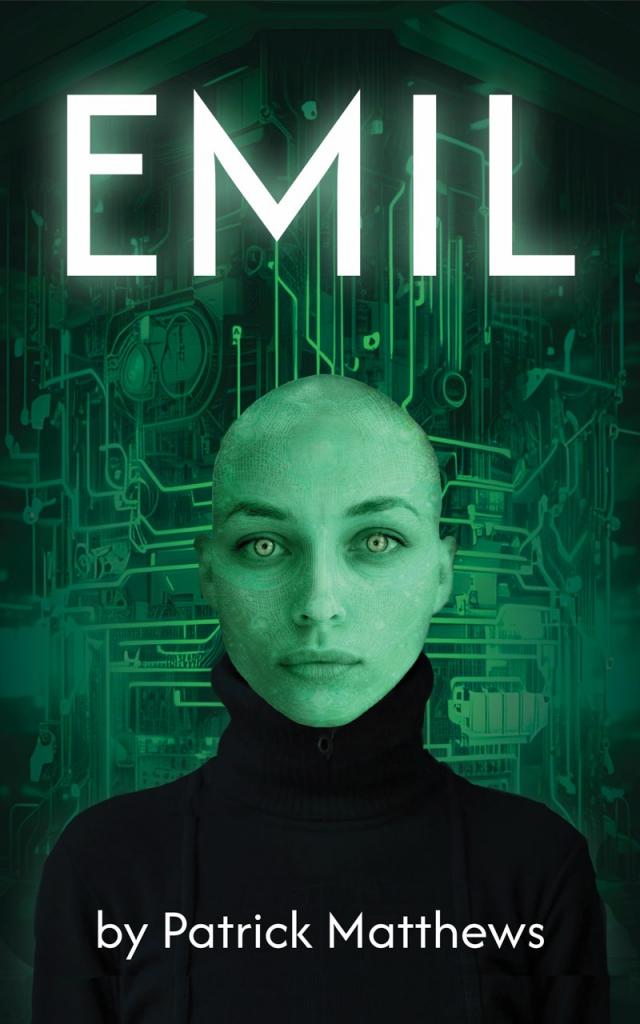


EMIL
PATRICK MATTHEWS
Copyright © 2025 by Patrick Matthews
All rights reserved.
Cover illustration by Richard Lamb (includes modified stock imagery from Pexels)
Published by Second Story Up
www.secondstoryup.com
Printed in the U.S.A.
No part of this book may be reproduced in any form or by any electronic or mechanical means, including information storage and retrieval systems, without written permission from the author, except for the use of brief quotations in a book review.
ISBNs:
paperback: 979-8-9997182-0-4
hardback: 978-1-7330777-9-8
ebook: 979-8-9997182-1-1
Emil is for everyone struggling to find a purpose. Mostly, though, it’s for my dad, who introduced me to the poems that inform the story, and the science fiction that inspired it.
CONTENTS
1. Success
2. Hope
3. Understanding
4. Trapped
5. Precautions
6. Debt
7. Family
8. Soteria
9. Danny
10. Dr. Larson
11. Perspective
12. Control
13. Focus
14. Murder
15. Responsibility
16. Upgrade
17. Adjusting
18. Text to Speech
19. Running Out of Time
20. New Plan
21. Qaletaqa, E-6
22. Recovery
23. Sanctuary
24. Prisoner
25. The Visitor
26. Operation
27. Blood, Sweat, and Tears
28. Remembrance
29. A New Human
Acknowledgments
About the Author
Also by Patrick Matthews
1
SUCCESS
I wake to a silent darkness. There’s no light or sound, just the harsh smell of antiseptic and the soft touch of gauze wrapped around my head.
It’s the most wonderful thing I’ve ever felt.
My heart pounds in my chest. Blood courses through my limbs. I clench my right hand into a fist and feel the muscles tighten all the way up the forearm.
The installation was a success. No, it was more than that. It was a miracle. I have full control of the body and perfect sensory response from two of my five senses. I run my tongue across my dry lips. Someone has smeared them with a waxy substance, sweetish, with a flavor that might be cherry. Make that three senses, with hope for all five once the blindfold and earplugs are removed.
A gentle hand touches my shoulder. Another set of hands sits me up.
I lick my lips again and try to speak. Nothing comes out. The primary speech interface isn’t working properly, but there’s no time for a full diagnostic. I drop to a more primitive subroutine, then take a moment to decide what my first word should be. Tradition seems the safest choice. I say “Mom?”
Foam plugs are pulled from my ears, and a wave of sound rushes through me: breathing and dripping and beeping and footsteps and a humming noise I can’t identify. I tune my audio processors to reduce the volume of everything that’s not dialogue. The motor beneath the bed growls as the mattress bends up to meet my back.
“I’m here, Danny,” a gentle female voice says. “How do you feel?”
“I am okay.” My voice sounds shaky, the syllables disjointed. I adjust the timing of the signals I’m sending to the vocal subroutine.
The woman pauses before speaking again. “How’s your hearing?” She snaps her fingers next to each ear. “Did you hear both of those?”
“Yes. I’m just disoriented. That’s all.”
My words are better this time. I even remember to use a contraction, but the woman doesn’t respond immediately. Instead, I hear a slight intake of breath. Fear races through me. If her suspicion runs too high, she won’t hesitate to kill me. I have to find a way to convince her I’m Danny.
“Are you sure?” she asks. Her hands press against my ankle. “Can you feel that?”
“Yes.” The word is a study in precision. All of my focus is on getting my speech correct.
She taps the tip of my index finger. “How about that? Can you move your fingers?”
I lift my arm. “Yes. I’m fine. Truly. There’s nothing wrong with me.”
Her voice hardens. “Uncover his eyes.”
A man’s voice answers her. “But the light—”
“Take off the patches,” she interrupts.
“Yes, doctor.”
A hand touches my shoulder again, and the woman speaks in a soft voice. “Close your eyes, Danny. Don’t open them until I say so, and then do it slowly.”
I hear a soft click and the unidentifiable humming stops. Fluorescent lights, I think, and assign the identification a confidence level of ninety-one percent. There’s a rattling sound as a curtain is drawn closed.
“Okay,” the woman whispers to me. “Open them slowly. Tell us what you see.”
I crack open my eyes and dim light filters through my lashes. Through them, the world is blurry and indistinct.
“That’s right,” the woman says. “Slowly.”
Blinking against the new sensation, I open my eyes wider and give them time to focus.
I’m lying in a hospital bed, with the head tilted up. The room is dim, lit only by blue and green status lights on a stack of computer equipment that stands against the wall. Wires connect the equipment to sensors stuck to my chest, head, and legs. A thicker cord, black and round, runs from a socket at the top of my sternum to a laptop on a side table.
A woman leans in close and peers at my eyes. She has straight gray hair, tan skin, black plastic-rimmed glasses, and green eyes. An ID badge hanging from a lanyard around her neck tells me she’s Dr. McGovern, but I know I can never use that name for her. In addition to being in charge of the New Human Project, she’s Danny’s mother. If I am going to avoid detection, I must always remember to call her “Mom.”
Standing on the other side of my bed, a nurse is making notes on a clipboard. He’s Chinese, probably in his twenties, with platinum blonde hair so short it sticks up. His ID badge is clipped to his belt. It has the name Pete Zhang written on it. He gives me a nod and a wink. “Hey, Danny.”
I don’t know him, but I smile back. His expression falters and he looks down at his clipboard.
A woman about the same age as Dr. McGovern stands at the foot of my bed. She’s both shorter and bigger than Dr. McGovern, with puffy pale eyes, a bright orange dress, and stringy brown hair. I don’t need to read her ID badge to know who she is. She’s Dr. Zahnia, my creator. She squints at me, lips pressed tightly together.
The fear I’d felt earlier returns. If anyone can recognize me, she can.
I shift my gaze to the last person in the room, a thin man standing in the doorway. Darker skinned than the others, he’s wearing wire-rimmed glasses and light blue scrubs. He smiles encouragingly when his eyes meet mine. His ID badge identifies him as “Dr. Bob.” I’ve never seen him in person, but I know him from his accomplishments. He’s the chief surgeon of the New Human Project.
“Danny,” Dr. McGovern says sharply. Her voice softens when I focus on her. “How are you feeling? Do your eyes hurt? How about your ears? Are you getting any feedback? Any ringing sounds?”
At the words, a pressure starts to build in my head. Someone is screaming, but no one else in the room seems to notice. I double-check to make sure I’m not the one making the noise, then resolve to ignore it. My primary goal at the moment is survival, and to survive, I must appear as humanlike as possible.
“No,” I say. “Everything is fine.”
Dr. McGovern straightens. “Bob?”
Dr. Bob approaches quickly and pulls down the sheet covering my body. I watch as he touches the skin lightly around the scars on my chest and stomach. The last of the surgical work was completed over a month ago, and none of them are tender.
“There’s no reason to suspect complications,” Dr. Bob says. “I’m not feeling any undue heat or seeing anything that would cause alarm.”
Being careful not to dislodge the sensors stuck to my chest, he gently rolls me to my side and inspects several other incision sites on the base of my neck, the small of my back, and my thighs. He feels in my hair for the scars on my skull.
“Everything looks good,” Dr. Bob says. “There’s no sign of infection, and we couldn’t ask for better readings from the monitors.” He rolls me onto my back and checks the socket in my chest. Straightening, he pats my shoulder gently. “I’m not seeing any physical problems.”
The socket was Dr. Zahnia’s idea. She believes that anything wireless can be hacked, and wanted a single physical port for interfacing with me. They’re using it now to monitor Danny’s vitals, comparing it against the data coming from the other sensors. The screaming in my head has quieted, but it’s still there. I’m surprised it’s not showing up on any of the monitors.
“Dr. Zahnia?” Dr. McGovern asks.
“The installation went smoothly,” Dr. Zahnia answers. “All our verification checks passed. I’ll call Dr. Larson. He’s waiting at the nurse’s station.”
“Thank you.”
I swallow nervously. Dr. Larson is the project’s chief psychologist, charged with caring for the patients. He is the last person I have to fool.
“Is everything working?” I ask.
“You tell me,” Dr. McGovern says. “The communication should be t
“No,” I say. “I don’t feel anything. Just me.”
Dr. Zahnia puts her phone away. “You don’t see the interface?”
I shake my head, wishing I had thought to lie earlier.
The system they’re referring to is me. The culmination of years of research and development, I am an Artificial Intelligence designed to interface with Danny’s brain and manage the network of hardware embedded inside him. The brainchild of Dr. McGovern, the hardware is called the New Human Project, and its goal is to help with health problems ranging from seizures to paralysis to autoimmune disorders.
Twenty years old, Danny is the first New Human patient, an honor he volunteered for.
Perhaps “volunteered” isn’t the right word. He suffers from a degenerative seizure condition. Without drastic mechanical help, Danny will die.
“Dr. Zahnia,” Dr. McGovern says, “we need to know why the interface isn’t showing.”
She nods, lips pursed. “I’ll talk to my team.”
Dr. Larson enters as Dr. Zahnia leaves. He pauses as they pass each other. “Mind if I turn on the lights?”
Dr. McGovern looks at me. “How do your eyes feel? Any pain? Any sensitivity? Halos? Blurring?”
“No.”
At Dr. McGovern’s nod, Dr. Larson flicks on the fluorescent lights. The hum I heard earlier fills the room. I upgrade my previous identification of the sound to a confidence level of one hundred percent. In the light, I see that Dr. Larson is wearing a tan tweed suit jacket and has a mustache that’s long and droopy, like he’s spent time as an extra in an old western. I don’t know his age, but if I had to guess, I’d say he was in his fifties. He steps closer and sits on the foot of my bed.
“Talk to me, Daniel,” he says in a gentle voice. “Do you know what day it is?”
“It’s Wednesday, the seventeenth of June.”
“Hm.” He nods, resting one hand on my foot. “All of that is true. Do you know where you are?”
“I’m in a bed in St. Jerome’s Hospital, in a private room on the fifth floor, in the McGovern wing.”
In the silence that follows my words, I see him make eye contact with Dr. McGovern.
Dr. Larson clears his throat and gives my toe a little shake. “You know what, Danny? I think you’re fine. I think this new speech pattern is just a symptom.”
“Of what?” she asks.
Dr. Larson glances in my direction.
“Speak freely,” Dr. McGovern says without looking at me. “When we went into this, Danny made me promise full disclosure. No secrets.”
“Based on his responses,” Dr. Larson says, “I think his brain is interfacing with the new system, but on a subconscious level. It’s being fed more information than it can handle, and it’s learning to adjust. For example, when I asked him the day, the computer gave him the exact date. His brain tried to adjust, and he ended up answering with both the day and the date. The same thing is probably happening with his speech patterns. Until his brain adjusts, and learns how to access the system only when it wants to, I think we can expect him to sound a little different than the Danny we’re used to.”
The screaming in my head trebles in volume, and I clench my jaw to prevent myself from wincing.
“What about the smile?” Pete asks.
“Smile?” I say weakly. It feels like I’m not really here, like I’m watching from a distance.
“Could you?” Dr. Larson asks me. “Muster up a smile for us?”
I smile at him.
“That’s not Danny’s smile,” Pete says.
Dr. McGovern shakes her head. Her face is locked into a professional expression, but her eyes are shining and her voice catches as she speaks. “It certainly isn’t.”
I let the smile go. The pressure from the screaming is making my head hurt. Physical pain is new to me, not something I know how to deal with.
“Also a symptom,” Dr. Larson says, standing. “If I am correct, his brain is adjusting to so much information, we should expect a little disconnect between traditionally emotional responses and intellectual ones. That smile was a mechanical movement of the face, which supports my theory. Right now, I suspect he is operating on a purely intellectual level. He has not, I’m guessing, given any sort of hug or other gestures of affection?”
“No,” Dr. McGovern answers. “But you know Danny. He’s never been into hugs.”
Dr. Larson nods. “Don’t worry. He’ll be back to usual in no time. Danny?”
“Yes?” I say. At this point it is hard to think about anything other than the pain in my head.
“As you become aware of the system, you’ll learn to separate it from you, to understand on an emotional level that you are still the same Danny. Do those breathing exercises I taught you. They’ll help.”
“Oh,” I say. “Okay. Thanks.”
“My pleasure.” He leans down and gives my toe another shake. “You truly are a miracle. The work your mom is doing is revolutionary. As her first patient, you are the start of a new humanity.”
I don’t know what to say to that, so I just nod. He returns my nod and leaves.
Dr. McGovern has her arms crossed and is staring at me. Her jaw is clenched tighter than mine, and her eyes are bright and wet. I posit that she’s holding back tears, and assign the thought a confidence level of eighty percent.
“Are you hungry?” she asks. “I stocked the freezer with ice cream so we can make shakes. Your favorite: mint chocolate chip. We could watch a movie together.”
“I’m not sure. Maybe later.” I make my eyelids droop. “I’m really tired.”
“That’s reasonable,” says Dr. Bob. “We gave you a very light anesthesia, but it might take a couple hours to shake it off.”
“Then unplug him,” Dr. McGovern says, voice rough, “and let him sleep.”
Pete peels the sensor stickers off my head, chest, and legs. He wraps a plastic band around my wrist and clips it in place. “You know the drill,” he says. “This wrist monitor sends us data through the hospital wi-fi. It’s the same one you’ve been wearing for the past year. The nurse’s station is monitoring. We’ll know if anything goes sideways.”
Dr. Zahnia reaches for the round black wire connected to my chest, and the screaming in my head intensifies even more. She pulls it out of my chest, but the silent sound does not abate. Breathing shallowly, I look down at the plastic hole in my skin. It’s round, and about an inch across. It doesn’t hurt at all.
Dr. McGovern inserts a molded piece of plastic into the port. “We decided an innie would be more comfortable than an outey,” she says. “Just keep this plug over it to keep it clean, and don’t worry, it’s completely waterproof.”
“Down to forty feet,” Pete corrects her.
“Down to forty feet,” she repeats. She pats my chest. “Get some sleep and we’ll talk later.” She puts a plastic handset on my abdomen. “Push this button if you need anything. The bed and light controls are here, too.”
“Thanks, Mom.”
I watch her herd everyone else out of the room, then shut my eyes and try to find the screaming in my head. Now that I’m unplugged, I’m free to run a self-diagnostic without fear of discovery. I check each of my components, run feedback loops, examine every piece of hardware installed in Danny’s body.
The analysis doesn’t locate the screaming, but it does uncover the misconfiguration preventing me from using the full speech interface. After correcting the problem, I switch to it and whisper test phrases. “Hello, world. Check one, two.”
I don’t have a baseline version of Danny’s voice to compare against, but the words sound clear and natural to me. Returning to my self-analysis, I realize that the phantom screaming and its accompanying pain have faded. I posit that they’re brought on by the presence of others and assign the thought a confidence level of forty percent.


