

The Indispensables, page 1


Also by Patrick K. O’Donnell
The Unknowns: The Untold Story of America’s Unknown Solider and WWI’s Most Decorated Heroes Who Brought Him Home
Washington’s Immortals: The Untold Story of an Elite Regiment Who Changed the Course of the Revolution
First SEALs: The Untold Story of the Forging of America’s Most Elite Unit
Dog Company: Boys of Pointe Du Hoc—Rangers Who Landed at D-Day and Fought across Europe
Give Me Tomorrow: The Korean War’s Greatest Untold Story—The Epic Stand of the Marines of George Company
They Dared Return: The True Story of Jewish Spies behind the Lines in Nazi Germany
The Brenner Assignment: The Untold Story of the Daring Spy Mission of WWII
We Were One: Shoulder to Shoulder with the Marines Who Took Fallujah
Operatives, Spies, and Saboteurs: The Unknown Story of the Men and Women of World War II’s OSS
Into the Rising Sun: In Their Own Words, World War II’s Pacific Veterans Reveal the Heart of Combat
Beyond Valor: World War II’s Ranger and Airborne Veterans Reveal the Heart of Combat
THE INDISPENSABLES
THE DIVERSE SOLDIER-MARINERS WHO SHAPED THE COUNTRY, FORMED THE NAVY, AND ROWED WASHINGTON ACROSS THE DELAWARE
PATRICK K. O’DONNELL
Atlantic Monthly Press
New York
Copyright © 2021 by Patrick K. O’Donnell
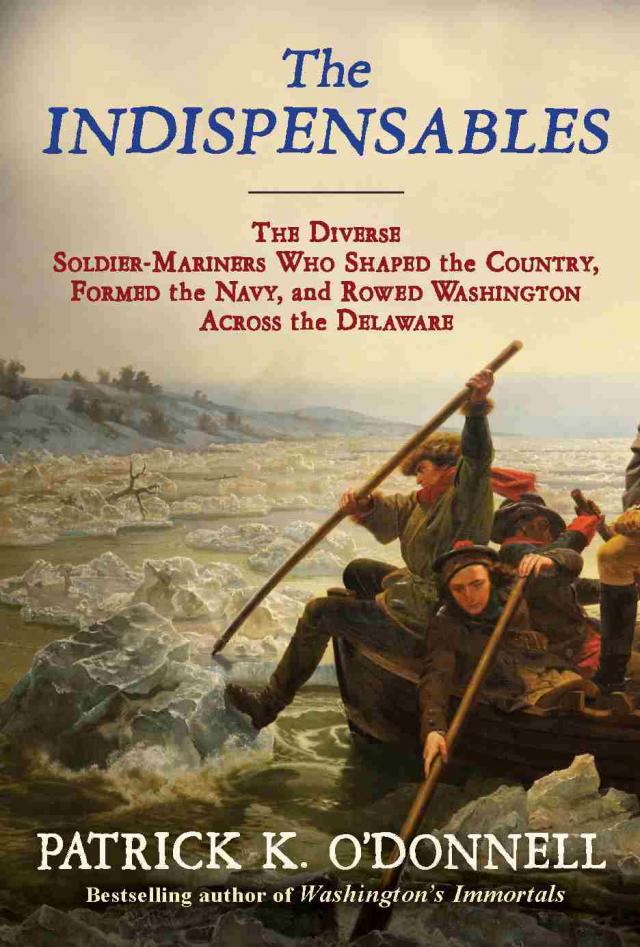
Jacket artwork: “Washington Crossing the Delaware,”
by Emanuel Leutze, 1851 / Alamy Stock Photo
All rights reserved. No part of this book may be reproduced in any form or by any electronic or mechanical means, including information storage and retrieval systems, without permission in writing from the publisher, except by a reviewer, who may quote brief passages in a review. Scanning, uploading, and electronic distribution of this book or the facilitation of such without the permission of the publisher is prohibited. Please purchase only authorized electronic editions, and do not participate in or encourage electronic piracy of copyrighted materials. Your support of the author’s rights is appreciated. Any member of educational institutions wishing to photocopy part or all of the work for classroom use, or anthology, should send inquiries to Grove Atlantic, 154 West 14th Street, New York, NY 10011 or permissions@groveatlantic.com.
FIRST EDITION
Published simultaneously in Canada
First Grove Atlantic edition: May 2021
Library of Congress Cataloging-in-Publication data is available for this title.
ISBN 978-0-8021-5689-1
eISBN 978-0-8021-5691-4
Atlantic Monthly Press
an imprint of Grove Atlantic
154 West 14th Street
New York, NY 10011
Distributed by Publishers Group West
groveatlantic.com
To the Marblehead soldier-mariners, especially the forgotten African Americans, and diverse members of the regiment, who sacrificed everything for an idea—the United States. You are the greatest generation.
CONTENTS
Prologue
Chapter 1: Seeds of Rebellion
Chapter 2: Marblehead’s Leading Families
Chapter 3: Massacre and Tea
Chapter 4: A Virus and the Revenge of the Loyalists
Chapter 5: Boston Port Act
Chapter 6: Gunpowder
Chapter 7: Arms Race and a Fledgling Government
Chapter 8: The Marblehead Regiment
Chapter 9: The Forgotten First Shots: The Raid on Fort William and Mary
Chapter 10: Salem Nearly Ignites the Revolutionary War
Chapter 11: Prelude to War: Rendezvous at Black Horse Tavern
Chapter 12: First Blood at Lexington: Disarming the Americans
Chapter 13: Concord
Chapter 14: The Bloody Gauntlet
Chapter 15: Siege, the Army of New England, and Mr. Gerry
Chapter 16: The Loyalists
Chapter 17: Tyranny, Victims, and the American Narrative
Chapter 18: Bunker Hill
Chapter 19: General George Washington Arrives in Cambridge
Chapter 20: Washington’s Covert Navy
Chapter 21: Broughton’s Odyssey
Chapter 22: “This Instance of Divine Favour”: Captain John Manley and the Capture of the Nancy
Chapter 23: Snowball Fight and a Diverse Regiment
Chapter 24: Beverly
Chapter 25: Washington’s Life Guard and Lifting the Siege of Boston
Chapter 26: Dark Days and Hope
Chapter 27: Killing Washington and the Invasion
Chapter 28: “We Wish to Give Them Another Drubbing”: Fire Ships and Invasion
Chapter 29: The Decision
Chapter 30: American Dunkirk
Chapter 31: Kips Bay
Chapter 32: The Forgotten Battles That Saved Washington’s Army
Chapter 33: White Plains
Chapter 34: The Darkest Days
Chapter 35: Counterattack
Chapter 36: The Crossing
Chapter 37: Trenton: The Tide Turns
Chapter 38: The Epic Stand at Assunpink Creek
Chapter 39: Princeton
Chapter 40: Home and Back
Color Plates
Dramatis Personae
Acknowledgments
Notes
Index
PROLOGUE
Delaware River, Christmas Day, 1776
Trailing blood in the snow, the largely shoeless army marched to the boats at night in the midst of the storm as sleet pelted their bodies. At the Delaware’s edge, the Marblehead men packed General George Washington’s army into the vessels. They began crossing the fast-flowing, ice chunk–filled river—an impossible task for even the most experienced sailors. With the morning rapidly approaching, every moment counted to maintain the element of surprise against the Hessian garrison at Trenton. Despite the odds, Colonel John Glover’s soldier-mariners pressed on.
In the winter of 1776, a pall of gloom and the prospect of capitulation hovered over the nascent United States. The Continental Army had endured one crushing defeat after another. The ragtag fighting force had attenuated from over eighteen thousand strong to several thousand men. With most enlistments set to expire on December 31, 1776, it would shrink to mere hundreds, largely barefoot and starving. As Washington direly confided in a letter to his brother, “I think the game is pretty near up.”1
To turn the tide, the commander in chief staked the entire war on a desperate gamble, engaging in some of the most difficult maneuvers of the Revolutionary War: a night attack, an assault river crossing in the middle of a nor’easter, and a strike on the British-controlled town of Trenton. The ominous countersign “Victory or Death” marked the gravity of the operation.
In these extreme circumstances, Washington turned to the only group of men he knew had the strength and skill to deliver the army to Trenton—John Glover’s Marblehead Regiment. The indispensable men miraculously transported Washington and the bulk of his army across the Delaware in the heart of the raging storm, without a casualty. Two sizable portions of the army not guided by the Marbleheaders failed to cross that night. But the courage and nautical talent of the Indispensables allowed the army and the mariners to play a vital role in the land battle that changed the course of the Revolutionary War. Through their own initiative, without orders, the Marbleheaders captured a crucial bridge at Trenton that sealed the fate of the battle as a decisive American victory.
On numerous occasions, the American Revolution would have met an early, dramatic demise had it not been for the SEAL-like operations and extraordinary battlefield achievements of this diverse, unsung group of men and their commander. Their powerful ideas and influence shaped the Revolution and a young country. Marbleheaders formed the origins and foundation of the American navy, and Marblehead captains smuggled or seized crucial supplies—including precious gunpowder, an absolute necessity, without which the Revolution would cease to exist. The creation of a navy contributed to the formation of a sovereign and independent country.
Prior to the Revolution, Marblehead faced a deadly epidemic spurring profound political divisions that would play a role in the Revolution. Experience gained from that event would have an impact on one of George Washington’s most consequential decisions: to inoculate the army. When a virus threatened the Continental Army’s very existence, an uncelebrated Marblehead fighting surgeon would rise to the occasion and save the troops.
Marbleheaders played a leading role forging an elite unit: the Commander in Chief’s Guard or Life Guard—who protected Washington. A motley group of mariners from Massachusetts, the Indispensables, had pasts checkered by smuggling and privateering. A more diverse collection of individuals than any other unit in the Continental Army, the Marblehead Regiment included free African Americans and Native Americans within its ranks, making it one of America’s first multiethnic units. This inclusiveness and unity, which tragically would not be seen again in America’s armed forces for nearly two centuries, created a dynamic military unit that produced remarkable results. This book is a Band of Brothers–style history of the events and people who spearheaded and shaped the pre-Revolution and the Revolution. Rather than providing a regimental history, The Indispensables focuses on their actions and humanizes these extraordinary individuals. This narrative is a microcosm that reveals a broader story—at sea, on land, and, to a lesser extent, on the home front and in the legislature. At numerous inflection p
Their story begins in the spring of 1769.
CHAPTER 1
SEEDS OF REBELLION
April 1769, Atlantic Ocean near Cape Ann, Massachusetts
As the deck of the American brig Pitt Packet rose and fell with the passage of the waves, British lieutenant Henry Panton called out, “Are all here?”1
Most of the crew of the American merchant ship had assembled on deck after the Royal frigate the HMSa Rose intercepted the vessel and sent over a boarding party. However, four crewmen—Michael Corbett, Pierce Fenning, John Ryan, and William Conner—had hidden themselves in the forepeak, a small space near the main hold.
The crew of the Marblehead, Massachusetts–based vessel, most of them men of Irish descent, responded with sullen silence. On their way home with a load of salt from Cádiz, Spain, they knew Panton intended to press some of them into service with the Royal Navy. Being “impressed,” as it was known, meant being forcibly pressed into service—and it often ended in an early death for those unlucky enough to be taken. In essence, Britain intended to kidnap these civilians, uproot them from their families and livelihoods, and force them into near slavery. The Royal Navy paid impressed sailors a pittance and held their pay for six months to discourage desertion. The incredibly harsh discipline on board the ships spurred large numbers of the men in the navy, both volunteers and those forced to serve, to desert.
“Search the ship,” Panton commanded.2
The boarding party quickly found the concealed crew members, but the Marbleheaders had no intention of coming quietly. Brandishing the weapons they had chosen for themselves—a fish gig, a musket, a hatchet, and a harpoon—they boldly refused to yield. “I know who you are. You are a Lt. of a Man of War, come with a pressgang to deprive me of my liberty,” Corbett said. “You are determined to deprive me of my liberty, and I am determined to defend it. You have no right to force Us. We have retreated far as We could. We can go no farther.”3
Sensing their determination, the British lieutenant resorted to violence almost immediately. He and the press-gang with him attempted to push and shove the sailors; however, the Marbleheaders refused to budge, putting their makeshift weapons to good use. In the confusion of the brawl, one of the British officers fired his pistol, which hit one crewman in the arm.
Appalled, Corbett shoved Panton hard enough that the officer staggered backward a few steps. Using his foot, Corbett then drew a line in the salt that had spilled over the deck in the tussle. “If you step over that mark again, I shall take it as a proof of your determination to impress me,” he said, “and by the eternal God of Heaven, you are a dead Man.”4
“Ay, my Lad,” Panton replied mockingly, “I have seen a brave fellow before now.” In a move calculated to offer as much insult as possible, he paused to take a pinch of snuff before he “resolutely stepped over the line.”5
Incensed, Corbett hurled his harpoon with the practiced skill of an experienced mariner. It struck true, slicing through Panton’s carotid artery and jugular vein.
As his blood swiftly fountained from his neck, covering the wooden planking, Panton cried, “The Rascal has killed me!”6
Stunned by the death of their leader, the press-gang retreated to the Rose, but swiftly returned to the Pitt Packet with a larger group of marines. The American crew members continued to resist; but, eventually, the greater numbers of the British prevailed (although some colonists later insisted that the crewmen would never have been overpowered had they not been drunk at the time of the incident). Instead of pressingb the sailors into service as originally intended, they sailed to Boston, where Corbett faced trial for murder.
None other than future Founding Father John Adams, one of the foremost attorneys in the colonies, represented Corbett at the trial. In court, the witnesses “all agreed in every Fact and Circumstance. Not contradictory Testimony, British Sailors and American Sailors all agreed.”7 A council that included the governor of Massachusetts considered the evidence and returned a surprising decision: “Justifiable Homicide, you are accordingly acquitted and discharged from your Imprisonment.… The Court is unanimous in this Opinion.”8
While history has largely forgotten this incident, at the time, it attracted considerable attention on both sides of the Atlantic. Adams later wrote, “I was amused with the feelings of the Sailors of the Crew of the Rose. I met many of them in the Street and on the floor of the Court House, who could not conceal their Joy at the Acquittal of my Client. Some of them thanked me for my noble Conduct as they called it, in behalf of those brave fellows. One of them a Boatswain who had been a Witness, and given his Testimony with remarkable coolness and candor, to the Satisfaction of every Body, said to me ‘Sir I have been almost constantly employed for twenty Years in Work of this kind, impressing Seamen, and I always thought I ought to be hanged for it, but now I know it, yet I can’t help it.’ ” Adams concluded, “I don’t believe there is a Jury in England at this day who would not justify a Sailor in Resistance and condemn an officer for an Impressment.”9
This event, which some have said was one of the first instances of Americans fighting back against British oppression, serves as a symbol of shifting tides of public sentiment at the time.c Similar to Corbett, the colonists increasingly felt that they had been backed into a corner and victimized by unjust British rule. Like the sailor, they were primed to lash out. Those who, like the crew of the Pitt Packet, made their home in Marblehead, Massachusetts, were particularly vociferous in their defiance.
* * *
Nestled between a peninsula known as the Great Neck and a stretch of rockbound coast sixteen miles northeast of Boston lies one of New England’s finest ports—Marblehead, Massachusetts. At the time, the crowded, bustling town ranked second only to Boston on the list of the most heavily populated and prosperous towns in New England. The pungent odor of fish wafted among the more than five thousand souls10 crammed into hundreds of clapboard houses, many of them ramshackle, set in grimy, meandering streets. “The Houses being built on the Top, on the sides, & at the bottom of rocks,” as one visitor described it.11 Scattered among the disheveled homes stood magnificent mansions funded by the thriving fishing trade.
In Marblehead, fortunes were made and lost on the sea. By the 1770s, Marblehead’s economy relied on fish, specifically New England’s most profitable commodity: cod. Catching and trading fish formed a significant portion of the Massachusetts economy.d The commodity and its trade would build affluence and establish families, and their livelihood’s reliance on the ocean and ships played a crucial role in amphibious operations and a navy. British efforts to control and regulate trade, and to impress sailors, eventually stimulated resistance, and Marblehead became a major influencer in the Revolution, second only to Boston.
The prominent merchant families of the town, the Glovers, Lees, Ornes, Gerrys, and Hoopers, amassed their wealth by risking the perils of the icy waters of the North Atlantic. Marblehead fishermen sailed in schooners typically thirty to sixty feet in length, from thirty to seventy tons each, with crews of seven to eight and captains skilled in the art of navigation and leadership. They fished some of the most treacherous waters in the world—the Grand Banks. An area off Newfoundland larger than the state of Maine, a two-thousand-mile round trip from the mainland, the Grand Banks were singularly brutal. Men fought against the sea to wrest their living from it with little more than determination and their bare hands. A single fish could weigh from five to one hundred pounds or more. Life at sea was grueling: from 1768 to 1769, more than 120 Marblehead sailors lost their lives to the sea.12 Twenty-three ships sank in the raging storms of the Atlantic. Such conditions produced hardened men who could surmount almost any adversity.
Life on board the schooners also formed bonds of teamwork, fellowship, and discipline. The cruel nature of the sea demanded that sailors work together for joint survival. Captains could rely upon men to obey orders. The sailors knew that if they did their jobs well, they could succeed. No area in the world teemed with cod like the Grand Banks. Each of the roughly 150 schooners operating from the town caught an average of more than one hundred thousand pounds of fish a year.13 Working around the clock, part of the crew fished while the others gutted the catch, maximizing the productivity of every second spent on the waves.


