

The Famine Orphans, page 1


Praise for the novels of Patricia Falvey
The Girls of Ennismore
“Falvey, adept at combining vivid historical detail and rich characterization, brings closure to Rose’s and Victoria’s amorous predicaments with brio and simplicity as the women eventually reunite in friendship.”
—Publishers Weekly
“An evocative, heartfelt story of how the bond of female friendship can survive and thrive through adversity. Beautifully drawn, full of rich historical detail, and with a truest Irish sense of place, I was seduced from page one.”
—Kate Kerrigan, New York Times bestselling author of Ellis Island
“An engaging narrative of class differences, sibling entanglements, inheritance of grand Irish estates, and the potential loss of them, finding home, finding love, all set against the turbulent 1916 Easter Uprising in Ireland. A complex and enjoyable read.”
—Susan Vreeland, New York Times bestselling author of Girl in Hyacinth Blue
The Girls of Ennismore
“Two friends, born of vastly different worlds, dare to defy convention and the strict bindings of societal class in Falvey’s latest novel. Rich in authentic historical and Irish detail, The Girls of Ennismore is a compelling story of love, duty, and reinvention, highlighting the vast rewards—or grave consequences—of following one’s heart. Fans of Downton Abbey will devour this sweeping tale.”
—Kristina McMorris, New York Times bestselling author of Sold on a Monday
The Titanic Sisters
“Falvey delivers the enchanting saga of two Irish sisters who board the Titanic with dreams of new lives in New York City. . . . Falvey does a good job capturing the girls’ excitement at leaving Ireland for New York, and of showing Nora’s gradual recovery of her memories. This new chapter of Titanic lore is worth plunging into.”
—Publishers Weekly
“Falvey’s engrossing historical novel charts the paths of two sisters as they journey from Ireland to early 1900’s America.... With sharply drawn characters and shifting landscapes, Falvey’s drama deftly explores the sisters’ life-altering transformations and relationships as they come into their own.”
—Booklist
Books by Patricia Falvey
THE YELLOW HOUSE
THE LINEN QUEEN
THE GIRLS OF ENNISMORE*
THE TITANIC SISTERS*
THE FAMINE ORPHANS*
*Published by Kensington Publishing Corporation
The Famine Orphans
PATRICIA FALVEY
kensingtonbooks.com
Table of Contents
Praise
Also by
Title Page
Copyright Page
Dedication
Part One - Famine
Part Two - Workhouse
Part Three - Voyage
Part Four - Sydney
Part Five - The Outback
Part Six - Freedom
Epilogue
Author’s Note
Acknowledgments
Discussion Questions
KENSINGTON BOOKS are published by
Kensington Publishing Corp.
900 Third Avenue
New York, NY 10022
Copyright © 2025 by Patricia Falvey
All rights reserved. No part of this book may be reproduced in any form or by any means without the prior written consent of the Publisher, excepting brief quotes used in reviews.
This book is a work of fiction. Names, characters, businesses, organizations, places, events, and incidents either are the product of the author’s imagination or are used fictitiously. Any resemblance to actual persons, living or dead, events, or locales is entirely coincidental.
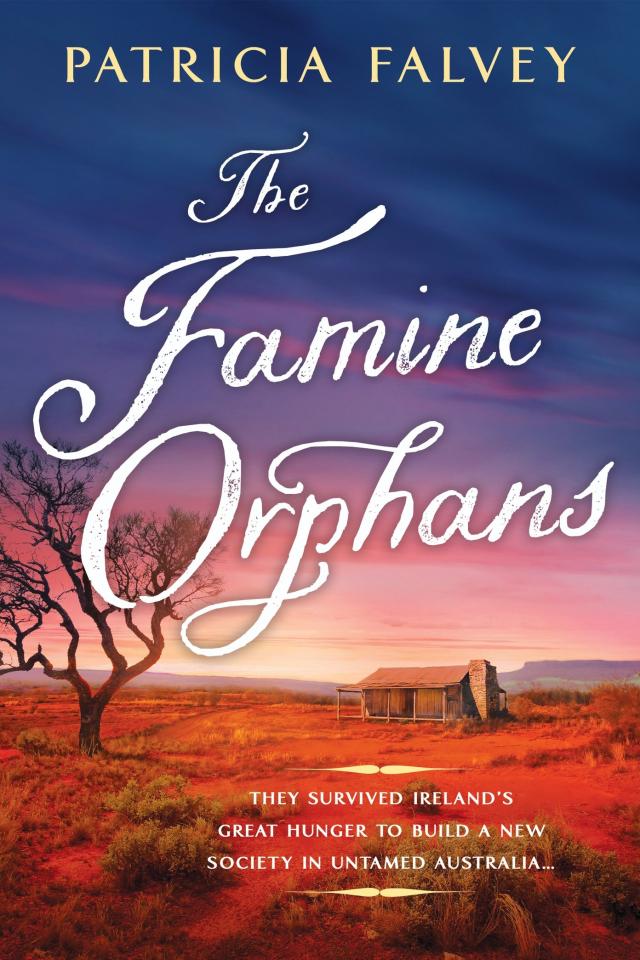
To the extent that the image or images on the cover of this book depict a person or persons, such person or persons are merely models, and are not intended to portray any character or characters featured in the book.
KENSINGTON and the K with book logo Reg. US Pat. & TM Off.
ISBN: 978-1-4967-4814-0 (ebook)
ISBN: 978-1-4967-4813-3
The authorized representative in the EU for product safety and compliance
is eucomply OU, Parnu mnt 139b-14, Apt 123
Tallinn, Berlin 11317, hello@eucompliancepartner.com
In memory of the Famine Orphans from Newry and other Irish Workhouses who sailed to Australia in 1848–1850, and forged lives there for themselves and their descendants.
Part One
Famine
1845
COME HERE TO ME ’TIL I TELL YOU A STORY—
I’m an old woman now and I want to get it all down before I die. You might think I’ve already forgotten much of it, but you’d be wrong. Like all Irish stories, this one has woven the light and dark threads of joy and sorrow into a shawl of memory that has wrapped around my heart and will never let go. It is not only my story but the story of all the young girls who lived it with me.
* * *
It began one day in the summer of 1845 when my wee brother, Christy, came running into our cottage holding what looked like a ball of black slime in his two hands. He was white in the face, his eyes bulging as if he’d seen a ghost. He choked out his words.
“The potatoes, Ma, look at them. They’re rotten.”
Ma spun around from the washbasin. “Och, Christy, don’t be joking us.” She moved closer and let out a gasp. “What the devil is that in your hands? Take it outside this minute.”
Four-year-old Maeve edged closer to him.
“Phew, it smells!” she said, wrinkling her nose.
Da came in right behind Christy, a pained look on his face.
“’Tis no joke, Mary,” he said, slumping down in the armchair beside the turf fire. “There’s a powerful blight on the crop.”
He nodded at Christy. “Take that muck outside and wash your hands at the well before you come back in.”
Christy shuffled off. Maeve and I looked from Ma to Da, neither of us daring to say a word.
“Och maybe it’s just on that one tract,” Ma whispered, “surely it’s not the whole crop.”
Da sighed. “Ah, but it is, Mary. Jimmy Fox and Bandy Hughes were just over here telling me the same thing. Their fields are full of rot. Not a healthy potato left in the ground.”
Ma made a sign of the cross. “Please God it’s only this crop. We’ve seen this before. Your own da used to talk about it. Remember that time years ago they were afraid they’d all starve? But the next crop came in healthy.”
Da shook his head. “Pray all you want, Mary. But I don’t think God will spare us this time.”
When the first crop came in healthy the following spring, we began to think Da had been wrong. We breathed a sigh of relief and went on about our business as if the blight of the previous year had never happened. But Da wasn’t wrong. Within a few months it returned, even more widespread than before. By the end of 1846, nearly every potato crop in the land was ruined, and the dreaded word “famine” rose from a whisper to a roar that was carried on the wind across the island of Ireland.
Like other tenant farmers, our family was dependent on the potato crop for our livelihood. For as long as I can recall Da had rented a few acres of land from Mr. Charles Smythe, who owned a powerful amount of land in Upper Killeavy in South Armagh where I was born. It was a common arrangement all over Ireland for men like my da to work as a laborer in the landlord’s fields for a small wage and the chance to lease a bit of ground where he could grow enough crops to feed his family and sell any spare produce for a small amount of money that went towards the rent. It might only be an acre or two, and the land might not be the most fertile, but having a patch of land to call his own brought pride to the hearts of men like Da, whose ancestors had been chased from their land by a succession of invaders. Every year Da planted potatoes. There was room, as well, for cabbage and turnips and for chickens and maybe a cow or a pig if, like Da, you had the spirit for it. But it was the potatoes that were our salvation. Even with just a small patch of land, a man could grow enough to feed his family year-round and leave them well-nourished even if there was no meat on the table.
I loved growing up on our wee farm, playing among the green fields of Upper Killeavy and round the foothills of Slieve Gullion mountain. Ours was a happy family, although a small one by Irish standards—the oldest was my brother Paddy, then myself, then came Christy, followed by wee Maeve. Da was hardworking and well respected, but Ma was the heart of the family. She was a great one for listening to other people’s sorrows. In those days our cottage was often filled with people—neighbors and strangers alike—while the teakettle bubbled constantly on the turf fire. Ma had been born in nearby Newry town into a family of thriving Protestant shopkeepers who disowned her when she married Da. She had, in their minds, committed two unforgivable sins—one, she had married beneath her station and, two, she had converted to Catholicism. But Ma had taken well to life on the farm, and the neighbors slowly came to admire her and seek her advice, including help with letters and such. Unlike many of them she could read and write. She taught Da and the rest of us to do the same.
It never crossed my mind that my life would change—I thought the carefree, happy days would go on forever. But I was wrong. After that first day when Christy brought the rotting potatoes into our cottage, everything changed. Soon the stores we’d filled with the only healthy crop of 1846 were empty again. Over the remainder of that year, and on into the next, we sold the pig, then the cow, and eventually the chickens, so we could get money to help pay our rent. All our neighbors were in the same boat as ourselves. What made our situation more desperate was that there were crops like wheat and barley and corn growing in the landlords’ fields but they were no good to us since we weren’t allowed to touch them. They were saved for export to the English mainland and beyond.
What I remember most about that time was the months after months of hunger. It was nothing like the vague pang of hunger you’d get sometimes but forget as soon as you were distracted from it. This hunger was like a ravenous demon that clawed ceaselessly at my belly, even during sleep. I bore it silently as did all of us except wee Maeve, whose wailing quieted to a whimper as her strength ebbed away. We buried her in September of 1847.
A week later, my brother Paddy announced he was leaving for England. A normally quiet lad, he stood facing us, twirling his cap in his hands, and made a speech I think he’d been practicing for days.
“I’ve got to go,” he began, ignoring Ma’s cries. “I can stay here no longer watching this suffering. I know I have hardly any money, but I still have my strength. I intend to get work on one of the merchant boats leaving Newry Docks in exchange for a free passage to Liverpool. I can haul heavy sacks as well as any man—better even.” He gave a shy smile. “There’s bound to be plenty of work to be had over there and, when I’ve enough saved, I’ll come back. By then, please God, the famine will have eased,” he said, pausing and gazing into each of our faces, “and if it hasn’t—well, we’ll have money for the fare to sail away from this cursed place!”
He was not to be talked out of his plan.
When we thought things couldn’t get worse, Mr. Smythe arrived on a cold October morning, to warn us he would have to put us out of our cottage if Da couldn’t pay the back rent he owed on his lease.
“I’m sorry things have to be this way, Mick,” he said as he accepted a cup of tea from Ma. He went on talking in a rush of words about every tenant being behind on rent and the big increases in Poor Law taxes he was having to pay for the new Newry Workhouse that had been built just a few years before. “You see, the rate is based on the amount of ground I own, including your wee patch, Mick, as well as on your cottage. And without the rents from you and your neighbors I’ll have no choice but to tear all the cottages down.”
He gave a heavy sigh as if he was expecting sympathy, but none of us said a word.
All that night Ma and Da and the neighbors sat in the kitchen, drinking tea and talking about what to do, while I sat in the corner with my arm around Christy. “Where will we go?” they repeated over and over. “We’ve no money to pay the rent we owe, let alone enough to emigrate.”
No one mentioned the workhouse. For as long as I could remember I knew that all over Ireland people had a terrible fear of workhouses. Da had often said he’d rather die than ever go to one of them places. “Once you’re in there, they break your spirit and you’re condemned to a life of poverty,” he used to say, “and you end up buried in a pauper’s grave.” I used to shudder when he talked about it, though never did I think we’d one day be facing that possibility. But we had nowhere else to turn. Ma’s relations had not spoken to her since her marriage to Da and, even if they had relented, my parents would have been too proud to ask them for help. In the end even Da agreed the workhouse was our only choice.
Early on the morning when Mr. Smythe’s agents were due to come with their crowbars and knock down our cottage, we hitched our old pony to the cart, filled it with our meager possessions, and set out for Newry Workhouse. Ma said she couldn’t bear to stay and watch our home destroyed, nor would she make a show of herself crying and begging to be let stay on like some of our neighbors had done. I was grateful we hadn’t lingered, but as we walked away, I fought the urge to look back just one more time at my childhood home.
We were not alone that morning. People just like ourselves—starving people who’d been put off their land—crowded the road that led from Slieve Gullion mountain down to Newry town like a procession of weary ghosts. It was mid-November, and a bitter wind blew scattered flakes of snow against our faces. Even though we had left in the dimness of early morning, the day seemed to draw in so fast that we lost the daylight in no time. In the darkness our old pony stumbled and collapsed into a ditch. No amount of coaxing could get her to stand up again.
We unhooked the cart and went on our way, pushing it in front of us. But it was soon clear that the four of us hadn’t the strength to push it for the rest of the journey. If Paddy had still been with us, we might have succeeded, but he wasn’t and there was no point wishing things were different. In the end we left it, and all our possessions with it, on the side of the road.
Ma brushed away tears. “At least some other poor craturs might get some good out of them,” she whispered.
The effort of trying to push the cart seemed to have taken all the strength out of her and she looked ready to collapse. I rushed towards her and took her by the arm to steady her.
When at last the outline of Newry Workhouse came into sight in the dim distance Da suddenly stopped and begged us to go on without him.
“You’ll stand a better chance of them letting you in without me,” he said. “They save what little pity they have for women and children.”
Ma and I stopped dead in our tracks and stared at him. I put my face close to his. I wanted to shout at him. Tell him he had no business leaving us now. But even in the dim light I could see the tears shining in his eyes and my throat squeezed shut against any words of anger. I looked at Ma. Surely she could talk sense into him. But, instead, she drew him into her arms, put her head on his shoulder, and wept aloud. Wee Christy clung to her skirts and sobbed. They stood like that for a long time until Da pushed them gently away and turned to me.
“Look after them, Kate,” he said. “You’re a big girl now, strong and with a good head on your shoulders.”
I pushed down the protest that wanted to explode from me. What was the point of arguing? Ma had already forgiven him. I nodded. “I’ll try my best, Da,” I said.
He sighed. “Go on now, there’s the girl. I’ll come for you soon.”
I took Christy’s hand and told Ma, who by then was in a bad way and could hardly walk, to lean on me. Together we climbed the hill to Newry Workhouse. The year was 1847 and I was fifteen years old.
Part Two
Workhouse
1848
Six months to the day after we arrived at the workhouse, I turned sixteen. It was the first birthday I could remember when there’d been no celebration at all. Even in those early years of the famine Ma had managed to find the ingredients for a currant cake with white icing, and she’d brought it to the table, lit with a wee candle, and Maeve and Christy and Paddy all cheered while Ma smiled and Da looked at me with tears in his eyes. Now, as I sat beside Ma on the straw pallet where she lay, I tried to picture every detail of those moments before they faded away from my memory for good.
A sudden May storm turned the sky black and set the dormitory windows rattling while rain pelted like bullets against the panes. Ma began to cough and I moved closer to her to try and keep her warm. I thought back to that November evening when Ma and Christy and I joined the queue outside the workhouse. A storm had been raging that night as well, but we were so numb with hunger and grief that we scarcely noticed it. Ma could barely stand up and Christy clung to me. I knew I would have to be the one to take charge as I had promised Da that I would.


