The Riddle Master of Hed, page 1


THE DARKEST RIDDLE
“Suppose you were a wizard restless with power, drawn to Lungold by the powers of Ohm and his promises of great skill and knowledge. You placed your name in his mind; with your trust in his skill, you did without question whatever he asked of you, and in return he channeled your own energies into powers you scarcely dreamed you had.”
“And then suppose, one day you realized that this wizard, whose mind could control yours so skillfully, was false to his teachings, false to you, false to every man, king, scholar, farmer tat he had ever served. What would you do if you found that he had dangerous plans and terrible puposes... that the very foundations of his teachings ere a lie? What would you do?”
Morgon watched his hands close on the table into fists, as though they belonged to someone else. He whispered, “Oh.” Then he said, “I would run. I would run until no one—man or wizard—could find me. And then I would begin to think...”
“Morgon emerges as a character in high relief, with the others melding solidly into place against an intricate plot accented by distinctive writing and evocative imagery.”
—ALA Booklist
“McKillip has created powerful images of a haunting silence, a universe full of secret purposes and terrible possibilities.”
—The National Observer
* * *
THREE STARS OF DESTINY
Long ago, the wizards had vanished from the world, and all knowledge was left hidden in riddles. Morgon, prince of the simple farmers of Hed, proved himself a master of such riddles when he staked his life to win a crown from the dead Lord of Aum.
But now ancient, evil forces were threatening him. Shape cangers began replacing friends until no man could be trusted. So Morgn was forced to flee hostile kingdoms, seeking the High One who ruled from mysterious Erlenstar Mountain.
Beside him went Deth, the High One’s Harper. Ahead lay strange encounters and terrifying adventures. And with him always was the greatest of the unsolved riddles—the nature of the three stars on his forehead that seemed to drive him toward his ultimate destiny.
***
THUS BEGINS THE STORY OF MORGON IN THIS FIRST VOLUME OF A POWERFUL NEW FANTASY TRILOGY...
Volume One: The Riddle-Master of Hed
Volume Two: Heir of Sea and Fire
Volume Three: Harpist in the Wind
* * *
A Del Rey Book
Published by Ballantine Books
Copyright © 1976 by atricia A. McKillip
All rights reserved under International and Pan-american Copyright Conventions. Published in the United States by Ballantine Books, a division of Random House, Inc., New York, and simultaneously in canada by Random House of Canada Limited, Toronto.
Library of Congress Catalog Card Number: 76-5492
ISBN 0-345-33104-4
This edition published by arrangement with Atheneum Publishers, a division of he Scribner Book Companies, Inc.
Printed in Canada
First Ballantine Books Edition: February 1978
Fifteenth Printing: September 1988
First Canadian Printing: March 1978
Fourth Canadian Printing: February 1980
Cover Art and Frontispiece by Darrell K. Sweet
* * *
The Riddlemaster of Hed
Patricia A. Mckillip
For Carol
the first eleven chapters
Table of Contents
1
2
3
4
5
6
7
8
9
10
11
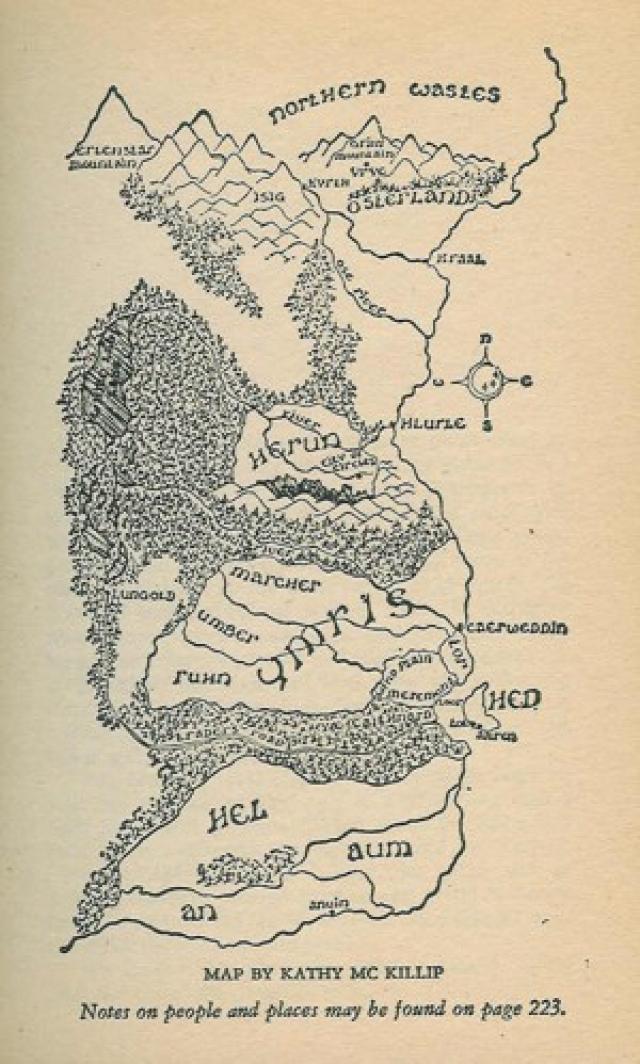
People and Places
* * *
1
Morgon of Hed met the High One’s harpist one autumn day when the trade-ships docked at Tol for the season’s exchange of goods. A small boy caught sight of the round-hulled ships with their billowing sails striped red and blue and green, picking their way among the tiny fishing boats in the distance, and ran up the coast from Tol to Akren, the house of Morgon, Prince of Hed. There he disrupted an argument, gave his message, and sat down at the long, nearly deserted tables to forage whatever was left of breakfast. The Prince of Hed, who was recovering slowly from the effects of loading two carts of beer for trading the evening before, ran a reddened eye over the tables and shouted for his sister.
“But, Morgon,” said Harl Stone, one of his farmers, who had a shock of hair grey as a grindstone and a body like a sack of grain. “What about the white bull from An you said you wanted? The wine can wait—”
“What,” Morgon said, “about the grain still in Wyndon Amory’s storage barn in east Hed? Someone has to bring it to Tol for the traders. Why doesn’t anything ever get done around here?”
“We loaded the beer,” his brother Eliard, clear-eyed and malicious reminded him.
“Thank you. Where is Tristan? Tristan!”
“What!” Tristan of Hed said irritably behind him, holding the ends of her dark, unfinished braids in her fists.
“Get the wine now and the bull next spring,” Cannon Master, who had grown up with Morgon, suggested briskly. “We’re sadly low on Herun wine; we’ve barely enough to make it through winter.”
Eliard broke in, gazing at Tristan. “I wish I had nothing better to do than sit around all morning braiding my hair and washing my face in buttermilk.”
“At least I wash. You smell like beer. You all do. And who tracked mud all over the floor?”
They looked down at their feet. A year ago Tristan had been a thin, brown reed of a girl, prone to walking field walls barefoot and whistling through her front teeth. Now she spent much of her time scowling at her face in mirrors and at anyone in range beyond them. She transferred her scowl from Eliard to Morgon.
“What were you bellowing at me for?”
The Prince of Hed closed his eyes. “I’m sorry. I didn’t mean to bellow. I simply want you to clear the tables, lay the cloths, reset them, fill pitchers of milk and wine, have them fix platters of meat, cheese, fruit and vegetables in the kitchen, braid your hair, put your shoes on and get the mud off the floor. The traders are coming.”
“Oh, Morgon...” Tristan wailed. Morgon turned to Eliard.
“And you ride to east Hed and tell Wyndon to get his grain to Tol.”
“Oh, Morgon. That’s a day’s ride!”
“I know. So go.”
They stood unmoving, their faces flushed, while Morgon’s farmers looked on in unabashed amusement. They were not alike, the three children of Athol of Hed and Spring Oakland. Tristan, with her flighty black hair and small, triangular face, favored their mother. Eliard, two years younger than Morgon, had Athol’s broad shoulders and big bones, and his fair, feathery hair. Morgon, with his hair and eyes the color of light beer, bore the stamp of their grandmother, whom the old men remembered as a slender, proud woman from south Hed: Lathe Wold’s daughter. She had had a trick of looking at people the way Morgon was gazing at Eliard, remotely, like a fox glancing up from a pile of chicken feathers. Eliard puffed his cheeks like a bellows and sighed.
“If I had a horse from An, I could be there and back again by supper.”
“I’ll go,” said Cannon Master. There was a touch of color on his face.
“I’ll go,” Eliard said.
“No. I want... I haven’t seen Arin Amory for a while. Ill go.” He glanced at Morgon.
“I don’t care,” Morgon said. “Just don’t forget why you’re going. Eliard, you help with the loading at Tol. Grim, I’ll need you with me to barter—the last time I did it alone, I nearly traded three plow horses for a harp with no strings.”
“If you get a harp,” Eliard interrupted, “I want a horse from An.”
“And I have to have some cloth from Herun,” Tristan said. “Morgon, I have to have it. Orange cloth. Also I need thin needles and a pair of shoes from Isig, and some silver buttons, and—”
“What,” Morgon demanded, “do you think grows in our fields?”
“I know what grows in our fields. I also know what I’ve been sweeping around under your bed for six months. I think you should either wear it or sell it. The dust is so thick on it you can’t even see the colors of the jewels.”
There was silence, brief and unexpected, in the hall. Tristan stood with her arms folded, the ends of her braids coming undone. Her chin was raised challengingly, but there was a hint of uncertainty in her eyes as she faced Morgon. Eliard’s mouth was open. He closed it with a click of teeth.
“What jewels?”
“It’s a crown,” Tristan said. “I saw one in a picture in a book of Morgon’s. Kings wear them.”
“I know what a crown is.” He looked at Morgon, awed. “What on earth did you trade for that? Half of Hed?”
“I never knew you wanted a crown,” Cannon Master said wonderingly. “Your father never had one. Your grandfather never had one. Your—”
“Cannon,” Morgon said. He raised his hands, dropped the heels of them over his eyes. The blood was high in his face. “Kern had one.”
“Who?”
“Kern of Hed. He would be our great-great-great-great-great-great-great-great-grandfather. No. One more great. It was made of silver, with a green jewel in it shaped like a cabbage. He traded it one day for twenty barrels of Herun wine, thereby instigating—”
“Don’t change the subject,” Eliard said sharply. “Where did you get it? Did you trade for it? Or did you...” He stopped. Morgon lifted his hands from his eyes.
“Did I what?”
“Nothing. Stop looking at me like that. You’re trying to change the subject again. You traded for it, or you stole it, or you murdered someone for it—”
“Now, then—” Grim Oakland, Morgon’s portly overseer, said placatingly.
“Or you just found it laying in the corncrib one day, like a dead rat. Which?”
“I did not murder anyone!” Morgon shouted. The clink of pots from the kitchen stopped abruptly. He lowered his voice, went on tartly, “What are you accusing me of?”
“I didn’t—”
“I did not harm anyone to get that crown; I did not trade anything that doesn’t belong to me for it; I did not steal it—”
“I wasn’t—”
“It belongs to me by right. What right, you have not touched on yet. You asked a riddle and tried to answer it; you are wrong four times. If I bumbled through riddles like that, I wouldn’t be here talking to you now. I am going down to welcome the traders at Tol. When you decide to do some work this morning, you might join me.”
He turned. He got as far as the front steps when Eliard, the blood mounting to his face, broke away from the transfixed group, moved across the room with a speed belied by his size, threw his arms around Morgon and brought him off the steps face down in the dirt.
The chickens and geese scattered, squawking indignantly. The farmers, the small boy from Tol, the woman who cooked, and the girl who washed pots jammed the door at once, clucking.
Morgon, groping for the breath the smack of the earth had knocked out of him, lay still while Eliard said between his teeth, “Can’t you answer a simple question? What do you mean you wouldn’t be talking to me now? Morgon, what did you do for that crown? Where did you get it? What did you do? I swear I’ll—”
Morgon lifted his head dizzily. “I got it in a tower.” He twisted suddenly, throwing Eliard off balance into one of Tristan’s rosebushes.
The battle was brief and engrossing. Morgon’s farmers, who until the previous spring had been under Athol’s placid, efficient rule, stared half-shocked, half-grinning as the Prince of Hed was sent rolling across a mud puddle, staggered to his feet, and, head lowered like a bull, launched himself at his brother. Eliard Shook himself free and countered with a swing of his fist that, connecting, sounded in the still air like the distant thunk of ax into wood. Morgon dropped like a sack of grain. Then Eliard fell to his knees beside the prone body and said, aghast, “I’m sorry. I’m sorry. Morgon, did I hurt you?”
And Tristan, mute and furious, dumped a bucket of milk over their heads.
There was an odd explosion of whimpering from the porch as Cannon Master sat down on a step and buried his face in his knees. Eliard looked down at his muddy, sodden tunic. He brushed futilely at it.
“Now look what you did,” he said plaintively. “Morgon?”
“You squashed my rosebush,” Tristan said. “Look what you did to Morgon in front of everybody.” She sat down beside Morgon on the wet ground. Her face had lost its habitual scowl, She wiped Morgon’s face with her apron. Morgon blinked dazedly, his eyelashes beaded with milk. Eliard sat back on his haunches.
“Morgon, I’m sorry. But don’t think you can evade the issue this way.”
Morgon moved a hand cautiously after a moment, touched his mouth. “What’s—? What was the issue?” he asked huskily.
“Never mind,” Tristan said. “It’s hardly something to brawl about.”
“What is this all over me?”
“Milk.”
“I’m sorry,” Eliard said again. He put a coaxing hand under Morgon’s shoulder, but Morgon shook his head.
“Just let me lie here for a moment. Why did you hit me like that? First you accuse me of murder and then you hit me and pour milk all over me. It’s sour. Sour milk. You poured sour milk all over—”
“I did,” Tristan said. “It was milk for the pigs. You threw Eliard into my rosebush.” She touched Morgon’s mouth again with her apron. “In front of everyone. I’m so humiliated.”
“What did I do?” Morgon said. Eliard sighed, nursing a tender spot over his ribs.
“You made me lose my temper, speaking to me like that. You’re slippery as a fish, but I grasped one thing. Last spring you got a crown you shouldn’t have. You said that if you answered riddles as badly as I do, you wouldn’t be here now. I want to know why. Why?”
Morgon was silent. He sat up after a moment, drawing his knees up, and dropped his head against them.
“Tristan, why did you pick today of all days to bring that up?”
“Go ahead, blame me,” Tristan said without rancor. “Here I am running around with patches at my elbows, and you with pearls and jewels under your bed.”
“You wouldn’t have patches if you’d tell Narly Stone to make you some clothes that fit. You’re growing, that’s all—”
“Will you stop changing the subject!”
Morgon lifted his head. “Stop shouting.” He glanced over Eliard’s shoulder at the row of motionless, fascinated figures, and sighed. He slid his hands over his face, up through his hair. “I won that crown in a riddle-game I played in An with a ghost.”
“Oh.” Eliard’s voice rose again sharply. “A what?”
“The wraith of Peven, Lord of Aum. That crown under my bed is the crown of the Kings of Aum. They were conquered by Oen of An six hundred years ago. Peven is five hundred years old. He lives bound in his tower by Oen and the Kings of An.”
“What did he look like?” Tristan asked. Her voice was hushed. Morgon shrugged slightly; his eyes were hidden from them.
“An old man. An old lord with the answers to a thousand riddles in his eyes. He had a standing wager going that no one could win a riddle-game with him. So I sailed over with the traders and challenged him. He said great lords of Aum, An and Hel—the three portions of An—and even riddle-masters from Caithnard had challenged him to a game, but never a farmer from Hed. I told him I read a lot. Then we played the game. And I won. So I brought the crown home and put it under my bed until I could decide what to do with it. Now, was that worth all the shouting?”
“He forfeited his crown to you when he lost,” Eliard said evenly. “What would you have forfeited if you had lost?”
Morgon felt his split mouth gingerly. His eyes strayed to the fields beyond Eliard’s back. “Well,” he said finally. “You see, I had to win.”
Eliard stood up abruptly. He took two strides away from Morgon, his hands clenched. Then he turned around and came back and squatted down again.
“You fool.”
“Don’t start another fight,” Tristan begged.
“I’m not a fool,” Morgon said. “I won the game, didn’t I?” His face was still, his eyes distant, steady on Eliard’s face. “Kern of Hed, the Prince with the cabbage on his crown—”
“Don’t change—”
“I’m not. Kern of Hed, in addition to being the only Prince of Hed besides me to own a crown, had the dubious fortune of being pursued one day by a Thing without a name. Perhaps it was the effects of Herun wine. The Thing called his name over and over. He ran from it, going into his house of seven rooms and seven doors, and locking each door behind him until he came to the inmost chamber, where he could run no farther. And he heard the sound of one door after another being torn open, and his name called each time. He counted six doors opened, his name called six times. Then, outside the seventh door, his name was called again; but the Thing did not touch the door. He waited in despair for it to enter, but it did not. Then he grew impatient, longing for it to enter, but it did not. Finally he reached out, opened the door himself. The Thing was gone. And he was left to wonder, all the days of his life, what it was that had called out to him.”
He stopped. Eliard said in spite of himself, “Well, what was it?”
“Kern didn’t open the door. That is the only riddle to come out of Hed. The stricture, according to the Riddle-Masters at Caithnard is this: Answer the unanswered riddle. So I do.”
“It’s not your business! Your business is farming, not risking your life in a stupid riddle-game with a ghost for a crown that’s worthless because you keep it hidden under your bed. Did you think of us, then? Did you go before or after they died? Before or after?”