

The Alleyman, page 1


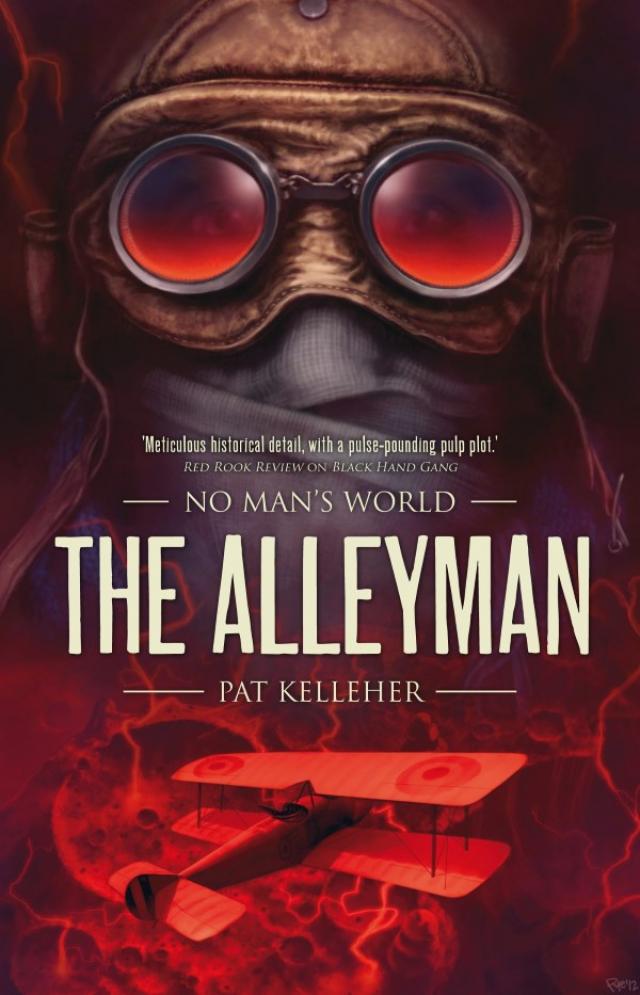
THE ALLEYMAN
The man stepped away from the glare of the window and into the chamber. Two stately red-surcoated Chatts stepped out of the shadows to attend him, their antennae waving in agitation at the Tommies’ arrival. The man, however, seemed quite at ease with their presence.
Everson could see him clearly now. He, too, wore a uniform. It was grey.
“A bloody Alleyman, here?” said Mercy, shaking his head. “And I thought we had the worst of it with Jeffries. Aren’t we ever to be rid of the bastards?”
The Alleyman ignored them, addressing himself to the officers. He had a proud bearing, born of Teutonic aristocracy. His uniform was immaculate. His hair was black and slicked into a centre parting, and he had a peculiar little bow of a mouth that gave him a petulant look. He clicked his heels together. “My name is Oberleutnant Karl Werner, late of the Jasta Bueller.” He held out a hand.
“You’re a German pilot.” Tulliver’s eyes lit up and he shook the hand enthusiastically. “Lieutenant James Tulliver, 70 Squadron.” Then he studied his host, somewhat aggrieved. “And, if I’m not wrong, I shot you down when we first arrived here.”
The German laughed and clapped his hands on the top of Tulliver’s arms. “Yes. Yes, you did.” He smiled broadly. “You’re a good shot,” he said. “But not too good, I think. As you can see, I am still here.”
An Abaddon Books™ Publication
www.abaddonbooks.com
abaddonsolaris@rebellion.co.uk
First published in 2012 by Abaddon Books™, Rebellion Intellectual Property Limited, Riverside House, Osney Mead, Oxford, OX2 0ES, UK.
Editors: Jonathan Oliver & David Moore
Cover Art: Pye Parr
Design: Simon Parr & Luke Preece
Marketing and PR: Michael Molcher
Creative Director and CEO: Jason Kingsley
Chief Technical Officer: Chris Kingsley
No Man’s World™ created by Pat Kelleher
Copyright © 2012 Rebellion. All rights reserved.
No Man’s World™, Abaddon Books and Abaddon Books logo are trademarks owned or used exclusively by Rebellion Intellectual Property Limited. The trademarks have been registered or protection sought in all member states of the European Union and other countries around the world. All right reserved.
ISBN (ePUB): 978-1-84997-446-2
ISBN (MOBI): 978-1-84997-447-9
No part of this publication may be reproduced, stored in a retrieval system, or transmitted in any form or by any means, electronic, mechanical, photocopying, recording or otherwise, without the prior permission of the publishers.
This is a work of fiction. All the characters and events portrayed in this book are fictional, and any resemblance to real people or incidents is purely coincidental.
NO MAN’S WORLD
THE ALLEYMAN
PAT KELLEHER
“When ants unite, they can skin a lion.”
– Iranian proverb
ACKNOWLEDGEMENTS
I would like to thank all those people who have helped bring the true story of ‘The Broughtonthwaite Mates’ to light. As ever, I am indebted to the members of the Broughtonthwaite Historical Society for their tireless efforts in collating the new information that has come to light since the publication of the first book. I would also like to thank Robert Scotton of the Media Museum North, for an insight into the work and career of the kinematographer Oliver Hepton, including his early pre-World War One erotica. I am grateful to Elizabeth Thompson of the National Archives for helping to trace the RFC service record of Lieutenant James Tulliver. I must also thank Jon, Jenni, David, Ben, Simon and Michael at Abaddon Books. Without their enthusiasm and unstinting support for this project, it wouldn’t have happened. Once again, I must thank my wife, Penny, for her continuing love and support. Finally, I would like to thank all those descendents of the men of the 13th Battalion of the Pennine Fusiliers who spoke to me, still hoping that the truth about the fate of their loved ones will come to light.
13th BATTALION PENNINE FUSILIERS:
COMPANY PERSONNEL
Battalion HQ.
C.O.: 2nd Lieutenant J. C. Everson
2C.O.: Sergeant Herbert Gerald Hobson
Company Quartermaster Sergeant Archibald Slacke
Pte. Henry ‘Half Pint’ Nicholls (batman)
Royal Army Chaplain: Father Arthur Rand (CF4) (‘Captain’)
War Office Kinematographer Oliver Hepton
Signals
Corporal Arthur Riley
Pte. Peter Buckley
Pte. Richard Tonkins
‘C’ Company
No 1 Platoon
C.O.: Lieutenant Morgan
No. 2 Platoon
C.O.: 2nd Lieutenant Palmer
1 Section
I.C.: Lance Corporal Thomas ‘Only’ Atkins
Pte. Harold ‘Gutsy’ Blood
Pte. Wilfred Joseph ‘Mercy’ Evans
Pte. George ‘Porgy’ Hopkiss
Pte. Leonard ‘Pot-Shot’ Jellicoe
Pte. David Samuel ‘Gazette’ Otterthwaite
RAMC
Regimental Aid Post
RMO: Captain Grenville Lippett
Red Cross Nurses
Sister Betty Fenton
Sister Edith Bell
Driver Nellie Abbott (First Aid Nursing Yeomanry)
Orderlies
Pte. Edgar Stanton
Pte. Edward Thompkins
Stretcher Bearer
Pte. Jenkins
Machine Gun Corps (Heavy Section) ‘I’ Company: I-5 HMLS Ivanhoe
C.O.: 2nd Lieutenant Arthur Alexander Mathers
Pte. Wally Clegg (Driver)
Pte. Alfred Perkins (Gearsman)
Pte. Norman Bainbridge (Gunner)
Pte. Jack Tanner (Gunner)
Pte. Reginald Lloyd (Loader/ Machine Gunner)
Pte. Cecil Nesbit (Loader / Machine Gunner)
D Flight 70 Squadron: Sopwith 1 ½ Strutter
Lieutenant James Robert Tulliver (Pilot)
Corporal Jack Maddocks (Observer)
For Elliott and Miles
PREFACE
“Keep the Home Fires Burning...”
The British Official History of the Great War, Military Operations: France and Belgium, 1916 Volume II (1938) simply states that on the 1st November 1916, the nine hundred men of 13th Battalion of the Pennine Fusiliers went over the top at dawn to attack a German position in Harcourt Wood on the Somme. They advanced into a gas cloud and vanished, leaving a crater nearly half a mile wide and eighty feet deep. The official explanation was a mass explosion of German mines dug under the British positions using an experimental high explosive. This is still the official position.
And it would have remained that way, had not a chance find in a French field by a farmer, ten years later, sparked a controversy that exists to this day and led to the one of the greatest mysteries of the First World War.
Known as the Lefeuvre Find, it contained several rusted film canisters of undeveloped silver nitrate film, along with, amongst other things, journals, letters, keepsakes, notes and what purported to be the Battalion War Diary. When developed, the black and white silent film – believed to have been shot by Oliver Hepton, a War Office kinematographer who had been assigned to film the attack – showed the Pennines apparently alive and well and on an alien world.
The film was dismissed by the Government as a hoax, playing on the hopes of the relatives and loved ones of those missing. However, there were those who believed its provenance and campaigned for the truth. Some of their descendants still do.
It became clear from the items recovered in the Lefeuvre Find that there were other casualties of the Harcourt Event, and that the phenomenon even extended up into the atmosphere. The Hepton footage (HF232) shows a member of the Royal Flying Corps, who has since been identified as Lieutenant James Tulliver, who was presumed to have been shot down and killed and whose body and plane wreckage were never found.
The First World War was one of the first truly technological wars, where industrialisation changed the nature of warfare. Manned flight was barely ten years old at the outbreak of the war, and within months, it was being used to kill. The war in the air developed into an arms race, with technological advances rendering machines and engine designs obsolete within months, as the push for advantages in speed, height and manoeuvrability drove huge leaps in innovation.
To those at home, the war in the air was a romantic notion that the RFC fostered. It seemed like an echo of a previous age, of chivalrous knights duelling in single combat. The mixture of romance, adventure and technology caught the public imagination, and many adventure story magazines of the time featured tales of derring-do in the air. None more so than Great War Science Stories, which featured a series of highly colourful pulp tales about Tulliver, Ace of the Alien Skies as he battled everything from flying dinosaurs to robotic sky pirates until the magazine ceased publication in 1932.
This third volume of the No Man’s World series continues the account of the Pennine Fusiliers’ true fate. It is based on the accounts of those who were there, where possible, although some events are inferred. All major events have been drawn from primary sources, including the papers of Arthur Cooke, author of The Harcourt Crater: Hoax or Horror, personal letters, and entries from the Battalion War Diary, as well as from the Flight Log of Lieutenant James Tulliver. This is now in the hands of a private collector in Australia, who wishes to remain anonymous but for the truth to be known.
1st November 2016 will see the one-hundredth anniversary of the disappearance of the Pennines. Renewed interest in the fate of the Broughtonthwaite Mates is constantly bringing new evidence and facts to light and so, while their hometown of Broughtonthwaite prepares to commemorate the centenary of the Heroes of Harcourt, we may yet finally discover the true fate of the Pennine Fusiliers.
Pat Kelleher
Broughtonshaw
Easter, 2012
PROLOGUE
“They Told Me He Had Gone That Way...”
THE GREAT BATRACHIAN ironclad tumbled into the crater, its tracks gouging broad ruts as it slid down the steep slope towards the tangle of alien jungle below. Poisonous barbed vines lashed its ironbound hide as the Ivanhoe ploughed through them, ripping them out at the roots and dragging them along with it.
Trills, howls, roars and whoops of alarm reached a crescendo as the intruder blundered through the undergrowth.
The great steering tail broke free and tumbled through the jungle on its own lazy trajectory, spewing hydraulic fluid as it spun.
The Ivanhoe plunged on, every impact slowing its momentum, the ironclad only coming to a halt as it collided with the buttress root of a huge trunk with a thunderous, hollow thud.
Overhead, the canopy thrashed as startled creatures bolted in terror and a tense silence descended. The jungle seemed to pause.
No predatory growl rose from the intruder to challenge them.
Half hidden by the dappled shade and torn foliage, the intruder clicked and groaned. Large leafy fronds sprouted from its tracks, caught in the track wheels. Shredded leaves and broken boughs lay strewn over its hull. The drivers’ visors hung shut and the ironclad’s great guns lay listless and bowed.
It was just another dead thing. Nothing to fear.
The sounds of the jungle began to trickle back into the silence, timid at first, but slowly gaining in confidence. Soon, the raucous chorus resumed.
Emboldened, scavengers loped through the undergrowth towards the ditched ironclad, perhaps sensing easy prey.
Inside the belly of the tank, Alfie Perkins opened his eyes.
Although the festoon lights had died, shafts of light punched their way in through pistol ports, boring down through the smoky haze that filled the compartment, criss-crossing the dark space like searchlights seeking out a Zeppelin.
He coughed as he breathed in the smoke. It smelled of burnt grease. He dragged himself into a sitting position, so his back was against the sponson door. The spasm of coughing set off a chain reaction of other pains, which only subsided when he stopped hacking. He was slumped in the gangway. He looked up to see the starboard six-pounder gun and Hotchkiss machine gun, its spent cartridge casings rolling around him with a tinkle of brass as he moved.
To his right, filling the centre of the compartment, the huge Daimler engine ticked to itself as it cooled.
His hand was covered in blood that had collected in a sticky pool on the gangway planks. In a surge of panic, he checked his body. His forehead felt tender, swollen. He shifted his weight and sharp pain flooded his right leg. His hand groped down the leg of his coveralls. Another jangle of pain. Broken, probably. At least he’d still got his leg. For the moment. He felt something warm and sticky below his knee. It was blood, but not enough to cause the sticky pool around him.
The blood that lay thick and pooled about him on the gangway wasn’t his.
He saw a crumpled shape further up the gangway.
“Lieutenant?”
There was no answer. He waited a moment for his nerves to stop screaming, and for his eyes to adjust. Lieutenant Mathers, the tank commander, was crumpled on the starboard gangway, having fallen from the commander’s seat at the front, his leg twisted and caught awkwardly under the bucket seat.
“Sir?”
There was no answer. Alfie struggled to recall what had happened. It would be easier if the pain in his head would stop. The last thing he remembered was the fire extinguisher flying towards him.
Frozen pictures, like shell-flash afterimages, burst in his mind. The Ivanhoe toppling over the edge of the crater. Falling. Mathers. A gunshot. The pyrene fire extinguisher. Blackness.
He looked at the slumped body in the gangway. He saw the glint of the Webley revolver and the sheen on the blood as it spread from Mathers’ head. Alfie remembered now. Possessed by some alien parasite, in a moment of lucidity, the Lieutenant had shot himself.
Alfie tried moving again, but couldn’t find the strength. He searched around, his hand groping among the scattered ammo boxes and tools within reach. It closed around a wrench. Steeling himself for a moment, he banged on the side of the sponson with what strength he had and yelled with as much gusto as he could muster.
“Help! In here! Anybody?”
Panting, he waited for a reply. None came.
He tried again and again, each time weaker and with less conviction that there was anyone outside to hear. Eventually he lost his balance and his broken leg twisted. He screamed, and when the pain had passed, he closed his eyes.
His voice low now, almost like a prayer: “Anybody.”
He woke up. Minutes later? Hours? He didn’t know. The only thing he knew was that he didn’t want the Ivanhoe to become his tomb, as Mathers had known it would become his.
Alfie breathed deeply of what faint traces of petrol fruit fumes were left to dull the pain, and then hauled himself to his feet. He waited for the nausea to pass. He pulled the handle on the sponson hatch and pushed. The hatch gave a little, but didn’t open. He put his shoulder to it and shoved. It gave a little more, but recoiled back. There was something against it outside, preventing it from opening.
Feeling his strength ebb, he kept his weight on his good foot and shoved again. This time light briefly flooded the compartment, and he could see a mass of russet leaves.
Gathering his strength, he shoved the hatch again, roaring. This time it gave, swinging open. Alfie lost his balance, tripped over the lip of the hatch and fell out, screaming as he caught his broken leg.
His fall was cushioned by the tangle of shrubbery in which the tank had come to rest. He shook his head, trying to clear the fug of pain that threatened to smother him.
A deep, mucus-addled panting filled the air. Alfie felt waves of warm, foetid breath wash over him.
He twisted his body to see, barely twelve feet away, a huge mouth, lips pulled back in a snarl, long serrated incisors dripping with drool. From deep within its thick matted pelt, two dark eyes regarded him with seeming contempt as it crouched on its six legs, pondering.
A growl began building in the back of its throat.
Never taking its eyes off Alfie, the creature let out a roar and pounced.
CHAPTER ONE
“At Some Disputed Barricade...”
THE SMALL, FLIMSY flying machine puttered across bright blue space, defying possibility; the persistent putter of its tiny engine echoed through the vast vault of the alien sky, belying its small size, like a skylark rising to sing.
In the forward cockpit, Lieutenant James Tulliver wiped the speckled build-up of oil from his goggles and revelled in the cold air. Fresh and sharp, it made him feel more alive than he ever did on the ground. Beneath the scarf wrapped round the lower part of his face, a broad grin spread until it almost ached. This was why he’d joined the Royal Flying Corps. At a thousand feet, the two-seater Sopwith 1½ Strutter had the alien sky all to itself, while winged creatures wheeled and soared on unseen currents below.


