

Empire of Self: A Life of Gore Vidal, page 1


ALSO BY JAY PARINI
Fiction
The Love Run
The Patch Boys
The Last Station
Bay of Arrows
Benjamin’s Crossing
The Apprentice Lover
The Passages of H.M.
Poetry
Singing in Time
Anthracite Country
Town Life
House of Days
The Art of Subtraction: New and Selected Poems
Nonfiction and Criticism
Theodore Roethke: An American Romantic
An Invitation to Poetry
Gore Vidal: Writer Against the Grain (edited by)
John Steinbeck: A Biography
Some Necessary Angels: Essays on Writing and Politics
Robert Frost: A Life
One Matchless Time: A Life of William Faulkner
The Art of Teaching
Why Poetry Matters
Promised Land: Thirteen Books That Changed America
The Selected Essays of Gore Vidal (edited by)
Jesus: The Human Face of God
Copyright © 2015 by Jay Parini
All rights reserved. Published in the United States by Doubleday, a division of Penguin Random House LLC, New York.
www.doubleday.com
DOUBLEDAY and the portrayal of an anchor with a dolphin are registered trademarks of Penguin Random House LLC.
Cover design by John Fontana
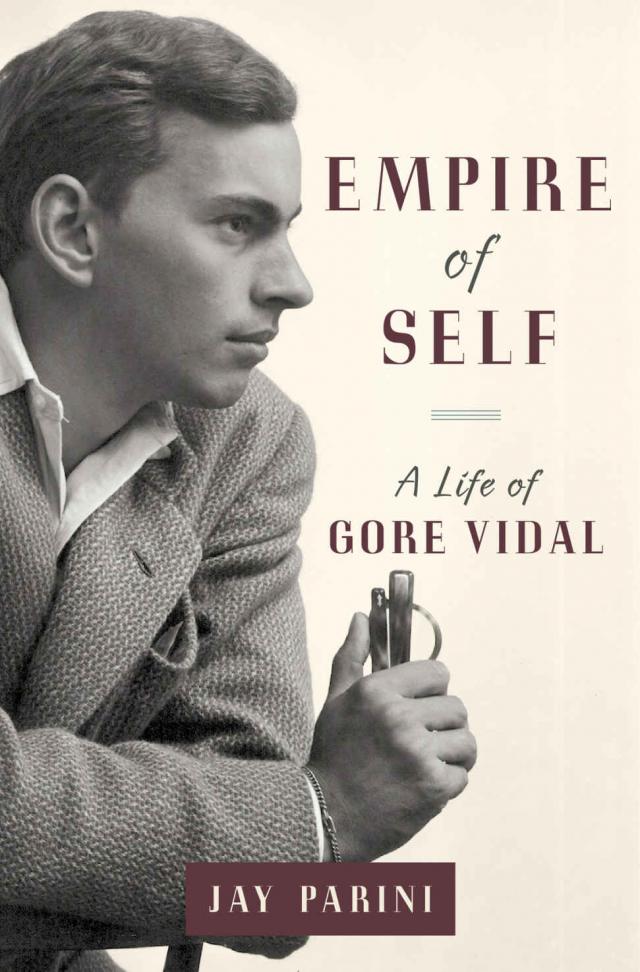
Cover photograph © Arnold Newman/Getty Images
Parini, Jay.
Empire of self : a life of Gore Vidal / by Jay Parini.
pages cm
ISBN 978-0-385-53756-8 (hardcover) — ISBN 978-0-385-53757-5 (eBook) 1. Vidal, Gore, 1925–2012. 2. Authors, American—20th century—Biography. I. Title.
PS3543.I26Z85 2015
813′.54—dc23
[B]
2015004719
eBook ISBN 9780385537575
v4.1
a
For Devon, always
Contents
Cover
Also by Jay Parini
Title Page
Copyright
Dedication
Introduction
Rock Creek Ramble
Chapter One
I. A Silver-Plated Mug
II. Capitol Steps
III. A Wider World
Truman and Gore at the Plaza
Chapter Two
I. Not a Lovely War
II. Two Roads Diverging
III. Storm at Sea
IV. Hearts of Darkness
Edgewater Recalled
Chapter Three
I. Portrait of the Artist as Balletomane
II. Pillars of Salt
III. Stateside
IV. More Dolce Vita
V. Finding Dutchess County
VI. Loving Howard
Beverly Hills Blues
Chapter Four
I. Detecting Life
II. The Spanish Main
III. Media as Messages
IV. Silvery Screens
V. More Visits to Small Planets
VI. Outlaws
VII. Ben-Hur
VIII. A Place at the Round Table
At the Water’s Edge—Hyannis
Chapter Five
I. “You’ll Get More with Gore”
II. Slouching Towards Camelot
III. Essaying the World
IV. Roman Spring
V. Julian Rising
Moravia and Gore on the Isola Tiberna
Chapter Six
I. Romanitas
II. Capitol Steps Revisited
III. The Holy Family
IV. Myra
V. Busy Weekends
VI. The Vidal-Buckley Debates
VII. Furious Visions
Miss Sontag Writes a Novel
Chapter Seven
I. A Bad Year
II. Writing Richard Nixon
III. Italian Hours
IV. Patriotic Gore
V. The Swirl
VI. Myron Unmanned
The Man Who Wouldn’t Fall to Earth
Chapter Eight
I. Half a Century
II. 1876 and All That
III. Memories, Dreams, Self-Reflections
IV. Apocalypse Not Quite Yet
V. Hollywood Redux
VI. Grace and Hope
Gore and Isaiah Berlin in Oxford
Chapter Nine
I. Acting President
II. Running in Place
III. Duluth: Love It or Loathe It
IV. Honorary Citizen
V. Land of Lincoln
VI. Ah, Venice!
The Lesson of the Master
Chapter Ten
I. “It’s a Trade”
II. “One Disaster After Another”
III. Fear of Flying
IV. Imperium
V. Sailing the Coast
VI. Adding Wings to the Mansion
Lenny and Gore
Chapter Eleven
I. “Our Country’s Biographer”
II. “The Other Side of the Camera”
III. Attacking the Sky-God
IV. Thinking About Sex
V. Retreats, Advances
VI. In the Widening Gyre
At the Harvard Faculty Club
Chapter Twelve
I. Rethinking Washington
II. Dreams of Wholeness
III. Elder Statesman
IV. Reviewing the Life
V. The Golden Age
VI. Still the Best Man
Songs in the Hollywood Hills
Chapter Thirteen
I. The Pamphleteer
II. Finding Founding Fathers
III. A Death Before Bedtime
IV. Marching to the Sea
V. The Last Memoir
VI. Mopping-Up Operations
VII. Snapshots of the End
Conclusion
Postscript
Acknowledgments
Notes
Photo Credits
About the Author
Illustrations
Introduction
My friendship with Gore Vidal began in the mid-eighties, when I lived for a period on sabbatical with my wife and young children in Atrani, a village on the coast of southern Italy. We rented a small stone villa on a cliff overlooking the sea, with a view to Salerno to the south and Capri just out of sight to the north. The bay glistened below us, almost too bright to bear, with fishing vessels departing each morning in search of mullet, mussels, mackerel, tuna, and squid that would be unloaded in the afternoon and sold in wooden barrels by the dock. I went in the mornings to a café in Amalfi, walking into town along a stony footpath where a thousand cats seemed to prowl, where sturdy women carried groceries slowly up hundreds of steps and children kicked footballs in back alleys. The smells of laundry soap, cat piss, and wildflowers were ubiquitous.
We had a rooftop terrace, above which rose a lemon grove and limestone cliffs. A massive villa—alabaster white, clinging to the rocks like a swallow’s nest—loomed above us, and we wondered who lived there in such opulence. Some Italian nobleman? A local Mafia don? A film star? When I asked the tobacconist in town about its resident, he said, “Ah, lo scrittore! Gore Vidal. Americano.” He explained that the writer stopped by his shop almost every afternoon for a newspaper, then retired to the bar next door for a drink, where he would sit and read for an hour or so before taking the bus up the hill to Ravello.
I knew the work of Gore Vidal moderately well already. Having been an antiwar activist during the Vietnam era, I admired his political commentaries in Esquire and The New York Review of Books. I never forgot his fiery debates with William F. Buckley during the presidential conventions of 1968, especially during the siege of Chicago. He had held his ground, driving Buckley mad with his relentless logic and unflappable manner. I had read half a dozen of his novels, including Julian, Myra Breckinridge, Burr, and Lincoln. Needless to say, I wanted to meet him.
Responding to a note I’d sent, Gore pounded on my door one afternoon not long after our arrival, inviting my wife and me to dinner. I was terrified, as his reputation preceded him, and thought he might be tricky. But a friendship soon blossomed. I often met him for a drink or dinner, and a series of conversations began that lasted until his death in 2012. It would be fair to say, in a crude way, that I was looking for a father, and he seemed in search of a son. We had a good deal in common, including a passion for liberal politics, American history, and books. We both loved Henry James, Mark Twain, Anthony Trollope, and Henry Adams—and we invariably found we had more to talk about than time allowed. We also shared a love of both Italy and Britain. By that time I had spent seven years in the British Isles, and it turned out we knew many of the same people. The literary world is, in fact, quite small—especially in Britain and Italy, where writers and editors often converge at parties and literary events.
In the decades that followed, we spoke on the phone every week—for periods on a daily basis. And I would stay with him in Ravello or, later, Los Angeles, meeting him often when he traveled. I have strong memories of our time together in such places as Rome, Naples, Edinburgh, Oxford, London, New York, Boston, even Salzburg and Key West. He proved more than helpful to me as a younger writer, reading drafts of my books, offering frank critiques and encouragement. We discussed his work at length, too—he would frequently send a typescript
His phone calls, in later years, often began: “What are they saying about me?” To a somewhat frightening degree, he depended on the world’s opinion. Once, in one of those memories that stands in for many others, my wife and I were sitting in his study in Ravello when he came in with drinks. On the wall behind his desk were twenty or so framed magazine covers, with Gore’s face on each one. I asked, “What’s that all about, those covers?” He said, “When I come into this room in the morning to work, I like to be reminded who I am.”
Over many decades he had built a huge empire of self, sending out colonies in various languages. “They love me in Brazil,” he would say. Or Bulgaria, or Turkey, or Hong Kong. I took his rampant egotism with a grain of salt. It was part of him, but only part. The narcissism was, at times, an exhausting and debilitating thing for Gore, as it proved impossible to get enough satisfying responses. He required a hall of mirrors for adequate reflection, and there was never enough. The nature of the narcissistic hole is such that it can’t be filled. At times, I wondered about how much money and time I spent in winging off to various far-flung cities to spend a few days with him, and my transatlantic phone bills reflected my own mania. But his flame was very bright and warm, and I was drawn to it.
He was usually kind to me, and to others in his surprisingly discrete circle of friends. He listened to my ideas for books and essays carefully, eager to respond in useful ways. He liked to know every detail in the lives of my children. He took an interest in my wife’s work as a psychotherapist and asked about this frequently. When we met in various cities, we had lavish dinners in good restaurants, and there was never any question about who would pay. “I’m very rich,” he would say, picking up the tab.
In the early nineties, Gore asked me to take over the biography that Walter Clemons was writing—or not writing because of writer’s block and diabetes (among other things that seemed to delay Clemons). My wife, perceptively, insisted that I decline, saying that I would have to choose between the biography and my friendship. I couldn’t have both. She understood that he would try to control what I wrote at every turn, driving us both insane. So I decided then to write a book that could only be published after his death, a frank yet fond look at a man I admired, even loved, and who had preoccupied me for such a long time. In the mid-nineties, I did edit a book about him, enlisting a number of critics to discuss phases of his career. I interviewed him then, and frequently in the years that followed, making it clear that one day I would write a book about him. He encouraged this Boswellian vein, and would sometimes say, “I hope you’re writing this down!” In fact, I did. And over the years, I interviewed people he knew, such as Anthony Burgess, Graham Greene, Alberto Moravia, Paul Newman, Richard Poirier, Frederic Prokosch, and many others. On several occasions I interviewed his companion, Howard Austen, a wry and congenial man with a big heart.
On one of my last visits with Gore, in the Hollywood Hills, he wondered if I would follow through and write a book about him. I said that I would. “So write the book,” he said, “and do notice the potholes. But, for God’s sake, keep your eyes on the main road!” In the course of bringing together thinking of nearly three decades about this complicated and gifted man, I’ve tried to take this advice seriously, emulating Gore himself, a writer who rarely lost sight of the road before him.
The reader will find brief first-person vignettes between the chapters, recollections of moments in our friendship that stuck in my head. In writing them, I thought of the suggestive vignettes between the stories of Ernest Hemingway’s In Our Time and how each positioned the reader to enter the next story. My vignettes were culled from my journals, in each case written soon after the event described. This is as far as I go in making this a memoir of a friendship. It’s not that. It’s the story of Gore Vidal’s extraordinary life and writing.
A passage from Gore’s 1959 essay on Suetonius, the father of biographical writing, comes to mind. He praised this great Roman biographer who, “in holding up a mirror to those Caesars of diverting legend, reflects not only them but ourselves: half-tamed creatures, whose great moral task it is to hold in balance the angel and the monster within—for we are both, and to ignore this duality is to invite disaster.” Gore certainly embodied both the angel and the monster, and he knew it. Over the decades, I witnessed more of the angel than the monster, although I saw him lash out at friends, and several times he said hurtful things to me, as when I got a fellowship at an Oxford college and Gore remarked, “They don’t let in wops like you, do they really?” I would always come back at him, saying he had insulted me, but he would usually pretend that nothing had happened, and I let it pass. I allowed him to speak rudely to me to maintain a sense of equilibrium between us—a fault of mine, no doubt. But one usually had a choice with Gore: Agree with him or leave. I valued our friendship for a variety of reasons, including his mentorship, and—perhaps more than most—have a lot of patience. I made the decision to hang in there.
My goal in writing this book has been to look at the angel and the monster alike, offering a candid portrait of a gifted, difficult, influential man who remained in the foreground of his times. Gore gave me full access to his life: his letters and papers, his friends. He told me to say what I saw whenever I wrote about him, not pulling my punches. That is, of course, how he lived his life. I’d like to think he would appreciate my efforts, although I’m not looking forward to our meeting on the other side.
Rock Creek Ramble
Gore gives a talk at the National Press Club in Washington, D.C., in 1991: a rousing “State of the Union” address. But in the morning, at his request, I drive him to the old house in Rock Creek Park that had belonged to his grandparents. “I haven’t seen it in a while,” he says as we enter the drive at 1500 Broad Branch Road. “It’s now the Malaysian embassy, but they know we’re coming.”
The circular drive has a fountain in the middle. “That wasn’t there,” he says, annoyed. “You could look across the street to the woods and see what we called the flags, pale irises. There was a rose garden somewhere, and it didn’t belong to the president. The creek itself was often orange-brown, and I used to wade there with my trousers rolled up to the knees. You’d never know a city lay nearby, on the other side of the park.”
It’s a large and lovely house on a hill, built of gray-yellow Baltimore stone, much larger than I’d imagined. A Malaysian secretary meets us at the door. “Mr. Vidal, this is an honor,” she says, bowing. She shows us to a white sofa in a room nearby, and two servants in white jackets bring tea and coconut macaroons. We talk with her for a while, and she apologizes for the absence of the ambassador, who apparently lives here. But Gore is itching to wander. “We’ll just have a look upstairs,” he says.
The woman seems unsure about this, but doesn’t interfere. Suddenly the decades fall away—and Gore is eight or nine years old, stepping into the hallway outside of his grandfather’s study. “He had so many books, which was an irony, because he was blind. In the attic were thousands of volumes, old yellow copies of the Congressional Record. My grandmother said to pay no attention to my grandfather when he grumbled. But he rarely grumbled. I was the child of their dreams, as I was quiet and liked to read. I read aloud to my grandfather in his study. We sat there night after night, working our way through Roman or American history. He would stop me, ask questions, making sure I understood what I read. Could there be a luckier boy in the world?”
He shows me a favorite place, this tiny alcove where he spent hours. “I would hear voices downstairs, and I would close my book and crouch on the stairs, hiding, listening. I could hear the voice of Huey Long—a low Southern drawl—or some other senator or congressional aide. I knew the sorts of thing they were saying, even if I couldn’t hear the words. My grandfather was the master of ceremonies, but he always convinced everyone in the room that he was right and, no doubt, Franklin Roosevelt was wrong.”
We step to the back door. “My grandfather kept chickens in the yards, so we had fresh eggs,” he says. “My job was to fetch the eggs. They seemed the most precious and wonderful things in the world to a boy of seven or eight. I didn’t eat chicken for a long time because I would think of those chickens, and it worried me that they had to lose their lives to feed us.”
Gore stands in the driveway for a long time, looking across the road to the park. Then he shakes his head and steps into my car. “It never pays to go back,” he says. “And you misremember it anyway.”


