Once He Made a Beginning: A Pride and Prejudice Variation, page 1


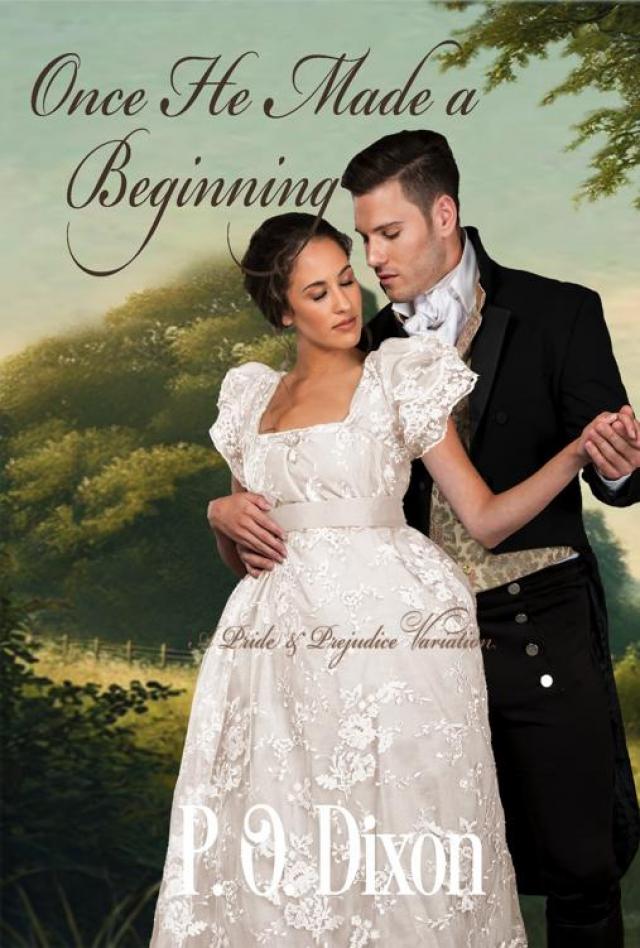
Once He Made a Beginning
A PRIDE & PREJUDICE VARIATION
P. O. DIXON
Contents
Introduction
Chapter 1
Chapter 2
Chapter 3
Chapter 4
Chapter 5
Chapter 6
Chapter 7
Chapter 8
Chapter 9
Chapter 10
Chapter 11
Chapter 12
Chapter 13
Chapter 14
Chapter 15
Chapter 16
Chapter 17
Chapter 18
Chapter 19
Chapter 20
Epilogue
P. O. Dixon Books
About the Author
Acknowledgments
Introduction
“Every Ending, a Promising Prelude to a Beautiful New Beginning.”
After his failed proposal at Hunsford, Fitzwilliam Darcy suffers a devastating accident that alters the course of his future. Overwhelmed with concern, unresolved feelings, and self-blame, Elizabeth Bennet finds herself compelled to stay by his side throughout his recovery. Is this fate’s way of giving them a second chance, or are some wounds too deep to heal?
One’s mind, unburdened by recollection, is free to embrace the promise of what lies ahead.
One
KENT, ENGLAND – SPRING 1812
Fitzwilliam Darcy, of Pemberley in Derbyshire. Those who truly knew the gentleman spoke of him as the finest landlord and master, quite unlike some young men who were restless and thought only of themselves. There was not one of his tenants or servants that would not give him a good name. He was fiercely loyal. So long as it was within his power, there was nothing he would not do for those closest to him. Any young woman would be fortunate indeed to have his love and devotion.
That is to say, any rational young woman. But, judging by Miss Elizabeth Bennet’s behavior that evening, she was far from rational. Indeed, she was her own worst enemy.
The parsonage walls flew by in a blur as Darcy stormed out of the front door, slamming it behind him. With his heart shattered, he stomped onto the stone path and across the lawn. He mounted his horse and set off through the park veiled in darkness. An empty feeling of despair took root in his stomach. His heart racing—his mind a jumble of disbelief and regret.
The moon and stars hidden behind blankets of clouds left him blind to whatever perils lay ahead as his anger choked back his disbelief, urging him faster into the dark night.
The way Elizabeth had looked at him, her eyes cold and accusatory, would no doubt haunt him until the day he died.
“I had not known you for a month before realizing you were the last man in the world I could ever be prevailed on to marry.”
Elizabeth had spoken with a coldness that could have destroyed him had he been a lesser man.
I cannot believe it. She hates me. Her mind has been poisoned against me from almost the first moment of our acquaintance. I was utterly oblivious to her disdain. Foolishly supposing I had ingratiated myself with her these past days in Kent, more than compensating for my feigned indifference all those weeks in Hertfordshire—all in vain. But no, nothing I could have said or done would have been enough for her to forgive me for imagined slights and the perceived blow to her pride.
Darcy tried remembering the worst things she had said to him, and his anger flared up again. It was hard not to wince when he remembered how she had shaken her head at him like a mother reprimanding a child for his foolishness.
He could not believe that he had been so blind. How could he have misunderstood her so completely? He cursed himself for his obtuseness and failure to understand this before it was too late.
She yelled at me. She called me arrogant, rude, and insulting. But I am none of those things. I am a gentleman and only have the best of intentions. The problem is that I was too honest... too straightforward, and she took offense. I only attempted to be earnest in expressing my feelings for her.
Her family is beneath mine in rank and fortune. Was I wrong in pointing out the obvious? But even so, I do not love her for her fortune or social standing. I love her because she is the most charming, intelligent, and witty woman I have ever met. At least, I thought she was all those things. How could I have been so mistaken about her character?
I am such a fool, thinking I could make her happy. I thought my wealth and stature would impress her. If I had known she hated me so much, I would never have courted her so ardently during our time here in Kent. I surely would not have given my cousin the strongest hint about my intentions toward her. Not only did I suggest as much to the colonel but to Anne as well. What will either of them think upon learning what a fool I have been?
Time swept by, and Darcy rode on with no thought of where he was going. With luck, the Rosings household would be settled by the time he returned, and he would be spared the questioning eyes of his cousin Colonel Richard Fitzwilliam, who could not doubt where Darcy had gone that evening and his reason for doing so.
Darcy had all but rushed out of the room when the Collinses arrived at Rosings, disappointed that Elizabeth was not with them as he had hoped. He was so eager to see her, to tell her how he loved her, and to offer her his hand in marriage. Now, he honestly wondered if he ever wanted to see her again. How easy it would be to return to London and pretend the past weeks in Kent never even happened.
On the other hand, his character simply could not abide his being so misunderstood, especially by the woman he had fancied himself in love with. Not that he would dare repeat the assertions she had found so distasteful and unpleasant. Still, he supposed some rebuttal to her misguided accusations against him was in order. Especially as it regarded that foul George Wickham, Darcy’s former friend and current nemesis. By not refuting whatever falsehoods Wickham had accused him of, Darcy felt as though the scoundrel had somehow won. That would never do.
Thus resolved, Darcy steered his horse around and headed to Rosings Park. He would write to Elizabeth and give his own account of things. Steady to his purpose, he composed the letter in his head, mulling over every minute detail.
Hours later, he laid his pen aside. Then, before folding the missive, he revisited his concluding sentiments:
“You may possibly wonder why all this was not told you last night, but I was not then master enough of myself to know what could or ought to be revealed. For the truth of everything here related, I can appeal more particularly to the testimony of Colonel Fitzwilliam, who, from our near relationship and constant intimacy, and, still more, as one of the executors of my father’s will, has been unavoidably acquainted with every particular of these transactions. If your abhorrence of me should make my assertions valueless, you cannot be prevented by the same cause from confiding in my cousin, and that there may be the possibility of consulting him, I shall endeavor to find some opportunity of putting this letter in your hands in the course of the morning. I will only add, God bless you.
“FITZWILLIAM DARCY”
Sealing the missive, Darcy shuddered at the memory of Elizabeth’s words. Did he dare share such intimate details of his life with someone who despised him as she did?
It is not as though the letter contains any repetition of those sentiments or renewal of those offers that were so disgusting to her, Darcy reasoned. I wrote without any intention of paining her or humbling myself by dwelling on wishes which cannot be forgotten too soon. Any inconvenience she may be occasioned by receiving and reading this letter must be pardoned for my character required it to be written.
Though it was early in the morning, Darcy was wide awake. He walked over to a window and drew back the heavy curtain to reveal the landscape shrouded in darkness. It will be some time yet before the sun rises, he considered. If all goes according to plan, soon enough, she and I will be standing face to face.
He planned to put the missive in Elizabeth’s hand despite the doubts plaguing his busy mind. Meanwhile, Darcy set off on a strenuous ride through the countryside to take his mind off Elizabeth, the letter, and what she might say or do.
In much the same fashion as he had ridden the night before, Darcy rode his horse with wild abandon. Without warning, the horse lurched beneath him. Then it stumbled and fell, sending Darcy tumbling over its head. He rolled down a hillside, his head smacking against rocks and roots. His lungs emptied as he lay at the bottom of a gulch, stunned and gasping for air. His horse, having recovered, galloped away over the fields.
Darcy struggled to sit up; his head spun, and his body ached. He tried to call out for help, but no words came out. Blood trickled down his forehead. He could feel the warmth of it dripping into his eyes.
Slowly, he pulled himself up onto his knees and hands and began making his way up the hillside. His arms trembled from the effort, and it was all he could do just to move an inch at a time. Visions of Miss Elizabeth’s face flashed through his mind: her anger, her disdain.
With a last burst of strength, Darcy made it up the hill and onto the path. He collapsed onto his back, his chest heaving as he fought to regain control of his breath. But it was no use. Darcy succumbed to sleep—his dreams filled with visions of Elizabeth, her countenance twisted in scorn and rage as she turned away from him for good. Before long, darkness overtook him.
Two
The heavy doors of Rosings flew open w
No one told Lady Catherine de Bourgh what to do. No one, especially in her own home, where she reigned supreme. Her formidable will dictated that she alone was best suited to oversee the unfolding crisis. Advancing toward the commotion, she was determined to make her own assessment of the situation.
However, seeing Darcy—her favorite nephew and the embodiment of her hopes and dreams—lying unconscious in such a wretched state was nearly too much for Lady Catherine to bear. All the color drained from her countenance, turning it a ghostly shade of pale. The sight of Darcy’s ashen face and the crimson stains covering everything her eyes could see struck her like a physical blow. The usually immaculate manor blurred around the edges, the grandeur of the room fading into insignificance in the face of Darcy’s condition.
Fitzwilliam Darcy, a proud, virile young man, now so fragile. He was as dear to her as a son, and in many ways, he had filled that role his entire life. She and her late sister, Lady Anne Darcy, had sanctioned him thus while in his cradle, planning his marriage to Lady Catherine’s daughter, Anne, from almost the moment of their births.
With the untimely death of her husband, Sir Lewis de Bourgh, Lady Catherine had come to rely on Darcy much more than she did anyone, even her own brother, Lord Edward Fitzwilliam, the Earl of Matlock, practically empowering the young man with the management of her vast estate, Rosings Park. It only made sense, for he was to become its rightful owner upon his marriage to Anne, was he not?
With her worry tugging at her, she suffered cracks in her stoic façade. She loathed this picture of herself—this unfamiliar sensation of helplessness, as much as she feared losing Darcy. Weakness of any kind was her abhorrence, even in the face of such a tragedy. She had not shed a tear in the wake of her own husband’s passing.
“What if my dear, dear nephew does not recover? What is to become of us?” the grand lady questioned aloud. “What is to become of my daughter, Anne?” Her voice trailed off as tears welled in her eyes. The gravity of the situation loomed over her.
It was rare to see the usually domineering and confident woman so vulnerable. Overwhelmed by hopelessness and despair, her body sagged, drained of all energy, as a cold sweat dampened her skin. Her limbs went numb, her legs buckling until she collapsed under the crushing force of her fears.
A voice called out, “Lady Catherine!”
Is it my nephew Fitzwilliam? Her ladyship wondered, wanting to ask and know, yet she struggled to respond. But it was all in vain, for her body betrayed her: her mouth was dry, her tongue heavy and thick, leaving her unable to speak.
The surrounding voices became even more indistinguishable as her heartbeat pounded in her ears, loud and rapid, drowning out all other sounds. Lady Catherine’s vision dimmed, the world fading into a silent abyss as she slipped into unconsciousness, her last thought a desperate plea for Darcy’s survival.
As Colonel Fitzwilliam took charge of the chaos, his military instincts kicked in, prompting him to act decisively. Memories of past battles surfaced briefly in his mind—of limbs and lives lost—but the split-second decisions made under fire had prepared him for moments like this, a moment no less critical here in the exquisite halls of Rosings than on the smoke-filled battlefields.
With both Lady Catherine and Darcy unconscious, he needed to act swiftly to secure the best medical attention for them. As he checked Lady Catherine’s pulse and glanced over at Darcy’s still form, thoughts of his cousin Anne invariably crept into his mind.
A grim expression settled over his face, causing the muscles in his jaw to tighten. He could not help but imagine how Anne, with her delicate constitution, would endure such a tragedy. The possibility of losing one or both of her loved ones, who were so essential to Anne’s life, would surely shake her to her core. He could only hope she had the strength to withstand it all should the worst unfold.
Thoughts raced like wild horses through his mind, each one more unsettling than the last. The cause of Darcy’s accident was clouded in mystery, haunting the colonel with its uncertainty. Was there any hope for his survival? Would he be able to pull through, or was death on the verge of claiming him? Darcy, who was like a brother to him—his closest friend in the world.
And Lady Catherine, lying motionless—the shock of seeing her favorite nephew in such dire straits clearly had been too much for her.
Colonel Fitzwilliam’s head shook slowly from side to side, his mind heavy with personal concerns yet determined to push them. The stately rooms of the manor seemed to vibrate with tension, their walls echoing with frantic footsteps and the distant sounds of medical preparations. Despite his dread, the colonel forced himself to focus on the task at hand, acutely aware of the ticking clock and the lives and livelihoods of so many hanging in the balance. But amidst his steadfast actions, one haunting question lingered in his.
What if it is already too late?
Three
Elizabeth tossed and turned, the events of last night heavy on her mind. She buried her face in her arms, searching for answers that refused to come. She stared blankly at the ceiling. The silence around her felt unbearable.
She could not believe that Mr. Darcy had actually proposed to her. Mr. Darcy—the proudest, most arrogant man she had ever met. The man who was primarily responsible for the disappointed hopes of her most beloved sister, Jane, and solely responsible for the near impoverished state of a decent gentleman, Mr. George Wickham. Mr. Darcy was the embodiment of everything Elizabeth despised. Yet, somehow, he had persuaded himself that he was in love with her and offered his hand in marriage.
As she recalled what occurred the previous evening, Elizabeth could not help but feel conflicted. She turned the previous night’s events over and over in her mind, sneering and blushing about them in equal amounts. To have garnered the ardent admiration of such a man, even if unconsciously done, was really something.
As she stared up at the ceiling, mentally tracing the intricate molding, Elizabeth’s busy mind was filled with thoughts of the enigmatic gentleman. She closed her eyes and pictured the haughty man’s intense eyes gazing into hers. His words reverberated in her ears. “You must allow me to tell you how ardently I admire and love you.”
Perhaps had his subsequent speech continued in that vein, she might have at least been flattered by what he had to say. Instead, aghast at the impropriety of his speech—and his assumption that she felt as he did—she was left silent. Mistaking her stunned silence as sufficient encouragement, the avowal of all that he felt and had long felt for her immediately followed. He spoke well, but there were feelings besides those of the heart to be detailed—specifically, her family’s want of connections and lack of fortune and his sense of her inferiority—of its being a degradation. Indeed, he owned he loved her against his will, against his reason, and even against his character.
How could she but refuse such an appalling declaration? That he had the audacity to accuse her of incivility because of the hastiness of her subsequent rejection of his offer merely added insult to Elizabeth’s injury. What she hoped would be the last words she ever wished to utter to Mr. Darcy could not help but intrude.
“From the very beginning—from the first moment, I may almost say—of my acquaintance with you, your manners, impressing me with the fullest belief of your arrogance, your conceit, and your selfish disdain of the feelings of others, were such as to form the groundwork of disapprobation on which succeeding events have built so immovable a dislike and I had not known you a month before I felt you were the last man in the world whom I could ever be prevailed on to marry.”
She congratulated herself for having thus refused him, although there would be a heavy price for her to pay were her mother to learn that her second eldest of five single daughters had refused yet another offer of marriage. Fewer than six months prior, Elizabeth had rejected her cousin, Mr. William Collins—the odious man in whose home she was a guest, what with his having married her intimate friend, the former Miss Charlotte Lucas, on the heels of Elizabeth’s rejection. And now, Mr. Fitzwilliam Darcy, one of the wealthiest and thereby one of the most eligible gentlemen to set foot in Hertfordshire since Mrs. Bennet started keeping track, found himself on her daughter’s list of rejected prospects.