

Cord 1, page 1


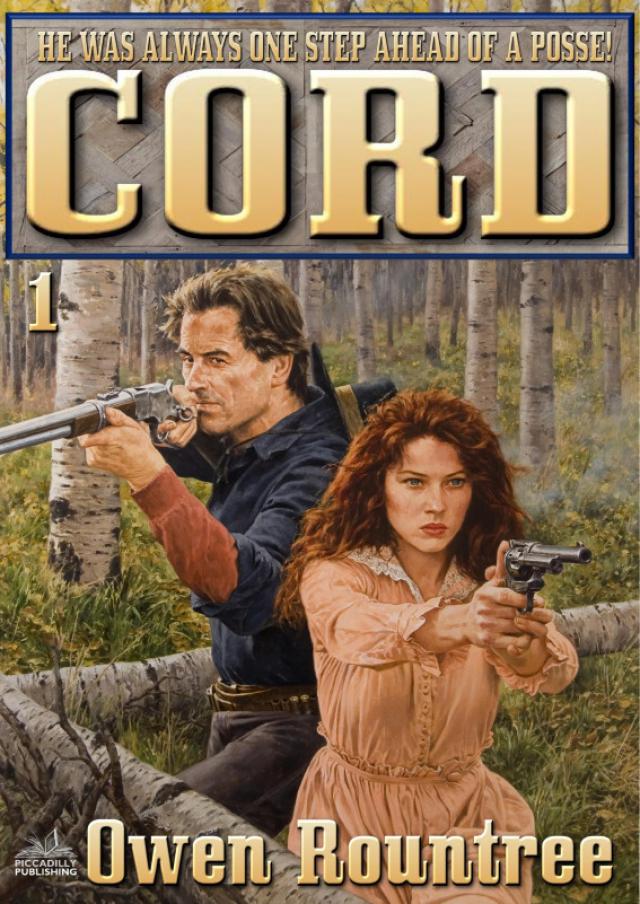
CORD
Just like Bonnie and Clyde, Cord and Chi are free spirits—and accomplished bank robbers.
This time they’re on the run-in two different directions. One of Cord’s old-time lawbreaking buddies needs a favor—and for Cord it’s a chance to settle an old score in a town that’s being overrun by the wrong kind of outlaws ...
CORD BOOK ONE:
CORD
By Owen Rountree
First Published by Ballantine Books in 1982
First Edition: August 2018
Names, characters and incidents in this book are fictional, and any resemblance to actual events, locales, organizations, or persons living or dead is purely coincidental. All rights reserved. No part of this book may be reproduced or transmitted in any form or by any means, electronic or mechanical, including photocopying, recording or by any information or storage and retrieval system, without the written permission of the author, except where permitted by law.
This is a Piccadilly Publishing Book
Cover Painting by Gordon Crabb
Series Editor: Ben Bridges
Text © Piccadilly Publishing
Published by Arrangement with the authors.
CHAPTER ONE
Cord had soft-footed his way off into the stand of scrub birch and aspen above the little creek, when he saw the stranger coming toward him over a rise in the low hills, maybe a mile away down the valley of the Musselshell River. Now Cord waited, holding his Colt Peacemaker extended before him in his right hand, his left hand gripping his right wrist so the nine-inch barrel was rock-solid as he stared over the open sights. Below him the cook fire, ringed by a circle of gray river stones, had burned down to mostly embers, and his coffeepot was steaming. The stranger had disappeared behind a dip in the trail, but Cord went on waiting.
The sky was streaked gray on darker gray, flat and dull in the broadening dusk. The remains of old snowdrifts, shaded from the spring sun on the northern side of the draws, were dirty and pocked. The day had been warm, but in the twilight Cord’s breath misted before his face.
Then he heard the clatter of a shod horse against a patch of stone. Whoever it was had waited a good bit before coming in. The horse that appeared was a dirty blue-roan gelding, and the man who dismounted wore a beaver Stetson and a long greasy coat with a sheep’s-wool collar. A fringe of blond hair showed from under the hat. The stranger stood looking around with what seemed more curiosity than caution, then squatted before the fire.
Cord waited until the man held the tin cup in one hand and the coffeepot in the other. When he spoke, his voice was flat, almost expressionless. “Hold,” Cord said. “Don’t even turn your head. I’ll blow it off.”
He moved down through the brush, circling to his left. Neither his eyes nor his gun left the man crouching in front of the small fire. Cord stopped when he was behind the man, the barrel of his revolver maybe five feet from the man’s back.
“You listen to me,” Cord said. “You put the pot down in the fire, then raise that hand. Then you put the cup down, and raise that hand. Then you stand and turn.”
The stranger moved cautiously, his hands nearly steady. When he turned, Cord saw he was almost a boy, not more than twenty. He wore a thin blond mustache, and there was a red turn of scar on one cheek. The man moved his hands slowly to the front of his coat, and Cord watched while he carefully unbuttoned it, then pulled it open to show that he wore no gunbelt
“What are you looking for?” Cord said.
“Coffee,” the other man said and grinned. “That pot, it was a-steaming there, and I saw your horse, so I figured there was somebody around someplace, maybe watering the brush, and whoever it was most probably wouldn’t mind.” The man rebuttoned his coat against the chill of dusk. “Real fine, on a cold evening, is what I was thinking. The coffee, I mean.”
“Help yourself,” Cord said.
“Name is Weems,” the man said. He held the tin cup in both hands and blew across the top. “Billy Weems … William my mother always called me ...”
“Thought you might like to know,” he went on, when Cord didn’t answer. “Since you got me held up and all. This is a swell trick you got here, setting out a pot of coffee and then holding down on whoever rides in. Too bad I ain’t got any large money for you.” The man sipped from the cup. “Coffee ain’t so bad though. That’s something.”
Cord lowered the .45, holding it loosely at his side, the barrel pointing at a spot on the ground between the two men.
“Got to tell,” Weems went on. “The pickings wasn’t always so slim. Week ago yesterday I got paid, and three days later I was in town down at Three Forks, drunk and playing some cards and getting my saddle horn polished once or twice a night, if you know what I mean. What I got left is two dollars in currency and forty-six cents in coin, and a watch they wouldn’t stand me five dollars for in the card game. But there was a few days …” The man sipped again from the cup, then shook his head, like he might really be sorry. “You’re not going to shoot me for being broke, are you?”
“You sure like to talk,” Cord said.
“Yeah,” Weems said. “Seems like it.”
Cord holstered the revolver, then came around to the other side of the fire. It was almost dark now, and the light from the burned-down coals of the fire was soft orange on the other man’s features. Weems looked up from his coffee.
“Finish up and ride on,” Cord said. “That’s how this is going to be.”
“Sure,” Weems said easily and started to rise.
Cord took two quick steps backwards and sideways, redrawing the Colt as he moved, held a moment with the pistol out before him, taking dead aim. He shot Weems once in the center of the chest. The impact of the heavy .45 slug lifted the other man off his feet and slammed him back into the darkness away from the fire.
Almost as he moved Cord caught the flash of gunfire from the corner of his eye and heard a bullet crack past his head and ricochet off the rocks behind him and into the night. He stood perfectly still and waited, having spun well out of the dim firelight himself, concealed by clouded night.
There was no other sound but the sighing of a slight breeze for long minutes. Cord held steady, watching, with his pistol raised, waiting. Once there was the sound of a boot scraping against rock, and only his eyes moved in the direction of the stream, but he could see nothing in the darkness outside the ring of firelight.
“Cord!”
The voice came from above him, about where the rifle shot had come from. It had a border drawl, Kansas maybe.
“Cord!” The voice sounded hollow in the stillness of the night. “You dead yet?”
A boot heel scraped against rock again. The evening movement of breeze had died, and now silence came back over the campsite. The fire was nothing but a small circle of embers, glowing faint red. The darkness seemed to take on weight.
Cord remained just outside the glow of the campfire, motionless, listening. His right arm, holding the two-pound Colt revolver, began to ache and turn numb, and Cord wondered if he would be any use with the weapon when the time came. But he would not lower it, could not allow himself the luxury of even that slight movement. Whoever was out there had a rifle.
If the other man was smart, he would wait until dawn. Cord put the thought from his mind.
The next shot, when it exploded in the night, was loud as a cannon. A second shot followed deliberately, and Cord felt a tug at the skirt of his coat. The flashes were bright in the darkness, but Cord did not return fire. The odds there were long, and that was not Cord’s style.
“You throw out your gun, right now,” the other man called. “You do it, Cord, if you’re still alive, just toss your weapon out into the light, and I won’t kill you. Swear to God on it, Cord.”
The silence was not so long this time. The other man was moving steadily, circling around the fire toward the little grassy shelf above the creek where Cord had picketed his bay gelding. The horse nickered, a high thin whine.
Then the clouds broke. For a moment the change was almost unnoticeable, opening like a slow false dawn, and then there were shapes that looked like things if you stared at them, or knew what you were looking for.
It was almost like a scene in a play, frozen in time. The man’s back was to Cord. His rifle was clutched against his body under one elbow, and he was unstrapping the saddlebags from Cord’s gelding. Five feet or so from Cord, beyond the fire, Weems lay sprawled on his back, head twisted at an impossible angle, the tin cup inches from his outflung left hand.
The other man tugged the saddlebags off the gelding and started to turn, then hesitated. Cord could just make out his expression. The other man screwed up his face, as if the light were too bright.
“Cord?” he said softly.
“Over here,” Cord said.
The other man dropped the saddlebags, turned, and fumbled at the rifle. Cord let him get it almost up before he pulled the trigger. The other man’s rifle jerked up and away from him, and he slammed back against the flank of Cord’s horse. The gelding whinnied and reared away. One of his front hooves struck the man somewhere in the back as he slumped toward the ground.
Cord moved around the remnants of the fire and crouched next to Weems’ body. The young man’s thick-fingered right hand was clenched tight, already beginning to go stiff with death rigor. The stubby barrel of a Remington over-and-under two-shot derringer peeked out from the fist. Cord gathered up the cup and pot, lashed them up, then picked up the saddlebags that had fallen beside the other man. He slung them over the gelding and laced them snug before opening one of the flaps to check the contents.
Inside he was carrying forty thousand dollars in currency, twenty in each pocket. Some of the bills were worn and soft like old buckskin, others were packaged crisp and new. Cord lifted a pack of fifty new twenties and riffled them like playing cards.
Then he tightened the cinch, tied the latigo down on the D-ring, climbed aboard, and headed the gelding down the valley of the Musselshell, putting the Crazy Mountains to his back. Both arms ached dully, and he was stiff and exhausted from two days on the trail, and hungry, but he heeded the urge to get away from this place. The clouds had broken almost completely now, and the moon hung before him in the sky like a translucent roundness of pale green ice.
CHAPTER TWO
The town over west on the Claris Fork of the Columbia River was called New Willard, because it was four miles east of Original Willard, where a man of that name had set up a trading post in the 1840s. The post was at the narrowest part of the Clark Fork Gorge, near the Bitterroot Mountains and the far western edge of the Montana Territory, and easy to defend against road agents and the occasional band of Nez Percé traveling through on its way to the buffalo country around Deer Lodge, or up toward the great falls of the Missouri.
But later on when people started to settle in that country, Willard set up a wheat-grinding mill four miles west of his post because that was where the river broke through the gorge with enough force to turn his paddle wheel, and that’s where people settled, near the mill. So Willard moved his post and turned it into Willard’s Mercantile, and now there was nothing left of the original post but two weathered sod-house walls and the rotten caved-in roof.
The day Cord rode into town happened to be Jacob Willard’s fifty-eighth birthday. Willard was a wealthy man, having grown with his town. In addition to the mill and the Mercantile, he owned the freight station, the Liberty Hotel, and the Equitable Bank. Jacob Willard fancied a cutaway coat, striped trousers, and an expensive beaver hat, probably because he had spent the first thirty years of his adult life in buckskins.
Cord knew none of this. His interest was limited to the fact that the town marshal and one deputy were the only law in New Willard, the county sheriff having been killed by road agents a little less than two weeks before. Cord also knew that several eastern meat buyers were in town for the spring cattle auction.
A third fact was most interesting. In the Equitable Bank there was at least a hundred thousand dollars, deposited by the cow buyers against purchases at the auction.
Cord had been in New Willard the first time two days before. In the barber shop he had had a shave and a bath, and let the barber trim his brown hair so it curled just above his bandana. True to the tradition of his profession, the barber liked to talk. It took only a few questions, casually phrased, to learn everything Cord needed to know.
Finished with the barber, Cord walked down the boardwalk and on to the Equitable Bank. Inside, he changed a twenty-dollar gold piece for currency. As he waited, Cord took in the layout of the lobby area, the two teller’s cages, the walk-in safe behind them, and the office door to his right. Cord thanked the young man who handed him his currency, and held the door open for a young woman holding a small child as he went back out onto the board sidewalk. The woman smiled and blushed slightly, and Cord tipped his hat.
The second time, Cord did not ride into New Willard alone; three others rode with him. Only the woman had worked with him before. Her name was Chi. Her sleek dark hair was plaited in two braids that hung down from under her flat-brimmed hat, and she wore a wool serape and leather pants tucked into hand-tooled boots that came nearly to her knees. The tapaderos on her stirrups hung almost to the ground, and the ties on her saddle were mounted in heavy silver conchos.
The two men were brothers named Avon and Buster Travis. They had come up to Cord in a bar in Orofino a week earlier, a territory and two hundred miles back, and told him about Willard and its bank. They had known who Cord was, and they were smart enough to know they needed the help of someone like him.
Whether they were smart enough to pull off the job, Cord wasn’t sure. Still, it was a short-odds gamble, and he had decided to take it. Avon Travis was about nineteen, with sandy hair and freckles the size of pennies, and a gold tooth that shone back in his mouth when he smiled, which was often. Cord found himself drawn to the boy, and wondered, but did not ask, why he wanted to rob a bank.
Cord suspected Buster was most of the reason. Buster worried Cord. He was four or five years older than Avon, and had none of his humor or easygoing ways. There was something bullying in his manner, especially toward Avon, as if Buster were always midstream in trying to prove something. Cord hoped things went simply and smoothly; he didn’t want Buster trying to prove anything on his time or territory.
They rode in together, taking their time, Cord and the woman in front, the Travis brothers following. Two old men were resting away their time on a bench in front of the hotel, and they looked up and stopped talking, but with no more curiosity than they might give any group of strangers. A woman with a shopping basket crossed the muddy street in front of them, and they reined in to let her pass.
The bank stood by itself at the far end of the street, a squat one-story granite building with ornate scrollwork carved under the eaves and something in Latin written beneath. There was a hitching rack in front, and two steps led up to the boardwalk that fronted the building but went nowhere.
As they rode up, the bank door opened and a man came out, dressed in eastern garb: a stiff-collared shirt, vest, and a Prince Albert coat. He was wearing low dark shoes. He looked up at Cord, looked away, and hurried off toward the center of town, like he didn’t enjoy being seen at his business.
Cord and Chi dismounted and handed their reins to Buster Travis, who stayed in his saddle. Cord unlaced his saddlebags and slung them over his shoulder, nodded to Avon, and waited while the younger brother moved his horse around to the side of the bank building closest to town. No one spoke.
Four people were in the bank when Cord and Chi entered. At one window, a teller was counting out money to an elderly woman. Behind the teller a thin gray-haired woman with a hook nose was sitting at a roll top desk entering figures in a ledger. The other teller, a middle-aged man with only a fringe of hair around his otherwise bald head, looked up expectantly at Cord and Chi. He wore a vest and arm garters.
Chi reached under her serape, brought out her Colt, and said, “Everyone hold very, very still.” Her voice was loud and steady.
The woman at the teller’s cage spun around, and Chi leveled the weapon at her midsection.
“Hold it,” Cord said quietly. The woman held her money in one fist, and a baby in the other arm, perched on her hip. Cord recognized her as the woman he had held the door for two days before. Her face was the color of buttermilk.
“Ma’am,” Cord said, and he stepped toward her, took her arm. When she did not resist he led her to a bench at the end of the tellers’ counter. “Would you sit here, please?” Cord said. “We won’t be long.”
“Let’s go,” Chi snapped.
“Fine.” Cord lifted his own weapon. “Everyone on the floor facedown.” The thin woman looked outraged. Chi gestured at her with the Colt and the woman rose from the desk, stared defiantly for a moment, then lowered herself awkwardly to the floor.
Cord moved to the end of the counter, and behind it through a half door. The walk-in safe had not been locked two days before; Cord had seen the hook-nosed woman open it by turning the handle. Still, he felt relief when it gave under his pressure. The currency was stacked in neat packets on two shelves to his right. Cord began to stuff it into his saddlebags.
He had just filled one and started on the other when he heard the first shot. In the other room, Chi had dropped to a crouch and was peering over the edge of the window. The baby started to cry loudly.
“Trouble,” Cord said.
“The worst,” Chi said. “That goddamned Buster.”
Cord looked over her shoulder. A man was lying on his back in the middle of the street. There was a spreading red stain in the middle of his shirt, and next to the stain, a silver star. Buster was off his horse and crouched beside the hitching rack. There was no one else in sight, but Cord could hear shouting in the direction of town.


