

In Pursuit of Spenser, page 1


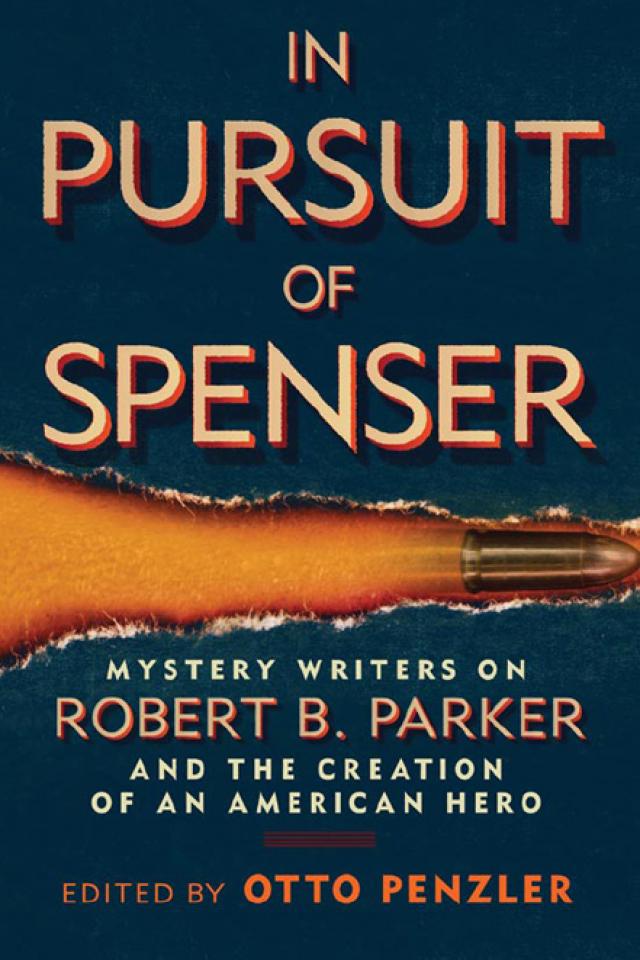
IN
PURSUIT
OF
SPENSER
“A close and revealing examination of Robert B. Parker—the author, the man, and the husband—brought to life by the observations and insights of fellow authors who knew him and his work. Extraordinary!”
—JOAN PARKER
IN
PURSUIT
OF
SPENSER
MYSTERY WRITERS ON
ROBERT B. PARKER
AND THE CREATION of an AMERICAN HERO
EDITED BY OTTO PENZLER
An Imprint of BenBella Books, Inc. | Dallas, Texas
All rights reserved. No part of this book may be used or reproduced in any manner whatsoever without written permission except in the case of brief quotations embodied in critical articles or reviews.
BenBella Books, Inc.
10300 N. Central Expressway, Suite 400
Dallas, TX 75231
www.benbellabooks.com
Send feedback to feedback@benbellabooks.com
10 9 8 7 6 5 4 3 2 1
Library of Congress Cataloging-in-Publication Data is available for this title.
978-1-936661-19-0
Copyediting by Erica Lovett
Proofreading by Cape Cod Compositors, Inc.
Cover design by Michael Fusco
Text design and composition by Neuwirth & Associates, Inc.
Printed by Berryville Graphics
Distributed by Perseus Distribution
(www.perseusdistribution.com)
To place orders through Perseus Distribution:
Tel: 800-343-4499
Fax: 800-351-5073
E-mail: orderentry@perseusbooks.com
Significant discounts for bulk sales are available. Please contact Glenn Yeffeth at glenn@benbellabooks.com or (214) 750-3628.
COPYRIGHT ACKNOWLEDGMENTS
“Songs Spenser Taught Me” © 2012 by Ace Atkins
“Voice of the City” © 2012 by Dennis Lehane
“They Like the Way it Sounds” © 2012 by Lawrence Block
“Spenser’s Code of Humor” © 2012 by Parnell Hall
“Parker and Spenser: A Collaboration” © 2012 by Loren D. Estleman
“Bob, Boston, and Me: A Remembrance” © 2012 by Jeremiah Healy
“A Man for All Seasonings” © 2012 by Brendan DuBois
“Spenser and the Art of the Family Table” © 2012 by Lyndsay Faye
“Looking for Hawk” © 2012 by Gary Phillips
“Who Is Silverman, What Is She?” © 2012 by S.J. Rozan
“A Look at Spenser for Hire” © 2012 by Max Allan Collins and Matthew Clemens
“Go East, Young Man: Robert B. Parker, Jesse Stone, and Spenser” © 2012 by Reed Farrel Coleman
“Parker Saddles Up: The Westerns of Robert B. Parker” © 2012 by Ed Gorman
“Spenser: A Profile” © 2012 by Robert B. Parker. Originally published by The Mysterious Bookshop.
“Introduction” and Other Materials © 2012 by Otto Penzler
For Joan Parker and,
in affectionate memory,
Bob
CONTENTS
Otto Penzler
INTRODUCTION
Ace Atkins
SONGS SPENSER TAUGHT ME
Dennis Lehane
VOICE OF THE CITY
Lawrence Block
THEY LIKE THE WAY IT SOUNDS
Parnell Hall
SPENSER’S CODE OF HUMOR
Loren D. Estleman
PARKER AND SPENSER: A COLLABORATION
Jeremiah Healy
BOB, BOSTON, AND ME: A REMEMBRANCE
Brendan DuBois
A MAN FOR ALL SEASONINGS
Lyndsay Faye
SPENSER AND THE ART OF THE FAMILY TABLE
Gary Phillips
LOOKING FOR HAWK
S.J. Rozan
WHO IS SILVERMAN, WHAT IS SHE?
Max Allan Collins and Matthew Clemens
A LOOK AT SPENSER: FOR HIRE
Reed Farrel Coleman
GO EAST, YOUNG MAN: ROBERT B. PARKER, JESSE STONE, AND SPENSER
Ed Gorman
PARKER SADDLES UP: THE WESTERNS OF ROBERT B. PARKER
Robert B. Parker
SPENSER: A PROFILE
A Bibliography of the Works of Robert B. Parker
Contributors
INTRODUCTION
| OTTO PENZLER |
APART FROM THEIR affection for dramatic stories with the classic Greek arc of a beginning, middle, and end, aficionados of mystery fiction agree on virtually nothing. One significant exception to that generality is in the realm of the hardboiled private detective story, where there is virtually no disagreement that the trajectory of its greatest proponents is a straight line from Dashiell Hammett to Raymond Chandler to Ross Macdonald to Robert B. Parker.
It is Carroll John Daly who actually invented the form, producing the universally acknowledged first hardboiled private eye story with “Three Gun Kelly,” which featured Terry Mack and ran in the May 15, 1923, issue of Black Mask magazine. Daly built on his historical significance by writing a Race Williams story, “Knights of the Open Palm,” for the June 1, 1923, issue of Black Mask. When he wrote a second Race Williams story, “Three Thousand to the Good,” for the July 15, 1923, issue, he had created the first series character in the history of the hardboiled dick. Just as there subsequently have been better airplanes than their Kitty Hawk contraption, it is Wilbur and Orville Wright who will always be remembered for getting there first, and this is Daly’s place—though he is less remembered today than either the Wright brothers or the infinitely superior tough-guy writer who immediately followed him, Dashiell Hammett.
While Daly was little more than a creative hack writer, Hammett elevated the private eye story to the status of serious literature. Arguments persist about whether Hammett influenced Ernest Hemingway’s work or the other way around, but publishing chronology cannot be debated, much to the disgust of those academics and critics who refuse to concede the irrefutable point that the best mystery fiction can, and should, be accepted for its significant literary contributions.
Hammett’s first story about the Continental Op, the nameless detective, or operative, who worked for the Continental Detective Agency, appeared in Black Mask on October 1, 1923. The outstanding character appeared in many further stories, as well as in Hammett’s first two novels, Red Harvest (1927) and The Dain Curse (1928). Hemingway’s first book, In Our Time, was published in Paris in a limited edition in 1924 and in the United States in 1925 with a tiny print run of 1,335 copies, by which time Hammett was already a well-established and highly popular regular contributor to the most important pulp magazine of its era (or any era, for that matter). It is possible, of course, that two profoundly brilliant writers separately turned away from the prevalent style of the time, the orotund prose of Henry James and his Victorian predecessors, to the lean, swift, straightforward dialogue and exposition that raced a narrative to its conclusion. However, just in case someone wants to open the conversation, one need only compare the dates of first publications to reach the only possible conclusion: Hammett deserves to be in the literary pantheon with the greatest of the greats.
Possibly the greatest stylist in the history of detective fiction is Raymond Chandler, whose first novel, The Big Sleep (1939), was published five years after Hammett’s fifth and final novel, The Thin Man (1934). Plot was not first among Chandler’s priorities. That first novel, marking the debut of Chandler’s PI, Philip Marlowe, has a plot so convoluted that a rather large hole went undetected by its editor and eventually confused the people making the motion picture version. Humphrey Bogart, who played Marlowe in the 1946 Warner Brothers film, asked director Howard Hawks who killed the chauffeur. Baffled, Hawks turned to the screenwriter who had written that sequence, William Faulkner, who acknowledged that he had no idea. Hawks wired the question to Chandler, who immediately wired back, “The butler did it.” There is, of course, no butler in the book or film.
It is the unmatched use of metaphor and simile in his prose, plus the nobility of his Everyman protagonist, Marlowe, that elevates Chandler’s works. An intellectual who came late to the writing life, Chandler was the first to define his detective as a savior of humanity in its battles with the forces of evil, likening him to the knights of history and legend. In his landmark essay “The Simple Art of Murder,” he described the role of the private detective:
Down these mean streets a man must go who is not himself mean, who is neither tarnished nor afraid. The detective in this kind of story must be such a man. He is the hero, he is everything. He must be a complete man and a common man, and yet an unusual man. He must be, to use a rather tarnished phrase, a man of honor . . .
Hammett would not have defined any of his private detectives in such romantic terms, but his protagonists operate on a similar principle, which is a code of honor. It would be difficult to think of his detectives as heroes because of their many flaws, whereas Parker unabashedly regards Spenser as nothing less than heroic.
Parker analyzed the private eyes of Hammett and Chandler in his doctoral thesis, defining them as the purest form of archetypical American heroes, who have three options open to them. The hero, he wrote, “may adjust his moral vision to the practices of his society. He may make a separate peace and withdraw to a place where his moral vision may be enacted. He may actively oppose those things in his society which he finds corrupt.” Parker avers that, in most American literature, the evolu
It is from this position, from this perspective, that Spenser was born. One of the most popular literary heroes of our time, Spenser is the love-child of his creator. Although Parker never used the words himself, he might well have paraphrased Ross Macdonald (another of Parker’s literary heroes), who said of his own creation, “I’m not (Lew) Archer, exactly, but Archer is me.” This is, of course, an acceptance of the reality that the detective is an idealized version of his creator, the man he would choose to be if he were a man of action rather than a solitary figure in the solitary profession of fantasizing.
For all his brilliance, both as an academic and as a creator of fiction that will endure as long as the world retains an appreciation of, and affection for, the written word, Parker was a simple man. He knew what he wanted to do with his life, which was to write detective stories. To earn a living, he taught at Northeastern University. He sought his Ph. D. and delighted in earning it because it gave him tenure and reduced his teaching load, enabling him to spend more time writing what he wanted to write.
Timeline: Doctorate, 1971. First Spenser novel, The Godwulf Manuscript, 1974. Full-time professor, 1976. Good-bye to academia and hello to full-time writing, 1979. Simple.
This clarity of thought extended to his love life. It has been written about often, but a rollicking dinner I had with the principals filled in extra details about the early meeting of Parker and Joan Hall. They were very young—generally stated as three years old, but a little leeway is called for as they were not exactly the same age—when they were at a birthday party. Joan threw her ice cream cone at Bob, who burst into tears. The sweet little girl’s response was to shout, “Crybaby!”
They lived in the same neighborhood as children and met again in college. Joan actively disliked the man who set out to win her heart, which he eventually succeeded in doing. They were married in 1956 but later separated because of fundamental differences about how they wanted to live. His desire was mainly to be left alone to write, while she was outgoing, gregarious, and social, happy to go to dinners and parties. Of their brief estrangement, Bob said, “I learned that I could live without Joan, but I didn’t want to.” They soon remarried but chose an unusual living arrangement in which she lived on one floor of the house and he on another. Totally devoted to each other (Parker dedicated virtually every one of his books to Joan), their happy marriage lasted until his death on January 18, 2010. He found the woman of his dreams and devoted the rest of his life to her. Simple.
Parker’s approach to writing was little different from his approach to the other aspects of his life. Once he was established as successful writer, he went to work most days and wrote. He got his style and rhythm down cold and remained consistent, with few books soaring above the others and few failing to match his usual level of excellence. Because Parker was occasionally criticized for producing slim plots, his publisher pressed him to write a bigger book, a longer one, as a way of getting him onto the bestseller list. He wrote A Catskill Eagle, which had many more pages and a lot more dead bodies, but seldom appears on lists of readers’ favorite Spenser novels. He never did it again. “This is what I write,” he said. “If you like it, you like it; if you don’t, you don’t. This is all I know how to do.” Simple.
Okay, maybe not exactly. While he enjoyed writing his books about Spenser, the Boston private detective on which Parker’s reputation will endure, he also tried several other types of books. First there was a straight adventure novel, Wilderness (1979), then a pure romance, Love and Glory (1983), his completion of a Philip Marlowe novel left uncompleted at the time of Chandler’s death, Poodle Springs (1989), followed by another Marlowe novel, Perchance to Dream (1991), and a sprawling, multi-generational novel about Boston cops, All Our Yesterdays (1994), which was his own favorite novel, an opinion shared by few. In 1997, with Night Passage, he created his second series character, Jesse Stone, a former member of the Los Angeles Police Department with a rocky past who moves east to become the police chief of a small New England town. It was not exactly a breathtaking surprise to find that Stone’s voice had the ring of familiarity, that his short, straightforward dialogue bore a strong resemblance to Spenser’s.
And Stone is not the only one of Parker’s characters who sounds like Spenser. Even Sunny Randall does, which is no bad thing. Her integrity and sense of honor are chiseled from the same block of marble as Spenser’s, so it is unreasonable to think that her responses to situations and people would be markedly different, and those responses are framed in language that evokes those sensibilities. Unlike Spenser, Sunny can’t cook, but that is not the point.
After she won an Oscar for As Good As It Gets, the actress Helen Hunt requested Parker to create a protagonist that she could play and, as soon as he learned that she wanted a novel, not a screenplay, he agreed, producing Family Honor for her in 1999. Sony immediately bought the rights for Hunt, who loved the book and the character. Sunny Randall had been planned as a series, because Hunt had hoped to play a single character over many years as both she and the heroine matured, but eventually the deal fell apart. Too bad, as Hunt, an actress much admired by Parker, would have had the role of a lifetime: a Boston private eye who likes to paint (as Hunt does), has a difficult relationship with a former husband with whom she is still in love, and is described by her sidekick Spike, a gay waiter and karate expert, as a “shooter, shrink, painter, and sex symbol.” Even though the motion picture never came to pass, both readers and Parker’s publisher liked the character so much that he continued the series anyway, producing an additional five novels.
Dickens had pretty much the same voice, whether writing about David Copperfield or Oliver Twist, and there was little to differentiate the dialogue of Athos, Porthos, Aramis, and D’Artagnan. Hammett’s Sam Spade and the Continental Op could have switched roles with little discernable difference. Chandler’s short stories and novellas featured a variety of private eyes, all of whom morphed into Marlowe when the short works were cannibalized for use in his novels without the need to alter their language.
Parker’s voice, too, remains recognizable and consistent, whether in the Spenser opera, cases involving an official officer of the law, tales about a female private eye, or the adventures of characters in the West from a different era (Virgil Cole and Everett Hitch, introduced in Appaloosa in 2005). It is the sound of Parker’s heroes that make them endure, but it is who they are that made them so loved in the first place. They can be counted on. When John Wayne rode into town, things were going to be fine. Superman wasn’t ambivalent about what to do with violent criminals. The Lone Ranger didn’t warn bandits that anything they said would be used against them in a court of law.
Spenser understands that justice doesn’t always coincide with the law. The world truly is, in fact, black and white; if you study a situation carefully enough you will find the line of demarcation and know what is right and what is wrong. For Spenser, that line is a chasm, and he chooses, from the beginning, to be on the right side. God help you if you choose the wrong side.
That is what a moral divide is about.
That is what a hero values.
That is why Spenser is one of the great heroes of our time.
• •
This festschrift assembles essays by many of today’s foremost authors of mystery fiction, mainly writers of private eye stories. It is a tribute to Robert B. Parker that so many have been influenced by his work and have no difficulty in acknowledging their debt to him. Each writes here of a specific element of the Parker world: the books themselves, his personal life, and the philosophical principles that guided both.
Chosen to continue the Spenser series, Ace Atkins provides a thoughtful essay about how Parker and, inevitably, Spenser, helped form his notion of what it is to be a man, especially the right kind of man.


