

Evenings and Weekends, page 1


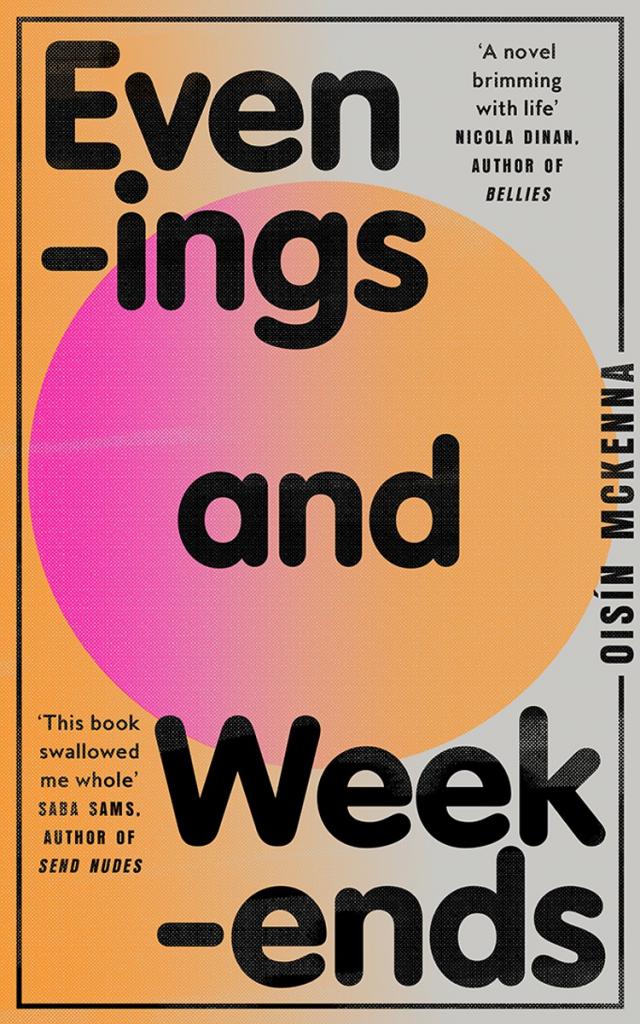
EVENINGS AND WEEKENDS
Oisín McKenna
Copyright
4th Estate
An imprint of HarperCollinsPublishers
1 London Bridge Street
London SE1 9GF
www.4thEstate.co.uk
HarperCollinsPublishers
Macken House
39/40 Mayor Street Upper
Dublin 1
D01 C9W8
Ireland
This eBook first published in Great Britain by 4th Estate in 2024
Copyright © Oisín McKenna 2024
Cover design by Jo Thomson
Oisín McKenna asserts the moral right to be identified as the author of this work
A catalogue record for this book is available from the British Library
Epigraph extract from ‘Peanut Butter’ in I Must Be Living Twice/New & Selected Poems by Eileen Myles. Copyright © 2015 by Eileen Myles. Courtesy of HarperCollins Publishers.
All rights reserved under International and Pan-American Copyright Conventions. By payment of the required fees, you have been granted the non-exclusive, non-transferable right to access and read the text of this e-book on-screen. No part of this text may be reproduced, transmitted, down-loaded, decompiled, reverse engineered, or stored in or introduced into any information storage and retrieval system, in any form or by any means, whether electronic or mechanical, now known or hereinafter invented, without the express written permission of HarperCollins
Source ISBN: 9780008604172
Ebook Edition © May 2024 ISBN: 9780008604196
Version: 2024-04-12
Dedication
For my mam, Fiona, and dad, Ricky.
Epigraph
‘summer as a
time to do
nothing and make
no money.’
‘Peanut Butter’ – Eileen Myles (1991)
Contents
Cover
Title Page
Copyright
Dedication
Epigraph
2019
Chapter 1
Chapter 2
Chapter 3
Chapter 4
Chapter 5
Chapter 6
Chapter 7
Chapter 8
Chapter 9
Chapter 10
Chapter 11
Chapter 12
Chapter 13
Chapter 14
Chapter 15
Chapter 16
Chapter 17
Chapter 18
Chapter 19
Acknowledgements
About the Author
About the Publisher
2019
1
A WHALE GETS STUCK IN THE THAMES. IT’S A RARE whale, a big whale, a northern bottlenose whale to be precise. Five metres in length, twelve tonnes of shuddering blubber and bone; thrashing, frantic, wildly distressed, its body half-beached next to shopping trolleys and syringes on Bermondsey Beach. By Friday, it becomes a sensation. People on Twitter give it a name. They photoshop its image over screenshots from The Simpsons, The Lord of the Rings, and Harry Potter, at first a hilarious meme, then an annoying fad once brands begin using it to sell their products on Instagram. It’s suddenly important to have an opinion. Callers to daytime talk shows wish the whale well and suggest schemes for rescuing it. Crowdfunds are set up, bake sales planned, and thousands of pounds are raised within hours, though some argue that certain causes – food banks, police bail funds, refugees crossing the Mediterranean, injured British army veterans, people in need of gender-affirming care, and generally, Syria – are more deserving of your money. Battle lines are drawn, arguments lost and won. Blame is attributed to some combination of carbon emissions, single-use plastics, the European Union, English nationalism, eco-fascism, the volume of fossil fuel required to keep the internet turned on, and anyone who still buys cheap clothes from high street shops. The exact ratio of factors is yet to be agreed, but one thing is certain: the whale is bad news. It points its finger in accusation. No one is innocent in the whale’s unblinking eyes. You, declares the whale, are morally, spiritually and ecologically bankrupt. The whale is alive, but only just about.
It’s a tense summer. It’s June. Dehydrated office workers spew from Tube stations with frayed nerves and anxiety. On every beautiful day, people feel compelled to look out their window and say, ‘It’s very worrying, isn’t it?’ as if it were tasteless to comment on the warm sun and blue sky without remarking on the mass extinction of humans and whales within the same breath. The air is warm and damp. No bedsheet is un-drenched, and everything, everywhere is sticky with sweat. The hours of each day are rationed between unbearable heat and biblical rain, and even though it has only been this way for three weeks, it is impossible to imagine that things have ever been any other way. People move slowly, if they move at all, and no one has thought a coherent thought all month.
. . .
ED SEYMOUR, A COURIER, IS DELIVERING A BOX OF pastries to an office in Canary Wharf, dripping with sweat and chirpier than he’s been in weeks. He’s cycling along the riverbank – not the fastest route, but so calming to watch the river glisten – when he spots the whale on the opposite bank. He steadies himself and rubs his eyes like a crazed cartoon character. Ed Seymour, a good man, a normal man, a man with a pregnant girlfriend, is certain that he’s hallucinating. He thinks the whale is the latest in a long line of imaginary creatures he’s encountered recently, sometimes friendly, sometimes threatening, but, crucially, never real.
It is not the first time that Ed has hallucinated this year. It is not the second, third or fourth time either. Nine weeks ago, Ed learned that his girlfriend Maggie was pregnant, and his life would change forever. While this change was not necessarily unwelcome, it was certainly unplanned, and shocking enough for Ed to call his friend Callum, a small-time drug dealer, and ask if they could meet at the pub. Callum, on learning the news, consoled Ed in the only way he knew how: he passed a tab of acid under the table. Ed didn’t want to get high, exhausted by the news of the pregnancy and the fact that his friend only knew how to express love through the sharing of drugs, but seeing that Callum was trying to express love all the same, and at thirty years old still keen to be seen as one of the boys, he wearily complied, at heart a people pleaser. Ed placed the tab beneath his tongue and twenty minutes later the walls turned pink and fleshy. They expanded and contracted like the walls of a lung, and Ed became spindly like a frail little bronchiole.
Now, he grips his handlebars, struggles to breathe, and wonders if he’s going to die. He’s had this thought more than once since January, when his dad, a labourer, passed away at fifty years old and Ed became aware that a life could end. Ed had always known about death in a theoretical sense, but now that he had encountered death in the flesh – his dad’s seizure, the chill of his hands – it was no longer abstract or hypothetical. It was real, wrenching, unacceptably painful, so painful that it should quite literally be impossible. Death could happen to anyone at any time, even people like Ed’s dad, big people, solid people, people with the weather-beaten resilience of a surviving Stone Age monument. Even those people die. Even Ed will die. So when he glares at the whale and his heart beats from his chest to his ears, he thinks: this is it. The end. I’ll never meet my baby.
He takes out his phone and almost calls Maggie, primed to say his last goodbye, but remembering she’s at work, and also, is pregnant, feels the news of his upcoming death would be both inconvenient and distressing. He managed to carefully conceal the acid trip from her – not the first secret he’s kept over the years – even though there’s no one who could have calmed him down from those panic attacks like Maggie could have done (taking him somewhere quiet, holding him, prompting him to breathe to the same rhythm that she does).
She was amazing at the funeral. She made sure everyone knew where the toilets were, and that there was coffee (normal and decaf) and which sandwiches had no butter and which had no mayo, and sometimes she told little jokes to break the tension. She could always tell when things were getting too much, and then she would put her hand around his hand, and squeeze it, and stroke it with her thumb, and she would quietly say: I love you so much.
That night at home, she cradled his head and kissed his hair, and he felt tiny as a baby.
Anyway, he calls emergency services instead, and when they answer he instantly blurts out a stream of unintelligible gibberish. He tells them his heart is racing and he thinks he’s dying and there’s a whale half-beached on the banks of the Thames but the whale does not actually exist.
‘Calm down, sir. I’m going to need you to start again.’
He tries to breathe like Maggie would have told him to.
‘I think I’m hallucinating. I’ve seen a whale on the banks of the Thames.’
The voice on the other end laughs.
‘You’re not hallucinating, sir. The whale is real.’
‘It’s real?’
‘It’s been on the news. The whale is real.’
Ed is mortified and relieved. He apologises, hangs up, and after taking a few breaths to calm down, takes a picture of the whale to send to Maggie. He says that he loves her and he can’t wait to see her later. He wishes her luck for her last day at work.
Then, he remembers that he is meant to be delivering pastries to a professional networking event, and partially on account of the scenic route, partially on account of the time lost to the whale, is now half an hour late. When he arrives, the professi
. . .
MAGGIE DOESN’T NOTICE THE MESSAGE FROM ED UNTIL later the same day. She’s on her break, her last one ever, in the kitchen of the Greenwich café where she’s worked as a waitress for the past eight years. It’s 4 p.m. In an hour, she’ll clock off for the final time. She notices Ed’s text, ignores it, and holds her phone up to Renée so that they can watch a news clip together.
Renée squints at the video and slowly shakes her head.
‘No. No. I just don’t see it, babe.’
Maggie laughs, incredulous, and says, ‘But they’re literally identical!’
‘I honestly don’t know what you’re talking about.’
They’re watching a marine biologist, Valerie, give an interview to the news.
Valerie has been tasked with the return of the whale to the sea. She explains to the reporter what the rescue operation will entail. She is confident and clear.
But here’s the important thing about Valerie: she looks exactly like Princess Diana. Or perhaps: somewhat. The precise likeness is contested, but suffice to say, someone posted a clip of the interview to Twitter, and within the hour: a new discourse.
Hundreds, then thousands, posted their take. They’re nothing short of identical. They’re literal opposites. The marine biologist does not, in fact, look like Princess Diana, and instead, looks like Lady Gaga, or Marine Le Pen, or, most bizarrely, Saint Hildegard of Bingen. A new subgenre of conspiracy theory emerges: Diana never died. She has been living the humble life of a marine biologist this entire time. First claimed ironically, then sincerely, then an impossible-to-interpret blend of the two. It’s not just that she looks like Princess Diana, say the theorists: she speaks like her too. She says, ‘Well, the Thames isn’t very deep for a whale of this size’, with the exact same intonation that Princess Diana said ‘Well, there were three of us in this marriage’ in her famous 1993 interview with the journalist Martin Bashir. All over London, people re-watch the interview and are struck by Diana’s magnetism. A gay icon, they say, a fashion icon, an icon of the twentieth century, Diana, Princess of Wales, we love you. Then: the pun, held back at first, but it can’t be helped: Diana, Princess of Whales, posted by dozens, hundreds, thousands within the hour, each claiming to have been the phrase’s true creator, and proclaiming all instances in which it is uttered uncredited to be flagrant violations of intellectual property. Then: the perfunctory debate on the digital commons – everyone has been here before, the old points rehashed – and Maggie wonders: does she truly believe that Diana, Princess of Wales and Diana, Princess of Whales are all that alike? But then, this is beside the point. The point is that it’s funny to say that she does.
How to explain all this to Renée?
Maggie puts her phone away and Renée returns to the chopping board. Hands deep purple with beetroot, she tells a story of her six-year-old son.
‘Jackson wants to be a marine biologist now. Can you imagine? I don’t have a clue where he gets it from. I know the sea is interesting, but he’s barely ever seen it.’ She chops rapidly while she chats, and Maggie remembers a joke from the internet about how the ocean is queer (expansive, unknowable, subversive). She starts to tell the joke to Renée, but doubts herself; they are of different generations, different cultural touchstones. She remarks simply, ‘The sea is gay, you know.’
Renée stares. Maggie is mortified. Renée is a serious woman, mother of Jackson, future marine biologist. Maggie is a woman who says things like ‘The sea is gay, you know.’
Renée laughs, perplexed. ‘What are you talking about – the sea is gay?’
‘Lots of gay kids like the sea.’
Renée sighs, ignores her, and rinses the beetroot from her hands. She says, ‘It won’t be long now until you’ve got a little marine biologist of your own. How are you feeling?’
Maggie breathes in. ‘I feel great,’ she says.
She pauses for a moment, lets her smile linger.
She goes on, ‘Like, I’m scared too, obviously. But no morning sickness, so that’s been a relief. And we’re all set for the big move. Just wish I didn’t have to leave you lot!’
‘Oh you won’t miss this place. You’ll miss London though.’
‘It’s only half an hour on the train. Basically a London suburb.’
Renée smiles encouragingly and says nothing more.
It’s almost twelve weeks to the day that Maggie and Ed had sex for the first time in months. A surprise even to themselves. They had returned home from a day in Brighton, a little drunk on beer and sun, a little more daring than normal. The city throbbed, unseasonably hot, its skin was flushed. Maggie throbbed too. His breath in her ear. The tips of their noses touching. A little sore at first, then, the imperceptible shift from gentle, go slow to fuck, that feels good, both wanting deeper, longer, more. They both came at once. He flopped on top of her, then onto the mattress, and his dick flopped onto his thigh too, sloppy with semen smeared down its side. It was cute. She smiled at it, and he smiled at her smiling.
Then: the missed period.
Then: the peeing on a stick.
Then: confirmation from the doctor. Undeniable. She was pregnant.
There were other events too. There was a mother on the street, and for the first time thinking: Could that be me? There were conversations with Renée, one of the first people Maggie told of her pregnancy, desperate for someone older and kinder to tell her what to do.
Subtle at first, barely noticeable, but by the time the doctor confirmed it, she had decided: it was fantastic, miraculous, the best thing that could have happened to her.
She was thirty years old: would this be her only chance?
And Ed? Ed will be an excellent dad. He does impersonations of cartoon characters. The baby will love his Homer Simpson, and the way he sings absent-mindedly in the style of Frank Sinatra. Sure, they will become a teenager and be embarrassed by the Frank Sinatra crooning – You’re such a loser, Dad – but Maggie will say in response, Don’t be so hard on your poor dad, he works very hard for you, which will be true, because Ed will work hard, does work hard, and he wakes up early on birthdays and Sundays and sometimes even Tuesdays to cook her favourite breakfast. That’s the life in store for you, little baby! Special breakfast from your dad on an otherwise uneventful Tuesday, and when you grow beyond your teenage years, you’ll look back on his embarrassing singing with absolute affection.
Of course, the money. The slow slog towards the back wall of their overdraft. Even at their most frugal – no holidays, no takeaways, no new clothes – they can’t afford their life in London, and that’s without a baby. How much did nappies cost? And food and cleaning products and childcare? They would make it work, they said. They would move further out. Leyton, Romford, Dagenham. A baby couldn’t have survived their flat in Hackney in any case. Ed can barely survive it himself. The damp in their bedroom has affected his breathing, his work, their sex life. The carpet has rotted through, and Ed’s breathlessness has become chronic.
So they improvised. They were grasping for anything to hand. It felt as if they had been put on the spot and ordered to agree the course of their life within seconds. Basildon! they blurted out under pressure, faces grimaced, shoulders hunched into a shrug as if to say: will this do? Is this the right answer? Baby! they went on, then the more uncertain … baby? and finally, looking at each other, nodding seriously: baby, they confirmed. Full stop.
She’ll get a job at the restaurant where her cousin works, Ed will work at one of the distribution centres in Tilbury.
‘I’ve never been to Basildon,’ calls Renée now, hauling boxes from the freezer.
‘It’s nice. Got a shopping centre. Leisure centre. Not too far from the sea. The rent is literally five times cheaper and the house is three times the size. We’ll be close to my mum, and Ed’s mum, so we’ll save a fortune on childcare, and Ed’s a homebird at heart anyway.’


