

The Throne of Saturn, page 1


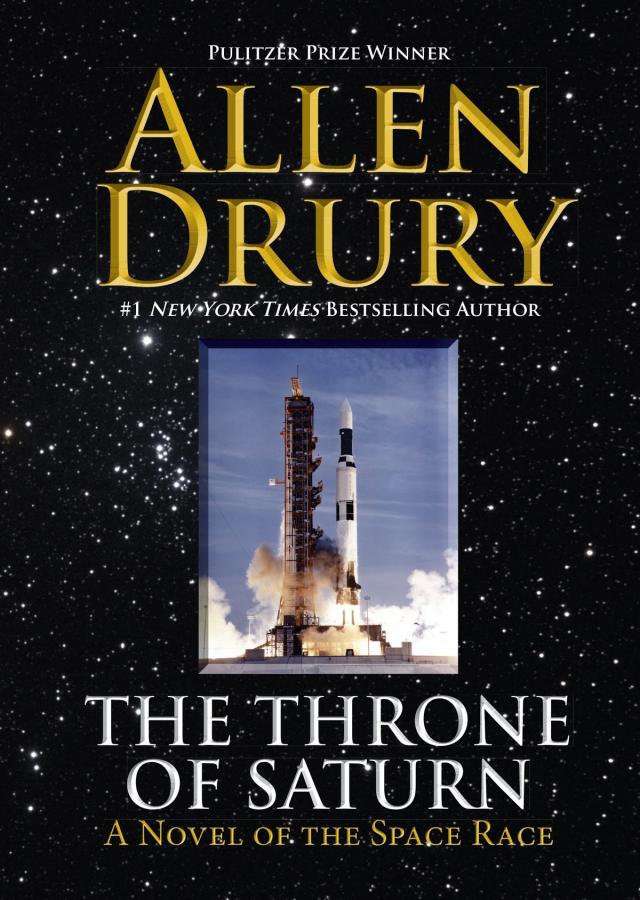
Book Description
An epic of the first manned mission to Mars, created by political mastermind Allen Drury, Pulitzer Prize-winning author of Advise and Consent.
After showing us the deep inner workings of Washington politics, Allen Drury turns his keen, dissecting eye on a complex space mission—the drama, the suspense, and the politics of America’s race to put the first human on the planet Mars.
Mission Commander Conrad Trasker faces countless problems and challenges—a maverick veteran astronaut who demands a place on the crew; a moody, crusading doctor, whose refusal to cooperate jeopardizes the lives of his crewmates; a union leader who tries to sabotage the flight for sinister political purposes; and a constant barrage of criticism from ambitious politicians and the nation’s media.
Against this background, Trasker and Planetary Fleet One plunge toward their rendezvous deep in interplanetary space … and a crisis that threatens not only the lives of the crew, but the entire future of American leadership in space.
The Throne of Saturn
A Novel of Space and Politics
Allen Drury
Foreword by
Doug Beason, PhD
The Throne of Saturn
Copyright © 2021 Allen Drury
Originally published by Doubleday & Company, Inc., 1970, 1971
All rights reserved. No part of this book may be reproduced or transmitted in any form or by any electronic or mechanical means, including photocopying, recording or by any information storage and retrieval system, without the express written permission of the copyright holder, except where permitted by law. This novel is a work of fiction. Names, characters, places and incidents are either the product of the author’s imagination, or, if real, used fictitiously.
The ebook edition of this book is licensed for your personal enjoyment only. The ebook may not be re-sold or given away to other people. If you would like to share the ebook edition with another person, please purchase an additional copy for each recipient. Thank you for respecting the hard work of this author.
WordFire Press has chosen to reissue selected out-of-print novels, in hopes of creating a new readership. Because these works were written in a different time, some attitudes and phrasing may seem outdated to a modern audience. After careful consideration, rather than revising the author’s work, we have chosen to preserve the original wording and intent.
* * *
EBook ISBN: 978-1-68057-181-3
Trade Paperback ISBN: 978-1-68057-180-6
* * *
Cover design by Janet McDonald
Cover artwork images by Adobe Stock
Kevin J. Anderson, Art Director
Published by
WordFire Press, LLC
PO Box 1840
Monument CO 80132
Kevin J. Anderson & Rebecca Moesta, Publishers
WordFire Press eBook Edition 2021
WordFire Press Trade Paperback Edition 2021
WordFire Press Hardcover Edition 2021
Printed in the USA
* * *
Join our WordFire Press Readers Group for
sneak previews, updates, new projects, and giveaways.
Sign up at wordfirepress.com
Contents
Major Characters in the Novel
Foreword
With Thanks
Book One
Chapter 1
Chapter 2
Chapter 3
Chapter 4
Chapter 5
Chapter 6
Chapter 7
Chapter 8
Chapter 9
Chapter 10
Chapter 11
Chapter 12
Chapter 13
Book Two
Chapter 14
Chapter 15
Chapter 16
Chapter 17
Chapter 18
Chapter 19
Chapter 20
Chapter 21
Book Three
Chapter 22
Book Four
Chapter 23
Chapter 24
Chapter 25
Chapter 26
Chapter 27
Chapter 28
Book Five
Chapter 29
Chapter 30
Chapter 31
Chapter 32
Book Six
Chapter 33
Chapter 34
Chapter 35
Chapter 36
Chapter 37
Chapter 38
Chapter 39
Chapter 40
About the Author
If You Liked …
Other WordFire Press Titles by Allen Drury
Dedicated To
the US Astronauts
and those who help them fly
* * *
Up from Earth’s Centre through the Seventh Gate
I rose, and on the Throne of Saturn sate,
And many Knots unravel’d by the Road;
But not the Knot of Human Death and Fate.
—The Rubaiyat of Omar Khayyám
Major Characters in the Novel
At Manned Spacecraft Center, Houston:
Dr. James Cavanaugh, Director of MSC (“Jim”)
Dr. Robert Hertz, Director of Flight Control (“Bob”)
Colonel Henry C. Barstow, Chief, Astronaut Office (“Hank”)
Colonel Bertrand L. Richmond, Director, Flight Crew Operations (“Bert”)
Colonel Conrad H. Trasker, Jr. (“Connie”), astronaut
Jane, his wife
Commander Alvin S. Weickert III (“Jazz”), astronaut
Clare, his wife
Dr. J.V. Halleck (“Jayvee”), astroscientist
Monetta, his wife
Dr. Petros S. Balkis (“Pete”), astroscientist
Colonel Hugo S. Gaudet (“Gaudy”), astronaut
Lieutenant Colonel Stuart Yule (“Stu”), astronaut
Yo-Shin, his wife
Dr. Emerson Wacker (“Em”), astroscientist
Other astronauts, astroscientists, and their wives
The medical staff
Members of the media
In Washington, D.C.:
The President
The Vice President
Dr. William Anderson (“Andy”), Administrator, National Aeronautics and Space Administration
Senator John Able Winthrop of Massachusetts, chairman of the Senate Aeronautical and Space Sciences Committee
Representative James L. Satterthwaite of Wyoming, chairman of the House Science and Astronautics Committee
Senator Kennicut Williams of Indiana (“Kenny”), a member of the Senate committee
Representative Cullee Hamilton of California, a member of the House committee
Percy Mercy, editor of the magazine View (“P.C.M.”)
Academician Alexei S. Kuselevsky, principal space adviser to the Soviet Government
Marlon Holloway, assistant administrator for public affairs, NASA
Members of the media
At Kennedy Space Center, Cape Kennedy, Florida:
Dr. Albrecht Freer, Director of KSC (“Al”)
Bob Ellison, chief of public affairs
Clete O’Donnell, a union leader
Members of the media
At George C. Marshall Space Flight Center, Huntsville, Alabama:
Dr. Hans Sturmer, Director
In Pasadena, California:
Dr. Vernon Hertz, Director of the Jet Propulsion Laboratory
At North American Rockwell, Downey, California:
Jim Matthison, manager
On the Moon:
The crew of Man in the Moon
Foreword
by Dr. Doug Beason, PhD
Allen Drury won the Pulitzer Prize for his landmark novel Advise and Consent, masterfully using his close, unfettered access to Presidents Franklin Roosevelt and Harry Truman to weave a fascinating and realistic narrative of politics at the highest level—a true highlight of twentieth century literature. The Throne of Saturn accomplishes this and much more, by bringing to life the excitement of the American space program, through multiple characters that only the best-informed observer could provide.
I was fortunate to have worked on the White House staff under both Presidents Bush and Clinton, as well as interact with NASA at the highest level on a Moon-Mars planning mission. In doing so, I witnessed not only backroom politics, but as a PhD physicist I contributed to the technology needed for a flight to Mars. As such, I can attest that in The Throne of Saturn, Allen Drury produced an incredibly realistic scenario, ranging from political infighting to highlighting technology that is still current by today’s standards, including liquid-oxygen thrusters and nuclear rockets.
Published in 1971, The Throne of Saturn is set after the last human mission to the Moon. It is a product of the post-Vietnam war era, reflecting the then-prevailing national mood driven by disruptive events. Since the manned Apollo program was bookended by the Martin Luther King riots in 1968 and the Watergate scandal in 1972, the novel reflects good-old-boy politics and a news media that was evolving from dispassionately reporting the news to advocating their own opinions.
Drury predicted the end of America’s manned lunar missions—and the loss of NASA’s focus—without a Mars mission. Sadly, his vision was borne out. Over fifty years later the US is still only venturing a few hundred miles above the surface of the planet: first to Skylab—a bare bones, low-orbiting space station—then to low-Earth orbit with the space shuttle, and today to t
However, Drury worked closely with space experts to mold a visionary future that might have happened, juxtaposed against a canvas of political turmoil. Those not intimately familiar with presidential politics may dismiss Drury’s portrayal of multi-level scheming and power plays by politicians, celebrities, and the media as simplistic, and people on both ends of the political spectrum may refuse to believe that it even happens. But the reality is that in the 1970s not everyone championed the space program, even with the historic accomplishments made just a few short years before. We’ve seen this throughout the years, with passionate fights for the priority of scarce dollars: could poverty be wiped out if only additional money is taken from a pie-in-the-sky space program?
On social issues, Drury would have been considered a progressive in his time, and without trumpeting his views he touched on themes that could be ripped from the headlines of today: racism, adultery, interracial affairs, gender confusion, homosexuality … The topics are presented in a plausible, realistic fashion—sometimes so subtly that the reader may go back and ponder what was written; and then blink as the implications hit them. The issues are not presented in eyebrow-raising fashion but evolve as actual concerns that may arise building up to and existing during an extended, multi-year mission with a single-sex crew living in ultra-close quarters.
Some readers may not be able to place themselves in that era’s milieu, and because the situations do not echo their own world experience, may think Drury leans too much toward one political direction or another. And make no mistake about it—there are extremes presented in the book. But Drury masterfully balances the political poles by using the U.S. president as a foil, having him make hard, unpopular short-term decisions for the long-term good of the whole.
For example, in an idealistic world, the only criteria for selecting astronauts would be based on how well the person does the job, how they react under pressure, and how they fit in with the crew. This criterion has a stellar success rate and has been used for missions ranging from lunar flights to nuclear submarines.
But in a world that needs the support of the entire public—a reality where even a whiff of racism could kill the entire program—Drury realized the selection criteria must be widened. This is best illustrated in a real-world example when in 1977, Army Secretary Clifford Alexander was given a list of all-White colonels for promotion to Brigadier General. Against the advice of his staff, Alexander asked for the records of eligible Black colonels … and Colin Powell, who subsequently rose to four-star general and later secretary of state, was at the top of that list.
Comparing the novel to more recent works may invoke a reaction of “why weren’t there any women on the crew, especially since such a long-term duration mission needs a balance of the sexes?” Quite simply, in the 1960s and early 1970s there were very few female pilots and no female US astronauts. The novel was not written as a guide path for gender equality, but rather as a realistic, most-likely scenario if a manned mission to Mars was mounted at that time. And that meant having an all-male crew. The result is that the stress on the astronauts, their families, the nation, and the various government agencies are well thought-out and presented in linear fashion, complete with detailing the necessary technology improvements needed to accomplish a successful mission.
Most books, and even factual texts tackling a mission to another planet, frequently gloss over the difficulties and human element present in a real-world project. The Throne of Saturn does not shy away from frankly dissecting the pros and cons of the most complex human-technology endeavor ever undertaken.
Nothing in life is easy, and Drury presents this massive undertaking with a detailed, impassionate view. So, enjoy this novel and know that the characters and the complexities of mounting a human mission to Mars are accurately and realistically portrayed.
* * *
A retired USAF Colonel, Dr. Beason has written 16 novels, 2 non-fiction books, and over 100 articles and short stories. A Nebula Award finalist and a Fellow of the American Physical Society, he was the Associate Laboratory Director of the Los Alamos National Laboratory and served as Chief Scientist of USAF Space Command.
With Thanks
Many are responsible for the facts and insights they gave me during the six months I researched this novel.
Most became, and I hope will remain after they read it, good friends.
None, of course, is responsible in any way whatsoever for what I did with the raw material about men and machines which they so generously provided.
Editorial space precludes listing them all. One group in particular, wrapped in its mantle of discretion and anonymity, I would not dream of naming. Suffice it to say that I am very grateful to those astronauts who talked freely—and told me a great deal. And I am equally grateful to those astronauts who were too cautious to talk freely … and told me a great deal.
For the rest it comes down to many, many kind people in Washington, Houston, the Cape, Huntsville. I should be remiss indeed if I did not mention three above all. The first is the most astute and amiable Dr. George E. Mueller, then associate administrator for manned space flight, NASA, who was unceasingly helpful throughout, and who first passed the signal along the supersensitive NASA network that I really wasn’t about to blow up the pads, and so people could probably relax and talk to me if they wanted to.
The second is the quietly knowledgeable and highly competent Gordon L. Harris, chief of public affairs, Kennedy Space Center, who helped immeasurably with technical information, insights into the program and details of Apollo missions which formed the basis for much of the verisimilitude surrounding the flight of Planetary Fleet One.
And the third is the delightful and supremely able Christopher C. Kraft, then director of flight control, now deputy director of the Manned Spacecraft Center, Houston, who patiently answered my technical questions, wrote me a genuine NASA-type technical description or two for use in the novel, and generally confirmed the logical parameters within which a novelist’s mind might roam. I hope he will not be too upset that I decided to stick to my planned three-Saturn launch (and advance the timetable substantially, for reasons hereinafter made clear) instead of the four or five he contemplates, for the first flight to Mars.
And of course, there are others, both inside NASA and out—Dr. Thomas Paine, then the Administrator of NASA; James E. Webb, the ex-administrator; Dr. Wernher von Braun; Julian Scheer, administrator for public affairs in Washington; Dr. Robert Gilruth, director of MSC; Richard Johnson, his assistant; Dr. Kurt Debus, director of KSC; Jack King, chief press officer, KSC, and his most helpful staff to whom everyone covering the Cape is indebted; Bart Slattery, chief press officer, Marshall Space Flight Center; Alvin H. Bishop, Jr., then of RCA at Cocoa Beach, now with the executive staff, Hughes Nevada Operations, who very kindly and generously shared his many friendships in the astronaut corps; William Eichstadt, who assisted in research and then did a yeoman job of deciphering and typing a complex and much scribbled-upon manuscript; many friends in the working—as distinct from the pontificating—press at the Cape, such as Mary Bubb of Fairchild Publications; Julie Divine, formerly of Fairchild; and many, many others who, during some ten years in which I have attended launches at the Cape, and then during the final six months of intensive research, did much to give me the facts and feel of the program.


