

I’ll Burn That Bridge When I Get to It!, page 1


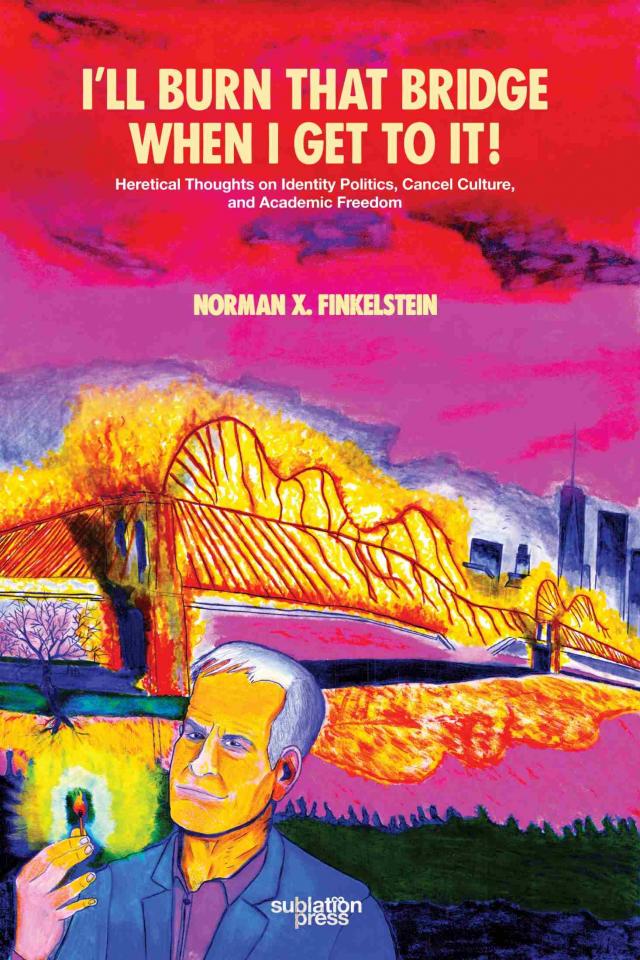
I’ll Burn That Bridge When I Get to It!
First Published by Sublation Media 2023
Copyright © 2023 Norman Finkelstein
All Rights Reserved
Commissioned and Edited by Douglas Lain
Copy Editor Konrad Jandavs
A Sublation Press Book
Published by Sublation Media LLC
Distributed by Itasca Books
www.sublationmedia.com
Print ISBN: 979-8-9867884-2-5
eBook ISBN: 979-8-9867884-3-2
Printed in the United States of America
To
Rudolph Baldeo
Nate Gauthier
Talal Hangari
Deborah Maccoby (general editor)
Jamie Stern-Weiner
Jonas Vognsen
My partners in crime
I feel a real and solid pleasure when anybody points out a fallacy in any of my views, because I care much less about my opinions than about their being true.
—Bertrand Russell
Contents
Foreword
PART I: IDENTITY POLITICS AND CANCEL CULTURE
1. Confessions of a Crusty, Crotchety, Cantankerous,Contrarian, Communist Casualty of Cancel Culture
2. Kimberlé Crenshaw Goes on a Safari
3. Ta-Nehisi Coates Demands Reparations, Sort Of
4. Robin DiAngelo Kicks Karen’s Butt
5. Ibram X. Kendi’s Woke Guide to
6. Barack Obama’s “Neat Trick”
Conclusion to Part I
PART II: Academic Freedom
Prefatory Note
7. Who’s Afraid of Holocaust Denial?
8. Do Pervs and Pinkos, Ravers
Conclusion to Part II
Acknowledgments
Index
Foreword
The subject of this book is the current political moment in which identity politics, cancel culture, and academic freedom loom so large. The book itself originated in “A Letter on Justice and Open Debate” that Harper’s published in 2020. The letter, signed by prominent public intellectuals across the political spectrum, decried the excesses of cancel culture. In the ensuing controversy, my name cropped up, not, however, as a victim of cancel culture but, it was said, of corporate culture. My publisher at the time proposed that I join the debate with a short book. He anticipated, it seems, that I would decry the hypocrisy of the decriers of cancel culture, many of whom, it might fairly be supposed, reacted with indifference (if not glee) to my own cancellation. Hypocrisy was rife, for sure. But the irrefragable fact remains that “woke” politics are intellectually vacuous and politically pernicious. I endeavor to demonstrate this in Part I by parsing the ur-texts of “woke” politics, and then by dispelling the dense mist that shrouds that ultimate “woke” product: the Obama cult. In Part II, I critically assess what’s become an article of faith in “woke” culture: that in the classroom a professor should teach only his own and not contending viewpoints on a controverted question; that he shouldn’t strive for “balance.” The last chapter of the book situates my own cancellation in broader perspective. It would be miraculous were my ego so invincible that I didn’t occasionally wonder whether my alleged incivility was valid grounds for denying me tenure and ultimately banishing me from academia. I therefore decided to probe, with the maximum judiciousness humanly possible, this question. If this book is laced with vitriol, that’s because so much of “woke” culture deserves contempt. If nonetheless a large amount of space is devoted to dissecting this nonsense, that’s because it’s not immediately obvious why it’s nonsense. Where, on the contrary, a historical or contemporary figure is deserving of reverence, it is duly recorded, and where an argument contains genuine content, it is treated with the measure of seriousness it warrants. On a separate matter, to maintain the smooth flow of the text, I have loaded into the footnotes supplemental documentation as well as material of less interest to a general reader. Finally, a “trigger warning”: professional advance comment on this book has in the main been savage. A Henry Holt & Company senior vice-president said of the manuscript: “There’s altogether too much of everything in the book, too many digressions, too many quotes, too many illustrations, and most important too much score settling, often personal. So instead of an argument, there’s a tirade; instead of an analysis, there’s an attack.” In another bilious response, famed revolutionary Tariq Ali of Verso panned the book as “incoherent” and “ineffective,” and then, in a seemingly desperate plea, implored me for my “own good” not to “throw a tantrum and be tempted by self-publishing.” It’s as if Franz Kafka and Max Brod in reverse: I want to publish my book; they want me to burn it for my “own good.” In any event, readers can decide for themselves whether the ensuing pages are devoid of argument, analysis, and coherence—or whether these rejection letters are just humdrum instances of cancel culture silencing too much truth when it touches too close to home.
New York City
September 2022
Part I
Identity Politics and Cancel Culture
What is the object of writing the history of Reconstruction? Is it to wipe out the disgrace of a people which fought to make slaves of Negroes?… Is it to prove that Negroes were black angels? No, it is simply to establish the Truth, on which Right in the future may be built.
—W. E. B. Du Bois
Chapter 1
Confessions of a Crusty, Crotchety, Cantankerous,
Contrarian, Communist Casualty of Cancel Culture
Are you now or have you ever been…?
What’s new about cancel culture?
Not as much as it might appear; but not so little either. Cancel culture is as old as culture itself. Every society establishes boundaries of what’s acceptable. If one finds, or places, oneself on the wrong side of them, one gets cancelled. The mechanisms can be subtle—a polite rejection letter after submitting a “controversial” article to a scholarly publication—or quite brutal—a stint in a re-education camp or an assassination. Julien Benda, in La Trahison des Clercs (The Treason of the Intellectuals), posited that, if you’re faithful to the values of Truth and Justice, it must inevitably come to pass that you’ll be ostracized—or, in the current idiom, “cancelled”—by society: “A clerk who is popular with the laymen is a traitor to his office.” He gestured to Socrates and Jesus.1 A true clerk, according to Benda, accepts Jesus’ dictum: “My Kingdom is not of this world.” Had Benda lived longer, he could have added to his martyrs’ pantheon Malcolm X and Martin Luther King, both of whom, it is now forgotten, were reviled at the time of their respective assassinations. Right after Malcolm X’s death, the New York Times editorialized that “the world he saw through those horn-rimmed glasses of his was distorted and dark. But he made it darker still with his exaltation of fanaticism. Yesterday someone came out of that darkness that he spawned, and killed him.” Who would’ve thunk the outré woke Times cancelled Malcolm X on his deathbed?2 When Martin Luther King spoke out against the Vietnam War, fellow Civil Rights Movement leaders denounced him for jeopardizing federal funding of the domestic War on Poverty. “What you’re saying may get you a foundation grant,” he retorted to one, “but it won’t get you into the Kingdom of Truth.”3 On the night before his assassination, as if he had a premonition that the next day would be his last, King eerily delivered what turned out to be his own eulogy. It was perhaps the greatest political speech in recorded history, arguably surpassing in poignancy Pericles’ oration as immortalized by Thucydides. The only possible rival to King among modern orators is Frederick Douglass, the pages of whose speeches to this day throb from his spoken words. In the last year before his assassination, King’s biographers report, even his closest collaborators deserted him as they mocked his morbidity, while a Harris Poll found that King had a public disapproval rating of nearly 75 percent.
Most of my heroes and heroines growing up had fallen victim to cancel culture. In the mid-1930s, the awesomely gifted African-American Paul Robeson was, except for President Franklin Delano Roosevelt, the most famous American in the world. But after taking the wrong stand in the Cold War, Robeson was cancelled. His income plummeted, he couldn’t rent a concert hall to perform, his name was whited out of sports records. “I met my brother the other day,” Robeson would sing, “and gave him my right-a hand. / And as soon as ever my back was turned, he scandalized my name.” The folksinger Pete Seeger was blacklisted on prime time until Johnny Cash and the Smothers Brothers forced higher-ups to allow him on their top-rated television programs. (Lee Hays, who performed with Seeger in The Weavers, famously quipped, “If it wasn’t for the honor, I would just as soon not have been blacklisted.”) Dr. Annette Rubinstein, who seamlessly embodied the unity of “theory and practice”—educated, cultured, but also a committed activist—was hauled before the House Un-American Activities Committee. To this day a half century later, I still remember the subject matter of each of the five lectures she delivered when I was an undergraduate (Post–Cultural Revolution China, Marxist Literary Criticism, the 1968 New York City Teachers Strike, leftwing Harlem Congressman Vito Marcantonio, and the New Deal Federal Theater Project). She wore her erudition lightly. “A complete bibliography of the books read during the preparation of this work,” she casually notes in the back pages of her two-volume
But to be effective, cancel culture doesn’t require such crudities as a blacklist. On the contrary, it’s more often than not effected with grace and aplomb. Professor Noam Chomsky popularized the phrase “manufacturing consent” to denote the mechanisms by which incongruous facts and opinions are filtered out in an ostensibly democratic society. His theoretical account was in some sense autobiographical. For decades, he himself was the most effectively cancelled intellectual in the United States. Even as he was in possession of a most remarkable mind, and even as his intellectual output was prodigious—antiwar clergyman William Sloane Coffin once rued, “Chomsky writes books faster than I read them”—his publications were ignored, he never appeared on news programs, and his opinions were never solicited. Chomsky’s worst transgression was criticizing Israel. The New York Times Sunday Book Review was the preeminent arbiter of literary taste. A favorable review made a book, an unfavorable one killed it. When Chomsky published his first book on the Israel-Palestine conflict, Peace in the Middle East? (1974), the Times recruited Michael Walzer, one of the signatories of the now-famous Harper’s Letter deploring cancel culture, to cancel Chomsky. “Were it not for the place he has made for himself on the American Left,” Walzer informed readers, “I doubt that any publisher would have accepted these articles in their present form.” In other words, this book—and its author’s opinions—could be safely ignored.4 And so they were. When Chomsky later published his searing indictment Fateful Triangle: The United States, Israel and the Palestinians (1983), it was such a hushed affair that hardly a U.S. periodical noticed it. Along the way, Chomsky was tarred with the cancelling epithets “Holocaust denier” and “self-hating Jew.” One signatory to the Harper’s Letter, Bari Weiss, was, until her flamboyant departure from the Times editorial page, the reigning Queen of Cancel Culture as she promiscuously hurled the epithet antisemite at any and all of Israel’s critics. If the Times recruited Weiss, it wasn’t because of her gifts, which, judging from her oeuvre, fell squarely on the deficit side of the ledger. Rather, it was to throw a bone to its readership base of Jewish billionaire alte kakers5 on the Upper East Side of Manhattan who, unlike millennial Jews, still swore by their Holy State. The Times was forced by circumstance to open its pages to some harsher coverage of Israel, as its high crimes and misdemeanors could no longer be credibly dismissed, while its obnoxious head of state (Benjamin Netanyahu) had thrown himself into President Trump’s waiting arms. So Weiss was charged with churning out shlock articles—singing paeans to Israel (and Jews) and ferreting out antisemites hidden in every nook and cranny—that warmed the cockles of alte kaker hearts. Incidentally, it is a staple of surveys on antisemitism to pose the question, “Do you think Jews believe they are superior to others?” An affirmative response marks one off as an incipient antisemite. Meanwhile, Weiss, in the peroration to her diminutive opus, How to Fight Anti-Semitism, offered this uplift to disconsolate Jews fending off homicidal antisemites at every turn while en route to Martha’s Vineyard:
We are a people descended from slaves who brought the world ideas that changed the course of history. One God. Human Dignity. The sanctity of life. Freedom itself. That is our inheritance. That is our legacy. We are the people commanded to bring light into this world.6
Isn’t it blazingly obvious that, if you think Jews harbor a superiority complex, you must be an antisemite?
Ideally, cancel culture doesn’t require external controls. Its norms are internalized; youthful radicals, so to speak, self-cancel as they negotiate the system. The most eminent Marxist economist of my generation was Paul M. Sweezy. Born with a silver spoon in his mouth, Sweezy attended Harvard College as an undergraduate where he was president of the Crimson, and later was the star graduate student in Harvard’s economics department, his class including many future luminaries in the discipline. (His dissertation, Monopoly and Competition in the British Coal Trade, won top honors.) Anticipating that Harvard would deny him tenure, Sweezy instead founded in 1948 the socialist periodical Monthly Review. On a personal note, he was my first mentor, warmly encouraging me as I despaired after suffering a thousand blows to the ego in graduate school. In an interview later in life, Sweezy described the subtle functioning of cancel culture. Recalling the radical intellectuals of his own youth who eventually made their peace with the system, Sweezy, ever generous, ever gentle, did not begrudge them the drift rightwards as they capitulated to the pressures and allurements of conformity:
For a lot of these people, and you can understand it, there was no real career to be made in the left movement. And there were many other careers to be made, the attractions were enormous, the possibilities in academia, the possibilities in government. [Robert] Solow [later a Nobel laureate in economics] and [Eric] Roll [later a major London banker] were almost paradigms of the kind of careers that were open to them. Very intelligent, bright radicals, who adjusted their politics to their jobs. It’s a kind of opportunism in a way, and yet in these cases it wasn’t crass or vicious. It was the kind of thing that the pressures of U.S. society make it extraordinarily difficult for a person to resist, especially if he doesn’t have some independent means.
You have to understand that I probably would have gone that way, too. I was fortunate in not having to depend on an academic salary. My father was a banker; as a matter of fact, he was the vice president of the First National Bank, which was one of the predecessor corporations to the Citibank now….
He wasn’t very rich. He could have been but for the crash of 1929…, but [there was] enough to live on. That was necessary. In the United States, if you don’t have access to a little surplus value, you know, you’re not going to be able to play a really independent role in the intellectual environment. So I don’t blame these people in any personal sense. I try to explain it and thank my lucky stars that I was able to escape those pressures, to which so many people succumbed.7
In short, covert conformity is the rule, while overtly coerced ideological conformity is the exception—it becomes redundant as everyone knows what it takes to succeed, while few experience more than passing qualms about submitting to it. “As a rule, by the time a man becomes a professor, he has been tamed, and has learnt the advantages of submission,” Bertrand Russell, who taught in the U.S. during World War II, recalled. “Radicals ... either surrendered and lapsed into listless cynicism, or stuck to their convictions and therefore abandoned the teaching profession.”8 After a while and to preserve self-regard, most professors probably do believe what it pays, or what they’re paid, to believe. Indeed, it would appear that they’re gifted with unique powers of adaptation. “For self-deception, you can hardly beat academics,” evolutionary biologist Robert Trivers has written. “In one survey 94 percent placed themselves in the top half of their profession.”9
Sweezy coined an expression capturing another facet of this self-censoring cancel culture that is as efficacious as it is elusive. If I might beg the reader’s indulgence, I will illustrate it with a personal anecdote. Although not yet tenured at her university, W. once summoned the courage to introduce me when I was speaking there. She later published a book on violent and nonviolent resistance in Palestinian politics. Her exhaustive endnotes cited everyone who had ever written anything on the topic. Except me, even though I had published more than a little about it. After reading the book, I sent her this email:


