

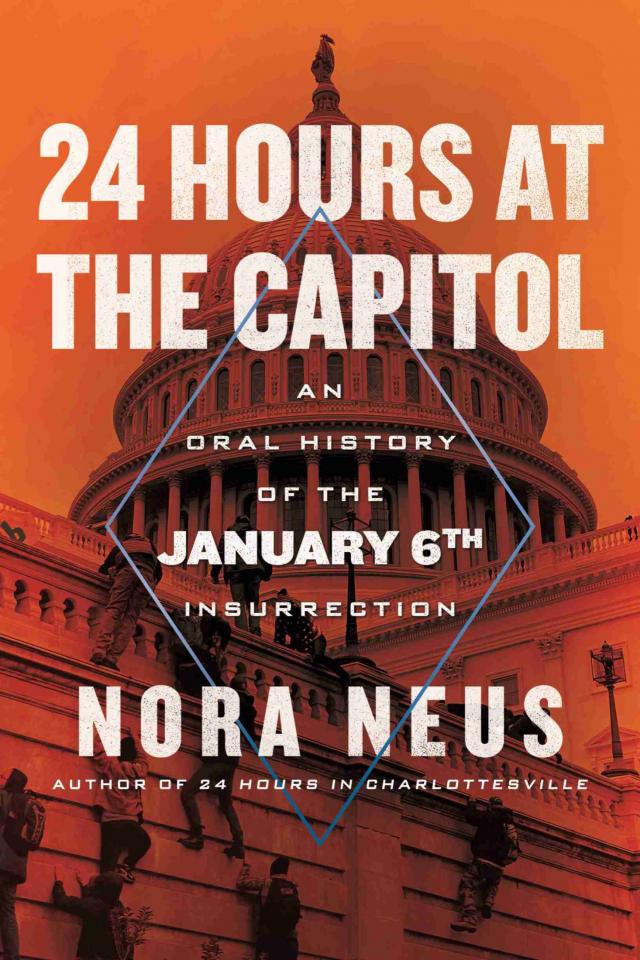
24 Hours at the Capitol, page 1


ALSO BY NORA NEUS
24 Hours in Charlottesville:
An Oral History of the Stand Against White Supremacy
Muhammad Najem, War Reporter:
How One Boy Put the Spotlight on Syria (with Muhammad Najem)
Renegade Girls:
A Queer Tale of Romance and Rabble-Rousing
For my grandparents:
Marion, Donald, Vivian, Linsy, and Ursula
“This is not a rally and it’s no longer a protest. This is a final stand where we are drawing the red line at Capitol Hill.”
—Post on the right-wing social network Parler, emailed to the FBI on January 2, 2021
CONTENTS
Introduction
Cast of Characters
PART 1: “A YEAR IN THE MAKING”
CHAPTER 1 “It’s time for fucking war if they steal this shit”
CHAPTER 2 “Will be wild”
CHAPTER 3 “One million patriots”
PART 2: THE INSURRECTION
CHAPTER 4 “That’s exactly how Charlottesville began”
CHAPTER 5 “Things started to get really violent”
CHAPTER 6 “Hand-to-hand battle”
CHAPTER 7 “Then all of a sudden we were inside”
CHAPTER 8 “If they stop the proceedings, they will have succeeded in stopping the validation of the President of the United States”
CHAPTER 9 “You can see the line of loss. The territory is theirs”
CHAPTER 10 “They just killed a girl”
CHAPTER 11 “Kill him with his own gun”
CHAPTER 12 “It just was another level into Dante’s Inferno”
CHAPTER 13 “The mob kept attacking even while we tended to their wounded”
CHAPTER 14 “You started to see the police officers make progress”
PART 3: “IT’S GOING TO REQUIRE A NATIONAL RECKONING”
CHAPTER 15 “Do I fear another one of these happening? Absolutely”
Acknowledgments
Notes
Index
INTRODUCTION
In the early morning hours of January 7, 2021, I got home from my overnight shift at CNN’s New York bureau, hung up my face mask, and went straight for my journal. It was—and is—how I best make sense of things.
As I wrote, I began to process what we’d all seen on our screens: thousands of armed American civilians besieging their own Capitol building. A president inciting them to violence. That same president clinging to power like a fascist autocrat. I kept circling back to one persistent thought:
“It’s hard to believe it was real and not some make-believe movie scene,” I wrote. “But at the same time, nothing about this is shocking. We knew this was coming. It was literally scheduled.” On December 19, President Trump had announced that a “wild” protest would take place on the day Congress was to certify the electoral college votes: January 6.
I’d felt this way only once before. Three and a half years earlier, on August 12, 2017, hordes of armed white supremacists had taken to the streets of my adopted hometown of Charlottesville, Virginia. We’d known that was coming, too. The hate groups had scheduled that rally weeks ahead of time, ostensibly over the removal of a Confederate statue. As the rally date approached, antiracist activists had pointed city officials and local law enforcement to the specific and credible threats that these extremists were making online. Yet the city had failed to listen, prepare, or protect their citizens. I tell this story at length in my previous book, 24 Hours in Charlottesville. The inactions of those in power allowed a white supremacist protestor to murder an antiracist counter-protestor, Heather Heyer.
We as a nation did not learn our lesson from that tragedy. President Trump had responded to it by claiming there were “some very fine people on both sides” in the streets of Charlottesville, and during the rest of his first term, the threat posed by the far right and white supremacists only increased. It often felt like a runaway train—we could see that we were heading for disaster, yet we were unable to stop it. Shortly after January 6, 2021, I wrote in another journal entry: “Where are the adults? Who do we call when it’s the president?” (I laugh now at my naivete: I understand now that there is nobody to call, and that we the citizens are the adults in the room.)
In the years since, many commentators have offered their version of the January 6 story. Too often, it is told as a self-contained arc: It begins in the months leading up to the 2020 election, with Trump seeding suspicions that voting would be “rigged” against him. It escalates with Trump’s attempts to invalidate the results once President Biden won, and it culminates with the insurrection at the Capitol. This is the story of “Stop the Steal.” But in reality, the story of January 6 begins all the way back in Charlottesville in 2017.
“We will never be able to unsee what I saw in Charlottesville, nor will I be able to unsee the aftermath watching these groups grow,” antiracist counter-protestor Constance Paige Young told me. “For a lot of people, it was like this big fuss around like, ‘Oh, Trump is so terrible and Trump is so bad.’ And it’s like, sure. We all understand that. However, there are these movements that are growing in real time that are very real and extremely dangerous. And somehow Trump is legitimizing them.”
Activists like Young watched in horror as the 2020 election approached, and then with an eerie sense of déjà vu in the weeks ahead of January 6, 2021.
“If you lived in Charlottesville, you didn’t see these things as disparate events. You saw it all as one movement, all sort of one trajectory, one timeline,” another Charlottesville-based antiracist activist told me. “You started to see the exact same storm clouds gathering, for lack of a better term. It was like we were seeing the same lead-up that happened before August 12th[, 2017]. We kept saying, ‘They’re coming to town, they’re gathering, they’re planning something. There’s going to be a larger event here. There’s going to be a culmination that is going to be violent and dangerous. ‘“
And so the attack on January 6 was both shocking and not at all surprising. It was the fault of one man—Donald Trump—and also encompassed a growing extremist movement.
Jacob Glick, investigative counsel for the House Select Committee to Investigate the January 6th Attack on the United States Capitol, summarized it well. To create the conditions leading to January 6, he told me, “You need the paramilitary movement to exist. You need the white power movement to exist. But you also need Donald Trump to be seen as an ally. And you also need Donald Trump as that ally to tell them to do something. And without all of those things happening, January 6th wouldn’t have happened.”
The opening three chapters of this book will tell that story of how January 6 was years in the making. The rest of the book will reconstruct the twenty-four hours of January 6 itself—a day that has gained even more significance since Trump won a second term in 2024. Many of the witnesses I interviewed see January 6 as the turning point that wasn’t: a moment in which the American people could have demanded accountability from the man responsible for an armed insurrection on our own Capitol. And briefly, it seemed possible. Congress convened the House Select Committee to Investigate the January 6th Attack, which released a final report on December 22, 2022, ascribing primary responsibility for the attack to Donald Trump. And the Department of Justice pursued charges against more than 1,200 rioters, sending many to prison. But in the long run, accountability has been hard to find. In 2024, the public went on to reelect Trump with millions more votes than he received the first time. After that victory, special counsel Jack Smith—who had been appointed by Attorney General Merrick Garland to investigate Trump’s role in the insurrection—dismissed the charges against the president, knowing that he would claim presidential immunity once he was back in office.
Much like my previous book, this narrative will tell the story through the voices of the people who were actually there. Their quotes have been condensed and edited for clarity and flow. I’ve removed many filler words, including “um,” “like,” and “you know.” I have at times edited quotations for clarification. I have also granted anonymity to a few sources who feared retribution, be it from the far right or from employers. In some cases, I gave a source a pseudonym (e.g., Jane, Larry, etc.), and in other cases, the source allowed me to use their real initials.
I chose not to interview any of the rioters who stormed the Capitol. Best practices in combatting the rise of hate groups include not conducting new interviews with their members—such interviews could be repurposed as propaganda or held up as a sign of legitimacy. I am still able to tell their story in their own words due to the work of the congressional January 6 select committee, which did interview insurrectionists and made the transcripts and sometimes recordings available. The insurrectionists are also quoted in the tens of thousands of pages of court documents, which include some of their private communications and messages. Already, many of these documents—once freely available online—have been taken down by the Trump administration, making books like this one even more important. I am indebted to two organizations for granting me permission to quote from their own collected oral histories of January 6: the United States Capitol Historical Society, a consortium of historical institutions in Washington, DC; and Co-Equal, a Washington, DC, nonprofit dedicated to preserving Congress as a co-equal branch of government. I thank them for the work they have also done in preserving the stories of this historic day and am grateful for their permission to access their recordings. I am also incredibly grateful to the many individual
Finally, I am incredibly grateful to the interviewees who trusted me enough to retell and relive what was for many of them one of the most traumatic days of their lives. I take seriously the weight of what I am asking them to do in these interviews. Sometimes I don’t even know how difficult it is for people to speak to me. When I reached out to photojournalist Jason Andrew, he responded quickly with what seemed like an easy yes. But weeks later, as we wound down an intensely emotional interview that had lasted for more than two hours, he told me what receiving my initial request had been like.
“I mean, when I got the email from you, I was on an assignment and I was up in New York,” he said. “And I literally called my wife crying. I was like, ‘I can’t do this.’ And she was like, ‘you don’t have to.’“ They talked through the decision, and ultimately Jason chose to speak to me in hopes that it would help him to process the experience more thoroughly.
Many people decided not to speak to me, and others simply did not respond to my emails. I have the utmost respect for their decisions. And I know there are even more people out there—both in Washington, DC, and around the country—who likely would have spoken to me if I’d asked, but there was simply no way to interview everyone. In that way, this book is just a sampling of experiences; I know that there are many more stories out there.
CAST OF CHARACTERS
Note: Names and titles reflect those as of January 6, 2021.
* denotes name changed
+ denotes original interview conducted by the author
MEMBERS OF THE TRUMP ADMINISTRATION
Michael Flynn, former national security advisor
Rudy Giuliani, attorney for Donald Trump
Greg Jacob, counsel to the vice president
Christopher C. Miller, acting secretary of defense
Mike Pence, vice president of the United States
Jeffrey Rosen, acting attorney general
Donald Trump, president of the United States
White House security official
MEMBERS OF CONGRESS
Rep. Mo Brooks (R-AL)
Rep. Ruben Gallego (D-AZ)
Rep. Paul Gosar (R-AZ)
Sen. Mitch McConnell (R-KY)
Rep. Jim McGovern (D-MA)
Speaker Nancy Pelosi (D-CA)
Rep. Jamie Raskin (D-MD)
Sen. Ben Sasse (R-NE)
Rep. Chuck Schumer (D-NY)
Rep. Eric Swalwell (D-CA) +
CONGRESSIONAL STAFFERS
Senior Black Democratic aide
Bruce,* congressional staffer
Craig,* congressional staffer
Leah Han, aide to Speaker Nancy Pelosi
Michelle,* congressional staffer
Richard,* congressional staffer
Shane Smith, aide to Speaker Nancy Pelosi
Cierra Stewart, aide to Sen. Sherrod Brown +
JOURNALISTS
Hannah Allam, NPR reporter
Jason Andrew, freelance photojournalist on assignment for the New York Times +
Sandi Bachom, filmmaker +
Olivia Beavers, Politico congressional reporter +
Igor Bobic, HuffPost reporter +
David Butow, freelance photojournalist +
Alan Chin, freelance photojournalist on assignment for Business Insider +
Anderson Cooper, CNN anchor
Julio Cortez, Associated Press photojournalist
Lisa Desjardins, PBS NewsHour correspondent
Jon Farina, freelance journalist on assignment for Status Coup News +
Adam Gray, freelance photojournalist on assignment for the Daily Mail +
Andrew Harnik, Associated Press photojournalist
Ron Haviv, freelance photojournalist on assignment for the New Republic +
Jane,* staff photojournalist for a major mainstream outlet +
Frank Lockwood, Arkansas Democrat-Gazette reporter +
Evy Mages, Washingtonian photojournalist +
Alex Marquardt, CNN correspondent +
Louie Palu, freelance photojournalist on assignment for National Geographic +
Mark Peterson, freelance photojournalist on assignment for the New York Times +
Nick Quested, documentary filmmaker +
Boris Sanchez, CNN correspondent +
Jake Tapper, CNN anchor
Stephen Voss, freelance photojournalist on assignment for Politico +
Chris Wallace, FOX anchor
Judy Woodruff, PBS NewsHour anchor
LAW ENFORCEMENT
Jimmy Albright, DC Metropolitan Police officer
Michael Byrd, US Capitol Police officer
Caroline Edwards, US Capitol Police officer
Michael Fanone, DC Metropolitan Police officer
Eugene Goodman, US Capitol Police officer
Aquilino Gonell, US Capitol Police officer
Daniel Hodges, DC Metropolitan Police officer
Larry,* US Capitol Police officer +
Gus Papathanasiou, US Capitol Police officer +
Steven Sund, chief of the US Capitol Police
Maj. Gen. William Walker, DC National Guard commander
DC FIRE AND EMERGENCY MEDICAL SERVICES (FEMS)
Craig Baker, assistant fire chief of operations
Timothy Bennett, sergeant paramedic
Kevin Cole, firefighter paramedic
Gary Dziekan, firefighter
Rocco Gabriele, firefighter paramedic
Glenn Hanna, firefighter paramedic
David Hoagland, lieutenant
Christopher Holmes, battalion fire chief
Jon Hope, firefighter
Mitchell Kannry, fire marshal
Ellen Kurland, EMS captain
La’Kisha Lacey, EMS captain
Danny McCoy, area commander
Sean McGee, firefighter paramedic
Angelo Westfield, battalion fire chief
RIOTERS
Stephen Ayres, rioter
Eric Barber, rioter
Joseph Biggs, Proud Boy
Janet Buhler, rioter
Thomas Caldwell, Oath Keeper
Daniel Herendeen, rioter
Joshua James, Oath Keeper
Saundra Kiczenski, rioter
Roberto Minuta, Oath Keeper
Dominic Pezzola, Proud Boy
Stewart Rhodes, Oath Keepers founder
Robert “Bobby” Schornak, rioter
Kevin Seefried, rioter
Justin Winchell, rioter
John Wright, rioter
CONGRESSIONAL SERVICE EMPLOYEES
Black service worker
Congressional food service employee
OTHERS
Jeremy Bertino, Proud Boy
Blaire Boyland, Rosanne Boyland’s younger sister +
Cheryl Boyland, Rosanne Boyland’s mother +
Lonna Cave, Rosanne Boyland’s older sister +
Rev. Gini Gerbasi, Episcopal pastor
Ricardo Mitchell, Labor Division of the Architect of the Capitol
Alexandra Pelosi, Speaker Nancy Pelosi’s daughter +
Christopher Rodriguez, director of the Homeland Security and Emergency Management Agency
Craig Sicknick, Brian Sicknick’s brother +
Enrique Tarrio, leader of Proud Boys
Paul Vos, Speaker Nancy Pelosi’s grandson
Jeff Walters, Architect of the Capitol carpenter
Constance Paige Young, activist +
Karlin Younger, DC resident who found a pipe bomb near the Republican National Committee headquarters
EXPERTS ON FAR-RIGHT DOMESTIC TERRORISM
Titles as of time of writing
Amy Cooter, militia and extremism expert, Middlebury College
Jacob Glick, investigative counsel for the House Select Committee to Investigate January 6th (as of January 6, congressional staffer) +
Mary McCord, executive director of the Institute for Constitutional Advocacy and Protection at Georgetown University +
Sandeep Prasanna, investigative counsel for the House Select Committee to Investigate January 6th +
Jacob Ware, Council on Foreign Relations research fellow +


