

This Brutal House, page 1


Also by Niven Govinden
We Are the New Romantics
Graffiti My Soul
Black Bread White Beer
All the Days and Nights
Diary of a Film
THIS BRUTAL
HOUSE
Niven Govinden
DEEP VELLUM PUBLISHING
DALLAS,TEXAS
Deep Vellum Publishing
3000 Commerce St., Dallas,Texas 75226
deepvellum.org · @deepvellum
Deep Vellum is a 501c3 nonprofit literary arts organization founded in 2013 with the mission to bring the world into conversation through literature.
Copyright © Niven Govinden, 2019
First published in Great Britain in 2019 by Dialogue Books
First US Edition, 2023
All rights reserved. No part of this publication may be reproduced or transmitted in any form or by any means, electronic or mechanical, including photocopy, recording, or any information storage and retrieval system, without permission in writing from the publisher.
LIBRARY OF CONGRESS CATALOGING IN PUBLICATION DATA
Names: Govinden, Niven, 1973- author.
Title: This brutal house / Niven Govinden.
Description: First US edition. | Dallas, Texas : Deep Vellum Publishing, 2023.
Identifiers: LCCN 2023018775 | ISBN 9781646052677 (trade paperback) | ISBN 9781646052882 (ebook)
Subjects: LCGFT: Novels.
Classification: LCC PR6107.O9 T55 2023 | DDC 823/.92--dc23/eng/20230504
LC record available at https://lccn.loc.gov/2023018775
Support for this publication has been provided in part by the Amazon Literary Partnership, the National Endowment for the Arts, the Texas Commission on the Arts, the City of Dallas Office of Arts and Culture, and the George and Fay Young Foundation.
ISBN (TPB) 978-1-64605-267-7 | ISBN (Ebook) 978-1-64605-288-2
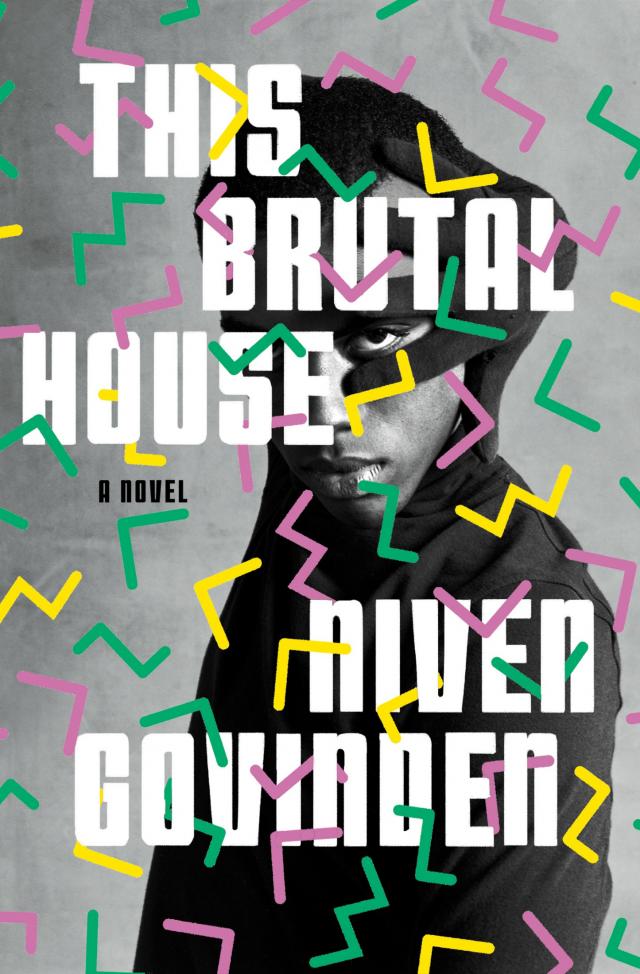
Cover image by Chantal Regnault
Cover design by Emily Mahon
Interior layout and typesetting by KGT
PRINTED IN THE UNITED STATES OF AMERICA
Contents
Into Great Silence
Teddy’s City [i] Boy
Vogue Caller [i]
Teddy’s City [ii] Between
Vogue Caller [ii]
Teddy’s City [iii] Grown
This Brutal House
Teddy’s City [iv] Bridge & Tunnel
American Icons
Acknowledgements
And no one stands up
Our silence stands up for us
Ilya Kaminsky
Witness the dark night of the soul in individual saints
Flannery O’Connor
Voguing came from shade
Willi Ninja
Into Great Silence
1.
We had Church here: on the steps of City Hall, waiting for answers they were reluctant to give. Power in silence over voice. Communion in holding hands; our flesh raw from molten candle wax; a chain unbroken. We had been taught from infancy that with pain comes purpose – comfort too, but prayer could rarely provide this once our children began to disappear. Our actions were fearful but emboldened, understanding in those first days that this had to happen now: our presence; a physical mass of our discontent. That as elders and mothers to these children, it was our duty to organise, to bring the candles and the people; to stand on those steps whilst they sweated inside City Hall and formulated their response. For as long as it took, we would wait.
We had a Church: a banqueting hall above a Korean supermarket, long neglected and dependent on our dollar. We worshipped in the parts of town that were still open to us; where we could not serve as reminders to various bigots of how nature could warp and deform. For all the progress our people made, however best we served them, loyal to our name and our origins, we were disapproved of, and unwelcome in our family neighbourhoods. We had to forget ourselves, regress, if we wanted to make a life there; which we could not do. We – men; older than the children who flocked around us, drawn to the vogue balls we created, the family we promised – became Mothers because we no longer had mothers of our own. We were drawn together by the air of absence that framed us; sadness matching sadness, unspoken but acknowledged. Within this space we created our Church, where joy and fierceness could reside; but also something beyond that: a higher consciousness to reach.
We stood on the steps of City Hall, reaching higher.
2.
It is our lawful right to protest. They cannot tell us otherwise. We are entitled to our rage, and to use this anger. It underlies our efforts to draw the community into the square where City Hall lies, making it clear to the children that we feel as they do; that we are bone tired from having to be strong, ashamed of our failings as protectors, and sick from the violence which we cannot escape. Mostly we are tired. It lines our faces and dampens our movement. We would lie down and hide were it not for this anger, which needles and keeps us awake; which sends us to the all-night printer to create leaflets; sets our feet across every nightclub, bathhouse and cruising joint to distribute them. We walk along cinema aisles, and across seats, where members of our Houses are giving out hand-jobs and the like to cover the rent. We remain in the era of community and brotherhood, whereby the children would turn down a trick once they understood why it was important to join our cause. Their obedience gave us strength; their docility as each followed the other on to the street and towards the square made our cheeks flush; how persuasion could be successfully deployed. The complainers were those whose needs went beyond mere remuneration: sex occupying a destroyed space that could never be filled. Still, this was anger that we could harness, so long as they too complied.
We were capable of leading armies in more progressive times; how the country could have utilised our talents were the culture a more compassionate one and we were not so afraid. If military success can stem from luck over judgement, benevolence from the unknown over what is planned; our contribution would have carried heft. Pride of America in our bearing; what can be read in our eyes. Instead, we must channel it here: two hundred strong at City Hall’s steps, and unmoving. From a long-held wish to command, we lead, clearing blocks step by step; an even pace held until the stragglers at the back fall into sync. We will not leave this place until we are heard, until there is satisfaction. Children who disappear cannot return. We know this. But we need the fact of their disappearances to matter; for those agencies in charge to listen and act. How it should not only be lost pageant queens whose faces grace the back of milk cartons but girls who are trapped inside the bodies of boys; those who break out of their incarceration by wearing make-up; boys who like boys; kids who come from nothing; children who are yet to understand the true creature they are, something beyond their origins. We are asking for our concerns to be taken seriously; for their lives to be investigated if there is hope, honoured if there is not. We need another to share our burden for we are at the point of crumbling; unbelieved and unheard.
Children disappeared from us for years. We lost Sherry, TyTy and Diamonds. We lost groups of banjee boys who were our nexus. T-girls with airs, desiring a greater life than we could provide. We could embroider quilts to cover this nation twice over, with the names of those we loved: those young people in our care who went out and did not return. They will not hear us outside City Hall, for we say nothing; our bearing and gestures urge the children not to speak. We wish those inside to fear the silent minority; the weight of what is unsaid conjoining, growing, as planets slowly take their form over millennia through the accumulation of rocks and dust. We are the dark matter that rises above the front doors and threatens to consume them. They should fear as we now fear; jump through hoops if it gives them the relief they crave and the answers we need. Only silence, the promise of silence can deliver this. Slogans and missiles mean nothing, for society has built them to deflect such attacks; nuisance flies to be swatted away. Now that our previous attempts have failed – using their methods; their agency: bureaucracy and all the playacting involved there – this approach is the only way.
We reached our position through trial and error; wasted years adhering to the official channels of complaint; registering our dissent through community action and the ballot box. Years of putting faith into the power of statistics at the ballot box; how power could be swayed by tipping the balance in marginal precincts; our energy focused on the campaign trail, believing that it was in our power to inform and persuade. When that failed, we attempted direct action – we recognised that we did not have decades to regroup, politically, nor did we have the taste for it; patronised and belittled, forced into a ghetto they viewed as essential to our enlightenment – taking to the streets in the spirit of our community-organising and activist forebears; an arsenal of placards and loudspeakers, baseball bats and rocks. Their thinking was that we would fear the rows of turned-out riot police, military in their bearing, but as threatening as country barn-dancers; that tear gas would contain us, when we had lived with nightclub smoke machines most of our adult lives, and learned how to see past the mist. We were pissed and no longer afraid.
We finally had use for the bodies we had spent so long starving and pumping. We learned the power of our physical strength. All that we had shied away from as children we discovered now: how far a rock could be thrown by a single hand; the furthest we could run when chased; the speed at which our blood glucose was assimilated after physical exertion; the power of our voices; the solidity of our fists. Battles on our neighbourhood s
We found success through rioting, making our dissatisfaction known. Effecting prolonged change was harder still. We were not prepared. What we had not factored on was how our spirit would be weakened by a sustained assault on our home streets; how it was impossible to switch off; smoke and blood trailing our movements; the imprint of a gloved fist sending us to sleep atop our battlefields. (The owner of the dry-cleaner’s beaten by the police, mistaking him for one of us, but not the ‘us’ they were thinking of.) Our voice was strong but there was nothing healthy in our attitude, often ready to turn on each other rather than concede a slight against the opposing side. Long after the police lines dispersed and our long-cherished complaints were addressed, we remained ghoul-like in our ghettos, fighting our shadows. Only through prayer did we remember ourselves and our capabilities.
Through our formative years, prayer was all we had. Devotion of the Projects and Inner Cities. We experienced periods of intense belief when the saviour’s light filled us and we felt it our duty to spread the message. Our work was our future; immeasurable riches that came from piousness and doing well. We seldom reflect on these times, inextricably linked as they are to the desire to please our parents; how obedience was expected in both church and home. That through prayer and ritual we were burying other desires; withholding the part of ourselves we were not yet able to share. Our questioning and later cynicism mostly occurred during this break: a domestic schism followed by a religious one. For the support found in certain quarters – a priest or family member who could readily accept our deviancy in private – we were forced to abandon our belief once we too had been cast aside. What light was had was then of our own making and could no longer be divined. For decades it remained so, as we became more fully ourselves. The gap widening as we moved further away from our families, who saw what we had become but lacked the bravery to support it. Our knowledge and adherence to all holy ritual fading into memory.
But in the same way that a flavour or scent can transport you back to childhood – a sip of warm milk flavoured with honey or the charred edge of a fried egg – so too can the peel of downtown church bells. Sunday-morning bells calling us to church. Once we opened our ears to them their summons was loud and resolute. They marked the start and end of each day. Their clear ring echoed the hollowness of our internal lives. We were happy mostly, but rudderless. Vogue balls were our cornerstone but they did not explain why we often felt alone in the days following. Something of the light returned once we accepted that faith needed to play a part in our lives. That’s not to say that we would return to blind worship – far from it – but more an understanding that our own church could be founded from the core principles that had kept us straight in youth. The Apostles started from the same point zero. We would follow.
We allowed ourselves to be guided by the Church; tentatively attending Sunday services in sympathetic neighbourhoods, visits that were both a refresher course and an exercise in nostalgia. The Father’s tone soothed and terrified, taking the briefest glance at us before preaching at length on sin. Afterwards he was welcoming and kind, offering us tea and introductions to various groups within the congregation. Knowing not to outstay our welcome, we shied away from church hospitality, though something in his manner and the particular quality of light there brought us back over successive weeks. Thick shafts of light emanating from beyond the stained glass; hitting the side of our faces as we knelt, and seeming to cleanse our imperfections. It was not His approval we were seeking, we realised, but our own.
The children indulged us, though suspicious of our conversions. One eccentricity among many. We expected no generation below us to follow our practice of worship. How could we, when we too had traversed a free-flowing discovery of what the city offered during our youth? Of places, and lovers; our bodies, and the sanctuary of the vogue balls; what freedom could mean. This we could not deny them. The children had their own points of faith, which we accepted though barely understood. When one of their own went missing, there was a sporadic turn to prayer, but they had no faith in its power or validity. Penance evaporating into the air, the moment the words left their lips; empty of intent; useless. They may as well have prayed to ice cream. Easier to curse Jesus and all the saints for a loss of protection that was not wanted in the first place. It was left to us alone – the house mothers – to follow a more structured path, for only through this would we arrive at answers.
When your child goes missing you will move heaven and earth to find them. You have the strength to rip buildings from their foundations; such is your determination to restore all that is precious. You will ask all the questions that need asking; implore every agency you can find. You fight the darkness that descends, any obstacle that limits your strength. True blackness only occurs when the second child goes missing, then a third. Any last methodology you cling to, the agencies you pursue become redundant. The chase that filled your days, from which trickled scant drops to nourish those seeds of hope you had protectively buried, is halted. After the fourth child has disappeared, you look to save yourselves and others around you; searching for an explanation and a space that goes beyond prayer.
Through silence we acknowledge our pain and are able to name what we feel. It near breaks us to contain the enormity of it, but somehow silence gives us strength. City Hall sees this in our faces and manner. It is why they are unable to turn us away. They recognise how our sadness could flood the city, with no rain or water cannon to wash it away; how we embed its fabric. We shall not engage. We will verbalise no demands. They will study the notes we leave and they will learn. They will acknowledge the size of our number, the physical weight of our presence, and understand their need to act on our behalf. Nothing will happen otherwise. We shall sit at their door and remain present, leaving them no option but to watch from their windows and wait for us to go away.
3.
On our first night we made the decision that we would sleep on the steps of City Hall. For all the effort it took to gather the children – the energy spent in explaining what we would do, and how – the beauty of seeing our mass pooled on those sandstone steps unravelled us; a trickle of an idea leading to a dark reservoir of unknown fathoms made it impossible to pack up and leave once we fell into deeper night.
‘Now you’re getting crazy.’
Teddy’s voice in our ears; the man we most relied on to help us organise; once one of our legendary children, still one of ours, but more than a decade past what the role allowed. At the balls, there were children, upcoming legends, and mother legends. He was forever upcoming, not interested in taking our role, only working as our legislator, improving what was already there. He allowed us the luxury to fall back upon our status as elders, taking care of our day-to-day business and leaving us to indulge our ideas. Now working for the City itself, in a minor role, of which we were still so proud, he was the rod that beat the children’s asses to keep them in line.
‘You want to keep this up. Seriously?’
Our movement, the justice we were seeking, could not keep office hours. That was unthinkable. Consciousness beats twenty-four hours a day. We would stay there to show that our belief did not waver, even while we slept, even when there was no one to watch us. This pain, this thought, was ingrained.
We were not prepared for an enforced stay, barely dressed for the day, never mind night, but it felt like the right thing; the only course to take. Once evening turned to night, still illuminated, because we were in the heart of the city, free now of gawkers and the noisiest of news folks, the police themselves growing tired and moving back into the shadow of their vehicles where sleep beckoned, we took our repose. We each lay across a step, our heads resting against shoes and whatever extraneous clothing we’d thought to bring. The children were left to decide whether they would join us. We did not explain. We simply grew tired and prepared for sleep.


