Pressure Chamber, page 1


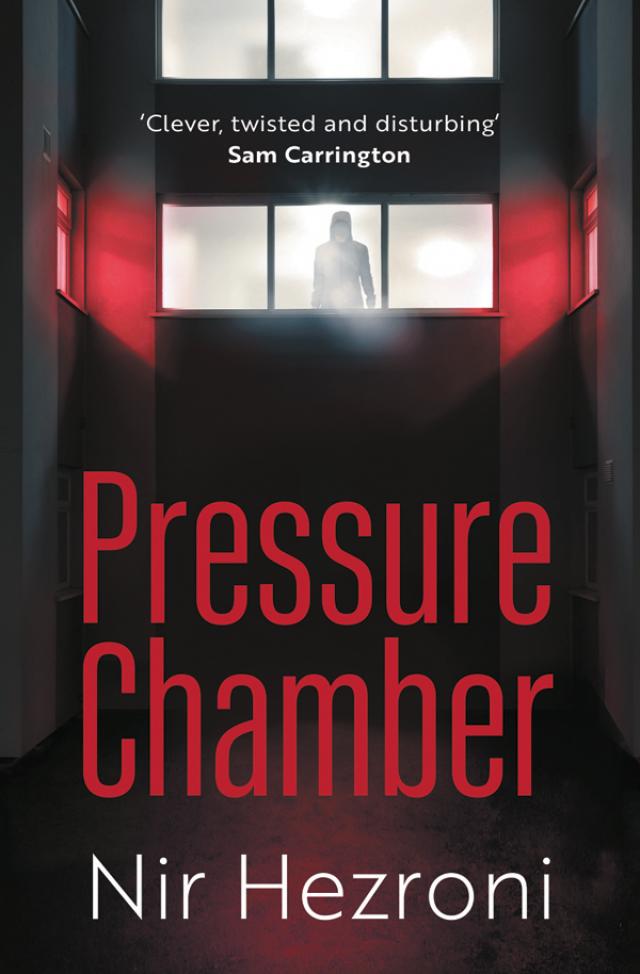
Pressure Chamber
Nir Hezroni
Translated by Steven Cohen
Legend Press Ltd, 51 Gower Street, London, WC1E 6HJ
info@legendpress.co.uk | www.legendpress.co.uk
Contents © Nir Hezroni 2021
The right of the above author to be identified as the author of this work has been asserted in accordance with the Copyright, Designs and Patents Act 1988. British Library Cataloguing in Publication Data available.
First published in Hebrew by T’chelet Publishing in 2020.
English Translation by Steven Cohen.
Print ISBN 978-1-78955-9-033
Ebook ISBN 978-1-78955-9-040
Set in Times. Printing managed by Jellyfish Solutions Ltd
Cover design by Simon Levy | www.simonlevy.co.uk
All characters, other than those clearly in the public domain, and place names, other than those well-established such as towns and cities, are fictitious and any resemblance is purely coincidental.
All rights reserved. No part of this publication may be reproduced, stored in or introduced into a retrieval system, or transmitted, in any form, or by any means electronic, mechanical, photocopying, recording or otherwise, without the prior permission of the publisher. Any person who commits any unauthorised act in relation to this publication may be liable to criminal prosecution and civil claims for damages.
Nir Hezroni was born in Jerusalem. His first two thrillers, were sold in two-book deals in six territories and have been optioned for film by Sony Pictures Television Inc. He now lives with his family near Tel-Aviv.
Follow Nir
@nirhezroni
Warning. Lucid dreaming, and how to induce lucid dreams, as described in the book, are very real. All people react to sleep paralysis differently, and some responses also have the potential to be problematic and could give rise to phenomena such as nightmares and psychological trauma. This book does not constitute a recommendation to experiment with lucid dreaming, does not purport to be a guide to lucid dreaming, and the author cannot be held responsible or accountable for any harm that may come, Heaven forbid, to any readers who decide to try out something from the book on themselves.
A second warning. The process of guiding someone into a trance that appears in Chapter 81 is real and shouldn’t be tried without prior knowledge of hypnosis.
Sleep, little baby, sleep Daddy has gone to the fields Mommy has gone out to work The demon with the hollow eyes is waiting on your rooftop Sleep peacefully, little baby Sleep deep
1.
She used to run along the seashore when it rained. The sand would empty of people and she could run fast without having to weave around amblers or beachgoers sitting under umbrellas with children sowing minefields of colorful plastic toys in her path. In the winter, she runs along the waterline, her feet leaving quick-fire impressions in wet sand in the wake of the receding waves, like skin that tightens after someone holds your hand over the spout of a boiling kettle, like her father used to do to her when she was small.
Daphne!
It always happened if she misbehaved, and she always misbehaved, or most of the time at least, so he’d say. If she’d known how to behave, she would have, and then there’d have been fewer marks on her hands.
Daphne! Come here!
She tried, when she was very small, with all her might, but the slaps and fists never failed to materialize, and so she stopped trying, and waited for it to happen. Better to bring things to the boil quickly, to take the punishment and get it over with.
Heavy steps
Her bedroom door opens
A large hand grabs a small wrist and tugs
The waves rumble to her right, raindrops drum against the sand. Water, a chemical compound composed of hydrogen and oxygen atoms, boils at one hundred degrees and freezes at zero. A human body is usually at 38.6 when measured with a thermometer under the tongue. A third of the way between the blue pain of zero and the red of one hundred.
It’s cold outside, but her body is warm, and she moves closer to the water’s edge, running over the white foamy limits of the waves that lick the sand, paying no heed to the small rocks that stab her bare feet.
Everything’s gray. Dulled. The pain, too.
PART 1
THE GUARDIAN
AUGUST 2016
2.
“Don’t fight it.”
He leans over her. A slender trail of blood trickles from her ear and drips onto the road, creating a bright red puddle on the black asphalt.
“Don’t be afraid.”
Her eyes open. She tries to say something, but her lips won’t move.
“It’ll be over soon.”
Her right foot convulses in her white Nike running shoe and stills. He puts his ear to her mouth and feels no breath.
He slowly runs the tip of his finger from her hairline all along the bridge of her nose, her mouth slightly open, his finger skipping from the upper to the lower lip, chin, neck, chest, grazed stomach from the blow, with horizontal scratches in the region of her belly button, covered with small drops of blood. A piercing. Silver-plated clover leaf.
He touches the tip of her nose again.
“There we go, it’s over. You see? It was quick.”
That which dies, let it die; and that which is cut off, let it be cut off. Zechariah, Chapter 11, Verse 9. Nine Eleven.
He stands up straight and walks away. Slowly.
It’ll take him years at this rate. He isn’t putting enough into this cycle and needs to amend his priorities somewhat. So many things to do. Life is the sequence of actions you take in the limited period of time afforded to you. People can live their entire lives without doing anything meaningful. Without driving a spoke into the universe.
He inhales deeply, drawing in the scent of the flowers in the courtyards of the private homes along the winding street, the smell of perfume, the sweat and blood on the sweatpants of the girl lying on the road, the stench of the fur of the dog lazing in the yard of the nearest house. The humid summer air pulsates around him. The earth and the flora moves and breathes. People in small houses are fast asleep in their boxy middle-class existences.
He gets into the car, which awaits him open-doored, buckles up and drives off.
3.
Daphne is sleeping in nothing but a pair of panties. The three-room apartment she rents with Anna is equipped with an air conditioner in the living room only, and that died on them a few days ago. She tried calling the landlords, only to learn that they were in China, on an organized tour for senior citizens. “We’ll take care of it the moment we return, in five weeks’ time,” they informed her before hanging up.
The fan she purchased does a good job of dispersing the humidity evenly throughout the room and cools her back somewhat by helping the sweat evaporate at a quicker rate. She of all people knows that the evaporation rate of a liquid depends on the type of liquid, its temperature, the surface area and the air flow above its surface. Under identical conditions, acetone will evaporate faster than benzene, which will evaporate faster than chloroform. She remembers the table of evaporation coefficients of liquids by heart.
The same nightmare keeps recurring. Her eyes move under her closed eyelids and the sweat on her back, comprised of water with the addition of sodium, calcium, magnesium and potassium, evaporates into the expanse of the room, mixing with the general humidity of the apartment and, through the open windows, the city of Tel Aviv as a whole. SCAMP. As a student of molecular biology, she used to come up with acronyms to remember the assortment of chemicals racing through the human body. Sweat is mostly SCAMP. Sodium. Calcium. Magnesium. Potassium.
She turns to the left in her sleep to lie on her side in the fetal position, exposing a sweat stain on the sheet. Sweat can be used sometimes for forensic identification purposes. Sweat can contain small traces of zinc, copper, iron, chromium, nickel and lead, and everyone has different amounts. Bodily fluids, skin cells, fingerprints, hairs – from the second we emerge from the body that has sheltered us, up to the moment we start to decompose and turn into other chemical compounds, after two and a half billion heartbeats, we’re constantly scattering remnants of ourselves wherever we go. The yellow brick road, she calls it; though she doesn’t feel like Dorothy – she feels closer to Elphaba, the Wicked Witch of the West.
She didn’t set an alarm for this morning. She only got out of the lab yesterday at 11 p.m., and, arriving home at her dilapidated apartment on HaNevi’im Street after an hour-and-a-half drive from the National Israeli Police Headquarters, she immediately crashed into bed.
Her cell phone rings.
Still half asleep, and thinking it’s the alarm she didn’t set, she reaches out and silences the device. It rings again a few seconds later. She looks at the screen. The name of her team leader appears alongside the time: five-thirty.
“Nathan?”
“Daph, don’t come into HQ this morning.”
“You’re an angel. I’m going back to sleep.”
“No, what I mean is you need to get up now and get yourself to Kiryat Ono.”
She looks at the half-closed shutter and the sun’s rays penetrating it creating sunspots on the bed, then reads the time on her cell phone. “It’s five-thirty in the morning.”
“A hit-and-run, young girl dead at the scene.”
“Shit.” She rubs her eyes.
“Do you have the kit in the car?”
It takes her a few seconds to remember before responding. “Yes. What’s the address?”
“I hope I make it there before they contaminate the entire scene. You on your way?”
“Yes, dressing and leaving Jerusalem in a few minutes. I’ll be there in an hour or so, depending on traffic.”
“See you there.”
“Daphne.”
“What?”
“Look with the eyes of a child. Ask yourself: What’s different? What’s happening on the street around the scene? What’s there that appears…”
“…to be out of place. Doesn’t belong there. On my way.”
She sits up in bed and stretches through a yawn, then heads to the shower and stands under a stream of cold water. She needs to wake up. She has to be sharp. She can’t afford to overlook a single detail.
Without Tel Aviv’s as-far-as-the-eye-can-see traffic, which will kick in a little later in the morning, she’s at the bottom of the hill, before Trumpeldor bends to the right, within fifteen minutes.
She parks behind a patrol car with flashing lights blocking the road, forming a barrier between the scene and the group of curious bystanders who have already emerged, coffees in hand, from the buildings on either side of the street. A second police car bars access at the other end. Between the two barriers stands a Magen David Adom ambulance. Two paramedics in white shirts with a red stripe at the end of their sleeves are busy packing up their resuscitation equipment and returning it to the vehicle.
Daphne gets out of her car, leaving the door open, and walks towards the scene.
“What’s up?” A weary patrolman greets her with tired red eyes. “What unit?”
She plucks her police ID card from her purse and says, “Forensics. Who’s been at the scene apart from you? Just the people I see here now? Any other cops who’ve left already? Another ambulance?”
He takes her ID card, briefly studies the photograph and then looks up at her. “No, just us,” he says, and returns the card to her. “We arrived half an hour ago with the ambulance. When they saw there was nothing for them to do, we closed off the road.”
“I’ll get my gear from the car.”
Without waiting for a reply, she turns around and goes back to her car, reaching into the trunk for the large metal suitcase, with its sticker reading FORENSICS in red letters on a white background that she received while on a crime scene investigators course. She opens the case, takes out a digital reflex camera and walks back over to the patrolman.
“Lift your leg.”
The young policeman appears taken aback. “Aren’t you going to the body?”
“It’s not going anywhere. All of you, on the other hand, are wandering around it and leaving shoeprints.”
He consents, and she photographs the soles of his shoes, then those of all the other people milling around the scene. The powerful flash of her camera casts an intense white light against the backdrop of the soft, orangey pink sunrise, emitting a faint beep as it recharges between shots. She also photographs the tires of the two police cars and the ambulance, their tread as well as the side of each tire that displays the details of the manufacturer and model number. When a driver brakes suddenly, it’s easy to collect evidence from the road. The tires heat up when the brakes are applied, leaving skid marks, a black trail of burned rubber. But there was no sudden stop here. She has a good look around her. No signs of emergency braking. Nothing to suggest a sudden veering to one side, no foreign paint marks or signs of a collision on the vehicles parked on either side of the road. The driver of the car who killed the girl didn’t see her at all. Drunk or under the influence of drugs perhaps. There are no glass fragments either, just a broken body lying on the road.
Daphne closes her eyes, inhales deeply, slowly releases the air from her lungs and then approaches the body: a young girl in a T-shirt and light blue sweatpants with black stripes running down the side. Her body is sprawled on the road, her head on the sidewalk. The fall must have culminated in a blow to the base of the skull against the curb. Bad luck – flash – her legs twisted in an unnatural position, exposed abdomen revealing scratches and grazes dotted with droplets of blood – flash – her head tilted back and a small pool of blood by its side, close to the curb – flash. Better that way. A sudden flash of pain and a quick death means a small pool of blood. The heart stops beating and doesn’t pump blood out of the body through a ruptured vein or artery. Prolonged pain and a still-beating heart mean a large pool.
She looks about twenty. Younger even. A thin line of dark blood marks a trail from her ear down to her hair, some of which is soaked, and another thin trail of blood runs from the corner of her mouth across her cheek – flash.
Head facing the sky, black curls, open brown eyes, mouth slightly agape and half a shoeprint in the pool of blood alongside her. Whose? The soles of the shoes of the policemen and paramedics were free of blood – flash-flash-flash. Daphne retrieves a bottle of luminol from her case and sprays the reagent on the road and sidewalk around the body, before surveying the scene with a UV filter.
She follows a short series of glowing blue shoeprints from the body into the road. Four steps, that’s all, that come to an end where the car had stood. He hit her, backed up, stopped, approached her to ascertain the extent of the damage, walked four steps back to his car and drove off. The blood marks left on the road by the tips of his shoes aren’t smeared; he didn’t run like someone who panicked and fled the scene. He stood over the body, surveyed it and drove away. She sprays more luminol but doesn’t find additional traces of blood in the area.
“Piece of shit,” she says to herself.
The policeman nearest to her looks up. “What was that?”
“Fucking piece of shit. He stood over her, watched her die, casually walked back to his car and drove off. In no apparent hurry.”
“Maybe she?”
“What?” She turns to look at him, realizing she didn’t bother to do so when she arrived at the scene.
“It could have been a woman driver.”
“Not by the size of the shoeprint.”
4.
She rests her camera on the hood of a parked car and lights a cigarette, noticing the glance from the policeman standing next to her.
“Want one?”
“Yes. Thanks.”
She hands him the box. He helps himself to a cigarette and leans back against the car. Side by side, they smoke in silence. The orangey pink of the sunrise has been replaced by a bright blue sky and the number of curious onlookers beyond the police cars has increased.
“When you gonna clear that away?” asks one of the neighborhood residents from the doorway of the building in front of them, surveying the blocked road. “I need to get to work.”
“That?” Daphne responds, standing up straight and taking a step towards him. “What’s that? Are you talking about the dead girl lying there? Is she that to you? How would you like someone to say, ‘Pick that up off the floor,’ after a car’s just flattened you on the street like a pancake? What the f—”
“Leave it,” the policeman says, reaching out to place a hand on her shoulder. “Don’t waste your energy.”
She turns around, collects her camera and returns to the middle of the street, just as a siren sounds and an additional patrol car arrives on the scene. A young, bearded man with cropped black hair jumps out.
He flashes a badge to the patrolmen, ducks under the police tape and hurries over to her. “What can you tell me?”
“A hit-and-run. The victim’s a young woman – nineteen going on twenty, I’m guessing. No ID on her person and her mobile’s still working but locked with a password.” She points to a transparent evidence bag containing white earphones and a white iPhone with a shattered screen. “It was thrown to the side from the force of the impact. I dusted it for prints in case someone touched it after she was run down. We’re going to have to wait for someone to call her to know who she is.”
“Anything else?”
“He didn’t even try to stop before he hit her. It appears deliberate.”
“How so? Maybe she jumped out between two parked cars and he didn’t have time to brake? She was wearing earphones; perhaps she didn’t hear him coming.”