Spin, page 7


She did not want to confront the evidence of what had to be impossible.
She ran her fingers briefly over the tapestry, the weft lines taut as wires. Dimly she sensed their feedback, faint and silvery as harp music behind a closed door.
There was only Aegesth, the hound master. The love she had felt for Alcander seemed like a dream.
She took a bus to the city centre and then walked through the maze of backstreets until she came to the dusty, flagged walkway that led to the lower, shabbier end of Athenaeum Street. There was a smell of overflowing dustbins and baking asphalt. Layla slipped along an access passage that ran between two of the houses then made her way along the lane overlooking the gardens. There was no one about. The last house in the road was enormous and very well kept. Its gleaming brickwork cast back the sunlight like a thrown discus, yet an aura of uncanny stillness surrounded it. Layla felt certain that in spite of the way it looked the house was empty and had been empty for years. Its back gates were padlocked shut
Layla stood in the shadow of its wall and listened to the cicadas, gradually adjusting her breathing to their steady rhythm. Eventually her heart rate began to subside.
It seemed to her that she had two choices: either she could accept what people said about her, or she could not. Nashe Crawe had called her gift a blessing, but if she allowed herself to believe that it would mean that in a sense the pictures, the colours, the feelings she experienced when she created her tapestries had never been hers. It would mean that everything she ever did, everything she had ever done, was predetermined. That she was not an artist, but an empty vessel, a convenient channel of communication between her own world and a realm she herself could merely glimpse through the panoramas.
She had always thought of her work as her passport to freedom. But if what Nashe Crawe believed was true then it was merely the badge of her servitude. Crea Atoll had accepted her calling and it had brought her adulation for a time. But in the end the tide had turned, as it had turned for Layla’s mother, as it turned for everyone, and where had the gods been then?
Surely it was better to be like Livia Sol, who had refused to accept the patronage of any religion, even when the rest of the world declared her insane? Or like Panteleimon, who insisted on his personal freedom, even when it led him to exile and ruin?
Thanick Acampos, she thought. Who are you really? She turned around to face the wall, then placed her foot in a cleft left by a missing brick and heaved herself up. The thorn trees had grown massively thick, covering the inside of the gates and making entry to the garden impossible without the use of a chain saw or a scythe. Only the orb spiders, the industrious Johannas, seemed free to come and go as they pleased. Layla watched one of them, a slim-bodied, delicate creature of a lighter brown than the plump beauty she had observed earlier in the summer, as she touched her toes to the rear of her abdomen and extruded a silken thread, a live, liquid quicksilver that hardened to gleaming transparency within a fraction of a second.
There was something balletic in the spider’s movements, the same lithe effortlessness that belied the hours of practice and rapacious desire that brought all art into existence.
Layla felt love rise in her, and a heartfelt admiration. She felt she would die to protect this creature, to ensure its right to continue doing what it did so well.
“So you still think we’re all dead, then?”
Layla was so badly startled it made her lose her grip on the wall. She dropped to the ground, grazing her palms and painfully jolting her knees. She thought at first it was the house’s owner that had called to her; then she saw it was the old woman, Thanick Acampos. She was incongruously dressed, in a dogtooth-pattern business suit and sturdy black court shoes. How can she stand it, in this heat? Layla thought. Those shoes must be killing her.
She looked like the ancient secretary to some particularly notorious gangland boss.
“I’ve looked for you everywhere,” Layla said.
“I thought you didn’t believe in me,” said Thanick Acampos.
“I don’t want to talk about that. I’ve had it up to here with all that god stuff. I want you to tell me about my mother.”
“Your mother drowned and she was terrified. But she called to my cousin Calliope and Calliope came and lifted her out of the water.”
“That’s rubbish and you know it. Why won’t you tell me the truth?”
“Do you still call it rubbish now?” The old woman bent down as if to adjust one of her stockings. Her outline seemed to shimmer, and for a moment Layla thought she was about to disappear as she had done before.
“No you don’t,” Layla cried. “Not again.” She reached out and seized the old woman by the sleeve, but the thickly woven material was sopping wet, and when the old woman turned to look at her Layla saw she was staring into the face of Romilly Perec. She looked exactly as she did in the stash of old photographs at the back of her father’s wardrobe, photos that had lain hidden so long Layla suspected Idmon Vargas had forgotten they were there.
She was taller than Layla and her skin paler, but she had the same coarse, unruly hair and emerald eyes.
“Tell me my name,” said Romilly Perec. She spoke in the dry, perplexing voice of Thanick Acampos.
“That’s vile,” Layla said. “Let her go!” She grabbed both her arms, digging her fingers into the sodden fabric of her clothes and pulling her forward. The woman’s eyes were shining with tears, and Layla remembered the morning of her departure from Kardamyli, the dawn stepping towards her across the sand in her pink suede sandals.
“You must tell me my name before I can release her, Layla Vargas,” the woman said. “You should accept your gift with grace, that’s all I ask. No gift is for free.” Her voice was different now, younger, but still hard-edged with what seemed to Layla like regret.
“My gift is my own,” Layla said. “It has nothing to do with you. I hate everything you stand for.”
“Are you sure about that? According to you I don’t exist in the first place.” She freed herself from Layla’s grasp and then embraced her. Layla felt her mother’s lips brush her forehead and then she seemed to turn to nothing in her arms. A gust of hot wind blew back her hair.
“Don’t go!” Layla cried. “I want to see you.”
“Then say my name.” The woman reappeared, not as the old hag or Romilly Perec but as an image from a black-and-white photograph: Bella Lukic in the role of the goddess Athena. Then this image too disappeared. In its place stood a woman in middle age. She was quietly dressed, in a shift of blue cotton. Her hair, flecked lightly with grey, was cut fashionably short. She exuded the same kind of weary dignity you might expect to find in a soldier who has fought heroically in many wars but who now deems war itself to be futile. She was beautiful, but in a way that made Layla afraid.
Of the old woman Thanick Acampos only the eyes remained: eyes that were the colour of amethyst, or the pure mauve light of a summer evening.
“I won’t go with you,” Layla said. “I won’t.”
“Stay then,” said the goddess. “Stay forever, and use your gift wisely, seeing as it pleases you so much.” She touched Layla lightly on the shoulder then disappeared. Layla stumbled forward, her attention distracted by a flickering movement on the periphery of her vision. She shook her head, hoping to clear it, and saw that one of the orb-weaving spiders had become tangled in her hair. She felt a second’s atavistic loathing at the thought of having the creature so unexpectedly close to her, then she plucked a stem of dried grass from the base of the wall and held it steady so the spider could climb to freedom.
The spider scuttled up the stalk, running hand over hand like a tiny brown monkey. Layla lifted her towards the overhanging branches of the thorn bushes and after a second’s hesitation the creature scuttled aboard a leaf and ran swiftly out of sight.
Layla dropped the grass stem in the dust and turned to go home.
She spent the rest of the day in her flat, overcome by a dazed lethargy that was like heat stroke, only worse. She went to bed well before midnight, but awoke barely an hour later feeling nauseous and disorientated. For some moments she struggled to remember where she was, then recalled the encounter with the woman in the lane behind Athenaeum Street, the dizzying afternoon heat and the cry of cicadas. She stumbled to the bathroom and vomited into the toilet, her stomach cramping painfully after each new bout of retching. Her head throbbed, as if she had been struck.
Heat stroke could do this, she knew, but the sun had never before affected her so badly. She made her way back to bed, a journey that seemed to take many hours. The mattress heaved and bobbed like a raft at sea, and the cotton sheet felt stiff as cardboard, chafing against her skin each time she moved. Feeling stifled, she threw it off. The sound of a passing car brought her out in gooseflesh.
Her thoughts seemed disordered and strange. At some point during the small hours she remembered the boy, the youth with the scarred back she had paid to have sex with her. It occurred to her that she might have contracted some awful disease from him, and the more she dwelled on the thought the more it took hold. Her action, all her actions up to this point, now seemed insane to her. She wondered if this was how her mother had felt when she knew she was drowning.
When morning came she felt better, although she did not remember sleeping, or when exactly it had begun to get light. The night terrors remained but they seemed less urgent, like the remnants of a nightmare that still seems true on waking but loses its grip on the world within the hour.
She thought she would be able to do her shift at the factory as normal, but while she was waiting at the bus stop she was seized by panic and forced to return to the apartment. The room stank of spent vomit and the dense, animal odour of her own soured sweat. She opened the single window, and the door that led out on to the small communal balcony. Salt air rushed towards her, its reek so powerfully pungent that she almost fainted. She clung to the balcony railing. Sunlight poured down, coating the sea below with a vitreous glaze. The fierceness of the reflected glare seemed to scour her retinas.
She keyed her father’s number into her mobile but the phone rang and rang with no reply. She wondered who else she might call, before realising there was no one she wanted to speak to.
When dusk came the fever left her. She went down into the street, where she could feel Atoll City breathing itself into life all around her. The evening air was mauve, soft and powdery as moths’ wings. She could hear the clink of glasses in the restaurants along the quay, smell the smell of frying fish from the Sharkman Tavern. Somewhere further off two girls were laughing, and in the distance, right out on the coast road, she could hear the hum of traffic heading for the skyway turnoff.
It was a moment of complete stasis, a second caught in amber, a bright jewel that she would later hold up to the eye of memory and squint inside, trying to recall its details and sensations. These were the things that defined her work, after all: details, bright moments that were the stand-ins for whole worlds of memory.
She felt lighter on her feet, as if the mass and nature of her body were of little consequence. It was form that mattered, transparency of vision, the warp and weft of the silk as it ran, like threads of spun glass, between the unaccustomed multiplicity of her limbs.
The silk flowed from inside her now, and like her breath it formed the core of her being. She remembered Alcander, her Panteleimon, whole now she knew, but still only a boy. A boy who was turning into a man but only that.
Still, her fragile cage of a body trembled at the thought of him, and the release of her silk from within was as a voiding of ecstasy.
* * * * *
ABOUT THE AUTHOR
Nina Allan’s stories have made numerous appearances in Black Static and Interzone. They have also featured in many anthologies, including Best Horror of the Year #2, Year’s Best SF #28, and The Year’s Best Science Fiction and Fantasy 2012. Her story cycle The Silver Wind was published by Eibonvale Press in 2011, and her next book, Stardust, will be available from PS Publishing in 2013. Nina’s website is at www.ninaallan.co.uk. She lives and works in Hastings, East Sussex.
* * * * *
SOON FROM TTA NOVELLAS
Cold Turkey by Carole Johnstone (40,000 words)
The Teardrop Method by Simon Avery (26,000 words)
Country Dark by James Cooper (41,000 words)
New titles will be announced soon
TTA Novellas are available to buy individually as Ebooks and also as part of a cheaper subscription in printed form. The first of the TTA novellas, Eyepennies by Mike O'Driscoll is now available as an e book here. (http://bit.ly/YJazs7)
Visit ttapress.com/shop for print edition ordering details
Interzone, Black Static and Crimewave are other E books from TTA Press on Amazon Kindle. Nina Allan has had stories in all three and we hope she will appear in future issues.
BACK PAGE
Return to CONTENTS
Back cover text:
“Nina Allan’s re-imagining of the Arachne myth, with its receding overlays of the modern and the antique, creates a space all its own. The scene is clean and minimal, the light Mediterranean, the story seems musing and sad: but by the last two pages, Spin has you in a grip that persists long after you put it down” M. John Harrison
“The writing is precise, the imagery vividly sensual; by re-imagining ancient myth in a stunningly realised alternate Greece, Nina Allan traps you in a web of story” Paul Kincaid
“Spin blends contemporary, fantastical, futuristic, and contemporary elements in a way that Nina Allan is making her own” David Hebblethwaite
“Allan expertly weaves SF, fantasy and mythology into a subtle, seamless, dreamlike whole. I loved it” Neil Williamson
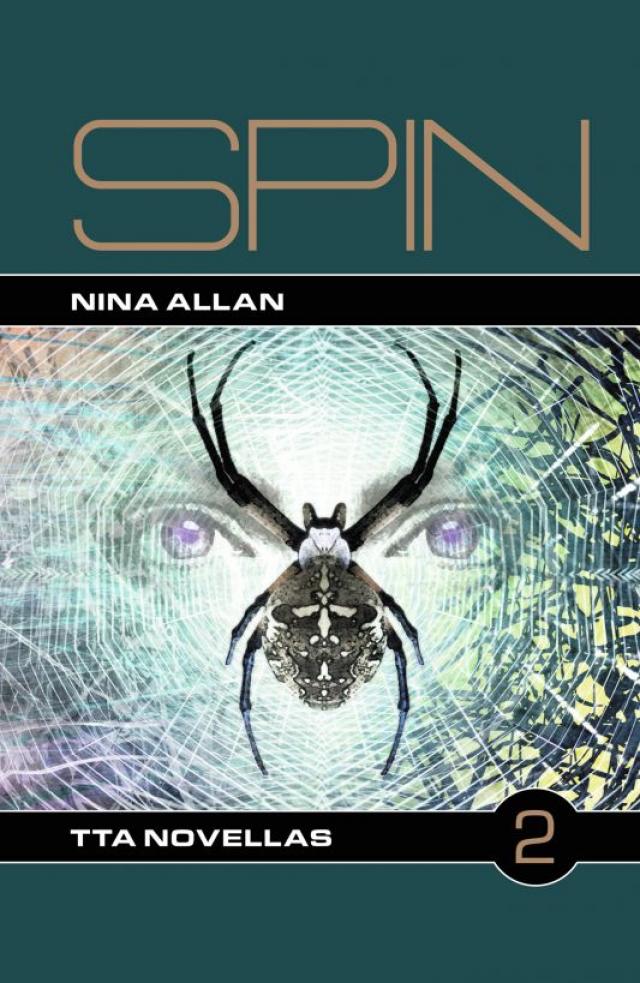
Back cover (Art by Ben Baldwin) follows:
Return to CONTENTS
Return to START
Table of Contents
SPIN
CONTENTS
START
Nina Allan, Spin