

Complete Works of Arrian (Delphi Classics) (Delphi Ancient Classics Book 34), page 1


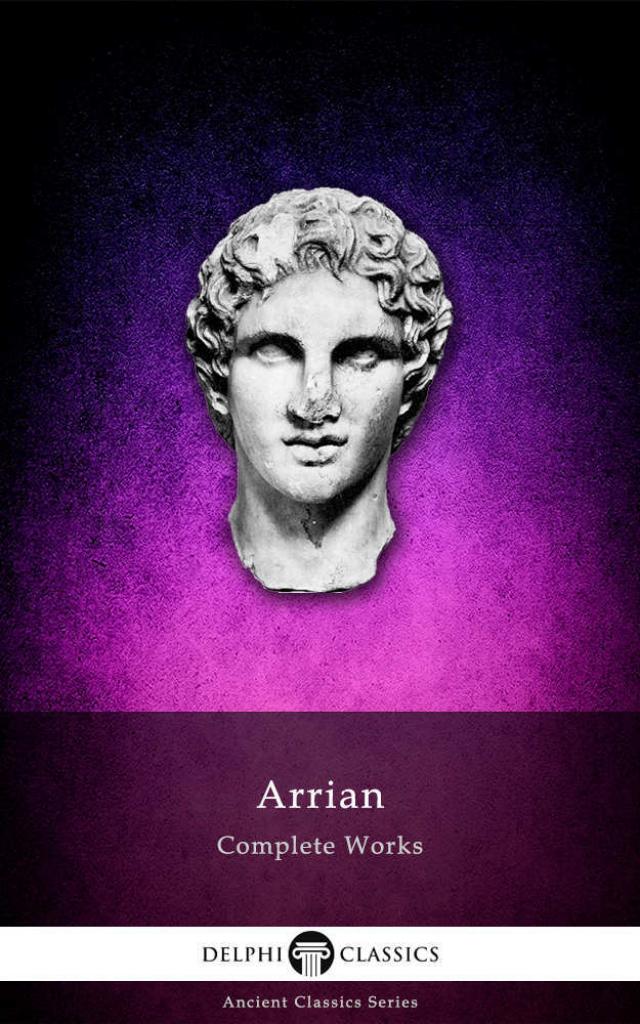
The Complete Works of
ARRIAN
(c. 86 AD– c. 160 AD)
Contents
The Translations
ANABASIS OF ALEXANDER
INDICA
DIATRIBES
ENCHEIRIDION
THE PERIPLUS
CYNEGETICUS
The Greek Texts
LIST OF GREEK TEXTS
The Dual Text
DUAL GREEK AND ENGLISH TEXT
The Biographies
THE LIFE OF ARRIAN by E. Iliff Robson
LIFE AND WRITINGS OF ARRIAN by E. J. Chinnock
The Delphi Classics Catalogue
© Delphi Classics 2014
Version 1
The Complete Works of
ARRIAN
By Delphi Classics, 2014
COPYRIGHT
Complete Works of Arrian
First published in the United Kingdom in 2014 by Delphi Classics.
© Delphi Classics, 2014.
All rights reserved. No part of this publication may be reproduced, stored in a retrieval system, or transmitted, in any form or by any means, without the prior permission in writing of the publisher, nor be otherwise circulated in any form other than that in which it is published.
Delphi Classics
is an imprint of
Delphi Publishing Ltd
Hastings, East Sussex
United Kingdom
Contact: sales@delphiclassics.com
www.delphiclassics.com
The Translations
Ruins at ancient Nicomedia — Arrian’s birthplace. Nicomedia was the capital of the Roman province of Bithynia, in what is now north-western Turkey, 50 miles east of Byzantium (Istanbul).
ANABASIS OF ALEXANDER
Translated by E. Iliff Robson
The Ἀλεξάνδρου ἀνάβασις, which concerns the military campaigns of Alexander the Great, is widely regarded as the most important historical source on the famous commander. The Greek term anabasis refers to an expedition from a coastline into the interior of a country, making a more literal translation of the title: ‘The Expedition of Alexander’. Arrian’s work on Alexander is one of the few surviving complete accounts of the Macedonian conqueror’s expedition. The historian was able to use sources which are now lost, such as contemporary works by Callisthenes, the nephew of Alexander’s tutor Aristotle, as well as Onesicritus, Nearchus, Aristobulus and the slightly later work of Cleitarchus. Most important of all, Arrian possessed a copy of the biography on Alexander by Ptolemy, one of Alexander’s leading generals and possibly his half-brother.
Arrian’s Anabasis of Alexander is primarily a military history, recording little of Alexander’s personal life, his role in Greek politics or the reasons why the campaign against Persia was launched in the first place. In the work, Arrian claims that Alexander’s greatness is worthy of praise and glory, and should be known by future generations. It is apparent from the first that the historian intended to make his subject’s life a legend through his writing.
At the time of Arrian’s life, the common Greek language of the Hellenistic and Roman periods was in universal spoken use. As a writer, Arrian was obliged by the prevailing literary custom of his time to compose his works in “good Greek,” which meant imitating as closely as possible the grammar and literary style of the Athenian writers of the 5th century BC; for example, the Attic style of Xenophon and Thucydides. Therefore, the style of the Anabasis of Alexander is inevitably stilted and artificial, although Arrian handled the strain of writing 500-year-old Greek better than some of his contemporaries. Xenophon was a good model of clear and unpretentious prose, which Arrian faithfully followed.
Arrian’s history of Alexander is generally considered by many to be a reworking of Ptolemy’s biography, though enhanced with material from other writers, particularly Aristobulus. As Ptolemy was a general, Arrian relied on him as a professional of military science for details of Alexander’s battles, on which Ptolemy was certainly well informed. Details of geography and natural history were taken from Aristobulus, although Arrian himself had a wide knowledge of Anatolia and other eastern regions.
The Anabasis of Alexander gives a reasonably full account of Alexander’s life during the campaign and in his personal assessment of the conqueror, Arrian adopts a neutral tone, avoiding flattery and censure. Instead, we are given a more realistic portrayal of the famous general. The historian concedes Alexander’s sensibility, vanity and weakness for drink and yet acquits him of the grosser crimes some historians have accused him of.
Philip II of Macedon, Alexander’s father
Bust of a young Alexander the Great from the Hellenistic era, British Museum
‘Alexander fighting king Darius III of Persia’, a mosaic dating from c. 100 BC, originally from the House of the Faun in Pompeii, now housed in the Naples National Archaeological Museum.
CONTENTS
BOOK I
PREFACE TO VOLUME I
BOOK II
BOOK III
BOOK IV
APPENDIX
PREFACE TO VOLUME II
BOOK V
BOOK VI
BOOK VII
MAP I.
Map of Alexander’s Empire and his route
BOOK I
PREFACE TO VOLUME I
Wherever Ptolemy son of Lagus and Aristobulus son of Aristobulus have agreed in their histories of Alexander son of Philip, I record their story as quite accurate; where they disagree I have chosen what I feel to be more likely and also better worth the narrating. Others have given various accounts of Alexander, in fact there is no one over whom historians have been more numerous and less harmonious. My own view is that Ptolemy and Aristobulus are more trustworthy narrators, for Aristobulus took the field with King Alexander; Ptolemy not only did the same, but, as he was a king himself, falsehood would have been more shameful to him than to anyone else. Besides, since Alexander was dead when they both wrote their histories, there lay on them neither any constraint nor any hope of gain in writing other than plain fact. Parts, however, of the records of others, such as appeared to me worthy of narration and not wholly untrustworthy, I have included as so much tradition about Alexander. Should anyone be surprised, when there is such abundance of writers, that it should have occurred to me also to compose this history, I beg him to reserve his surprise till he has first surveyed their work and made the acquaintance of mine.
I. The death of Philip is placed in the archonship of Pythodemus at Athens; Alexander, then about twenty, succeeded, being Philip’s son, and came into the Peloponnesus; so runs the story. There he gathered together the Peloponnesian Greeks and requested from them the leadership of the Persian expedition, which they had already granted to Philip. All agreed except the Lacedaemonians, who replied that their country’s custom did not permit them to follow others; it was theirs to take the lead of others. The Athenians also made some show of violence; but they collapsed at Alexander’s first approach and conceded to him a position even more honourable than had been given to Philip. Alexander then returned to Macedonia and began to get ready for the Asian expedition.
In the spring he went Thracewards, to the Triballi and Illyrians, since he learned that they were restless: moreover, as they marched with his borders, he did not think well to leave them behind him, when going on an expedition so far from home, unless they were thoroughly subdued. Starting from Amphipolis, he invaded Thrace, that is, the territory of the independent Thracians, with Philippi and Mount Orbelus on his left. Then — so the historians tell us — he crossed the river Nessus and in ten days reached Mount Haemus, where there met him in the defile of the approach to the mountain many of the merchants in arms and the independent Thracians; they had occupied the height of Haemus, and were all ready to bar the progress of the expedition, which must needs pass the height. Collecting carts, and throwing them in advance, they proposed to use the carts as a stockade from which to put up a defence, if they were pressed; but it was also part of their strategy to launch the carts at the Macedonian phalanx as the troops mounted the slope just where the mountain was most sheer. Their idea was that the closer the phalanx when the descending carts charged it, the more their violent descent would scatter it.
Alexander, however, consulted how he could most safely cross the ridge; and since he saw that the risk must be run, for there was no way round, he sent orders to his men-at-arms that at whatsoever time the carts swooped down the slope upon them, those who, being on level ground, could break formation, were to part to right and left, leaving an avenue for the carts; those who should be caught in the narrows were to form close together; and some actually falling to the ground were to link their shields closely together so that the carts coming at them and (as was to be hoped) bounding over them by their gathered impetus should pass through without doing harm. And thus it happened, according to Alexander’s orders and anticipation. The one lot parted their phalanx, and the carts sliding over the shields of the others did little harm; not one man perished beneath the carts. The Macedonians now took heart of grace, finding that those most dreaded chariots proved harmless, and raising their cheer charged the Thracians. Alexander sent for the archers from the right wing to the front of the other phalanx — this being the more convenient side — to shoot thence at the Thracians whenever they attacked. He himself took the shock-troops, the Foot Guards, and the Agrianes, and led them to the left, where the archers by their volleys held up any advances of the Thracians, and the phalanx had no grave difficulty, coming to close quarters, in driving from their position the lightly clad and ill-armed highlanders; who, in fact, did not await Alexander leading on his men from the left, but casting away their arms helter-skelter fled down the mountain-side. Fifteen hundred perished; few were captured alive, by reason of their speed and their local knowledge; the women, however, who had followed them were all taken, with the children, and all their impedimenta.
II. Alexander sent the booty to the rear, to the cities on the coast, appointing Lysanias and Philotas to deal with it; then himself crossing the ridge he marched through Haemus to the Triballians, and so arrived at the River Lyginus; as you approach Haemus, it is three days’ march from the Ister. Syrmus, King of the Triballians, learning some time before of Alexander’s march, sent on the women and children to the Ister, ordering them to cross to an island in the river called Peuce. To this island the Thracians who are neighbours to the Triballians had fled on Alexander’s approach, and Syrmus and his suite also; but the mass of the Triballians fled back to the river whence Alexander had started out the day before.
Hearing of their move, Alexander turned back to attack the Triballians, and found them already encamping. They, caught as they were, formed line near the glen by the river; but Alexander in person, throwing his phalanx into deep formation, led it against them, ordering the bowmen and slingers to skirmish ahead and discharge their arrows and stones upon the tribesmen, to see if he could entice them into the open from the glen. They, when in range, receiving these volleys, rushed forward upon the bowmen to come to grips with them, being unarmed as bowmen are. But Alexander having brought them out of the glen ordered Philotas to take the cavalry of upper Macedonia and charge their right wing, where they had advanced farthest in their outward rush. Heracleides and Sopolis he ordered to lead the cavalry from Bottiaea and Amphipolis against the left wing. The foot phalanx, and the remaining cavalry, which he deployed in advance of the phalanx, he led against the centre. While the battle was still at long range, the Triballians held firm, but when the phalanx in close formation charged them stoutly and the cavalry, no longer shooting, but actually thrusting them with their horses, fell on them here, there and everywhere, the enemy turned and rushed through the glen to the river. Three thousand perished in the flight, but only a few were caught alive, owing to the density of the wood which lay in front of the river, and because nightfall prevented the Macedonians from any thorough pursuit. Of the Macedonians, according to Ptolemy, eleven cavalry-men and about forty foot-soldiers perished.
III. Three days after the battle Alexander reached the Ister, the greatest river of Europe, draining the greatest tract of country and acting as a barrier to very warlike tribes, Celts for the most part — its springs rising in Celtic territory; the farthest of these peoples are the Quadi and Marcomanni; then it passes the Iazuges, a branch of the Sauromatae; the Getae, who call themselves immortals; the bulk of the Sauromatae; and the Scythians as far as the outlets; where through five mouths it runs into the Black Sea. There Alexander finds at the mouth of the river warships come to join him from Byzantium through the Black Sea. These he manned with archers and men-at-arms and sailed against the island where the Triballians and Thracians had taken refuge, and endeavoured to force a landing. The tribesmen, however, kept swooping down to the river-side wherever the ships touched land; these were few in number, and carrying only a small body of troops; the island was for the most part steep for landing; and the current past the island, as was natural in the narrows, was swift and difficult to contend with.
Thereupon Alexander withdrew his troops and decided to cross the Ister to attack the Getae who were settled on the farther side, both because he saw a large force of them gathered on the bank, to repel him, should he cross — there were about four thousand mounted men, and more than ten thousand on foot — and also because he had been seized with a desire to land on the farther side. He himself embarked in the fleet; the leather tent covers he had filled with the hay, and gathering all the available boats, cut from single trees, from the countryside (there were plenty, for the river-side dwellers use them for fishing, for up-river expeditions among themselves, and even more for thieving), he ferried across on these as much of his force as was possible. About fifteen hundred cavalry and four thousand foot-soldiers crossed with him.
IV. The crossing was made at night where there was a deep cornfield, and this concealed them the more, as they kept close to the bank. About dawn, Alexander led the troops through the field, ordering the infantry to smooth down the corn with their spears, held obliquely, and so lead the way to untilled ground. As long as the phalanx was marching through the com the cavalry followed; but when they emerged from the tilled land, Alexander in person took off the cavalry to the right wing, ordering Nicanor to lead off the phalanx in oblong formation. (On open ground the various units formed squares, and the whole phalanx, moved κατά κépas, in rectangular shape, broader than it was deep.) The Getae did not sustain even the first charge of the cavalry; for Alexander’s bold stroke came as a great shock to them, in that he so easily crossed the Ister, greatest of rivers, in one night without so much as bridging the stream; the solidity of the phalanx was terrifying, and the onslaught of the cavalry violent. First the enemy took refuge in the city, about a parasang away from the Ister; then, seeing Alexander bring up his phalanx along the river, that the infantry might not be caught by any ambush of the Getae, with the cavalry on the front, the enemy deserted in turn their city, which was feebly fortified, taking up on their cruppers as many of the women and children as the horses could carry; and then marched as far as possible away from the river towards the desert. Alexander captured the city and whatever plunder the Getae had left behind. This plunder he ordered Meleager and Philip to take to the base; he razed the city and sacrificed on the bank of the Ister to Zeus the Preserver and Heracles and Ister himself, for permitting the passage. Then in daylight he took all his force safe and sound back to the camp.
At this juncture came commissioners to Alexander from the other self-governing tribes along the Ister and from Syrmus, King of the Triballi; others from the Celts settled on the Ionian gulf. The Celts were tall and haughty; but all professed desire for Alexander’s friendship, and he gave to all, and received from all, proper assurances. Of the Celts he enquired what, of mortal things, they most dreaded, hoping that his own great name had reached as far as the Celts and farther, and that they would confess that they dreaded him beyond all else. Their answer, however, proved unexpected to him, for, living as they did in difficult country far from Alexander, and seeing that his invasion was really directed elsewhere, they said that their greatest dread was lest the sky should fall upon them. He declared them his friends, made alliance, and sent them home, casually remarking, “What braggarts these Celts are!”
V. He then went towards the Agrianes and the Paeones. There a message reached him that Cleitus son of Bardylis was in revolt, and that Glaucias, king of the Taulantians, had joined him. The messengers also told him that the Autariates were going to attack him on his march. For these reasons it was thought well to move off as soon as possible. Langaros, king of the Agrianes, was known to have shown regard for Alexander even in Philip’s lifetime; he had also been on an embassy to him personally; on the present occasion he was in attendance on Alexander with his bodyguard, the finest and best-armed troops he had; and when he learnt that Alexander was enquiring who and in what numbers these Autariates were, he told Alexander that he need not trouble about them, they were the least warlike of the tribesmen in those parts; he would himself invade their country, so that they might rather be occupied with their own affairs. Alexander agreed, and he invaded them, devastating their country.


