Shot With Crimson, page 1


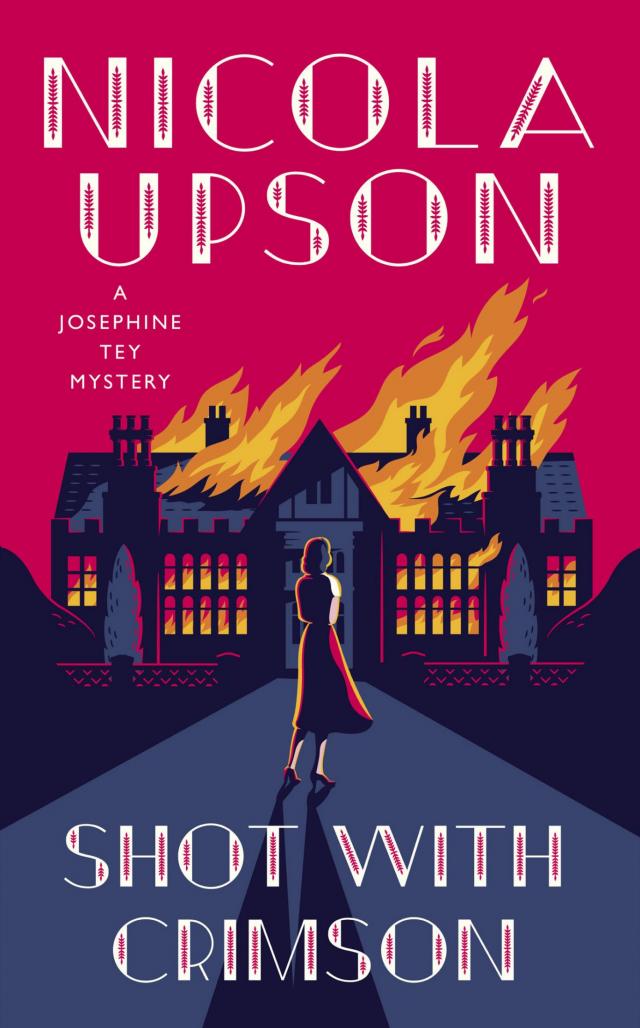
SHOT WITH CRIMSON
A JOSEPHINE TEY MYSTERY
Nicola Upson
For Walter Donohue, with love
The sky above our heads was inky black. But the sky on the horizon was not dark at all. It was shot with crimson, like a splash of blood. And the ashes blew towards us with the salt wind from the sea.
—Daphne du Maurier, Rebecca
SUMMER 1917
PROLOGUE
The road was long and dreary, at least to my ten-year-old eyes. I was used to a life of colour, and I found its absence puzzling: vast grey skies that weighed heavily on the day; the dark fenland soil, stretching for miles on either side; a ribbon of tarmac, scarcely wide enough to hold the car. Every now and then, the monotony was broken by a house with a brightly painted fence or a thicket of green, but those moments were rare, and when they came, only emphasised the blandness of the world around them. It depressed me, that landscape, for reasons I would have found hard to explain; the house itself was a happy place, but the journey never failed to make me sad.
‘Daphne?’ My father’s voice was sharp, as it always was when he found me quiet or withdrawn, too lost in a world that didn’t involve him. He caught my eye in the rearview mirror and smiled, still happy and affectionate in those early years. I sat in the back of the car, sandwiched contentedly between my sisters, listening as he and my mother talked about the friends they were going to visit, the children we would get along so well with, the adventures we would have in a house so much bigger than our own. He was right about the house. Dear old Milton, the essence of Manderley—a fine country mansion, set in sprawling parkland and loved by one family for generations. Milton was as open as Manderley would be secretive, her life lived robustly in the present moment, but the spirit of those rooms found its way so easily to the pages of Rebecca, as vivid to me then as at our first meeting, on that summer’s day when the war was grinding slowly to a close.
The journey seemed interminable, but at last we entered the grounds by a single-storey lodge, its windows wide open and a family’s washing hung on the line in a neat, enclosed garden. The driveway didn’t twist and turn like Manderley’s, and its bushes weren’t hostile or menacing. Instead, the lane cut politely through ground that rose and fell, flanked by heavily wooded plantations kept firmly within their boundaries. By the time the trees cleared, the sun had burnt through, and we emerged into a different, cloudless day. In keeping with the fairy tale, another building appeared up ahead, a sort of miniature chapel made from honeyed stone, with little turrets and a circular window above the door—Gothic, I would say now, but back then it seemed too strange and too magical to be so easily classified. The building fascinated me, but it held no novelty for my parents, and we drove quickly past, stopping only at a crossway where several drives met. I heard my father mutter something about Piccadilly Circus; to this day, I don’t know if it was a joke or if that’s what the junction is really called.
The car swung with a flourish onto the gravel at the front of the house, and there it was before me for the first time—elegant rather than imposing, with handsome Elizabethan stonework and a host of mullioned windows, embattlements, and attic rooms that seemed to promise adventure. I’m not sure I can say why it made such an instant and lasting impression on me. Perhaps it was simply the exhilarating freedom of childhood and the first big house I had known, or the feeling—so tangible during the war—that our world was hovering on the brink of change. Lately, I’ve begun to think that it was more than that, even then; a premonition of some kind, a certainty that what happened while we were there—innocent, illusory, never fully understood—would eventually touch us all.
There were glass houses and a walled garden nearby, and a stable block adjoined the house. As we got out of the car, hot and sticky from the drive, I could hear the sound of horses’ hooves, and—in the distance, somewhere over to my left—a fountain. The tranquillity barely had time to register before it gave way to other noises growing louder through the trees, the choke of an engine and the crunch of heavy tyres over stones. Behind us, the door of the house flew open, and five or six people emerged, but they were not the family that my parents had described; they were women in nurses’ uniforms and men dressed in khaki, and they looked at us with annoyance, as if we were in the way. My father drew me protectively towards him, and I felt the heat of his hand on my shoulder. ‘It’s all right, Daphne,’ he said. ‘The house is a hospital for the war, but there’s nothing to be frightened of. They’re taking care of our boys, making them strong again.’
In spite of his reassurance, I remember thinking at the time that the war was coming straight towards me, that the invasion we’d been conditioned to fear had finally arrived. There were five vehicles in all, three ambulances and two open-topped buses, and from where I was standing, the convoy looked as if it were forcing its way through the line of lush, green laurel bushes. As it drew closer, the atmosphere amongst the men on board seemed to sap every bit of hope from the day. Some of the soldiers hung their heads, and all I could see was the top of a helmet; others leant quietly against their neighbour for support. A foreign sun had tanned their skin as it had bleached the colour from their clothes, and rusted bloodstains stood out against white rags, incongruous in the English countryside. What struck me most, I recall, was how dirty they were, like animals rolling in a field. I could never have known at that age how apt a comparison it was.
The walking wounded disembarked in a muddle of boots and elbows and breath, and the exhaust fumes that had been so overpowering were replaced by the pungent smell of sweat and leather. They stood bewildered in a group, waiting for someone to tell them what to do while their less fortunate colleagues were unloaded gently but efficiently from the ambulances and taken into the Hall first. I remember wondering why my father had called them ‘boys’ when they seemed so old and defeated. As I stared, unable to help myself, I locked eyes with the man on the nearest stretcher, his sunburnt face stark against the pillow, the mud of the trenches still thickly encrusted on his boots. I felt myself flush, but the soldier simply looked back, doggedly blank, as if the world I belonged to was something he had long ago lost touch with.
We were rescued by my mother’s friend—kind and gracious and ethereal, like someone from a Barrie play. She swept us through the house to the family’s wartime quarters, a modest set of rooms between the kitchen and what was now an operating theatre, and I could see by the look on my parents’ faces how much had been lost in the relinquishing of privacy and comfort. To my sisters and me, though, the hustle and bustle seemed noble and exciting, an adventure in which we could share without any noticeable hardship to our own lives. My earliest memories from inside the house are jumbled now, and some seem more dreamlike than others: men in loose-fitting convalescent uniforms, huddled round one end of a dining table while a butler looked on; a group of soldiers playing billiards under a Rembrandt; rows of empty deck chairs stretched out along the south terrace; dishes piled high with mashed potato. I remember very clearly the banter and the coughing, the clatter of knives and forks, and the scraping of chairs across polished floors. When we got to the family’s private dining room, which had pink and white walls and an enormous clock built into the fireplace, we ate delicate food off plates that were painted with birds.
After lunch, we were told to run along and play while the grown-ups talked. The hospital areas were strictly out of bounds, but the gardens and family rooms would be ours to explore for the duration of our stay. If we’d done as we were told, the afternoon would have passed innocently enough, I suppose, but our guide was a pale-faced little boy who seemed unfazed by the invasion of his home, and he was as eager to break the rules as we were to lead him astray. Within minutes, we found ourselves in a long gallery which had been transformed into a ward. I waited to be shooed away, but the nurses smiled at the boy of the house, obviously used to seeing him there, and nobody asked us to leave. The room was naturally light and airy, decorated in a restful green with white stucco leaves and ribbons. Generations of the family looked down at us from the walls, but their disapproving stares were obscured now by bed railings and medical equipment, and the essential femininity of the room jarred with those who occupied it. There was an air of calm about it, and I wondered how it must feel to these men to come from the world of blood and dirt that I had glimpsed outside to this haven of peace, where the only disturbance was the shaking and folding of a sheet, the scrubbing of a floor. Every now and then, a cry of pain rose above the ordinary sounds of the afternoon, and a nurse moved silently to one of the beds, a red cross emblazoned on her chest. Another sat by a soldier’s side, her face close to his as he struggled to dictate a letter home, and I found myself imagining what he might be saying and who was waiting anxiously for those words. I was so caught up in my own invented world that I didn’t notice the others leave.
Less brave on my own, I went back to the hallway to look for my sisters, but they were nowhere in sight. There was a breeze coming from the end of the passage, so I went towards it, hoping to find a way out to the garden and drawn, in any case, to the sound of a gramophone. This room was smaller than the converted ward, but just as light and pleasant, with pillars at intervals all the way down and a sarcophagus filled with ferns in the centre. It led out to the terrace, and the French doors were all wide open, their curtains billowing gently. Some of the soldiers were resting under awnings in the open air. Beyond them, on the lawn in front of the house, others played croquet, the blue of their uniforms patriotically offs
The model was exquisite, a miniature replica of Milton that somehow seemed more real than the building we were standing in. He smiled when he saw my delight in it, and turned it this way and that to show me the detail—the bays and the central porch that we had entered by, the softer south side that I had yet to see, the chimneys and parapets. Everything was perfectly proportioned, so vivid and lifelike that I half expected to see a figure at one of the windows, and I watched as he showed the soldier how to cut the matches to form joints for the angled rooftops, waiting patiently while he got the hang of it. There was a sheaf of papers on the table, designs for all sorts of models drawn carefully to scale, and he pushed them towards me to look through, then gave me his name and asked for mine.
‘Are you a clever girl, Daphne?’ he asked, when we had chatted about my family and what we were doing there. I’d often been told that I was, so I answered truthfully, without hesitation, and he smiled. ‘Then would you do something for me?’
He reached into his trouser pocket and took out another model, this time of the Gothic folly that had intrigued me so much on the way in. It was even smaller in scale than the miniature of the Hall, but its features were perfectly formed, and my face must have lit up as I studied the spires and arches that had disappeared too quickly through the window of the car, hardly able to believe that something so delicate could exist. ‘I made this for someone who’s not very well, but I’ll get in trouble if I leave the ward. Would you deliver it for me if I tell you where to go?’ I hesitated, unsure of the vast house and labyrinthine corridors that were still so strange to me, but he had the measure of a curious ten-year-old. ‘I’ll make you one just like it if you’ll do this for me—but keep it to yourself, do you understand?’
Who doesn’t love being part of a secret? The challenge was almost as irresistible as the bribe, and anyway, I wanted to please this clever, gentle young man who could apparently do magic. There could be nothing wrong, I told myself, in such an act of kindness. I took the present and listened carefully as he told me where to go; then he squeezed my shoulder and wished me luck. ‘Come and tell me when you’ve done it,’ he said, ‘and thank you, Daphne.’ I turned to look back from the doorway, wanting, I suppose, a last scrap of encouragement, but he was already engaged with the soldier again, talking to him as if he were the only other person in the world, and I wondered briefly what it must be like to have that sort of attention. Disappointed, I hurried to the main hallway before I could forget the directions he had given me. That huge staircase, with its gilded, wrought iron banisters, still seems grand to me, even now, but it was a thousand times more daunting to a child, and I felt very small as I climbed timidly up to the first landing, where a lead-paned window looked out over parkland and grazing sheep. The stairs split to the left and right, and I hesitated for a while, waiting for a nurse to pass me and hoping that I wouldn’t be challenged, then glancing in both directions and taking the right-hand side as instructed. The window leads threw crisscross patterns onto the walls and carpet as I climbed another short flight of steps and found myself at the head of a long, narrow corridor with closed doors on either side—never had I seen so many closed doors. A welcome shaft of light came from the window at the end, and I moved forward slowly, conscious of the alternating patches of sun and shade on my face, counting the doors carefully to make sure I chose the right one. When I was certain, I reached up towards the handle, startled for a moment by the silhouette of my own hand against the wood, enlarged and distorted in the shadows.
It should have occurred to me that someone else might be in the room, but I was too intent on my mission to stop and think. The door was opened from the inside before I had a chance to touch it, and I was confronted by a woman dressed entirely in black, a crucifix hanging at her neck. I had no idea who she was, of course, and I never knew her name, but she stood looking down at me, an expression of pure hatred on her face, and instinctively I put my hands behind my back, hoping to hide the model. I wanted to run, but she seemed to hold me with that stare. Forced to articulate her now, I find myself automatically falling back on the words that were always in my mind when I wrote Danvers—the hollow eyes, the white skull’s face, a child’s view of the witch from a fairy tale. Was she really like that? Those memories may or may not be real, and I have no way now of knowing, but—accurate or not—they refuse to be shaken. How foolish of me to imagine that I had ever made her up.
She asked me who I was and what I was doing there, her voice taut with anger, and I backed away down the corridor. My silence only infuriated her more, and as she stretched out her hand to shake the answers from me, I found my feet and ran. Everything is a blur after that, although I know that she followed me as far as the stairs, shouting as she went, and I know I heard a noise like the crack of a whip soon afterwards—but I was too desperate to get outside to consider what that might have been, and in any case, as soon as the sun hit my face and I saw my sisters playing on the lawn, the whole thing seemed like a terrible dream. I never told anyone what had happened, not even Angela or Jeanne. For a while, I dreaded bumping into my magician and having to admit that I had failed him, but I needn’t have worried: I never spoke to him again, and eventually he faded from my thoughts. Until today, I had no idea what had become of him, no notion that—in a very different way—he had worked his magic for me a second time. I wonder if he made the connection or if he even remembered the clever little girl who let him down?
When I saw the model of the Hall again, a few days into our stay at Milton, it had been smashed to pieces, although I don’t know by whom. I still have the miniature he gave me, a gift made for another, and it was wrong of me to keep it. It’s there on the bookshelf, next to the jay’s feather from the woods at Menabilly and the photograph of my father in his dressing room, and every time I look at it now, I can’t help but wonder if I could have changed things. If I’d got there earlier, if I hadn’t hesitated on the stairs, if I’d been braver in facing her, would the years have turned out differently? But that was in the past, I tell myself. The trick, as most of us know, is to keep it there.
SEPTEMBER 1939
1
The boat train pulled slowly into its designated platform by the side of the ocean dock, and Josephine breathed a sigh of relief, taking more pleasure than she would ever have believed possible from the prospect of leaving the country. The sense of anticipation among the passengers had built steadily during the short journey from Waterloo to Southampton, and now that they were within walking distance of the ship that would take them across the Atlantic, some could barely contain their excitement. She wished her own emotions were that simple, but this impatience to get underway had very little to do with the romance of travel or the thrill of America. Whichever way she looked at it, the ticket that she clutched in her hand smacked of running away, but she didn’t care. For the moment, all she longed for was to see Marta again, and to put as much distance as she could between herself and the memories of the last few days.