

Skrimsli, page 1


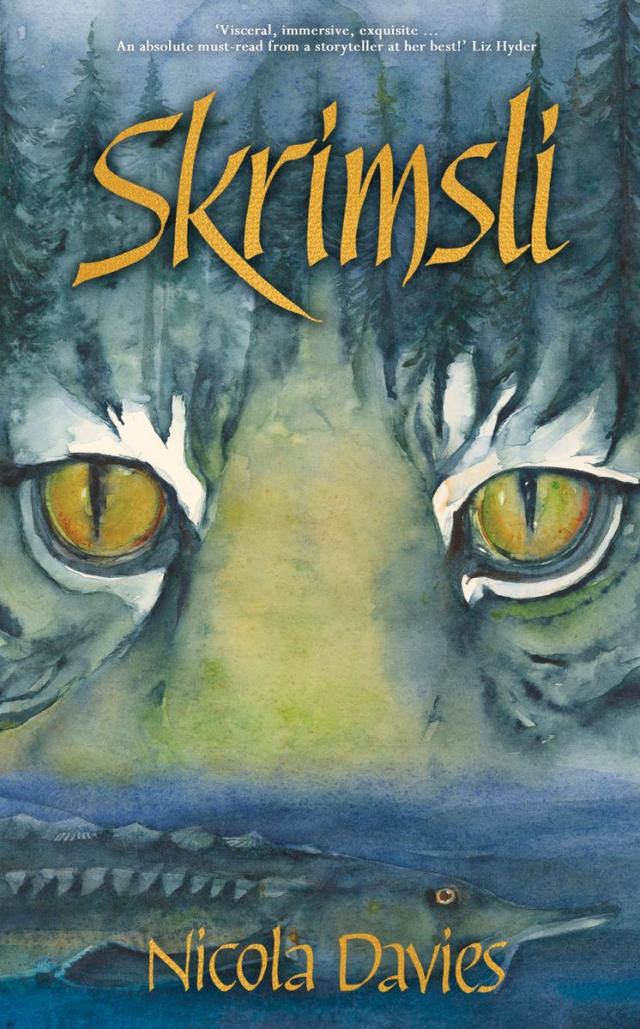
Praise for Yoto Carnegie Medal nominated
The Song that Sings Us
‘A magnificent adventure story.’
The Scotsman
‘Career-crowning.’
Observer best children’s books of the year
‘It balances the line between grief and wonder, hope and fear. I was chilled, heartbroken and felt reflected in it too, but the story, it is glorious and visionary with epic adventures and beautiful characters! I loved it so much.’
Dara McAnulty
‘A gripping adventure that will set your heart racing and stir your soul. Utterly unputdownable, packed with unforgettable animal characters (humans included) … Vivid and original, this is a story for now.’
Helen Scales
‘Beautiful. Heart-wrenching, gripping, strange and glorious. Jam-packed with brilliant characters and big ideas. Loved it! I am also now in love with a sea-faring tiger captain…’
Liz Hyder
‘Beautiful, lyrical and fast paced. The Song That Sings Us is a story of our time. It parallels the urgency of the challenges we face to protect this world.’
Gill Lewis
‘Wild, powerful and passionate, The Song that Sings Us is an extraordinary weaving of fierce action and tender poetry, a heart-wrenching yet hopeful symphony of the threads that connect all life on Earth.’
Sophie Anderson
‘… a hyper-imaginative book, bringing to mind the complete works of Philip Pullman with their sprawling cast of animal familiars, Yan Martell’s Life of Pi with which it shares a tiger on a boat – although this one has ‘fur like fire and soot, whiskers like strands of white wire, green eyes like the aurora’.’
Jon Gower, Nation Cymru
‘Captain Skrimsli!’ the woman calls out over her shoulder, and the others take up the cry. ‘Captain Skrimsli!’ Even the rowers have stopped their singing now, and instead call out one word.
‘Skrimsli! Skrimsli! Skrimsli.’
What does this mean? Is it an instruction that they need to follow?
Suddenly the cry of Skrimsli breaks down into cheers and the crew who line the gunwales step back. In their place is a huge tiger.
‘Hold on tight!’ the green-coated woman yells. ‘The captain will get you aboard!
From The Song that Sings Us by Nicola Davies
(Firefly 2021)
‘Skrimsli was not a character I planned. He happened without me having to think about him first. And then he almost took over The Song that Sings Us, so it seemed a good idea to give him a story of his own, and to tell the history of how a tiger becomes a talking sea captain!’
Nicola Davies
DEDICATION AND THANKS
This book is dedicated to everyone who struggles to
find a place where they truly belong.
With thanks (again) to my first audience: Jackie Morris,
Cathy Fisher and Molly Howell
And to my husband Dan Jones for … everything
Who are you if you’ve never seen another face like yours?
Where do you belong if you don’t know where your home is?
What do you call yourself when others call you ‘freak’?
How can you be brave when you are full of fear?
Why would you choose purpose over love?
The tiger and the sturgeon and the owl are the keepers of the forest. Each must speak to each to keep the forest whole. But the owl, who speaks to both the river and the trees, is the greatest keeper of them all
Contents
Title Page
Dedication and Thanks
1. Owl – Death and Birth
2. Kal – Dark Stars
3. Skrimsli – The Elephant’s Eye
4. Owl – The Iron Collar
5. The Palatine – Eagle Eyes
6. Kal – Night Visitors
7. Skrimsli – You Are Not Prey
8. Owl – Bargains
9. The Palatine – A Prince and his Plot
10. Kal – The Breaking Storm
11. Skrimsli – A Reckoning
12. Owl – Ancient Fishes
13. Skrimsli – The Unexpected Friend
14. Kal and the Palatine – Silken Layers
15. Owl – Learning the Story
16. Skrimsli – Skins on the Wall
17. Kal – A Map in the Sand
18. Owl – Under the Bridge
19. Skrimsli – Back in the Cage
20. Kal – Possibility and Uncertainty
21. Owl – The Eagle and the Dart
22. Skrimsli – The Pirate Princess
23. Kal – The Bird at the Gate
24. Owl – Leader of the Pack
25. Skrimsli – All at Sea
26. Kal – You Are Yourself
27. Owl – Kin
28. Ekar – New Crew, New Name
29. Kal – The Erem Plan
30. Owl – Shapes and Shadows
31. Skrimsli – Into the Dungeon
32. The Palatine – The Last Assassin
33. Ekar, Kal, Owl – Partings: Ekar
34. Skrimsli – Tiger
35. Owl – Home at Last
36. Skrimsli – The Monster
37. Owl – Nettle’s Seed
38. The Palatine – The Throne Restored
39. Kal – The Grass Ocean
Epilogue
Fun Facts
Copyright
1
Owl
Death and Birth
Night was Owl’s time. He could move around the circus like a shadow, unseen and undisturbed. He could rest amongst the animal pens in the Menagerie Marquee, listening to the rumbling talk of the elephants and the comforting snores of the sloth bears. He could poke sticks into the little stove and cook whatever food he’d scavenged from the deserted mess tent. There was no one to gawp and jeer and call him a ‘Freak of Nature: The Human Boy with the Face of an Owl!’
But tonight, Owl’s peace was disturbed, because Narastikeri, the old tigress, was dying. Everyone in the circus came to take a look at her. Saldo and Zuta, the trapeze artists, were first, Zuta sobbing into a lace handkerchief. Old Galu Mak, the dog trainer came next and whispered to the tigress through the bars, ‘You are crazy-pretty pussy cat, Madam.’ The cooks and the stable hands, the wardrobe master and the maintenance ladies, the musicians and the master of provisions, all remembered the days when Narastikeri had been the star of every show. They all filed past, peered sadly at the withered creature panting on the dirty straw, and shook their heads.
Even the ‘jantevas’ – the roadies, whose job it was to lift and carry and fix, and who treated everyone with contempt – piled out of their caravan and shuffled past to pay their respects. They clutched their caps in their big hands, mumbling like small boys at their auntie’s funeral.
Everyone took Narastikeri’s dying as a very bad omen. Another sign of the poor luck that had dogged the circus since they began this ill-fated tour. Majak’s Marvellous Circus had been sent to the mountain provinces by the Nordsky Department of National Pride. But mountain people didn’t like circuses and the weather had been harsher than anyone had expected, with heavy snow from October. The circus had ended up stranded in a small town, at the end of a broken train line, in a sea of snow. People talked of running away, but where was there to run to? Dalz and Tapis, the trick riders, had tried it two nights ago. They had vanished, with four of the best horses and a litter of beautiful hound pups that Galu Mak had planned to add to her act. Just this morning two of the horses had come back lame and spooked, without riders or pups.
‘We’re gonna die here in these damn mountains,’ Galu Mak had said.
Narastikeri’s procession of visitors continued. Owl watched them from his hiding place under the stack of benches behind the dying tigress’ cage.
The last to make a visit were the boss himself, Kobret Majak, and his bear, Karu. Kobret was almost as big as his bear, a huge man with a face as hard as a cut diamond. Karu shuffled behind him, unkempt and dead-eyed, so much under Kobret’s control as to have no real mind of his own. All the other animals drew back as Kobret and his bear passed by. They carried fear with them like a cloud.
In front of his audience Kobret Majak played the part of the jolly ringmaster. He claimed that kindness and reward were all he used to train his animals. But it was lies. Kobret possessed the power of Listening, the ability to tune into animals’ minds. He liked to deny it because it had fallen out of favour with the Nordsky Government. But he had it alright and used it to force his way into the minds of animals, to implant pain and terror. That was how he made them do the tricks that made audiences gasp in wonder.
Listeners like Kobret could not enter human minds. So he used the claws and invincible strength of his slave, the bear Karu, to terrify the humans too. Animals and people only had to look at Kobret Majak and Karu to feel afraid.
Narastikeri was almost beyond Kobret’s cruelty now. She closed her eyes and her belly heaved, trying to push out the cubs she’d carried for too short a time. It was obvious that she was slipping away, but Kobret showed no kindness or concern for the tigress who had been famous for her beauty and skill. As usual, all he thought about was money. He turned to Akit, the stable hand whose job it was to see to the care of the animals and growled.
‘I paid a fortune to get her mated to that white tiger!’ Kobret said. ‘These cubs were supposed to pay my bills.’
Karu turned to Akit and bared his teeth. The man cowered.
‘Narastikeri’s old and sick, Boss,’ Akit whispered. ‘Maybe
‘How dare you criticise me?’ Kobret roared. ‘Don’t you know how much money people will pay to pet a white tiger cub?’
Owl thought that Kobret would hit poor Akit, who raised an arm to protect himself.
‘No, no, Boss. Course not.’ Akit paused. Owl could see how much Narastikeri’s state upset him: enough to risk Kobret’s anger and Karu’s claws. ‘There is an animal healer in the town who we could ask for, Boss,’ Akit suggested quietly.
‘And what will that cost?’ Kobret hissed. ‘No. I’m not throwing good money after bad.’
‘Could I have the key to her cage then, Boss?’ Akit went on bravely. ‘So I can make her a bit more comfortable?’
Kobret turned to the stable hand and poked him in the chest with one thick finger, while Karu stood close, snarling to back up his master.
‘Comfortable? This is an animal! It is a mute, dumb beast. It’ll be dead by morning, when I’ll take the last bit of profit from it that I can: its skin. You have other work to do. Now get out, before Karu makes a meal of you!’
Karu stood up on his hind legs, towering over the man, who staggered backwards, then ran.
Kobret kicked the bars of the cage, cursed, and stalked out of the menagerie, grumbling and growling, just like his bear.
At last, apart from the usual sound of ropes and canvas arguing with the wind, it was quiet. The people had gone back to their cozy caravans to moan about this disastrous tour. The tears they cried over Narastikeri were partly shed for their own plight. Owl guessed that most of them had forgotten about the dying tigress the moment they’d left the tent.
Owl crept from his lair and sat looking through the bars at Narastikeri. Her fur was dirty and matted, and her breathing was irregular. Under her closed lids her eyeballs rolled. She gave a small growl of pain and bared her broken, yellow teeth. Years of Kobret’s cruelty had made the old tigress mean, and Owl had always been afraid of her, but his heart hurt to see her suffering like this. So he shuffled closer, then closer still, until at last he could reach out a hand to touch her head. She flinched a little at first but then she let him stroke the stripes between her eyes.
Kobret kept the only key to the cage, so Owl could not get inside, but he gave what small help he could. He fetched clean rags and water and reached through the bars to clean her crusted eyes and drip water onto her lips. But he could do nothing to help the cubs. One by one, as the night went on, they appeared, each too small and weak to take a single breath. Narastikeri tried to lick them into life, but she was barely strong enough to lift her head. Owl’s arms were too short to reach any of them – to clear their mouths and noses, or massage breath into the tiny bodies with their faint fuzz of pale fur.
The sixth cub was the last. It was not pale like the others, not one of the ‘litter of beautiful white tiger cubs’ that the Majak’s had already advertised on posters all around the snowy town. This one was the colour of fire. But it too lay still and did not seem to breathe. Owl looked at it and wondered how something so bright could not be alive.
Narastikeri managed to open her eyes and look at her last, flame-coloured child. She let out a long, low moan and Owl felt her grief envelope him. How could she be comforted, he wondered. The only comfort he knew himself was to escape to the place he kept safe inside, the great green forest where he had been born. In his mind he could plunge into its greenness, not just a colour but a feeling of home, of peace and belonging. Its trees were huge, their branches reached to the sky, their roots spoke under the brown earth. He had lived in one of those great trees, in a shelter woven out of stems and twigs like a giant nest. Many creatures thrived there, bears and owls, tigers and wolves. Ancient fish, huge sturgeon, swam in the deepest pools of the slow rivers.
In that place Owl had not been a freak. He had fitted like an eye in its socket, or a leaf bursting from a bud. He remembered arms rocking him and whispering words:
‘The tiger and the sturgeon and the owl are the keepers of the forest. Each must speak to each to keep the forest whole. But the owl, who speaks to both the river and the trees, is the greatest keeper of them all.’
Where was that forest now? Somewhere to the north was all he knew, because he had been stolen from it when he was so small. All he had to guide him was the name of his village, Bayuk Lazil, and the little wooden sturgeon on a string around his neck. He wrapped his fingers around it and whispered the words Bayuk Lazil like a spell. This was his route back to that place of green and belonging. Owl wished he could take Narastikeri with him, but he could not. Immersed in the comfort of his green home, Owl fell asleep.
He was woken by the shouts of the jantevas. It was light, the grey-blue light of a snowy landscape. In her cage, Narastikeri was quite still. The cage had been opened and the jantevas were swarming around her like eager maggots.
‘Get out of the way, Freak Boy,’ they told him. ‘We got a dead tiger to skin and get rid of.’
Owl scuttled back to the safety of the stack of benches. Even in death the tigress was formidable; it still took five men to move her out of the tent to skin her in the open, then throw her remains into a waiting cart. The sixth was left behind to clean out the cage and to scoop the dead cubs into a sack. One by one they dropped like wetted lead, but as the big hand grabbed the last one, the orange cub, it squeaked. It was alive! Owl knew the man had heard it too.
‘Leave the fire-coloured cub!’ Owl called. ‘Please!’
None of the other jantevas would have bothered to answer, but this was the one called Brack, who had a split in his lip. His brothers teased him and called him ‘freak’, the same word they used for Owl.
Brack shook his head. ‘Orders!’ he said. ‘Orders.’
‘Where will you take them?’ Owl asked.
‘Ground’s too ’ard for burying,’ Brack lisped in reply. ‘Boss says drop ’em through the ice on the lake.’
He hurried away, with the sack over his shoulder.
Owl waited for the sound of the cart’s wheels crunching over the snow before he moved. He didn’t want the jantevas to see him. Then he hurried from the tent, turning his eyes from the bloody stain on the snow where the tigress had been skinned. Owl knew a short cut, a path the townspeople used, that ran from the perimeter fence around the circus, between the trees, down to the jetty at the lakeside. That would be where they’d take Narastikeri and her cubs. Owl ran along it, his short legs struggling through the snow, his arms flailing. But even his fastest pace was much too slow. By the time he had reached the lake, the jantevas were on their way back and their cart was empty. He was too late. A jagged hole in the ice showed black water where the bodies had been dumped. He lay down on the jetty and stared into the ice hole. Nothing. Narastikeri’s body must have sunk straight to the bottom. He leaned further, trying to look through the blackness. There! There! His heart skipped; the sack had caught on something below the surface. He could see it still floating, almost within reach.
How long would a sickly newborn cub survive in ice-cold water? Not long. Heart racing, Owl wrenched a fallen branch from the snow-covered tangle of undergrowth and struggled with it to the jetty’s end. He took two goes to hook the sack with the crooked, unwieldy thing. Then more long moments to loosen the knotted string that tied the neck of the sack. Finally, he reached inside and pulled out the fire-coloured cub.
It was a male, or would have been, but it was stone cold, still and limp. Owl sat down. He had thought himself hardened beyond crying, but tears came into his eyes now as the cub lay like a rag in his lap. Owl felt defeated, more beaten than ever before. Then he remembered something he’d once seen Galu Mak do with a newborn pup that hadn’t breathed. She’d held the little creature by its back legs and swung it round. He remembered how the pup had spluttered into life. Owl stood up; he held the cub dangling by its back legs. It seemed so brutal, but he had to try. He swung the cub around his head. Water flew from its drenched coat and its small tail flopped about. He swung again. Once, twice. Nothing.





