The Woman in the Lake, page 1


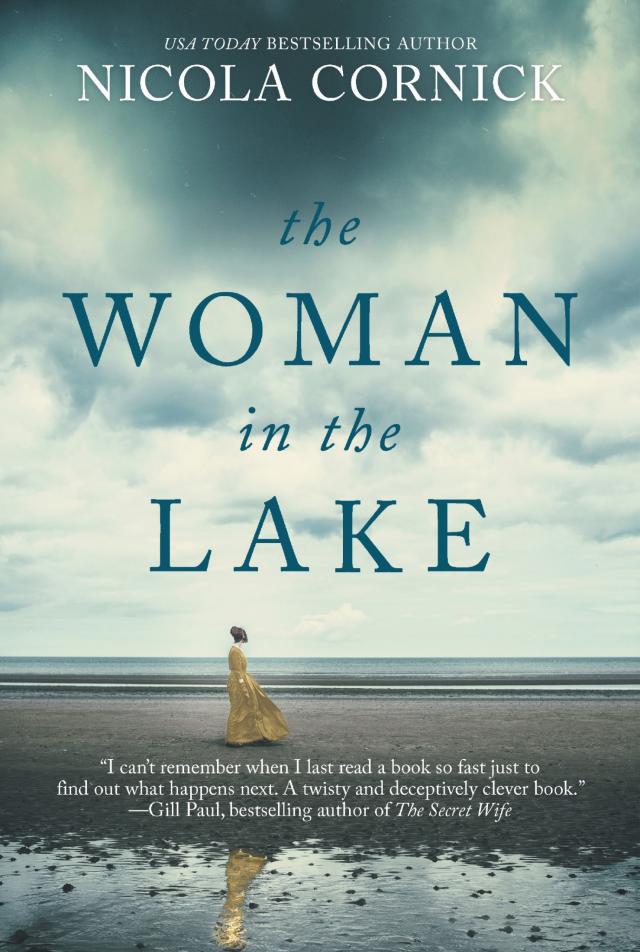
From the bestselling author of House of Shadows and The Phantom Tree comes a spellbinding tale of jealousy, greed, plotting and revenge—part history, part mystery—for fans of Kate Morton, Susanna Kearsley and Barbara Erskine
London, 1765
Lady Isabella Gerard, a respectable member of Georgian society, orders her maid to take her new golden gown and destroy it, its shimmering beauty tainted by the actions of her brutal husband the night before.
Three months later, Lord Gerard stands at the shoreline of the lake, looking down at a woman wearing the golden gown. As the body slowly rolls over to reveal her face, it’s clear this was not his intended victim…
250 Years Later...
When a gown she stole from a historic home as a child is mysteriously returned to Fenella Brightwell, it begins to possess her in exactly the same way that it did as a girl. Soon the fragile new life Fen has created for herself away from her abusive ex-husband is threatened at its foundations by the gown’s power over her until she can't tell what is real and what is imaginary.
As Fen uncovers more about the gown and Isabella’s story, she begins to see the parallels with her own life. When each piece of history is revealed, the gown—and its past—seems to possess her more and more, culminating in a dramatic revelation set to destroy her sanity.
Praise for
THE WOMAN IN THE LAKE
“A fascinating tale with intriguing twists, which kept me reading late into the night.”
—bestselling author Barbara Erskine
“Nicola Cornick is the mistress of keeping you up way beyond lights out because you just can’t put it down.”
—bestselling author Katie Fforde
Select praise for the novels of Nicola Cornick
THE PHANTOM TREE
“There is much to enjoy in [this] sumptuous novel.”
—Sunday Mirror
“Filled with romance, drama, mystery and intrigue. Perfect for fans of Tracy Rees, Barbara Erskine, and Kate Riordan.”
—Historical Novel Society
“A brilliant time-slip novel with a great twist in the tail!”
—Woman magazine
HOUSE OF SHADOWS
“Atmospheric and elegant, House of Shadows casts a hypnotic spell.... [It] blends a supernaturally tinged historical drama à la Outlander with a cozy village mystery to addictive, mesmerizing effect.”
—BookPage
“For fans of Barbara Erskine and Kate Morton comes an unforgettable novel.... House of Shadows delivers all that it promises.”
—Heroes and Heartbreakers
“There’s a beautiful and ethereal feel to the story, and I found myself with chill bumps reading late at night.... Delightfully atmospheric, House of Shadows is masterfully spun out, [and] deftly performed. Fans of Susanna Kearsley will enjoy this book.”
—Fresh Fiction
“Popular fiction author Cornick skillfully packages all [the plot] elements into an enjoyable read.”
—Booklist
“Fans of Kate Morton will enjoy this gripping tale.”
—Candis magazine
“A must-read for fans of romantic time-slip novels. An intriguing journey that weaves between the 17th-century life of the Winter Queen, Elizabeth of Bohemia, and a modern-day missing-person case.”
—Historical Novel Society
“A gripping read.”
—BBC Radio
Also by Nicola Cornick
THE PHANTOM TREE
HOUSE OF SHADOWS
THE WOMAN IN THE LAKE
Nicola Cornick
For Julia, a Swindon girl.
About the Author
Nicola Cornick is a historian and author. She studied at London University and Ruskin College, Oxford, and works for the National Trust as a guide at the seventeenth-century hunting lodge Ashdown House in Oxfordshire. Her award-winning books are international bestsellers and have been translated into twenty-six languages.
www.NicolaCornick.co.uk
Contents
Quote
Prologue
Chapter 1
Chapter 2
Chapter 3
Chapter 4
Chapter 5
Chapter 6
Chapter 7
Chapter 8
Chapter 9
Chapter 10
Chapter 11
Chapter 12
Chapter 13
Chapter 14
Chapter 15
Chapter 16
Chapter 17
Chapter 18
Chapter 19
Chapter 20
Chapter 21
Chapter 22
Chapter 23
Chapter 24
Chapter 25
Epilogue
Author Note
Acknowledgments
Excerpt from The Phantom Tree by Nicola Cornick
“Time flies over us, but leaves its shadow behind.”
Nathaniel Hawthorne
Prologue
Eustace
April 1765
I KNOW WHAT they will say of me when I am dead. I will be cast as a madman and a fool. They will blame the divorce, so scandalous for a peer of the realm, and claim that it drove me to misery and delusion, that it turned my mind. They will rake up all the old gossip and call my wife a whore.
It pleases me that society will slander Isabella over again. I will gladly tolerate being painted a cuckold and a weakling if it hurts her. I wish I could hurt her more, but she is beyond my reach now, more is the pity.
There are those who call me a wicked man. They are wrong. True evil requires intent, and I never had the will or the cunning to be truly wicked. Only once was I tempted to commit murder and even then it was not my fault, for I swear I was possessed. It was the golden gown that moved me to evil and the gown that led to that most terrible mistake.
I remember the horror of it to this day. I still see the scene so clear before my eyes. She was walking ahead of me, through the dappled moonlight, and I recognized the gown and hastened my step. I swear I had no fixed intention, no thought of murder, not at that moment. I wanted to talk, to reason with her. Then, on the path by the mill, she seemed to stumble and fall, and all of a sudden I was seized by the thought that this was my chance to be rid of the threat forever. I could not bring myself to touch her directly so I nudged her body with my boot and she rolled gently, so gently, over the edge and into the pool.
I see it all again: the silver moon swimming beneath the water and the golden gown billowing out about her like a shroud slowly unfurling. I needed to claim that gown but my fear made me clumsy, and I ripped it from her body when it would not yield to my hands. And then...
I break out into a cold sweat whenever I remember. Everything is so vivid. The sweet scent of lime blossom mingled with the stink of dank weed from the millpond, the endless roar of the water over the sluice like the rush to bedlam.
And then... The body rolled over in the water and I saw her properly for the first time in the moon’s reflected glow. It was not the face of my nemesis. I stood there with the gown dripping in my hands and then I was sick—sick with revulsion, sick with fear, sick with disappointment.
Binks came upon me as I knelt there, retching up my guts.
“I will attend to this, Lord Gerard,” he said, as though he were my butler tidying away a glass of spilt wine. “You should have left it with me, as we agreed.”
Binks was a damned impertinent fellow but a useful one, and I was not going to argue with him. I took my carriage back to Lydiard House and I sat here in my study and I drank more than I had ever taken before. I was out cold for three days.
When I came to my senses, the first thing I saw was the golden gown draped across the end of my bed like a reproachful ghost. I wanted to be rid of it, to burn it, rip it to shreds or give it to the first beggar woman I saw, but at the same time I was too afraid, afraid that somehow, some day, it would return to haunt me. My only safety lay in keeping it close to me. Wherever I went the gown came with me, wrapped up tightly, hidden away to contain its poison, but with me all the same. And that is how it haunted me forever after. That is how it has possessed me, in mind and body.
I have no notion what happened after I left Binks to do the work that I dared not do. I heard reports of the tragedy, of course, for the servants were full of the story and it was in all the local newspapers. It was a famous scandal that respected Swindon banker and businessman Samuel Lawrence had drowned his wife in the millpond and then apparently taken his own life, following her down into those dark waters.
In time I almost came to believe those stories myself.
Except that for as long as the gown is with me, I will remember the truth. I will remember Binks, who disappeared like a will-o’-the-wisp once the deed was done, and I will remember Binks’s men, the Moonrakers—hard men, smugglers, criminals. I have lived in fear of them these past twenty years for I know they hate me for killing one of their own. My life is so much more precious, infinitely more important than theirs, and yet I live in fear of a gang of felons.
From the drawing room window I can see the lake here at Lydiard Park glittering in the morning sun. On the days when I am too drink-sodden and addled to walk, the steward places me here, telling me that it will raise my spirits to see the world outside. Little does he know that nothing could cause me more pain than to look upon the shining water. Or perhaps he does know it, and places me here to torment me. Perhaps he hates me too.
The Moonrakers will come for me soon. This morning I received a token from their leader. It was such a beautiful gift, an inlaid box. I unwrapped it with greedy excitement until I saw the drawing on the lid: a hanged man, the word “remember,” and the initials CL. Then I dropped it, and it went skittering away across the floor, propelled by my sick revulsion.
She need have no fear. I shall never forget that day. The gown will remind me. It will possess me to my last breath.
The sun swims under the rippling water and the day turns dark. The Moonrakers are ready. Ready to fish for their fortunes again, ready for time to repeat itself, ready for the secrets to be told.
1
Fenella
2004
SHE COULD NEVER forget the day she stole the gown.
Twenty-three of them visited Lydiard Park that day. It should have been twenty-five, but Emily Dunn had chicken pox and Lauren Featherstone’s parents had taken her on holiday to Greece despite the fact that it was still term time and Mrs. Holmes, the headmistress, disapproved. Mr. Featherstone paid the fees, though, so Mrs. Holmes kept quiet.
There were three teachers as well, not that many to keep them all under control. Two of them looked harassed—Miss Littlejohn always looked harassed, and Mr. Cash didn’t really like children much—they all knew it even though he never said so—but Miss French was all relaxed and smiley. Miss French was cool, more like a big sister than a teacher.
“Just one more room to visit, girls,” she coaxed, when they all started to drag their heels through heat and tiredness and endless stately home corridors, “and then we can go to the tea room and the shop.”
Fen didn’t have any money to spend in the shop because her grandmother had forgotten again. She wasn’t sure if anyone remembered to pay her school fees either, but until someone said something she was stuck at St. Hilda’s and that was fine. She’d been to worse schools, plenty of them, some of them boarding, some not. She made friends quickly and easily because she’d learned how. It was either that or forever be the loner, the outsider, the one who came and went without leaving a trace.
“Fen.” Jessie, her best friend, all brown curls and bossiness, was pulling on her sleeve. “Come on.”
But Fen lingered in the state bedroom as the gaggle of schoolgirls in their red-and-white summer dresses and red blazers went chattering through the doorway into the drawing room. As soon as they were gone, the silence swept back in like a tide, cutting her off. It was odd, as though a thick door had slammed somewhere separating her from the rest of the world. She could hear her own breathing, feel the sun on her face as it fell through the high windows to speckle the wooden floor.
It wasn’t a room that appealed to her at all. Her bedroom in her grandmother Sarah’s house in West Swindon was quite small, painted pale green and had an accumulation of vintage bits of china and glass and other small pieces that Sarah had encouraged her to buy on their trips to the flea markets and car boot sales. This huge space with its flock wallpaper, soaring white pillars and four-poster bed with its embroidered hangings seemed completely lifeless. It was no one’s room, merely a museum. The whole place felt empty to her and a bit creepy; the other rooms held waxwork type figures in period dress that had made her shudder. The other girls had giggled over them but Fen had imagined them as zombies or automatons come to life, stalking the corridors of the old house.
There was a door in the corner and beyond it a room that looked to be full of light. It beckoned to her. Fen peeped inside. It was small, oval-shaped, painted in blue and white like the Wedgwood vases that her grandmother collected. What caught her eye, though, was the stained-glass window with its tiny little painted panels depicting colorful pictures of fruit, flowers, animals—was that an elephant?—something that looked like half man, half goat, a ship to sail away in, a mermaid... Fen could not draw very well, which frustrated her because she like pretty things and wanted to capture them. The window enchanted her.
She stretched out a hand towards the light, wanting to touch those bright panes and experience that vivid world, but before her fingers touched the glass there was the sound of running footsteps behind her.
“Fen! Fenella! Where are you?”
It was Jessie’s voice, anxious and breathless now. Fen dropped her hand and turned quickly, hurrying back through the door of the closet into the bedroom beyond. Jessie was not there. Everything looked the same, as empty and lifeless as before. And yet on second glance, it did not. It took Fen a moment to realize what was different. The shutters at the windows were closed and the lamps were lit. They smelled unpleasantly of oil and heat. Perhaps one of the curators had come in whilst she was in the blue closet and had decided to block out the bright sun in case it damaged the furnishings.
That was not the only difference, though. The bed was rumpled, covers thrown back, and the wardrobe door was half-open, revealing shelves of clothes within that looked as though they had been tossed aside by an impatient hand. All of a sudden the place looked lived-in rather than frozen in time. It was an unsettling feeling; instead of making the house seem more real to her, it gave Fen the creeps. Looking straight ahead, aware that her heart was suddenly beating hard but not quite sure why, she walked quickly through into the drawing room to find the rest of the school trip.
In the drawing room the differences were even more marked. There was a fire burning fiercely in the grate even though here the shutters were thrown back and the room was in full sunlight. It was so hot and airless that Fen felt the sweat spring on the back of her neck and trickle uncomfortably beneath her collar. The whole house was as quiet as a sepulcher. It was uncanny.
Over the high back of one chair, shimmering in the light with a soft, golden glow was the most beautiful dress Fen had ever seen. She stared at it. It felt almost impossible to tear her gaze away. She did not even realize that she had started to move towards it; her hand was on the material and it felt soft as clouds, lighter than air, a trail of silver and gold spangled with stars.
“Pound? Where the hell are you, man?”
Fen had not seen the figure sitting before the window, almost hidden by the high curved back of a wing chair. She jumped at the crack of his voice and spun around. He was fair, florid, dressed in a wig and badly fitting jacket with some sort of scarf wound carelessly about his neck and a waistcoat flapping open. He looked bad-tempered and drunk. Fen was only thirteen, but she knew an alcoholic when she saw one. She could smell the fumes on him from where she was standing. Nevertheless she opened her mouth to apologize. He was probably a reenactor or some sort of room steward, although really it didn’t seem appropriate to have drunks in costume wandering about the place.
“I got lost—” Quick, facile lies came easily to Fen; they were her survival tactics. But the drunk wasn’t looking at her, more over her shoulder towards the doorway.
“Pound!” the man roared. “Damn you, get in here now and pour me more wine!”
There was a bottle on the table, Fen saw, cruelly placed either by accident or design just out of his reach. He lurched forward and almost fell from the chair, clutching at the sides to steady himself. She saw his face clearly then, the vicious lines drawn deep about the mouth, the pain and frustration and anger in the eyes. Panic seized her. She wondered if she had unwittingly stumbled into some sort of performance put on for the visitors. Yet that didn’t feel right. There was no audience apart from her and the intensity of the man’s fury and desolation seemed all too visceral. She needed to get out of there.
“Take me...”
The golden gown seemed to call to her. She felt the allure of it and was helpless to resist. The impulse was so strong and so sudden that she reacted instinctively. She grabbed the gown and ran, fumbling to push it into her rucksack, her feet slipping and sliding on the wooden floor. She was panting, her heart thumping, and she stopped only when she burst through the doorway into the hall and saw the startled faces of staff and visitors turned in her direction.