

Swallows, page 1


Also by Natsuo Kirino
Out
Grotesque
Real World
A Borzoi Book
First Edition
Published by Alfred A. Knopf 2025
English language translation © 2025 Lisa Hofmann-Kuroda
Penguin Random House values and supports copyright. Copyright fuels creativity, encourages diverse voices, promotes free speech, and creates a vibrant culture. Thank you for buying an authorized edition of this book and for complying with copyright laws by not reproducing, scanning, or distributing any part of it in any form without permission. You are supporting writers and allowing Penguin Random House to continue to publish books for every reader. Please note that no part of this book may be used or reproduced in any manner for the purpose of training artificial intelligence technologies or systems.
Published by Alfred A. Knopf, a division of Penguin Random House LLC, 1745 Broadway, New York, NY 10019.
Originally published in Japan by Shueisha Publishing Co., Ltd., Tokyo, in 2022. Copyright © 2022 Natsuo Kirino.
Knopf, Borzoi Books, and the colophon are registered trademarks of Penguin Random House LLC.
Library of Congress Cataloging-in-Publication Data
Names: Kirino, Natsuo, [date] author. | Hofmann-Kuroda, Lisa, translator.
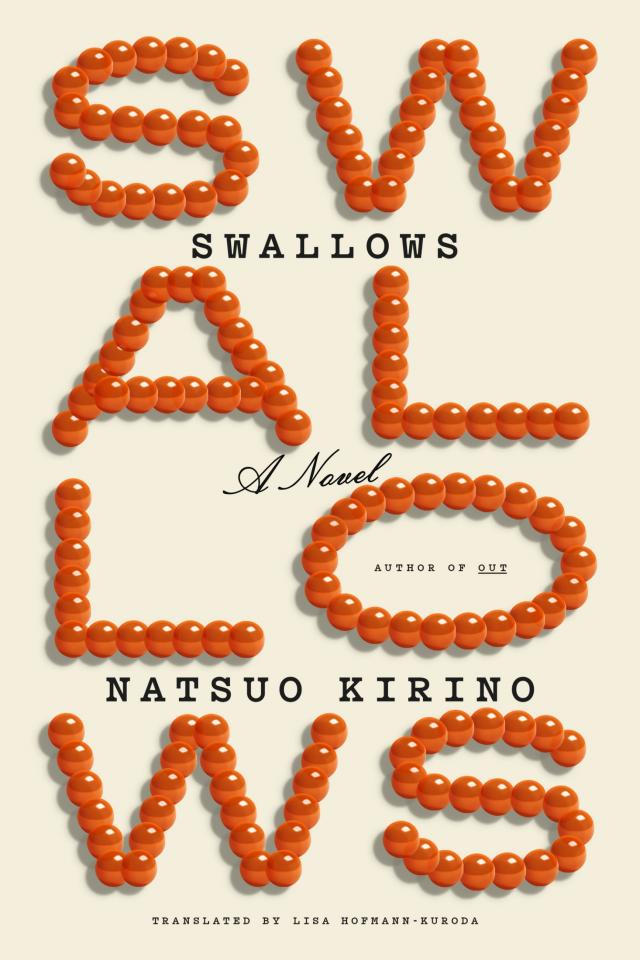
Title: Swallows : a novel / Natsuo Kirino ; [translated by Lisa Hofmann-Kuroda].
Other titles: Tusbame wa modotte konai. English
Description: First American edition. | New York : Alfred A. Knopf, 2025. | Translated from the Japanese.
Identifiers: LCCN 2024030437 (print) | LCCN 2024030438 (ebook) | ISBN 9780307267580 (hardcover) | ISBN 9780593804094 (ebook)
Subjects: LCSH: Single women—Fiction. | Surrogate mothers—Japan—Fiction. | LCGFT: Novels.
Classification: LCC PL855.I566 T8713 2025 (print) | LCC PL855.I566 (ebook) | DDC 895.6/35—dc23
LC record available at https://lccn.loc.gov/2024030437
LC ebook record available at https://lccn.loc.gov/2024030438
Ebook ISBN 9780593804094
penguinrandomhouse.com | aaknopf.com
Cover design by Tyler Comrie
The authorized representative in the EU for product safety and compliance is Penguin Random House Ireland, Morrison Chambers, 32 Nassau Street, Dublin D02 YH68, Ireland, https://eu-contact.penguin.ie.
ep_prh_7.3a_152929783_c0_r0
Contents
Chapter 1
Hard-Boiled Egg
Chapter 2
A Race Against Time
Chapter 3
Fertilization Pilgrimage
Chapter 4
Baby 4 U
Chapter 5
The Soul of an Infant
A Note About the Author and Translator
_152929783_
Chapter 1
Hard-Boiled Egg
1.1
A single white egg rattled around the bottom of a small pot. At the local Miyoshi Mart, a carton of ten cost 198 yen—the cheapest option around here. At a rate of one a day, the whole carton would last for ten days. Cheap, packed with protein, easy to prepare. Just put one in a pot with some water, wait fifteen minutes, and done: a hard-boiled egg.
“Do you know what makes an egg an egg? If you boil it for fifteen minutes, it becomes hard-boiled. That’s the definition of an egg. In cooking, it’s important to know the essence of your ingredients.”
Isogai-san, one of the patients in the nursing home where Riki used to work, never got tired of repeating this refrain. She would sit up straight in her wheelchair, giving off a proud, standoffish vibe, though her pink pajamas were splattered with food stains.
Isogai-san’s name was written in a complicated character that no one could read. Whenever someone pronounced it wrong, she snapped back, correcting them: “It’s Isogai.”
Sometimes she would point to her lapel and say, “It’s Isogai,” even though she wasn’t wearing a nametag and no one had addressed her. And so she became known in the nursing home as the old woman who went around saying, “It’s Isogai,” and “Do you know what makes an egg an egg?,” regardless of whom she was talking to.
But there were no hard-boiled eggs at the nursing home cafeteria, since many of the elderly people there were incapable of peeling an eggshell to begin with. And, besides, hard-boiled eggs could get stuck in their throats. So the only egg dishes the cafeteria served were a sickly sweet dashi-maki egg (always a hit), a dollopy egg-drop soup, or, on rare occasions, a soft-boiled egg.
That’s why Isogai-san’s obsession with hard-boiled eggs was a mystery to everyone. Over time, rumors circulated that she used to work as a cook, which made people more forgiving of her specific brand of dementia. She also developed a reputation for having a spot-on analysis of the nature of an egg.
One day, one of the nursing home staff told the elderly patients about a famous chef she had read about on the internet, who was always going on about the “essence of ingredients.” As a result, patients who had up till then vaguely sympathized with Isogai-san’s “essence of the egg” speeches came to agree with her much more readily. Shortly thereafter, however, Isogai-san caught a cold, developed influenza, and died unexpectedly.
If the nature of a chicken egg is that it becomes hard-boiled after eight minutes, what about the egg inside a woman’s body? If you boiled it, how long would it take to harden? “Oh, Isogai-san! Tell me—what is the essence of a human egg?” Riki called out the familiar name as she stared into the boiling pot.
Riki had worked at the nursing home for almost two and a half years, from age twenty-one to twenty-three. It had taken her that long to save 2,000,000 yen, day by painstaking day. For most people, that might seem like nothing; but for Riki, the only reason she was able to put away even that much was that she’d been living with her parents the whole time.
She was hired at the nursing home, which had recently opened near her parents’ place, shortly after graduating from a junior college in northeastern Hokkaido. Her parents were overjoyed when she was hired, saying it was a good thing, since sooner or later they were bound to end up there anyway. But on her first day at work, Riki glimpsed an old woman playing with a ball of her own feces, and immediately wanted to quit. She couldn’t believe people actually did things like that.
As it turned out, however, it wasn’t the nursing home’s fault that Riki didn’t last long. Wherever she went, it was the same. Even after moving to Tokyo she still couldn’t hold down a job. Sometimes she wondered whether she was the problem, whether she was just too impatient. But eventually she realized what made these jobs so intolerable to her: it was the sense that her fate was already decided, that there was nowhere else to go—while, in reality, she still had no idea who she was, or what she wanted to do with her life.
A while back, a friend of hers from high school had gotten a job at a nail salon. It was then Riki realized that people who were sure of what they wanted to do in life and pursued their goal single-mindedly were stronger and had a much easier time of things. Her friend had gone to a nail-technician school in Tokyo for a year, then started working at a salon managed by the school. Now she was working at the salon’s main branch, in Shibuya. Whenever Riki looked at her friend’s Instagram, she could tell she was thriving. Her boyfriend was a hairdresser who worked in Harajuku. But it wasn’t Shibuya, Harajuku, or the boyfriend that Riki was jealous of, so much as the sense that her friend seemed fulfilled.
She had seen this friend just once since moving to Tokyo, when they met up at a café in Ebisu. This was right around the time when Riki had started working part-time at a company that sorted flyers and other printed material in West Nippori.
Riki felt intimidated at the mere mention of a neighborhood like Ebisu, and her friend showed up that day looking especially elegant, her hair dyed a stylish reddish-brown, dazzling everyone around her. The moment she saw her friend’s elaborate nails, Riki physically and mentally recoiled, scooting back in her chair involuntarily.
She tried to explain away the immense gap that had opened up between her and her friend by the fact that she had never pursued a real career. But when her friend proudly showed off her nails—“Look, I did these myself!”—all she could think was no, it was because she had no talent to speak of that things had turned out this way.
Why was it that things just seemed to be getting worse and worse since she came to Tokyo? There was nothing for her back home in Hokkaido. She’d had a huge fight with her dad right before she left, so she refused to go back, simply as a matter of pride. And, besides, it wasn’t like she had the money to pay for the flight.
She had left home with 2,000,000 yen, but somehow it had all dried up within a span of six months. There was the key deposit for her apartment to pay for, and the rental deposit, then the fridge, microwave, bed, furniture, pots and pans, and tableware. All that on top of her ever-increasing living expenses, and the money just seemed to evaporate. And now she had zero savings.
Her frustration with her job, coupled with the sense that she wasn’t particularly good at anything, left Riki feeling hollow inside, day in and day out. She never knew that being poor could feel this lonely, this suffocating. Just once in her life, she wanted to experience what it felt like to not have to worry about money.
The misery of buying up all the discounted food at the supermarket just before closing, trying to find new ways to cut down on her energy bill, walking instead of taking public transit, buying clothes only at used clothing stores: she wanted out of all of it.
The timer went off on her phone. Exactly eight minutes. Riki drained the boiling water from the pot and added cold water to cool off the freshly boiled egg. She stood at the sink and began to peel off the shell. Sometimes pockets of air would get into the egg while it was cooking, and if you rolled it around a bit, small cracks would appear in the shell, making it easier to peel from the bottom.
She should have told Isogai-san that this was the essence of an egg. But Isogai-san wouldn’t have believed her—even though, if some culinary specialist had said the same thing, she wouldn’t have batted an eye. Riki could just picture her narrowing her eyes in suspicion. This is who I’ve become, thought Riki. A nobody who no one cares about, dismissed even by the likes of Isogai-san.
Riki poured some soy sauce into a dish and dipped her egg into it. Ever since she was a child, she’d always liked eating her hard-boiled eggs with soy sauce, not salt. That’s why she’d hated school field trips: they would only let you bring salt. When she told this story to the first guy she dated after moving to Tokyo, he’d made fun of her for it.
“Soy sauce? On your eggs? Wow, you’re really country.”
He was three years older than Riki. He had a goatee, and a thick northern Kanto accent. He was a bit pretentious. She’d met him while working as a temp at an import shop, though “import shop” made it sound much fancier than what it actually was, which was merely a clothing store. The man said he only worked there because they let him wear a goatee.
You’re one to talk, Riki thought. You’re the one who has an accent. Then, as if he’d read her mind, he started bragging about how the prefecture he was from was technically within the Greater Tokyo Metropolitan Area, so it didn’t count as rural, the way Hokkaido did. He was perceptive only when he sensed that other people might be judging him.
Riki was a late bloomer, and he’d taken her for a fool, lied to her, dated other women behind her back, got what he wanted out of her, and left.
Ever since then, Riki had wondered whether there was really any point to men at all. In her eyes, they were rude, stupid beings who only ever thought about themselves. Throwing their dirty shoes on the floor, never putting them away. Leaving the toilet seat up, not noticing if they left a little pee on the floor, and just stepping in it. Opening other people’s fridges without asking, drinking the bottle of sparkling wine she’d been guarding like a treasure. Falling asleep spread-eagle in the narrow bed and kicking Riki off. And since he believed women were supposed to serve him, he didn’t care if he came inside her. When she told him she was worried about getting pregnant, he laughed, saying if she forced him to marry her because she got pregnant, he’d be the one in trouble.
All the men Riki had met since coming to Tokyo were people she’d never dream of sleeping with even if they were stranded on a desert island. I don’t need a man, I’d rather be alone, she thought—but the reality was that, with her salary, she couldn’t afford to be single.
Riki’s current job was working as a temp in the office of Kitamuki General Hospital. Every day, she sat in that old, dim hospital for nine and a half hours—from eight in the morning until five-thirty, when the office closed. But her monthly pay was only 140,000 yen. Of that, 58,000 went to rent—for a cheap apartment that didn’t get much light—which only left her with 82,000 a month to live on.
Someone else who had the same job but lived at home might be able to afford a coffee at Dean & DeLuca, but as it was, Riki couldn’t even afford a coffee from 7-Eleven. Her contract was supposed to end next year, too, so she’d have to look for a new job after that. She yearned for money and security from the depths of her being.
* * *
•
Riki pulled the cod roe onigiri she had bought on her way home from work out of the plastic shopping bag. She almost never bought anything from the convenience store because it was too expensive, but today she’d made an exception when she saw a sign that said “Sale: 100-yen onigiri.” Giving in to her growling stomach against her better judgment, she’d bought enough to last her through breakfast the next morning.
She chewed the tiny, squishy beads of cod roe with her front teeth. Salmon roe, cod roe, herring roe, mullet roe. Riki imagined all those tiny beads packed inside her ovaries, turning into money.
Once in middle school, when she was at her grandmother’s house over the New Year’s holiday, she’d had to strip the thin membrane off the herring roe and found herself wondering if each of her own eggs was also covered with something like that. Would you pull on the membrane to yank it out of the uterus? Would it hurt? Would there be fewer eggs over time? What did it feel like to have them removed?
A while back, Teru had asked if she’d wanted to apply to be an egg donor, and she’d done some research about it on the internet. Since then, she’d asked herself, almost obsessively, what exactly an egg was made of. Maybe eventually she’d end up like Isogai-san, talking about nothing but eggs. But, in fact, she had no idea what the essence of an egg was.
Her own eggs would be fertilized by the sperm of a man she’d never even met. Then her eggs would be removed and placed inside the uterus of the man’s wife, and become a baby. Did that mean the baby was still hers?
Let’s say she applied to be an egg donor, matched with a couple, had her eggs fertilized, and a baby was born. Then, say she got pregnant later in life and had her own child. Would that mean the two children were technically siblings?
Then what if the two happened to meet—fall in love, even? Would that count as incest?
If she got married, should she tell her partner that she’d donated her eggs in the past? And, vice versa, if her partner told her he’d donated sperm, how would she feel about that?
The questions kept coming, and she wasn’t sure what to do. After she’d eaten a hard-boiled egg, a cod roe onigiri, and a bowl of miso soup with cabbage, Riki pulled up the egg-donor website she’d bookmarked earlier. Just then, she got a text from Teru.
“Did you apply for that thing?”
They’d talked about applying to be egg donors together. Teru had heard about it from a gynecology nurse she knew, who made it seem like a pretty good deal. Apparently, you could get paid up to 500,000 yen.
“No, not yet.”
“Come on, it’ll be worth it.”
“Maybe.”
There was a lot of information you had to fill out on the application. Name, address, occupation, blood type, height, weight, shoe size, previous illnesses, chronic conditions, vision, hair type, skin color, whether you had single or double eyelids, whether you had a history of smoking, whether you had any tattoos or piercings. Then you had to list your passport number, any history of traveling overseas, future goals, reason for applying, and education history. Plus any history of illness in your immediate family, as well as their occupations.
It also said you needed to include a photo of yourself and one of you as a baby, if possible. Riki scrolled through the photos on her phone and found one she thought wasn’t too bad. She was wearing her hospital uniform, which she thought made her look more serious.
But as she was filling out the information, she began to doubt whether Teru’s application would be accepted, or even her own. After all, Teru had her ears pierced and had gotten double-eyelid surgery. She’d already spent over an hour on the application but couldn’t shake the suspicion that it was all a waste of time. What if her eggs weren’t chosen? How would she feel then?
* * *
•
Riki entered Kitamuki General Hospital through the back entrance at 7:50 the next morning. She stamped her time card and headed toward the locker room. The physical-therapy nurses who worked at the rehab center were already there. They’d changed into their uniforms and were shuffling into the dim hallway. They were all young and energetic, and every time Riki passed them in the hall, they’d say good morning to her in their chipper voices. It annoyed her, even if she knew it was just a conditional reflex.


