The Rose Bride, page 1


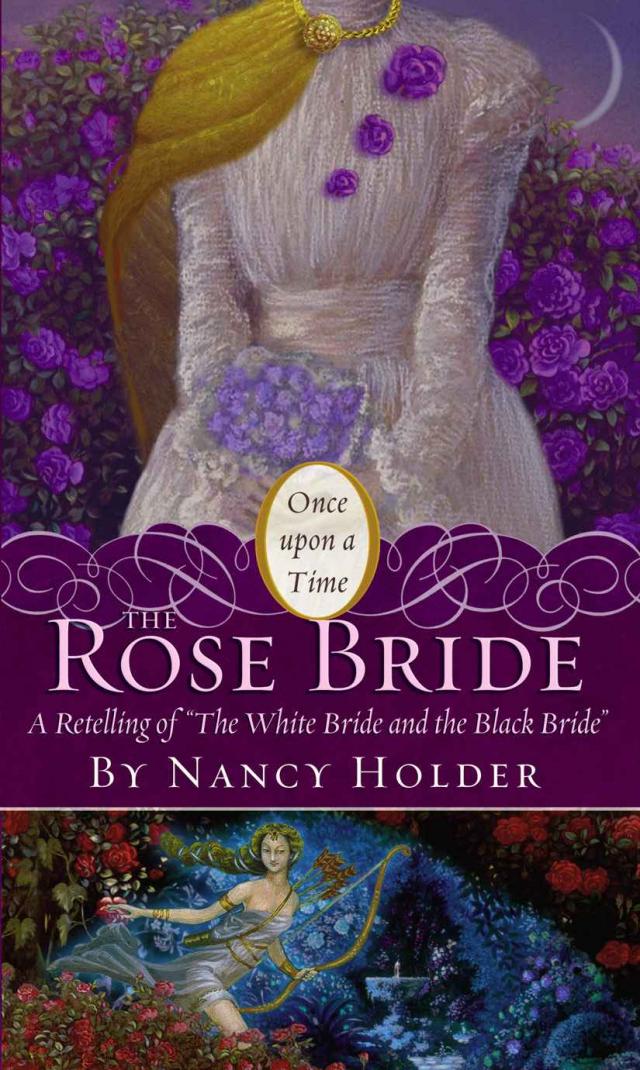
After Elise fell asleep, Rose crept to the garden.
Ombrine had ordered her to stay out of it—
especially at night—and promised severe
punishment if she disobeyed.
But it was in this garden she had last seen her mother, and had heard the joyous news that her father was coming home.
“You are loved,” the roses whispered.
“I was loved: she said brokenly. “But now they’re gone:’ She began to cry again.
Moonlight gleamed around Rose like her mother’s sheltering arms, and after a time, she fell into a deep, heavy sleep.
And in that sleep, a glowing hand cupped a shimmering white mouth pressed against her ear.
A voice whispered, ‘Alas, daughter of she who made the wish, you still must walk through the shadows until you see the light. Once you learn the lesson, two broken hearts shall mend.”
Rose slumbered and didn’t hear the voice.
But her heart heard it.
“ONCE UPON A TIME”
IS TIMELESS WITH THESE RETOLD TALES:
Beauty Sleep: A Retelling of “Sleeping Beauty”
By Cameron Dokey
Midnight Pearls: A Retelling of “The Little Mermaid”
By Debbie Viguié
Snow: A Retelling of “Snow White and the Seven Dwarfs”
By Tracy Lynn
Water Song: A Retelling of “The Frog Prince”
By Suzanne Weyn
Before Midnight: A Retelling of “Cinderella”
By Cameron Dokey
The Storyteller’s Daughter: A Retelling of
“The Arabian Nights”
By Cameron Dokey
Golden: A Retelling of “Rapunzel”
By Cameron Dokey
This book is a work of fiction. Any references to historical events, real people, or real locales are used fictitiously. Other names, characters, places, and incidents are the product of the author’s imagination, and any resemblance to actual events or locales or persons, living or dead, is entirely coincidental.
SIMON PULSE
An imprint of Simon & Schuster Children’s Publishing Division
1230 Avenue of the Americas, New York, NY 10020
www.SimonandSchuster.com
Copyright © 2007 by Nancy Holder
All rights reserved, including the right of
reproduction in whole or in part in any form.
SIMON PULSE and colophon are registered trademarks
of Simon & Schuster, Inc.
The text of this book was set in Adobe Jenson.
Manufactured in the United States of America
First Simon Pulse edition June 2007
2 4 6 8 10 9 7 5 3
Library of Congress Control Number 2007923285
ISBN-13: 978-1-4169-3535-3
ISBN-10: 1-4169-3535-5
eISBN-13: 978-1-4424-3017-4
To “Chipmunk” Belle, child of light,
and her fairy rings:
Club Weirdo:
Haley “Elvis” Schricker, Jesse “Otter” Greenfield, Emily
“BobThing” Hogan, Steffi “Staff” Sontgerath, and
Julia Jules” and Mandy “Mandy-Candy” Escobedo
The Ones Who Were There Before the Beginning:
Grace Beck, Sarah Wilcox, Melody and Mallory
Muehlbauer, and Alexandra and Anna Rose Morel
And with gratitude, love, and deep respect to:
Melanie Tern,
CLG,
and my mother, Marion Elise Smith
Love is much like a wild rose, beautiful and calm,
but willing to draw blood in its own defense.
—Mark Overby
Love looks not with the eyes, but with the mind;
And therefore is winged Cupid painted blind.
—William Shakespeare
PROLOGUE
Once Upon a Time . . .
In the Land Beyond . . .
Crown Prince Jean-Marc, son of His Royal Majesty Henri III, Heir to the Throne of the Land Beyond, Beloved of Zeus, caught his breath as Lucienne, Princess of the Silver Hills, walked with her ladies and her priestesses into the airy, domed temple of his god. Sunshine poured in from the cloudless sky, tinting her magnificent silver gown with golden light. Over her braided silvery-blonde hair, she wore a tiara of glittering diamonds and enameled crescent moons, signifying her devotion to the goddess Artemis.
Her starry midnight-blue eyes gleamed as she caught sight of Jean-Marc waiting for her at the altar. He was dressed in ermine robes lined with gold, a black-and-gold doublet and black hose, and a heavy gold crown. Jean-Marc’s black hair curled around his ears, revealing the sharp planes and angles of his face, softened by his smile. His brows were dark, and his deep-set eyes darker, and filled with rapture as he gazed at Lucienne, his bride of four months.
The prince had been a solitary youth, left to his own devices by a father who married a succession of wives. Each queen had died—Jean-Marc’s mother, Marie, had been King Henri’s second wife—and the temple of Zeus had consecrated seven royal stepmothers since Jean-Marc’s birth. To think that at last the lonely prince had found a boon companion to share his life! Who would have dreamed that the prince and princess, joined together for political reasons, would fall so madly in love? It was enchanting. Miraculous. Surely a gift from the gods.
So it must be that Zeus, presiding in the form of a great marble statue, bearded and broad-chested, looked down on them with favor. Aglow with sunshine and torchlight, was he not smiling?
The chief priest of Zeus stretched forth his arms in greeting. His two assistants flanked him. All three wore white togas bordered with gold, and crowns of laurel pushed low over their foreheads. The head priest was the oldest. On his right stood his associate, a priest in the fullness of his manhood; on the left, a boy acolyte, to signify the youngest age of man.
King Henri, Jean-Marc’s father, was not there. The recent widower had been called away on matters of State, but he had toasted his son and daughter-in-law the night before, wishing them both the answer to all their prayers as the three tossed their golden goblets into the flames.
They were about to hear if this month, that prayer would be answered.
The altar was covered with roses of scarlet and creamy ivory—red for the House of the Land Beyond, white for the Silver Hills. Also, vapors of burning incense and towers of gleaming gold coins, payment for the gift of prophecy bestowed upon the three holy men. There were hundreds of coins, all graced with the likeness of Henri, and they would be given to the poor in the name of the king. The Land Beyond was the center of a vast realm and the treasury bulged with taxes and tribute.
Lucienne’s three priestesses, dressed in white robes caught at the shoulders with silver stars, wore diadems of the moon in her phases over long white gossamer veils that covered their braids. They carried diamond-studded silver arrows, symbols of their patroness, Artemis, Goddess of the Hunt and of the Moon. The priestess who led the procession was a crone, revered as a wisewoman and midwife. The priestess of childbearing age walked on Lucienne’s right. The third priestess, a newly consecrated maiden, held Lucienne’s left hand—the one nearer the princess’s heart—to give weight to Lucienne’s wish to bear the crown prince’s son.
As the priestesses reached the altar of their priestly counterparts, they regally inclined their heads and no more, for they were equals. But Lucienne made a full curtsy to the men of Zeus, which included her husband. Moving swiftly, Jean-Marc took his place beside her, and gallantly helped her to her feet.
Jean-Marc laced his fingers through Lucienne’s. She squeezed his hand. He couldn’t take his eyes off her. Her dark blue eyes widened, framed by her unusual silver-and-gold tresses, and the prince felt as though he were staring into the eyes of Artemis herself. He knew Lucienne had prayed to the Lady the night before and that the tender wishes of her women held great sway with the goddess.
“I have cast the runes,” the chief priest of Zeus announced as he lowered his gnarled hands to the altar. The other two priests lifted festoons of roses to reveal a round, beaten-gold tray, and on it, a simple scattering of ancient bone rectangles.
Jean-Marc and Lucienne held their breaths as both stared at the runes. They couldn’t read them. No man could, save the one who threw them.
Lucienne’s mouth worked silently, praying to Artemis. Their hearts and bodies were new to each other, and yet both hoped, both dared . . .
“I have cast the runes,” the priest said again, his voice booming. His words echoed off the white stone columns, and he broke into a smile. “You will have a son in the spring and he will mend two broken hearts.”
Lucienne caught her breath and threw her arms around her husband. Aware of the young life inside her, Jean-Marc was afraid to hold her. But as she ecstatically melted against him, he grinned and caught her up, whirling her in a circle beneath the temple dome. She threw back her head and laughed, her golden hair flying behind her head like a cape.
“A son!” cried the priests, as the youngest one raced to the statue of Zeus and hefted the ceremonial torch from the wall. He lit the enormous pile of papery-dry laurel leaves and oak branches in an alabaster bowl at the foot of the god. Smoke billowed and streamed toward the hole in the ceiling.
The priestesses took up the cry, raising their arrows above their heads. “A son!”
Outside the temple, gongs clanged. Bells chimed. Cheers rose up. The kingdom began rejoicing. Riders bolted from
“Let’s go and receive the blessing of the people,” Jean-Marc said, setting her down as if she were made of crystal and tenderly enfolding her hand with both of his. Jean-Marc could scarcely believe his good fortune. A son. His heir.
“First, I must thank the goddess,” she reminded him.
“I’ll thank her too,” Jean-Marc said impetuously.
But as they turned to go, the priest of Zeus cleared his throat and said, “Your Majesties, I ask your pardon, but it occurs to one that the prince might thank Father Zeus first, as he is your family’s patron.”
A shadow crossed Jean-Marc’s face, as if the massive statue of his god had shifted on its dais. Jean-Marc gazed up at the statue, and it stared impassively down at him. Chilled, the prince sank at once to his knees.
“M’excusez,” he murmured. “Of course. I owe my loyalty and gratitude to the Lord of the Gods.” He lowered his head. “Forgive a thoughtless disciple.”
“He accepts your apology. He is pleased with you,” the priest told Jean-Marc. His features softened. “After all, he’s giving you a son.”
Jean-Marc smiled at the older man, but his princess looked troubled. She remained silent until the two had left the temple, but as their delighted guards grouped around them, she said softly, “Your god isn’t jealous, is he? He won’t punish you for forgetting to thank him?”
“Of course he won’t punish me,” Jean-Marc scoffed. “I’m the son of the Land Beyond. Zeus favors my house.”
He put his arm around her shoulders. He could hardly believe it. He had been alone most of his life, but he had a family now.
“The priest said our child would mend two broken hearts,” she persisted. “Whose hearts could those be, but ours? Broken because we angered the god?”
“Perhaps they’re my heart and my mother’s,” Jean-Marc replied. “I am told she wept when I was born, because she knew she was going to die.” And so she had, three days later.
He spoke without self-pity, but his gentle princess, soon to be a mother herself, slipped her hand into his and said, “I won’t leave you. Ever.”
“Merci, ma belle,” he replied, and he suddenly felt a whisper of pain deep in his heart. Confused, he fell silent. This was one of the happiest moments of his life; there was no cause for heartache. He pushed a smile onto his face. He didn’t want to dampen Lucienne’s joy. It was the dream of queens and princesses everywhere to give birth to an heir, and Lucienne’s dream would soon come true.
And she, and he, and their child, would live happily ever after.
Would they not?
ONE
Once upon a time, in the Forested Land, a merchant named Laurent Marchand lived with his second wife, Celestine, and their little daughter, Rose. Laurent toiled endlessly to acquire vast wealth, and Fortune smiled on him. His family lived like nobility in a sprawling slate-roofed château that towered above fertile orchards and wild woods teeming with game. They dressed in fine silks and satins and dined on dishes of gold bound with silver. Their servants were happy and counted themselves lucky indeed to work for such a prosperous man.
But as with all forested lands, shadows cast their darkness over the manor on the hill. That was to be expected. Most living things begin in the absence of light: The vine is rooted in the earth; the fawn takes form in the womb of the doe. So it is with secret wounds and heartaches. They can father the greatest happiness—if a brave, shining soul will bear them from the darkness and lift them to the light.
So it is also with the deepest of all joys: a love so true and everlasting that it can heal such wounds. For true love is true magic, as those who have found it can attest.
Laurent’s dark, secret wound was named Reginer Marchand. Reginer was Laurent’s son by his first wife, who had died giving birth to him. Laurent pinned all his hopes on his heir, waiting for the day when his son would be old enough to help him expand his vast domain. He believed that with Reginer by his side, he would amass a fortune larger than any he could create alone.
But Reginer wanted to be a painter, not a merchant. He spent days, nights, weeks at his easel, reveling in his artistic vision. Thanks to Laurent’s efforts, the family would never run out of money, so why sacrifice his dream on the altar of commerce?
Laurent was infuriated by his son’s “disloyalty.” Painting was a fine pastime, but there was an estate to manage and trading to do. Anger grew on both sides, and one stormy January night, Laurent and Reginer quarreled violently. Reginer packed a bag and stomped out of the grand house. Biting sleet pierced his ermine cloak, and the winter wind wailed like mourners at a funeral.
“Go! Go and be damned!” Laurent yelled, shaking his fist at his son’s retreating back. “Though you starve, though your children beg in the streets, never ask a thing of me! Think of me as your father no longer and never dare to put your hand on my door!”
Heartsick and humiliated, Reginer obeyed his father’s command to the letter. Years passed, and he did not return.
When Laurent married his second wife, Celestine, and brought her to the estate, she was sorry to learn of the rift between her new husband and his firstborn. Despite her gentle entreaties, Laurent still refused to forgive Reginer. And as Celestine loved her husband and owed him everything, she promised that she would follow his edict and bar the door to her stepson. But Reginer never came. So the shadow of the wound became invisible, although it was still very real.
The other shadow that fell across the lives of the Marchands was easier to see, although it too, had to do with the aching of the human heart. It was Laurent’s near-continuous absence from the beautiful château and his family.
“I chase gold as others chase the hare,” he boasted to his delicate, fair-haired wife, “and I do so for you and our daughter. My love is such that you will never go wanting.”
He didn’t understand that Celestine and Rose were sorely wanting indeed: When he was gone, which was more often than not, they missed him terribly. His time and attention were more valuable to them by far than their jewels and dresses. Of a moonlit evening, Celestine would walk along the stony terraces of the château, gazing past the topiary garden, the hedge maze, and the chestnut groves to the narrow, winding mountain passes, searching for her husband’s retinue. She understood that Laurent loved them, but there were times she felt more widow than wife.
Aside from her beloved child, Celestine’s boon companion was Elise Lune, who had served as Celestine’s nurse at the family seat on the Emerald Plains. When Celestine married Laurent, the young bride begged Elise to come with her to the Forested Land.
“I shall know no one there,” Celestine reminded her. “And one hopes that one will have children, and such tiny blossoms will need tending. . . .”
Elise had no other family and loved Celestine like her own child. So she left the comfort of the Emerald Plains to journey with her young mistress to the Forested Land. She was the first to know that Celestine would have a child and she helped in the delivery of Rose. Many a night she walked the floors of the Marchand mansion, singing lullabies and bouncing the teething child. She was with Celestine when Rose took her first step. And it was she who slipped Celestine’s gold coins bearing the likeness of King Henri beneath Rose’s pillow whenever the dear girl lost a tooth. She was so beloved that she became Tante Elise—Aunt Elise—and the fact that she was a servant slipped from everyone’s minds.
When little Rose turned seven, Celestine decided to create a rose garden for her daughter’s pleasure. Once the dozens of bushes were planted, Celestine tended them with nearly as much love and devotion as she showered on la belle Rose. The roses responded and the garden became an astonishing bower of unearthly beauty, a lush, velvet canopy of crimson hanging over a blanket of scarlet, opulent with heady perfume. Celestine placed two stone statues of young does at the entrance to the grotto and erected a life-size marble statue of the goddess Artemis in the center. Strong, serene Artemis was the Goddess of the Hunt and of the Moon, and Celestine was devoted to her. Artemis watched over women everywhere and offered them protection when and where she could.