

Finding My Olympia, page 1


CONTENTS
Title Page
Copyright
Dedication
Author’s Note and Trigger Warning
ONE
TWO
THREE
FOUR
FIVE
SIX
SEVEN
EIGHT
NINE
TEN
ELEVEN
TWELVE
THIRTEEN
FOURTEEN
FIFTEEN
SIXTEEN
SEVENTEEN
EIGHTEEN
NINETEEN
TWENTY
TWENTY-ONE
TWENTY-TWO
TWENTY-THREE
TWENTY-FOUR
TWENTY-FIVE
TWENTY-SIX
TWENTY-SEVEN
TWENTY-EIGHT
TWENTY-NINE
THIRTY
THIRTY-ONE
THIRTY-TWO
THIRTY-THREE
THIRTY-FOUR
THIRTY-FIVE
THIRTY-SIX
THIRTY-SEVEN
THIRTY-EIGHT
THIRTY-NINE
FORTY
FORTY-ONE
FORTY-TWO
FORTY-THREE
FORTY-FOUR
FORTY-FIVE
FORTY-SIX
FORTY-SEVEN
FORTY-EIGHT
FORTY-NINE
FIFTY
FIFTY-ONE
FIFTY-TWO
FIFTY-THREE
FIFTY-FOUR
FIFTY-FIVE
FIFTY-SIX
FIFTY-SEVEN
FIFTY-EIGHT
FIFTY-NINE
SIXTY
SIXTY-ONE
SIXTY-TWO
SIXTY-THREE
SIXTY-FOUR
SIXTY-FIVE
SIXTY-SIX
SIXTY-SEVEN
SIXTY-EIGHT
SIXTY-NINE
SEVENTY
SEVENTY-ONE
SEVENTY-TWO
SEVENTY-THREE
SEVENTY-FOUR
SEVENTY-FIVE
SEVENTY-SIX
SEVENTY-SEVEN
Acknowledgements
Finding My Olympia
A Novel
Nancy Econome
Published by Kafeneon Productions
This is a work of fiction. Names, characters, places and incidents either are the product of the author’s imagination or are used fictitiously. Any resemblance to actual persons, living or dead, events or locals is entirely coincidental.
Copyright © 2025 by Nancy Econome
All rights reserved. This novel, including its characters, plot, and any other elements, is the intellectual property of Nancy Econome. No part of this work may be reproduced, distributed, or utilized in any form or by any means, including but not limited to electronic or mechanicalmethods such as photocopying, recording, or information storage and retrieval systems, without the prior written permission of the author.
Contact: nancyeconome.com
Furthermore, the author expressly prohibits the use of this novel, in whole or in part, for training, learning, or any other purposes by artificial intelligence systems. Any unauthorized use is strictly prohibited and may result in legal action.
Finding My Olympia Paperback: ISBN 978-1-7344288-2-7
Finding My Olympia e-book ISBN: 978-1-7344288-3-4
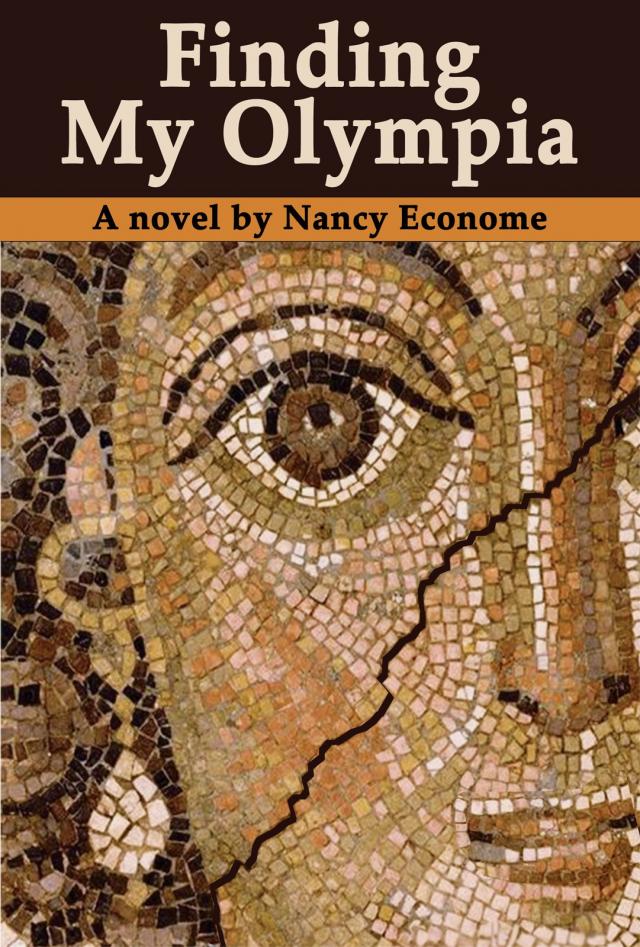
Front cover: Original image via the Met Museum, New York
Fragment of a Floor Mosaic with a Personification of Ktisis; 500–550, with modern restoration. On view at The Met Fifth Avenue in Gallery 301.
The bejeweled woman, holding the measuring tool for the Roman foot, is identified by the restored Greek inscription as Ktisis, a figure personifying the act of generous donation or foundation.
Chapter Logo Original Art
Camera chapter logo original image credit:
© Kameraprojekt Graz 2015 / Wikimedia Commons / License: CC-BY-SA 4.0
Rolling Pin Whisk Chapter Logo Original Image: AdobeStock_349896483
Rosemary Chapter Logo Original Image: istock-1163580541
Credit: Alisa Pravotorova
Book Design: Happenstance Type-O-Rama
Cover Design: Nancy Econome
Additional cover graphics: Allyson Pirenian
www.nancyeconome.com
For my sister Janet, with thanks for a lifetime of love, support, determination and brilliance.
Author’s Note and Trigger Warning
This fictional story touches on themes of loss, grief, resilience and references to sexual assault. These topics may be sensitive for some readers.
ONE
Olympia’s Diary
I’m alone and I have no idea where they’ve taken me. I’m a prisoner in a world that craves my beauty but couldn’t care less about finding me. But why should they? I’m just an immigrant girl who dropped out of high school with the skills of a seamstress. I write my thoughts on these scraps of paper, hoping to quiet my fears.
I’ve been afraid before. Alone before. When I was thirteen, I was plucked from my Greek village, motherless, deposited in the small town of Woodland, California. I never blended in — although God knows I tried. My olive skin and long black hair kept me from the circles of respectable girls. Now I hardly feel Greek anymore. I am certainly not American.
I wish my family could help find me, but my Uncle Stavros only yearns to return to the simple village life in Greece. He’s busy with his bakery and other not-so-legal business activities. And the other well-meaning Greek men who live with him. Well, they would be little use in finding me. They can hardly navigate daily American life.
My only hope is my sister Yianna. She is strong, younger and yes, much more American than I am. She charges ahead and doesn’t fear shame like I was taught in Greece. I dream our bond as sisters will somehow draw her near. Or just maybe the power of our matching Evil Eye bracelets will pull her close and rescue me.
TWO
A week after Olympia’s disappearance, Yianna had carefully washed and ironed her sister’s apron, hopeful she would walk through the door any minute. After six months, the lifeless apron dangling in the bakery kitchen was a stinging reminder that her sister had not come home.
She tried to make sense of Olympia’s absence, but chaos was the only word that floated into her mind. She had looked up the word in the high school library. To the ancient Greeks, Chaos was the emptiness, the abyss, the void before the world came into being. That was life now, a deep void where Olympia had been. To stop the aching, Yianna vowed she would search until she found her sister. No one else seemed to be doing the job. Especially the sheriff.
Just before Olympia vanished, Yianna remembered the two of them crowding around the Christmas dinner table surrounded by Uncle Stavros and the three old Greek men who rented rooms behind the bakery. Then, by the Monday after Christmas 1954, Olympia was gone. She simply vanished while walking home from work at Mira’s Tailor Shop, at least that’s what the sheriff wanted them to believe. His skimpy report said there were no solid leads, that Olympia had probably met a man and left with him. Yianna was sure Olympia did not seek a man’s attention. Her sister would rather spend an afternoon digging in the garden, weaving on her loom or observing the movements of local birds than spending time with a man.
Ten years older than eighteen-year-old Yianna, Olympia filled the space their mother should have occupied. Now Olympia was erased from Yianna’s life just like both her parents had been. One thing Yianna was certain of: her sister would never leave her. They had suffered too much together.
Olympia was decidedly Greek, down to her delicately accented English and her lowered eyes in the presence of men. Yianna, however, was American first and then Greek in that order.
By the time Yianna was a teenager, there was no older Greek woman in the family to teach her how to serve coffee when male visitors arrived or how to take the smallest piece of chicken on the platter. Yianna was the one who lugged around a camera and snapped photos everywhere she went.
Yianna had not sensed the coming danger to Olympia, not even a hint from the Evil Eye bracelets she and Olympia wore around their wrists. No warning from the thick coffee grounds slathered inside the cracked cup from which the local Greek lady told fortunes. No one seemed to know where Olympia was. Or no one was telling.
THREE
So, this is America in 1939? Agh!
Stavros lifted his feet from the sticky tiled floor in the murky Greyhound bus station and searched for a clean spot. Glancing about the terminal he was disappointed. This was no warmhearted welcome to America. Shouldn’t this station be tidier than that grimy steamship on which he and his two nieces had just immigrated from Greece to New York? If Stavros had kept this lowly state of cleanliness in his own bakery in Argos, his customers would have never bought a loaf.
Not having a proper bath in more than a week was a problem for a man like him. He had always been a sweet-smelling gentleman in his village. Mustache trimmed just so. Stavros chaffed as he stepped down from the train that brought Olympia, Yianna and him across the country in five relentless days. He quietly congratulated himself on the success of providing meals, wiping noses and acting like the rock on which his thirteen and three-year-old nieces could depend, if only temporarily.
Stavros was at a loss only when little Yianna sobbed to convulsions, having left behind the rag doll handmade by her mother, his late sister-in-law. He took her hand silently, angry with his inability to quiet this willful child. What did Stavros know of dolls and mothers anyway? That was too much to ask of a bachelor. He finally spotted an ice cream vendor and bought the girl a melting ice cream bar to quiet her hysterics.
He couldn’t really blame Yianna. Her mother Angeliki had been like a candle at their little St. Anthony Greek Orthodox church, one minute burning brightly, the next minute pinched to smoke and ash. She had suddenly died from typhoid fever only weeks before they were to board the steamship to America. After a miserable two-week quarantine, Stavros had no choice but to transport the two girls to his brother, Christos, their father, who lived in California. Now, after three weeks of traveling on a ship, a train and now a bus, he simply wanted this final leg of the journey to be over. Amesos! Now!
His original life’s plan was to forever live in his small village home, to make joyful love to women and to bake perfect loaves with crusty tops and soft interiors. In Argos, Stavros had been a man of standing. A baker, an artist, revered for the texture and flavor of his bread. Friends and neighbors walked into his bakery hungry but waltzed out satisfied, their empty stomachs tamed by his fresh-baked treasures. Who could want for more? Stavros had crossed his fingers behind his back when he told his brother he would stay in America. He would do so — at least temporarily. It was a known fact in Argos that Stavros had a mind of his own.
Before the journey to America, he took great effort to learn important English words from his old friend Yorgos. They had played backgammon together nearly every evening in their village taverna, O Chopánis, The Shepherd, on the few nights when Stavros was not with a woman. But when his brother Christos finally sent money to buy steamship passage for his wife Angeliki, Olympia, Yianna and himself, Stavros began studying the phrases in earnest, small buoys that might help him navigate the sea of English he knew would soon overwhelm him.
Christos had decided the family would move to America, their safe, new home before another big war erupted in Greece. Christos had ears for everything political. Stavros depended on him for that since he himself rarely paid attention to politics. Stavros obeyed his brother because he owed Christos his life.
But now here in America, Stavros instantly felt like a stupid foreigner. He presented a note to the train porter which displayed the hand-printed sentence, “Need directions for bus to Woodland.” Stavros could only hope the writer of the message, a fellow Greek train passenger, had scrawled it correctly.
“W-w-where?” Stavros sputtered to the porter, rolling his r and raising his eyebrows to act out the question. He also had learned to say: how much, thank you, can I have and sorry. Stavros mused he might need the sorry after a bar fight, considering his quick temper.
“Where?” He tried his best to avoid eye contact with this important man. The porter tilted back his cap in the blistering Sacramento midday sun and read the note. Dressed in his blue wool uniform, sweat beading on his forehead like bubbles, the porter scanned Stavros and the two children he dragged along. Stavros watched his eyes linger a little too long on his beat-up hat and the girls’ worn, homemade shoes. Then, with a sigh, the porter simply pointed in a southerly direction.
“Than’ you!” Stavros energetically headed toward the bus station, his nieces barely keeping pace with his steps. He was grateful Olympia was sufficiently knowledgeable in feminine ways to handle bathrooms and dressing situations with the electric Yianna. The sooner Stavros could deposit his nieces with Christos, the better.
His secret plan was to stay with Christos for a time, assist with setting up a household for Olympia and Yianna and then return to Argos. How could an impending war be as horrible as Christos imagined? As boys, both brothers had witnessed the brutal Turkish annihilation of Smyrna, surviving by luck and, of course, because of Christos’ cleverness. What war could be worse than that massacre?
Stavros owed his life to his brother but believed that Christos approached life too cautiously. His brother had married the beautiful Angeliki at a young age and refused to swig the jug or bet a drachma at their local taverna. Then Christos left for America to lock in a secure life for the Diamantopoulos family, always including Stavros.
Stavros grabbed the soft hand of his younger niece but her struggle to keep up convinced him he needed to carry her to make good time to the bus station. From there he would deliver the girls to a farmhouse in Knights Landing, near Woodland, about twenty miles northwest of Sacramento. A letter from Christos which Stavros kept secure in his jacket breast pocket listed the address and walking directions from the bus stop. He felt a little guilty, thinking about the girls like livestock. But little Yianna had jitters in her legs and his patience had been stretched to the limit attempting to keep her in sight.
Olympia was never a problem. She clung to her uncle as they passed groups of businessmen, their wrists weighed down with gold watches and their fingers heavy with pinky rings. Stavros watched her black eyes widen as she took in the young women who were unaccompanied by men right on the street, their hair loose, curls bouncing as they walked to work. Olympia self-consciously touched her rough brown scarf knotted under her chin and looked away from the young American women.
Stavros surveyed downtown Sacramento with a critical eye. He was unsure of his brother’s assessment of this new world. He pulled the girls past the brick office buildings, a lonely tamale cart, an empty ice cream parlor with wire-back chairs waiting for customers. He passed restaurants with no outdoor arbor or backyard garden where minstrels could play their rebetiko songs. Sacramento held no special charm. But neither had Chicago or New York or any of the cities the train passed through. He might have been wrenched from the small village of Argos, but that did not mean he was devoid of elevated taste. Stavros knew he would forever be searching for a soft landscape with delicate, fragrant spring breezes, or a small cosmopolitan city center with charming restaurants, cafes and fountains. Like Rome, he mused, although he’d only seen a postcard.
But this responsibility, hauling two young girls halfway around the world, was something Stavros never asked for. This immense favor for his brother was thankfully coming to an end. And that suited Stavros just fine.
FOUR
“Pou eímaste? Where are we?”
Olympia had rarely strung together a sentence since they arrived in America. But now she was articulating the very question Stavros had been pondering. They had finished their bus journey only to walk half an hour to this place. Stavros, Olympia and an exhausted Yianna stood on the perimeter of a fierce green lawn that surrounded a small farmhouse drenched in dazzling aqua-blue paint.
Like a jewel, the well-kept wooden house was situated in a small grove of walnut trees which shaded the roof from the heat. Stavros could see it was jammed wall-to-wall with people. A few men who had spilled out into the garden were sipping beer from brown bottles. Stavros’ energy had faded and he felt like a shirt left too long on the clothesline. The three travelers had consumed only a skimpy breakfast, a slice of hard tack bread and milk for the girls.
He crept closer, with his nieces following his footsteps, feeling uneasy in the midst of this crowd of men and women dressed in stiff black suits and dresses. The screened-in porch burst with faces, hands, plates of food and low chatter. The tempting aroma of dolmadakia, grape leaves tightly wrapping rice, sweet onions and herbs, filtered through the screen to the three travelers.
“Miláneh elliniká! They’re speaking Greek!” Olympia impulsively ran toward the house, pulling Yianna by the hand as if starved for words that sounded like home. But Stavros drew forward slowly, warily. Why should the farmhouse his brother had leased for his family be crowded this time of day?
Inside the screen door, pushing through the bodies wedged together, he halted as if a guard had stopped him. He instantly understood. This was a makaría, a funeral luncheon, perhaps for one of the shepherds who worked with Christos. His brother had written about these older men who herded sheep with him in the Sacramento Valley.
From the open front door, Stavros could see Olympia and Yianna circling in the crowded kitchen. The girls slid several paximathia, Greek biscotti, from the stack of toasty cookies set on crystal platters and stuffed them in their mouths.


