

Dead Man's Hand-Five Tales of the Weird West, page 1


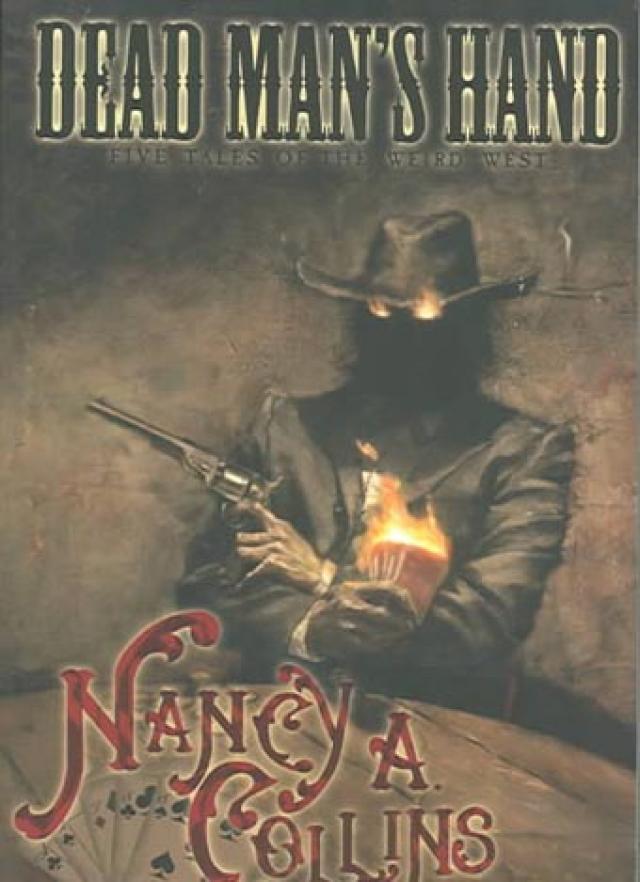
Dead Man’s Hand
Five Tales of the Weird West
By
Nancy A. Collins
Foreword
by Joe R. Lansdale (his ownself)
Nancy Collins is a real writer, and that is the best thing to know. Anyone who knows the alphabet believes they are a writer... but Pilgrim, it ain't so. Nancy, who I still think of as a young and new writer, has now been a published writer for some years. I can say with sincerity that she has learned her craft well.
She is established, but she's just as adventurous as when she was starting out. These stories will give you a taste of earlier work, and some of the more recent. The tales differ somewhat in tone, but all have a deep echo. Her more recent work has a more casual, richer texture to the prose, but that does not take away from the earlier tales, among which are some of my favorites.
Nancy is best known for Sonja Blue, her vampire "heroine," but her range exceeds this. Here are a variety of stories to prove it. They are, to my way of thinking, the best of her work.
Sonja Blue is neat, but she's just the tip of the iceberg. Though Nancy is best known as a writer of 'vampire stories, an author who created a hip modern interpretation of the vampire, she has written far more than that. Had she not, Sonja Blue alone might have been enough to cement her as an important writer in the field of horror.
In fact, her influence is far greater than most are aware of. I see comics and films, books and stories, that show her influence all the time. Sometimes directly, sometimes subtly.
She has gradually been assimilated into pop culture.
Her best work is her short work, and it's the writing style–the attitude—that actually reveals the nature of her roots and interests: the rural South (her roots) and the West (her interests).
Nancy focuses on the dark aspects of these areas, and there are many. Darkness presents itself elsewhere as well. But when she writes these stories, I can't help but be involved, because she loves and knows of what she speaks. Yes, Virginia, you can love the darkness as a spectator sport, even if you are not a participant.
Of the newer works, "Hell Come Sundown" is a particular favorite of mine, but I must admit a strong partiality to the sweat and leather tale "The Tortuga Hill Gang's Last Ride." But there's also "Walking Wolf" and "Calaverada." They ain't plucked chickens, friends. All good. All memorable. All showing the aforementioned roots and interests.
Saddle up partners. Nancy is about to be your tour guide on some great, and often dark, adventures. You'll really enjoy them. I have no doubt.
When I read Nancy, I feel as if I'm reading a combination of Southern writers and Robert E. Howard, a touch here and there from a gaggle of Western writers. There's some of that old pulp meat in these tales; the best of the pulps; that part that pulls you along and throws you down and holds you tight, and says: "Listen. I have a tale to tale, and you must hear it."
Combine these sensibilities, and you have Nancy at her best, pulling it all together, creating her own story telling web, her own style, her personal accent. I dislike selling stories. I admit it.
I like to sell the author.
I only sell products I believe in.
I believe in Nancy's work.
So don't take my word for it.
Open the book.
Have a taste.
The first taste costs you nothing more than the price of a book. Unless you borrowed it (don't steal) from the library, authors need their pennies to buy their shoes, so go out and buy a copy.
It will be money well spent.
And it will cause you to spend more of your hard-earned coins on this fine teller of tales in the future. Though she has been around a while, I believe her career is just beginning. Heating up.
Ladies and Gentlemen, and everyone in between those simple labels.
I present to you a great writer.
Nancy Collins.
Hell Come Sundown
Hiram McKinney glanced up from his Bible as the cherry-wood mantle clock chimed eight o'clock. The timepiece, with its hinged convex glass lens and elegantly embossed Arabic numerals, was one of the few luxuries that had survived the trip from Tennessee to Texas.
"It's time you got off to bed, young man," Hiram told his son, who was toiling over his McGuffey's Reader workbook.
"Please, Pa, can't I stay up a lit'l while longer?"
"You heard yore daddy, Jacob," Miriam McKinney countered, without looking up from the sock she was darning.
"Yes ma'am," Jake replied glumly, setting aside his schoolwork as he scooted his chair away from the table.
The seven-year-old walked over to where his parents sat before the fieldstone fireplace to bid them good night. His mother put aside her sewing and leaned forward, pecking her son the cheek.
"Night, Jake."
"Night, Maw. Night, Pa," the boy said, turning to his father.
Mr. McKinney glanced up from his reading. He gave his son a fond smile and a nod. While Jake would never be too old for his Maw to kiss, Hiram had recently decided that the boy was beyond such mollycoddling.
As Jake headed for his room, Mrs. McKinney called out after him one last time: "Pleasant dreams, sweetheart."
Neither saw the boy flinch.
The McKinneys came to Texas fifteen years before, setting down stakes on prime ranching land along the Nueces River, near Laredo. For the first five years they lived out of a one-room cabin. Then, as time moved on and they gradually became more prosperous, Hiram added a second room, so that he and Miriam no longer had to sleep where they ate. Three years later, Jake was born.
Jacob was not the McKinney's first child, but he was the only one to survive the cradle, his older brother and sister having succumbed to disease before they got their first tooth. For the first three years of his life he slept in the family bed. Then he was moved to a pallet in the corner. When Jake reached the age of five, it was decided that he was old enough to move to the lofted area above the communal room. For the next two years, Jake drifted off to sleep listening to his parents discuss their day's activities or plan what needed to be done to keep the homestead running smooth.
As the McKinney family's fortunes continued to rise, Hiram decided they could afford constructing a room for their son, placing it opposite their own, so that the layout of the house resembled a capital T.
Most boys Jake's age would have been thrilled to have their very own room. And, at first, Jake was very excited by the prospect. But all that changed after his first week of sleeping alone. The very first night, his screams woke up the house. His father charged into the room in his long johns, shotgun in hand, convinced that Comanches were dragging his son out the window. Once Hiram realized that was not the case, he cussed to beat the band.
When Jake told his parents about the thing that came out from under his bed, they listened for a moment then exchanged looks. Pa was more than a little put out by the whole thing, but when he saw how frightened, Jake was, he made a show of getting down on his hands and knees to prove there wasn't a boogey man hiding under the bed.
Maw McKinney said it was only natural for a young boy to be frightened the first time he had to sleep on his own. All his life, Jake had slept within earshot of his family. Sleeping by himself in a separate part of the house would take some getting used to. His father had grudgingly agreed to that point–after all, he himself hadn't slept in a separate room until after he was married, and even then he'd never truly slept alone.
However, as Jake's night terrors continued, his father's tolerance rapidly eroded. Pa was of the opinion that Maw was mollycoddling the boy, where Maw felt that Pa was in too big a hurry to make a man out of a child.
This was not a new argument between the McKinneys, but it grew with each passing birthday. Since Jake loved his parents with all his heart, knowing he was the reason for them not getting along tore him up something fierce.
Jake wanted to be a man and make his daddy proud, really he did. But there was something going on that neither of his parents truly understood. The reason for his night terrors wasn't bad dreams or fear of being alone. The simple fact of the matter was that his bedroom was haunted. Jake wasn't real certain how that could be, as no one ever lived in it before. He had always been of the impression that it took someone dying in a place to make it haunted, but apparently that wasn't a hard-and-fast rule.
However, he had learned that whatever it was that lived under his bed did follow a pattern of behavior. Whatever it was didn't come out every night–just those that coincided with the dark of the moon. He also knew that the thing was scared away by screaming and light, even if it was the weakest candle flame. Just a hint of lamplight appearing under the crack of the door as his mother came to check on him was enough to cause the apparition to fold in upon itself like a lady's lace fan.
At first he thought that the thing that haunted the room could only harm him if he looked at it, so he slept curled up in a tight little ball, the covers pulled up over his head. At first this seemed to stymie the thing from under the bed, but it eventually figured out that it could force him to throw back the blankets by sitting atop his huddled form until its weight threatened to suffocate him. As terrible as the creature was to look upon, the very knowledge that the thing was sprawled across his bed was even more horrifying.
After the first couple of weeks, his father forbade his mother from checking on him whenever he cried out during the night. When it became clear his mother would no longer be coming to his aid, Jake realized that it was up to him, and him alone, to solve his problem.
He at first attempted to battle the monster by keeping the lamp burning beside his bed all night long. This worked at first–until his father began complaining about the amount of oil that was being wasted. The general store was in Cochina Lake, over ten miles away, and the McKinneys only went there once every six weeks. Because of the increase in consumption, they were close to being out of fuel, and with two weeks to go before the next trip.
Jake's nights were seldom restful, and his dreams rarely pleasant. Even on those nights he was not haunted by the thing from under the bed, he slept fitfully, waking every time a timber groaned or a branch scraped the side of the house. Still, as bad as things were, he could not bring himself to tell his parents the truth of his situation. For one, he knew they would not believe him, and another, he did not wish his father to see him as a frightened little boy. If being born and raised in Texas had taught him anything, it was self-reliance. This was his problem, by damn, and it was up to him to solve it, come what may.
~ ~ ~ ~ ~ ~ ~
The light cast by Jake's lamp chased the shadows back into their respective corners as he entered the darkened room. The curtains his mother had fashioned from old flour sacks were pulled tightly shut against the moonless night. Aside from the bed, the only other furnishings in the room were a nightstand, a footstool and a double chifforobe, since the room had no closets. The walls were made from planks his Pa had cut at the local sawmill, and the chinks between the boards were caulked with river clay to keep the wind out. That the solitary window in the room boasted panes of glass instead of waxed cloth was a testament to the McKinney family's newfound prosperity in this unlikely promised land.
Jake carefully placed the lamp on the nightstand and began to undress, neatly folding his clothes over the foot of the bed as he did so. He removed his nightshirt from its place under his pillow and pulled it on over his head. Jake gave the room one last apprehensive look before blowing out the light and jumping under the covers. The interlaced ropes that supported the mattress groaned slightly as he tried to get comfortable under the pile of quilts that covered the bed.
Instead of burrowing down to the heart of the bed like a prairie dog-like he usually did–Jake lay on his back and stared at the ceiling, as rigid as the rafters above his head. His arms were stiffly extended along his sides atop the covers, his hands balled into tight fists as if prepared for a fight.
A finger as long and thin as a pitchfork tine emerged from the shadowy region under the bed. It was followed by its brothers, each as long and narrow as the first. The spidery, overlong digits were joined to a wide, flat palm, which was attached to a bony wrist. The fingers hooked themselves into claws, digging into the floorboards as the thing dragged itself clear of the bed. It stood up once it was free, unfolding itself like a pocketknife. Its knobby back made a clicking sound as it shrugged its shoulders, locking its spine into place.
It was pale as a frog's belly, with skin like that found on a pitcher of milk that's been left to sit too long. Its body was hairless, save for the tangle of lank, greasy curls that hung from its lopsided head like a nest of dead snakes. Its legs were as long and thin as tent poles, and bent backward at the knee so that it seemed to be both walking away from and toward its prey at the same time.
The face, if you could call it one, was toadlike in appearance, with wide, rubbery lips, a pair of slits in place of a nose, and two huge, blood red eyes that glowed like an angry cat's. When the thing smacked its lips, Jake could see the inside of its mouth was ringed with jagged teeth.
When the fiend stared down at Jake, the boy saw a brief glimmer of surprise in its hideous eyes. Clearly it had not expected its victim to be so exposed. Still, it knew better than to question its good fortune. The thing moved so that it loomed over the boy, bending low so that its hideous face was mere inches from Jake's own, its spiderlike talons poised to spear the terrified child's eyeballs.
Although the thing before him filled him with terror, Jake bit his tongue to keep from crying out. The time had come for him to face that which frightened him and become its master.
The horror that hovered before him blinked an inner eyelid, and the nasal slits that served as its nose dilated sharply, catching scent of the subtle change in the chemistry of fear. Emitting a low growl, the thing abruptly turned its head on its shoulders like an owl, so that it was staring over its shoulders at the chifforobe.
The moment the monster took its murderous gaze off him, Jake kicked back the bedclothes, causing the creature to swivel its head back in his direction. "Now!" the boy screamed at the top of his lungs. "Do it now!"
The doors to the chifforobe flew open with a bang, and out of its depths stepped a man dressed all in black, from his scuffed cowboy boots and floorlength duster to the hat on his head. He brandished a pistol in hands so pale it looked as if they had been dipped in whitewash. His face was equally pallid, save for his eyes, which burned like red-hot coals dropped in a snow bank. About the pale man's neck was cinched a bolo made from a polished stone the color of blood.
The thing from under the bed flipped its head back around on its shoulders and snarled at the intruder, displaying a ring of razor-sharp teeth. A sane man would have fainted dead away or fled the scene, but the pale man opened fire instead. The thing clutched its midsection, a look of confusion and pain on its hideous face, before collapsing onto the floor.
"You did it!" Jake shouted gleefully, jumping up and down on the bed. "You killed him!"
"Don't get too excited there, son–you can't really kill these critters," the pale man replied, holstering his pistols.
There was a loud slam as the door to Jake’s room flew open and Hiram McKinney entered the room, galluses dangling from his pants, shotgun ready.
"Who in hell are you, mister, and what are you doing in my boy's room?" he thundered.
The pale man raised his hands slow and easy, so as not to tense the rancher's trigger finger. "The name's Hell. Sam Hell. And I'm here at your son's request."
"That's right, Pa!" Jake said excitedly, jumping up and down on the bed. "This here's the Dark Ranger! He come here to get rid of the monster! See?!? It's real! It's really real! And it came out from under my bed, just like I tole ya!"
Hiram looked to where his son was pointing. "Sweet baby Jesus!" he gasped, his eyes started from their sockets. "What in Heaven's name is that?"
"Heaven has nothing to do with it, Mr. McKinney. May I put my hands down now?"
"Hiram, honey? What is going on in here–?" Mrs. McKinney poked her head around the doorjamb, a homespun shawl about her shoulders and her hair gathered into her nightcap. She gave out with a squeal of horror upon seeing the thing sprawled across the floor.
"Tell you the truth, Miriam–I have no earthly idea what's going on."
"I sent for him, Pa! I saw his advertisement in the back of this magazine, and I wrote him, telling him what was wrong, and he wrote back and said he could help and tole me what to do what to when he got here!"
"Excuse me, folks–but as I've been trying to explain to your boy here, this dance ain't over yet."
The man called Hell stepped over the body of the fiend on the floor, pushed back the sackcloth curtains and opened the window, which swung inward on a hinge. A second later a woman dressed in the fringed riding chaps and beaded pectoral of an Indian warrior clambered over the sill.
"Comanche!" McKinney shouted, lifting his weapon.
Hell turned and grabbed the barrel of the shotgun in one milk white hand, forcing its muzzle to the floor. Hiram tried to yank the shotgun free from the pale stranger's grasp, but there was no budging it.
"Yes, Pretty Woman is a Comanche." Hell said matter-of-factly. "And I would kindly appreciate it if you did not point your gun at a lady–one who happens to be my business partner, at that."
The Comanche woman acted as if she did not see or hear what was going on about her as she knelt beside the creature on the floor. Muttering a chant under her breath, she removed a grass-rope lariat tied about her waist and hogtied the unconscious creature like a steer ready for branding. Just as she finished trussing it up, the thing made a wailing sound, like that of a wounded elk, and began to struggle.


