

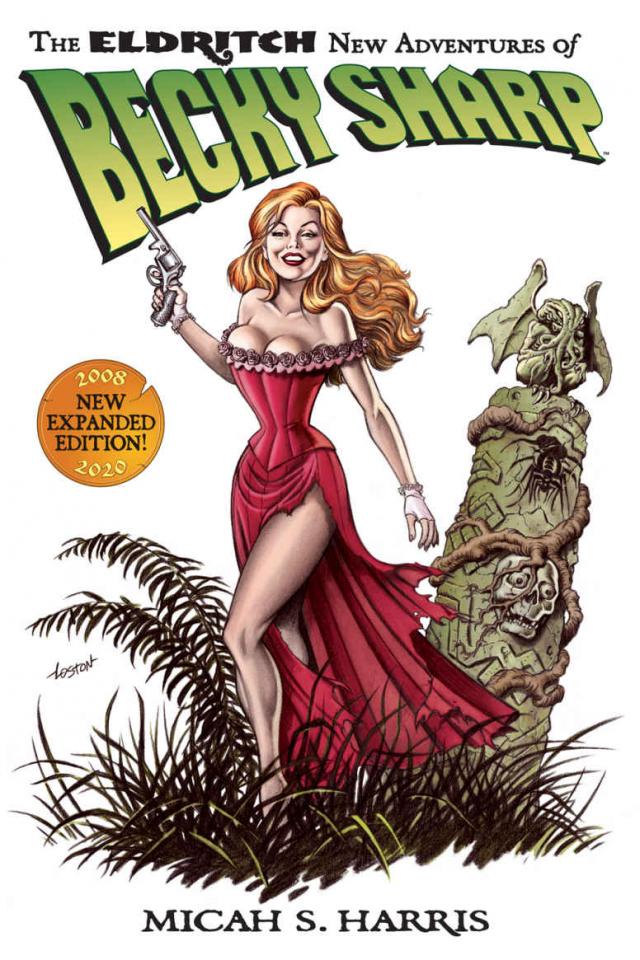
The Eldritch New Adventures of Becky Sharp, page 1


Contents
Acknowledgements
Dedication
Foreword
Resembling the Slitherings of a Mermaid
Chapter One: 1840 —
The League of Zervan Akarana
Chapter Two: 1841 —
The Doom That Came to Kor
Chapter Three: 1843 —
The Ape Gigans
Chapter Four: 1844 —
The Legacy of Captain Clegg
Chapter Five: 1844 —
Bane of the Barbary Corsairs!
Chapter Six: 1848 —
Shadows Out of Time
Chapter Seven: 1893 —
Queequeg’s Fetish
Chapter Eight: 1893-1894 —
Cette Femme-La Qui Sont Etre S’Obeit
Chapter Nine: 1894 —
The Hand of the Black Pharaoh
Chapter Ten: 1917 —
The Encounter on Great Pulteney Street
Chapter Eleven: 1917 —
What Lurked Within the Artists Gallery
Chapter Twelve: 1917 —
The Testimony of Rebecca Sharp
Chapter Thirteen: 1917 —
Out From the Abyss
Chapter Fourteen: 1917 —
The Judgement of Sâr Dubnotal
Chapter Fifteen: 1925 —
S. Latitude 47˚ 9’, W. Longitude 126˚ 43’
Afterword
“Frontal Development”
Biographical Note
Also by MICAH S. HARRIS
Novels
The Eldritch New Adventures of Becky Sharp - 2020 Visionary Edition
Murder in the Miracle Room
Ravenwood, the Stepson of Mystery: Return of the Dugpa
Jim Anthony, Super Detective: The Hunters (with Joshua Reynolds) 2nd Edition
The Chronicles of Aarastad
Portrait of a Snow Queen (The Witches of Winter Book One)
Graphic Novels
Heaven’s War (with Michael Gaydos) 2nd Edition
Audio Books
Ravenwood, the Stepson of Mystery: Return of the Dugpa
Jim Anthony, Super Detective: The Hunters (with Joshua Reynolds)
The Eldritch New Adventures of Becky Sharp is copyright and
trademark 2008 by Micah S. Harris. All rights reserved.
Entire contents of this revised edition copyright 2020 by Micah S. Harris.
Cover, frontispiece and title page illustrations copyright 2008 by Loston Wallace.
Illustrations for chapters two and thirteen copyright 2020 by Loston Wallace.
Illustrations for chapters five, nine, and fifteen copyright 2020 by M. Wayne Miller.
Original edition introduction copyright 2008 by Mark Schultz.
Introduction for the new edition copyright 2020 by James Bojaciuk.
Book design and logo by Nathan Pride
Additional editing by James Bojaciuk
A Minor Profit Press ™ Edition
July 2020
Acknowledgements
I am grateful for the enthusiasm with which this novel, in earlier drafts, was received by Angela Bacon Reid and Matthew Baugh, both of whom provided much appreciated editorial input. Additional thanks go to Arthur Congleton who also critiqued portions of the manuscript and provided essential consultation on matters of the British military and historical weaponry.
My thanks to J.M. and Randy Lofficier and Black Coat Press whose Tales of the Shadowmen series first allowed me to bring to light Becky Sharp’s post-Vanity Fair career.
Much appreciation, too, to Mark Schultz for his unflagging support of my writing for three decades now. Meeting him and his wife Denise for the first time, when they lived in a small Allentown, PA home back in 1989, remains a cherished memory of mine. Besides being a superlative illustrator and storyteller, Mark is the kind of true gentleman they just don’t seem to turn out anymore. I am proud that he is probably the biggest fan of my version of Becky Sharp…
…rivaled only by 18thWall Productions publisher James Bojaciuk. James not only reread Thackeray’s epic Vanity Fair to prepare for his introductory essay included herein, but also kindly volunteered to give the manuscript a fresh edit for this 2020 Visionary Edition.
Special thanks to M. Wayne Miller for loaning his excellent talents for black and white illustration to render the drawings appearing here for the first time. Wayne is the Chris Van Allsburg of horror, and I’m happy to have him joining us this time around!
Loston Wallace graced this book’s original cover, frontispiece, and title page with his alluring renditions of Becky. All are retained here along with two illustrations by Loston debuting in the current publication. These drawings are not only a record of his talent but also of one of the best collaborations and friendships it has been my privilege to enjoy.
Dedication
For my mom and dad, who, when I was a kid, were either taking me to the library or bringing the library home to me!
Foreword
Why Becky Sharp Has Relevance in a Lovecraftian Universe
Personally, I never would have made the connection. I never would have seen the possibilities of placing William Makepeace Thackeray’s realist ur-femme fatale, the marvelously ruthless Miss Rebecca Sharp of Vanity Fair, in a full-blown pulp fantasy adventure.
Can you blame me? Would you have made the connection?
Lucky for us, Micah Harris has this odd sort of vision and The Eldritch New Adventures of Becky Sharp continues his fascinating series of “what if” adventures. There’s a correct term for this subgenre that involves the lifting of characters and concepts from any number of popular authors’ legacies — often in concert with historical personages — to then mash them into improbably plausible alliances and relationships. Micah has told me the term — often, I suspect — but for the life of me I can’t remember it.
Maybe that’s because this particular subgenre is beyond my personal capacity for invention. My mind doesn’t think down those paths. Which is fine by me, because it makes it all the more pleasurable to read Micah’s cross-pollinated hijinks: his inventiveness invariably catches me by surprise. Although we both share similar pulpy interests and both inject them liberally into our storytelling, Micah takes his borrowings in directions of which I can’t conceive. True surprise in storytelling is rare enough and always welcome.
Micah has tons of brass and I think he takes his biggest risks in this story. Foremost, it’s all good clean pulp adventure, but there is something else underlying the rollicking thrills. Micah has placed moral barometer Becky here for good reason: there is a strong current of morality running through this story, much as Micah has examined in his graphic novel of 2003, Heaven’s War. Here, however, the morality is of a different sort.
Becky may have been a shockingly immoral character to a mid-19th century culture built upon social and religious convention (and I’ll admit I don’t know enough about Thackeray, a noted humorist, to guess at his true intent), but, by transporting her to a new context, one situated in a frighteningly expanded universe as revealed by 20th century science, her “immorality” becomes more a reflection of a practical will to survive in a hostile environment. In Vanity Fair, Becky does what she must to flourish in the English social jungle to which she was born — and she was pretty darn good at it. She certainly wasn’t hypocritical about her aspirations. Here, Becky is given proper respect: her skills are tested in the (allegorical?) jungles of an annihilating cosmos.
My hat’s off to Micah for putting those skills to the service of a cognoscenti that has graduated from fretting class distinctions to the bigger problems now recognized to confront the human race in a Lovecraftian universe that doesn’t recognize moral superiority. Micah throws so much of the wonderfully outré at Becky, so much of the last two centuries’ speculative fears concerning our diminished status in the grand scheme of things, that I ultimately can’t help but sympathize with her peerless survivalist aptitude. (And if that aptitude includes a predatory sexual allure, hey — she works with the tools she’s been given, and all the more fun for us readers.)
I know that if I were lost in Micah’s construct, searching out Kor in deepest Africa, or stumbling over Skull Island, or trapped inside one of the Great Race of Yith, or moving towards an inner Earth through horrors borrowed from myriad fevered imaginations, I would absolutely want to have someone as pragmatic and skilled as Becky with me.
Dangerous? Yes. In the end, she might very well have us all as hive insects to her queen bee. But with her on the throne, at least we could be assured that the species would survive.
And that’s saying something in a Lovecraftian universe.
Read on and see if you don’t agree.
Mark Schultz
April 2008
For his skills as an artist and comics storyteller, MARK SCHULTZ has won five Harveys, two Eisners, an Inkpot, a Spectrum, three Haxturs, and probably four or five other freshly minted trophies while you’ve been reading this sentence. He has illustrated Robert E. Howard’s Conan the Barbarian, chronicled the adventures of Superman, and currently spends much of his time in the days of King Arthur, giving Prince Valiant his marching orders as the writer (first with artist Gary Gianni and now Tom Yeates) of Hal Foster’s classic of the American Comic Strip — a legacy which couldn’t be in better hands!
Watch for Mark’s upcoming graphic novel in which he returns at last to the comic book medium and his classic
Resembling the Slitherings of a Mermaid
An Introduction for the Special Edition of The Eldritch New Adventures of Becky Sharp
by JAMES BOJACIUK
“Ah! Vanitas Vanitatum! Which of us is happy in this world? Which of us has his desire? or having it, is satisfied?—Come, children, let us shut up the box and the puppets, for our play is played out.”
~William Makepeace Thackeray’s Vanity Fair (ch. LXVII)
“Vanity Fair is a difficult novel.” Six words packing an inexpressible amount of understatement. Yes, it’s long—300 thousand words compared to an ordinary novel’s 50-150. Of course, it’s bedecked with characters. Naturally, it requires a familiarity with history that many modern readers are unprepared to handle. But it goes deeper. Most readily available editions excise the illustrations. These are not the kind of illustrations which only help set the mood and aid the imagination (as with Sidney Paget’s or Florence Briscoe’s work), but are essential to the novel as flesh to the bones. Who murdered Joss Sedley? Only a reader armed with art can say. Yet it goes still further. The novel is written in a sardonic, criminal cant which throws further walls between the narrator and author, the narrator’s audience and the author’s audience. It does not say what it means, and surely the author would strangle his narrator if only he could get his hands around his neck.
To celebrate this special edition of The Eldritch New Adventures of Becky Sharp, let’s look under the hood of Harris’ novel to find what parts—to stretch a metaphor—he’s borrowed from Thackeray’s Vanity Fair. There are some wonderful connections that might otherwise be missed.
Vanity Fair is no longer a novel we’re familiar with. Oliver Twist, Alice’s Adventures in Wonderland, and Pride & Prejudice have been kept alive through decades of adaptations—and even if we miss Dickens’ commentary, suppose Alice met Tweedledee and Tweedledum in Wonderland, and convince ourselves that Jane Austen wrote serious romances about serious people, we are at least familiar with the outlines of the plots. Oliver falls into the dangers of the poor. Alice falls into Wonderland. Elizabeth falls in love, despite her best efforts. There is no such luck for Vanity Fair: left with too much material for even a miniseries to adapt, and a confusing narrator, even the more faithful adaptions have left a great deal of material on the shelf.
The title of the novel is no passing fancy. On the very first page, we find ourselves in John Bunyan’s own Vanity Fair, straight from The Pilgrim’s Progress. Our narrator, the stage manager, emerges. Dismissing morality, he offers us a puppet show put on by children. He is far from a reliable narrator, switching between jaded portraits of those involved to implication and lies. He pretends to be our friend, though he is anything but. We are, at least, distantly familiar with the remainder of the context: Becky Sharp falls to a low social position and carves her way to the top of society, by charm, manipulation or murder.
This may feel unconnected to The Eldritch New Adventures of Becky Sharp in every way except for Becky herself. Surely we lack an unreliable narrator. Surely we lack puppets. Surely we lack the cosmic significance implied by Vanity Fair being but a show put on in Vanity Fair.
Vanity Fair’s narrator is worse than unreliable. Unlike The Cabinet of Dr. Caligari’s Francis, he does not even do us the courtesy of believing his own press. He lies, he knows it, and he treasures it—as it is his own petty power over the audience. He will paint over pure actions with black, and make black actions blacker. Even the pure-at-heart will be made into monsters—or simply made ineffectual. And yet, for all of the power he seems to have over the reader, and for all the effort he extends toward dominating the text, he is ultimately rendered more powerless then his subjects.
These are aspects Becky assumes in this novel. At moments of importance or uncertainty, the seeming absolutes of third person narration wash away. We are left with the perspective of a known liar. She manipulates us, as she has manipulated everyone else, and she glories in her backstabbing and crimes. She and the narrator of Vanity Fair are one and the same, so far as it matters. She will justify her murders, rapes, and horrible abuses to herself, hoping to convince the reader, and attempt to pass on her bigotries as well. She should not be heeded, even if hers is the only voice on the page. Even when third person resumes, we are left at the mercies of her perspective and lies—we cannot get far enough away from her to get away from her perspective. There seems to be no escape, as these narrators indulge in every horrible fancy. But how can we deal with such a vile narrator?
It’s not a matter of endurance. Instead, the narrator is the key which turns both novels’ lock. Without them, we would see immortality play out without comment or relief. Things would be as black as they appear. They would be acts of evil, free of context, in a dead universe. But this is not what Thackeray’s stage manager leaves us with. Though he is immoral himself—though he is a diabolist himself—though he builds a prison of despair around himself and us, this narrator is also the key that frees us from his prison. Goodness and light are nearer when our narrators speak, than when they remain silent.
This was quite Thackeray’s intent. As he wrote to George Henry Lewes,
What is the Gospel and life of our Lord (excuse me for mentioning it) but a tremendous Protest against pride and self-righteousness? God forgive us all, I pray, and deliver us from evil.
I am quite aware of the dismal roguery wh. goes all through the Vanity Fair story–and God forbid that the world should be like it altogether: though I fear it is more like it than we like to own. But my object is to make every body engaged, engaged in the pursuit of Vanity and I must carry my story through in this dreary minor key, with only occasional hints here & there of better things—of better things wh. it does not become me to preach.
To shed further light on his intent and goals, it is worth turning to a master of this form, Flannery O’Connor. Their approach to fiction, and using their faith in their fiction, was nearly identical. Where Thackeray is brief in explaining this, O’Connor is expansive. She allows us to see into Thackeray’s process, and just what he means by creating characters as deplorable as these. In O’Connor’s hands, Goodness—and particularly Grace—were proclaimed by everyone from con men to serial killers. They could not help it, even when they set to make the universe a dead and ugly place. As Flannery O’Connor wrote (A Habit of Being),
I am mighty tired of reading reviews that call [A Good Man is Hard to Find] brutal and sarcastic. The stories are hard but they are hard because there is nothing harder or less sentimental than Christian realism. I believe that there are many rough beasts now slouching toward Bethlehem to be born and that I have reported the progress of a few of them, and when I see these stories described as horror stories I am always amused because the reviewer always had hold of the wrong horror. (90)
…My “message” (if you want to call it that) is a highly moral one. Now whether it’s “moralistic” or not I don’t know. In any case, I believe that the writer’s moral sense must coincide with his dramatic sense and this means that the moral judgment has to be implicit in the act of vision. Let me make no bones about it: I write from the standpoint of Christian orthodoxy. Nothing is more repulsive to me than the idea of myself setting up a little universe of my own choosing and propounding a little immoralistic message. I write with a solid belief in all the Christian dogmas. I find this in no way limits my freedom as a writer and that it increases rather than decreases my vision. It is popular to believe that in order to see clearly one must believe nothing. This may work well enough if you are observing cells under a microscope. It will not work if you are writing fiction. For the fiction writer, to believe nothing is to see nothing. I don’t write to bring anybody a message, as you know yourself that this is not the purpose of the novelist; but the message I find in the life I see is a moral message. (147)


