

The Battle For Skillern Tract, page 1


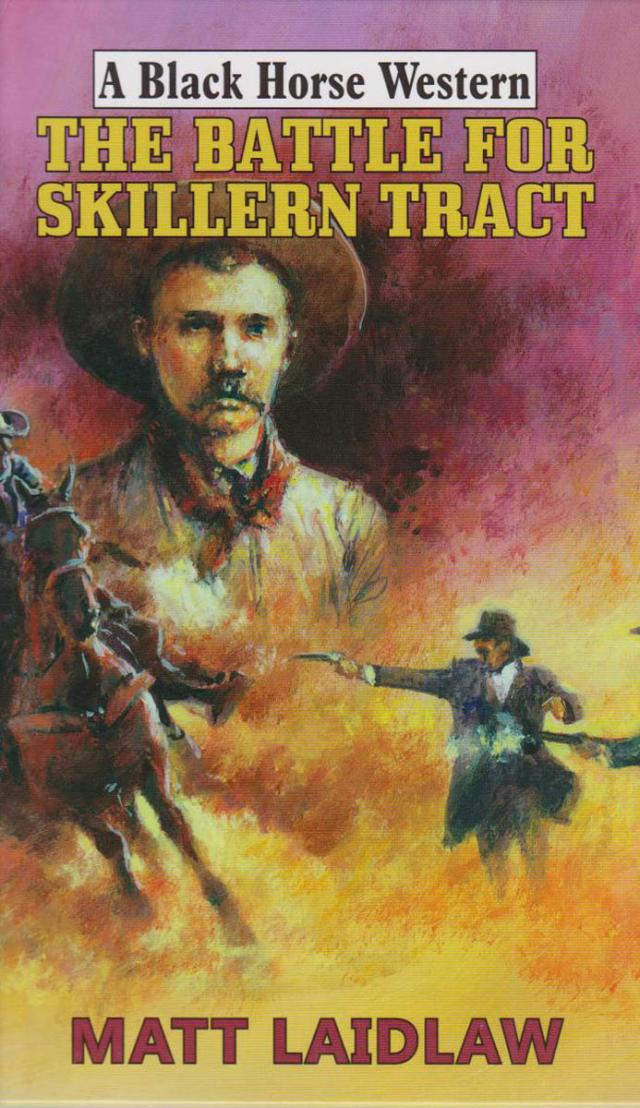
The Battle for Skillern Tract
When desperate ex-Confederate officer Zac Hunter rides into Nacogdoches, he has his mind set on bank robbery. What he finds when he walks into the bank is a robbery already in progress and town marshal Dan McCrae dying from gunshot wounds.
Hunter is accused of murder by Councillor Morgan Jarrow, then abruptly offered the job of town marshal. He is forced to serve notice on businessmen drilling for oil on the Skillern Tract, crosses swords with lawyer Tyne Coburn and the two gunslingers Yantze and Levin, and must decide if Deputy Quint’s strange confession is the truth.
As the various factions in Nacogdoches struggle for supremacy, Hunter is drawn into a vicious cycle of trearhery and murder. The showdown would come in a blazing gunfight on the Skillern Tract.
By the same author
Raiders of Concho Flats
Outlaws of Ryker’s Pool
The Robbery at Boulder Halt
The Deliverance of Judson Cleet
The Four-Way Split
The Night Riders
www.johnpaxtonsheriff.co.uk
The Battle for Skillern Tract
MATT LAIDLAW
© Matt Laidlaw 2009
First published in Great Britain 2009
ISBN 978 0 7198 2389 3
Robert Hale, an imprint of
The Crowood Press Ltd
The Stable Block
Crowood Lane
Ramsbury
Wiltshire SN8 2HR
www.crowood.com
www.bhwesterns.com
This e-book first published in 2017
The right of Matt Laidlaw to be identified as author of this work has been asserted by him in accordance with the Copyright, Designs and Patents Act 1988
PART ONE
ONE
10 September, 1866
Hunter broke camp in the luminous half light that comes a long time before true dawn. He kicked earth over the embers of his breakfast fire, then rode out of the cottonwoods and forded the ox-bow on the Sabine River. Slick wet stones clattered under the iron of his horse’s shoes. The morning river mist swirled around the big blood bay’s hocks. With soft words and a sharp flick of the reins Hunter urged the reluctant horse through the water, up the far bank and onto Texas soil. By sunrise he had put the Sabine ten miles behind him; by the time the sun’s beat beating on the back of his neck was uncomfortable he had covered the full thirty miles to Nacogdoches and was able to look down over the sprawling town from a low rise.
A hot wind had picked up and he could taste the East Texas dust like grit on his teeth as he dismounted. His mount had turned its tail to the wind and was standing patiently, head down, legs braced. Steadying himself by leaning back against the saddle, Hunter looked across the dark timber cloaking the undulating terrain for as far as the eye could see, then down towards the clearing on the muddy river. Then, lifting to his eyes the French field-glasses he’d carried with him through The War between The States, he studied the layout of Nacogdoches’ rutted streets. He adjusted the knurled focusing wheel and used the strong magnification to pull residential properties, commercial premises, horses and riders and people on foot so close he could have been studying them from across the street.
Activity, but not too much. Few people about that early in the morning, and from where he was, almost a mile away, Hunter had the benefit of one-way observation: he could look without being seen, and what he was looking for was the town’s bank. Quickly finding the ugly building standing on one side of the town’s wide square, his belly was gripped by a nervous cramp and suddenly his mouth was so dry he couldn’t spit. Through the glasses he was having difficulty holding steady he could see that the bank’s doors were open for business. The hitch rail in front of the building was empty. He doubled if the morning’s first customers had arrived. There was nothing stopping him from riding down there, walking in through those doors with a drawn gun and, for the lust time in his life, committing armed robbery.
And walking out again, less than five minutes later, a rich man. Maybe. If the cashier played ball. If there was no guard armed with a shotgun. If the manager cared more for his wife and family than he did for the bank’s money. A lot of ifs. Too many of them. But what the hell kind of choice did he have?
The wind hissed through the trees as he stowed the glasses in his saddle-bag, finding himself fumbling like a frightened school kid with strap and buckle. Parched leaves rustled overhead like dry paper, and the big horse whickered softly. Hunter pulled his threadbare Confederate army jacket about him as if to cocoon himself against the rising fear that was causing his thigh muscles to tremble. With cold deliberation he fought that fear by slipping from its holster his converted 1861 Colt Navy revolver, pulling the hammer back to half-cock and opening the loading gate to the side then spinning the cylinder with his thumb so that the bases of the live rim-fire cartridges glittered in the sun.
He grunted with satisfaction. Enough gleaming metal in that weapon, even without pulling the trigger, to scare the hell out of ordinary bank tellers or a manager conscious of his own thin hide. He snapped shut the gate and bolstered the .38, then reality forced him to revise that opinion: the finest weapon in the West would be of no use to him if the manager turned out to be a hero with a scattergun under the counter and Hunter had to fight his way out. Blasting his way out of the bank would put him out on the street. On the street, a lonely figure in that wide square, he’d be as exposed as a beetle on a white bed-sheet. And it wasn’t the ordinary citizens of Nacogdoches who were cause for concern.
A final sweep of the field-glasses before he’d lowered them had told Hunter that the town marshal’s office and jail lay almost directly across the square from the bank. The rattle of gunfire emerging from the town’s financial centre would surely bring the marshal and his deputies tumbling out onto the street and leave Hunter stranded and looking at a long spell in the Texas state penitentiary, or a sudden, violent death.
So it was a toss up, Hunter thought bitterly. Turn back to the Sabine, or ride into the town, rob the bank, and ride out with a gunny-sack stuffed with cash.
His choice. The first option was the safe one; the second could see his bloody body sprawled in the dust of that square, used bank-notes spilling from the fallen gunny-sack to be caught and whirled aloft by the wind.
Not an easy decision to make, but not too difficult either if the man looking at those choices was alone in the world. The complication here was that if Hunter took the second option, and died in the attempt, the real loser would be a hard-working, lonely widow. Twenty-four hours ago, Alice Hunter had watched her only son ride away from their Louisiana homestead at Natchitoches on the Cane River. No word of where he was heading. No suggestion of when he’d be back. What he had told her, with as much conviction as he could muster, was that when he did return their troubles would be over. Money would no longer be a problem and she would be able to give up her work in the town’s one greasy café.
Well, Hunter thought, in a short while he’d be making all her dreams come true, or eating his words in what would certainly be his own last supper. Because there was no decision to be made. That had been made seven days ago when he rode home from the war to find his pa long dead, his ma living in poverty and his own prospects as bleak as a New York blizzard.
TWO
The town of Nacogdoches was a settlement of mostly run-down shacks and two storey business premises with flimsy false fronts clustered on both sides of a slow-running creek that was an unnamed minor tributary of the Sabine, which itself was formed by the confluence of the Cowleech Fork, Caddo Fork, and South Fork rivers. Hunter’s field-glasses had not lied. Some shops and businesses were open as he rode in – pale skirts swirled in the shadowy gloom of the general store; a cowpoke was walking his horse in through the wide doors of the livery barn; an old man with long grey hair was standing gazing up at the swirls of red and white on the pole outside the barber’s shop – but the square when he reached it was hot, dusty and deserted. Almost. In the time it had taken for him to ride in from his observation point atop that low rise, two riders had hitched their horses to the peeled-pine rail in front of the bank.
A quick glance across the square at the marshal’s office revealed no movement, no sign of life. He’d be at breakfast, Hunter reckoned, either in his office or eating fried steak and eggs washed down with black coffee in the town’s café. The marshal, and maybe one deputy. If there was a second, he’d be the night man. That put him at home, in bed, snoring, but the others too damn close for comfort. The square, as he’d observed from afar, was a potential death-trap.
Jaw tense, Hunter swung down in front of the bank. He loose-tied the bay alongside the two ragged broncs standing hip-shot in the hot sun, took a folded gunny-sack out of his saddle-bag and tucked it into his gun-belt. Then he stood for a moment, as if deep in thought, hoping to give the appearance of a businessman getting clear in his mind the financial transactions that lay just moments ahead. That brought a thin, humourless smile to Hunter’s lips. Some businessman, he thought, and the legality of the so-called transaction he had in mind was surely open to question.
Strangely, the proximity to his goal had steadied his nerves. He’d thought about pulling up his bandanna as a crude mask, but realization that if this one-man raid on the Nacogdoches bank was a success he’d be splashing back through the Sabine river and into Louisiana before nightfall made him reject the idea. Besides, he’d figured, who in his right mind recalls with
A broad stone step led up to the bank’s doors. Hunter tilted his head, heard the sound of men talking with raised voices inside the building and looked back briefly but with a spark of renewed interest at the two broncs tethered alongside the bay. Then, deliberately concentrating solely on the task that lay ahead, he stepped up and began to push open the heavy doors.
At once his ears were assailed by a thunderous fusillade of gunfire. Stunned, his ears ringing from the roar of exploding shells, he counted six or more shots in the furious volley. Then the firing ceased. Caught by indecision, his mind a whirl of confusion, Hunter realized instinct bad made him draw his six-gun. That settled it; he was halfway there. Gritting his teeth, he pushed the door all the way open. Then he sprang inside the bank, stepped to one side and flattened himself against the wall.
The air stank of cordite. Gunsmoke was a blue haze drifting towards the overhead oil lamps. Two men stood in the centre of the small room. Their menacing presence made them loom large. The small room seemed overcrowded. They were between Hunter and the cashiers’ counter. They held empty gunny-sacks and smoking six-guns. A third man was slumped against the side wall. Wide of shoulder, heavy of frame, he was slowly sliding down the wall as if the strength was leaking from his legs. A shield glittered on his vest. His shirt was blood-soaked, his moustachioed face a red mask. His staring grey eyes were filmed by death.
In the fraction of a second it took for Hunter to take in the scene, a cool draught swept through the room and caught the door. It swung on oiled hinges, then slammed shut with a bang. The two men caught in the centre of the room whirled to face Hunter, boot-heels squeaking on the board floor. Long-barrelled pistols lifted. Unshaven faces twisted in shocked snarls. The gunmen’s hair was lank and greasy. Above the stink of cordite Hunter caught the reek of horse sweat from their stained pants.
Their eyes narrowed. Hunter registered that instant of decision, knew their fingers were tightening on triggers; knew that in the next fraction of a second he could die, or fight to stay alive.
He sprang sideways. His Colt came up and level. He dropped to a half-crouch and snapped off two rapid shots. Both bullets slammed into living flesh. The two men staggered backwards. Six-guns fell from suddenly nerveless hands, clattering on the boards. Again Hunter cocked the big Colt with his thumb. Then he saw that no third shot was necessary. Both men fell heavily to the floor. Their bodies were borne down by the weight of the angel of death settling on their shoulders. They lay unmoving. The sudden quiet in the bank was the silence of a chapel when the last throat has been cleared before the final hymn.
Then the door was kicked open.
Three men tumbled over the threshold. The first man in was long and lean, wore a badge on his vest and carried a six-gun as if it was something strange he’d picked up in the street. He was followed by two men in dark suits powdered with dust. One was small, with pale blue eyes and thin grey hair almost covering a pink scalp.
The other was big, and dangerous. He walked in last. His penetrating eyes, unblinking as a rattlesnake’s, weren’t missing a trick.
In a flash, Hunter saw the situation through the eyes of the newcomers. He was the only man standing inside the bank. The air was acrid with gunsmoke. He was holding a pistol that had been fired. Three men lay dead or dying on the floor. One of those men was a lawman. His shirt was blood soaked. He was an ageing lawman: his hat had fallen off exposing grizzled grey hair, and his shirt was soaked in blood.
‘What the hell kept you so long?’ Hunter said to the man he guessed was a deputy, grabbing the initiative and using it in the hope of knocking the more dangerous big man off his stride. ‘If I hadn’t walked in when I did—’
‘Drop that pistol, now,’ the big man said. And he lifted the Greener shotgun he’d been holding unseen alongside his right leg and levelled it at Hunter. ‘Drop it, or I drop you – and believe me, there’s nothing I’d enjoy more.’
For a long moment, Hunter hesitated. The three new arrivals were between him and the door. Out of the corner of his eye he detected movement, and knew that terrified bank employees were emerging from hiding places. One would be the manager, or owner. His courage would be returning. Humiliation would be replaced by anger. And there’d be a gun of some kind behind the counter, effectively stopping any hope of escape in that direction.
Then, as if he’d soaked up some of the big man’s power, the skinny deputy with the high cheekbones of an Indian stepped forward. He grabbed a handful of shirt and rammed his pistol up under Hunter’s chin.
‘Do as Jarrow says.’
Head back, Hunter drew a deep breath, expelled it, then let his Colt slip from his fingers.
As it hit the floor, the big man stepped forward. He pushed the deputy aside and kicked Hunter’s Colt across the room. Then he took a half step back to give himself space, swung the shotgun by its stock and slammed the double barrels against Hunter’s jaw.
Pain knifed through Hunter’s face, flashed like liquid fire behind his eyes. He lurched backwards, cracking his head hard against the wall. Coppery liquid pooled in his mouth. He shook his head, spat out a fragment of broken tooth, felt blood dribble down his chin. Carefully, be wiped it away with the back of his hand, never taking his eyes off the man with the shotgun.
The third man, the small fellow with pale-blue eyes, stepped forward with his mouth open as if to protest. Jarrow waved him away.
‘That was to put you in the right mood,’ he informed Hunter pleasantly.
‘It had the wrong effect,’ Hunter said. ‘All it’s done is made me remember your face.’
‘Dead men don’t have memories,’ Jarrow said. ‘You’ll hang for murder.’
‘I saved your town’s cash. Shot dead two bank robbers.’
‘That’s not what I see,’ Jarrow said. ‘How about you, Quint?’ He looked at the rawboned deputy. ‘How d’you read this situation?’
‘Those two’ – the deputy pointed at the two dead men – ‘planned on robbing the bank, but walked straight into a heap of trouble. Marshal McCrae was already in here. I know Dan McCrae’s capabilities with a gun: they stood no chance, and he downed them easy. Then their pard walked in, and I guess McCrae wasn’t expecting a third man ’cause he took this third fellow’s slugs in the head and chest.’
‘Strachan?’ Jarrow look questioningly at the little man, who had now backed away.
That worthy cleared his throat, then shrugged uncertainly. ‘I suppose that’s one possible interpretation of events—’
‘The only one,’ Jarrow cut in with a growl.
Hunter shook his head. ‘Look at them.’ He swung an arm, gesturing at the board floor, the bodies of the filthy, unshaven men he’d shot. ‘Do I look like them, do I look like a bank robber?’
‘To me, you look like a cool, efficient killer,’ Jarrow said. ‘A ringleader. Those two fools were seen entering the bank. Then we heard gunshots. Seconds after those gunshots, you followed them in and we heard two more shots as we ran across the square. We burst in here, McCrae’s taken two slugs and you’re standing holding that smoking pistol.’ He gestured over his shoulder at Hunter’s Colt. ‘You denyin’ any part of that?’
‘No. Why should I? That’s exactly the way it happened.’
‘Right. McCrae shot your partners, you walked in and put two shots into McCrae.’
‘Wrong—’
‘You followed them in—’
‘Yes. But that doesn’t make me one of them.’
‘That does,’ Jarrow said, and he pointed at the gunny-sack tucked in Hunter’s gun-belt.
In the sudden silence a man in white shirt, string tie and dark trousers appeared on the other side of the counter, lifted a flap and came through. The shirt was stained with sweat under the arms. His plump fact; was pale and glistening. He wore spectacles, and his soft hand shook as he lifted it to adjust them.
Jarrow swung towards him.
‘What happened here, Soames?’
‘I opened up, as always, first man in was Marshal McCrae.’
‘What about Wilson, is he here?’


