

Life Beyond Us, page 1
part #1 of European Astrobiology Institute Presents Series


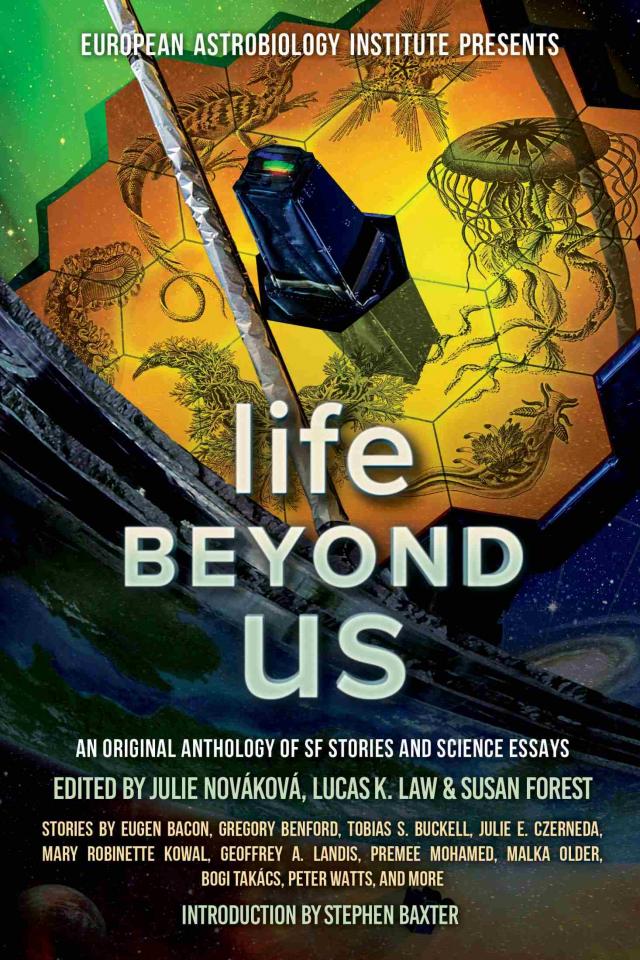
Table of Contents
Life Beyond Us
European Astrobiology Institute Presents
Copyright Information
Editors' Dedications
Foreword, Julie Nováková
Introduction, Stephen Baxter
Hemlock on Mars, Eric Choi Essay: Planetary Protection, Giovanni Poggiali
The Dog Star Killer, Renan Bernardo Essay: That Cold Black Cloud, Stefano Sandrelli
Titan of Chaos, G. David Nordley Essay: Flying Instead of Diving, Fabian Klenner
Cloudskimmer, Geoffrey A. Landis Essay: Earth’s Sister Planet, Dennis Höning
The Lament of Kivu Lacus, B. Zelkovich Essay: Robots in Space are Great, Ania Losiak
Heavy Lies, Rich Larson Essay: Major Transitions, Stephen Francis Mann
The World of Silver, Tomáš Petrásek Essay: Wet Wet Wet, William Bains
Spider Plant, Tessa Fisher Essay: Signs of Life (and How to Find Them), Tessa Fisher
This is How We Save Them, Deji Bryce Olukotun Essay: Valuing Life, Erik Persson
The Far Side of the Door, Premee Mohamed Essay: Space Agriculture, Raymond M. Wheeler
Ranya’s Crash, Lisa Jenny Krieg (translated by Simone Heller) Essay: You are not Alone!, Jacques Arnould
Spiral, Arula Ratnakar Essay: Spiraling into the Unknown, Tomáš Petrásek
The Last Cathedral of Earth, in Flight, Tobias S. Buckell Essay: The Latest Black Hole Planet, in Formation, Amedeo Romagnolo
The Secret History of the Greatest Discovery, Valentin D. Ivanov Essay: Cooperation without Communication, Valentin D. Ivanov
Human Beans, Eugen Bacon Essay: Microbial Life and Belonging, Tony Milligan
The Mirrored Symphony, D.A. Xiaolin Spires Essay: Mirror Images, Dimitra Demertzi
Lumenfabulator, Liu Yang (translated by Ladon Gao) Essay: Crystal Green Persuasion, Nina Kopacz
Cyclic Amplification, Meaning Family, Bogi Takács Essay: The Science of Xenolinguistics, Sheri Wells-Jensen
The Diaphanous, Gregory Benford Essay: Life 2.0, Geoffrey A. Landis
The Sphinx of Adzhimushkaj, Brian Rappatta Essay: Finding Common Ground, Philippe Nauny
Defective, Peter Watts Essay: How did They Know it was Agni?, Joanna Piotrowska
The Dangers We Choose, Malka Older Essay: The Habitability of Water Worlds, Floris van der Tak
Third Life, Julie E. Czerneda Essay: The Unveiled Possibilities of Biomaterials in Space, Martina Dimoska
Forever the Forest, Simone Heller Essay: Astra Narrans, Connor Martini
Still as Bright, Mary Robinette Kowal Essay: —And the Moon be Still as Bright, José A. Caballero
Devil in the Deep, Lucie Lukačovičová Essay: Some Like It Hot, Natuschka Lee & Julie Nováková
Deep Blue Neon, Jana Bianchi Essay: Destined for Symbiosis, Jan Toman
Afterword I, Wolf D. Geppert
Afterword II, Lucas K. Law & Susan Forest
Acknowledgments
About the Contributors
About the Editors
Copyright Acknowledgments
European Astrobiology Institute (EAI)
European Science Foundation (ESF)
Laksa Media Groups Inc. (LMG)
EUROPEAN ASTROBIOLOGY INSTITUTE PRESENTS SERIES
EDITED BY JULIE NOVÁKOVÁ, LUCAS K. LAW, AND SUSAN FOREST
Life Beyond Us: An Original Anthology of SF Stories and Science Essays
LAKSA ANTHOLOGY SERIES:
SPECULATIVE FICTION
EDITED BY SUSAN FOREST AND LUCAS K. LAW
Strangers Among Us: Tales of the Underdogs and Outcasts
The Sum of Us: Tales of the Bonded and Bound
Shades Within Us: Tales of Migrations and Fractured Borders
Seasons Between Us: Tales of Identities and Memories
EDITED BY LUCAS K. LAW AND DERWIN MAK
Where the Stars Rise: Asian Science Fiction and Fantasy
BOOKS BY SUSAN FOREST
ADDICTED TO HEAVEN SERIES
Bursts of Fire
Flights of Marigold
Gathering of Ghosts (forthcoming)
ADDICTED TO HEAVEN: THE NEXT GENERATION SERIES
Rivers of Ivy (forthcoming)
EUROPEAN ASTROBIOLOGY INSTITUTE PRESENTS
Life
Beyond
US
An Original Anthology
of
SF Stories and Science Essays
Edited by Julie Nováková, Lucas K. Law, and Susan Forest
LAKSA MEDIA GROUPS INC.
www.laksamedia.com
Life Beyond Us: An Original Anthology of SF Stories and Science Essays
European Astrobiology Institute Presents
Copyright © 2023 by Julie Nováková, Lucas K. Law, and Susan Forest
All rights reserved
This book is a work of fiction. Characters, names, organizations, places and incidents are either a product of the author’s imagination or are used fictitiously, and are not to be construed as real. Any resemblance to actual situations, events, locales, organizations, or persons, living or dead, is entirely coincidental.
Laksa Media Groups supports copyright. Copyright fuels creativity, encourages diverse voices, promotes free speech, and creates a vibrant culture. Thank you for buying an authorized edition of this book and for complying with copyright laws by not reproducing, scanning, or distributing any part of it in any form without permission. You are supporting writers and allowing Laksa Media Groups to continue to publish books for every reader.
Library and Archives Canada Cataloguing in Publication Title
Title: Life beyond us: an original anthology of SF stories and science essays / edited by Julie Nováková, Lucas K. Law, & Susan Forest.
Other titles: European Astrobiology Institute presents
Names: Nováková, Julie, editor. | Law, Lucas K., editor. | Forest, Susan, editor.
Description: Science fiction stories accompanied by science essays.
Identifiers: Canadiana (print) 20220259453 | Canadiana (ebook) 20220259747 | ISBN 9781988140476 (hardcover) | ISBN 9781988140483 (softcover) | ISBN 9781988140490 (EPUB) | ISBN 9781988140506 (PDF)
Subjects: LCSH: Science fiction, English 21st century.
Classification: LCC PN6120.95.S33 L54 2023 | DDC 823/.0876208092—dc23
LAKSA MEDIA GROUPS INC.
Calgary, Alberta, Canada
www.laksamedia.com
info@laksamedia.com
Edited by Julie Nováková, Lucas K. Law,
and Susan Forest
Cover Art by Dan O’Driscoll
Cover Design by Veronica Annis
eBook Design and Interior Design by Jared Reid
Picture credits: Illustrations by Ernst Haeckel [Kunstformen der Natur (1904)] appeared throughout this book. Licensed under Public Domain via Wikimedia Commons.
FIRST EDITION
JULIE NOVÁKOVÁ
To Φ and μ
let your curiosity and enthusiasm never ever fade
LUCAS K. LAW
To all of us
let’s not forget the fragility of life in water, on land, and in air
treat it with respect, kindness, and care
SUSAN FOREST
To the dreamers
and to those who make our dreams real
Foreword
Julie Nováková
“T-minus fifteen seconds . . . T-minus ten . . . Nine, eight, seven, six, five, four, three, two, one . . . And liftoff!”
Twenty-five years ago, on October 15, 1997, the joint NASA-ESA-ISA mission Cassini-Huygens launched from Cape Canaveral aboard a Titan IV rocket. I was six years old, and if I’d heard the news at all, I scarcely registered it. When the mission arrived at Saturn in 2004, I was paying closer attention, and when the Huygens lander was to touch down on Titan in January 2005, I was eagerly waiting for the acquisition of signal and the first transmitted images.
In a way, the Cassini-Huygens mission embodies the spirit of Life Beyond Us: cooperation across nations, curiosity, charting places where no one has ventured before (save for the Voyager flybys)—and, ultimately, finding exciting possibilities for perhaps actual life beyond us and changing humankind’s perspective forever.
Titan remains one of the most fascinating and mysterious objects of the solar system: a huge moon veiled by a dense hazy atmosphere, with dunes, rivers, and seas of hydrocarbons on its surface and a water-ammonia ocean deep underneath it. We’re yet to map its complex chemistry (biochemistry, even?) and learn its history. How come it still has so much of the quickly destroyed methane to make it “warm” (under Saturn vicinity standards, mind you)? How deep is its inner ocean, and does it connect to the surface in meaningful ways? Are there active ice volcanoes? How far down does the largest methane sea, Kraken Mare, reach, and how does it behave? Could it possibly host living organisms?
Not just one, but two Life Beyond Us stories explore the possibility of life on Titan, each from a different angle—and still the moon would offer plenty more opportunities for exciting stories and wild, yet scientifically potentially plausible, speculations.
The Cassini orbiter also explored Saturn’s tiny moon Enceladus and imaged the geysers spewing from beneath its icy crust. We now know that Enceladus, though being just about 500 kilometers across (find the Czech Republic on the world map and look at its size from west to east—that’s how tiny), harbors an inner o
Only future exploration will tell. Perhaps surprisingly, no one chose Enceladus as their story setting, though we visit a much larger and warmer exoplanetary water world in Malka Older’s “The Dangers We Choose.”
But every mission ends some day. Cassini’s did five years ago: on September 15, 2017, it plunged into the abysmal depths of Saturn in a final dive after months of skirting the rings and grazing the atmosphere. It was a spectacular ending for a spectacular explorer.
The mission is over. Its legacy lives on as data yet to analyze in new contexts to reveal more answers, and even more questions yet to answer. An exploration effort such as this one rarely means saying the “final word”; despite what some drier textbooks might seem to tell us, we’re still writing the chapters. Life Beyond Us gazes around the corner, trying to glimpse where it might lead us.
The stories in Life Beyond Us are, first and foremost, stories. They are meant to entertain, excite, inspire, provoke, daydream, mesmerize. At the same time, they show us possible pathways to life beyond us. Some depict curious scientific ventures; others have taken a more metaphorical approach. They remind us that imagination is also an integral part of science.
Each story is accompanied by an essay exploring its scientific elements, be these interstellar clouds, the deep hot biosphere, animal communication, exomoons, or black hole planets. Finally, if you are an educator and wish to use examples from Life Beyond Us in your classroom, you can go to europeanastrobiology.eu/life-beyond-us to download a toolkit with tasks and discussion topics that we plan to regularly update as our knowledge and understanding changes.
Because, again, science rarely has a final take on anything. There’s always room to explore, to form new hypotheses and test them, discover the unexpected and fill in the blanks.
Are there hot hydrothermal vents in Mars’s subsurface, perhaps serving as the last refuges of local life?
Has Venus always been a hellish, dry, pressure-pot of a planet?
Could some of Saturn’s ocean-bearing moons be vastly younger than the rest?
Out in the cold faraway reaches of the Kuiper Belt, could there still be habitable spots?
Are there conditions for life on the planets orbiting the Sun's nearest neighbor, Proxima Centauri?
Those and many more—and they could be wrapped up under: where can we find actual life beyond us?
We don’t know. We have a lot of thoughts about this, a huge swirling pool of ideas, some data currents going here and others elsewhere, some results pointing in one direction and others in another. It’s vitally important that we realize this and expect the scientific consensus to shift. But it doesn’t shift on a whim; it’s not a mere change of heart. It’s backed by data and our understanding of the data’s implications. In today’s world, it’s increasingly important to realize how science works; while the evolution of Titan’s atmosphere might not affect our everyday lives, the next pandemic, next hurricane, or next asteroid strike will, and basic understanding of the process of science then might help save our lives. Collectively, greater understanding, knowledge, and also imagination and empathy will save lives.
As I’m writing this, the world remembers the sixty-second anniversary of human spaceflight. It seems to be almost universal for people who have ventured to space to regard Earth as a whole, not as a world divided by borders, nationalities, politics, or religions. But it’s a precious and (in many ways) fragile whole, and many of us surface-dwellers cannot even see its wholeness, waging terrible wars against our living environment as well as each other.
In science fiction, we have the power to create worlds where violence has not won; where empathy and reason prevail; where joyful curiosity beckons us forth as one people, one planet, one galaxy.
It’s never too late to try.
—Julie Nováková, Prague, Czech Republic, 2023
Introduction
Stephen Baxter
Is there life beyond Earth?
We see objects in the sky, the stars and planets; we see the Moon, which looks, even to the naked eye, like another Earth, with dark “seas” and bright “highlands.” If there is life down here on Earth, why not up there in the sky?
It may be a question as old as humankind, and as a scientific conundrum the problem could probably be said to go back millennia, to the elaborate (though incorrect) cosmological modelings of the ancient Greeks.
Before the development of the telescope in the seventeenth century, however, we knew less about the planets of our own solar system than we do of many exoplanets now. But even then there was a suspicion, held by the likes of astronomers Galileo and Kepler, that other stars, other suns, might host planets as did our Sun, and so might harbor life (as mentioned by José A. Caballero in this volume, in his essay accompanying the story “Still as Bright” by Mary Robinette Kowal).
Those early telescopic astronomers could do little more than track and analyze the orbits of the solar planets (though the resulting understanding, leading to the confirmation of Copernican models of a Sun-centered solar system and Newton’s law of gravity, was an epochal achievement). But, later, more refined telescopic observations seemed to reveal surface details on the other planets, either real or existing only in the eye of faith, apparently Earth-like or otherwise—cloud banks on Venus, and on Mars polar ice caps, what looked like seas, even what appeared to be artefacts in the “canals.” But our imaginations were often Earthbound—we could not seem to imagine worlds drastically different from our own—so that in The War of the Worlds (1897) H.G. Wells launched an invasion from a Mars like a small, cold, dying version of Earth. We would need space probe data, delivered decades after Wells, for the close-up proof that forced us to accept that our companion worlds were all very different from Earth in many ways.
Crucially, the first space-age observations seemed to indicate that, after all, the planets could host little or no life. But such views are changing, with new visions (as in this volume) of possibly habitable locations on Mars, on Saturn’s moon Titan, even in the temperate high clouds of scorched Venus (as in Geoffrey A. Landis’s story). Life may be there, after all, even if it is quite unlike our own.
And even as we studied the sky, so we began to widen our understanding of life on Earth itself. Some of the more moving stories in this volume touch on the possibility that there may be life, even intelligence, lurking in the poorly explored environments of our own familiar planet.
Meanwhile, however, the old dreams of Galileo and Kepler—dreams of other worlds circling other stars—had continued to stimulate the science fiction writers of the early twentieth century. And while many of these fictional planets, like Wells’s Mars, often more or less resembled Earth, some of the more imaginative dreamers wondered whether other kinds of planets could be waiting to be found, perhaps quite unlike those of the solar system.
Thus it would prove in reality, with, for example, many of the earliest exoplanets to be discovered being “super-earths,” rocky worlds with masses larger than the Earth’s—the largest rocky world in the solar system—but less than our giants of ices and gases: Jupiter, Saturn, Uranus, and Neptune. But by the time of the first super-Earth discoveries, the science fiction writers had been imagining and exploring such worlds for decades.





