

The Wind Called My Name, page 1


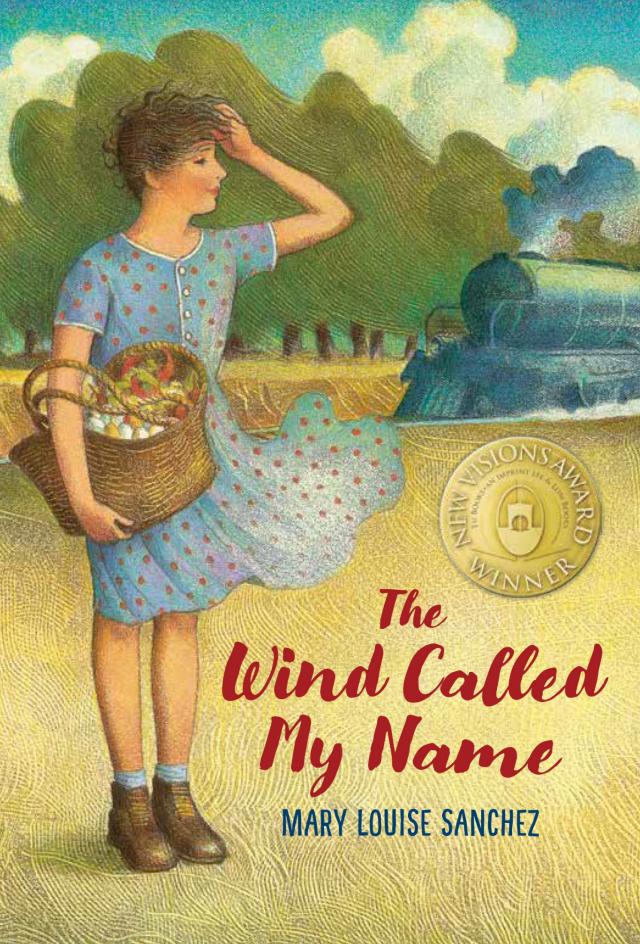
This book is a work of fiction based upon the life of the author’s mother. It reflects some real stories from the author’s family, combined with many characters, incidents, and details that are the product of the author’s imagination. Some names and details have been changed to protect the privacy of individuals.
Copyright © 2018 by Mary Louise Sanchez
Rosette illustration copyright © 2018 by Arthur Sanchez
Jacket illustration copyright © 2018 by Raul Colón
All rights reserved. No part of this book may be reproduced, transmitted, or stored in an information retrieval system in any form or by any means, electronic, mechanical, photocopying, recording, or otherwise, without written permission from the publisher.
TU BOOKS
an imprint of LEE & LOW BOOKS Inc.
95 Madison Avenue, New York, NY 10016
leeandlow.com
Edited by Cheryl Klein
Book design by Christine Kettner
Typesetting by ElfElm Publishing
Book production by The Kids at Our House
The text is set in Kennerley Roman
with display type in Modern Love and Harman Deco
Manufactured in the United States of America by Worzalla Publishing Company
EPUB ISBN 978-1-62014-781-8
MOBI ISBN 978-1-62014-782-5
First Edition
Library of Congress Cataloging-in-Publication Data
Names: Sanchez, Mary Louise, author. | Sanchez, Mary Louise.
Title: The wind called my name / Mary Louise Sanchez.
Description: First edition. | New York : Tu Books, an imprint of Lee & Low Books Inc., 2018. |
Summary: When ten-year-old Margarita Sandoval’s family moves to Wyoming during the Great Depression, she faces racism, homesickness, and the possibility that her grandmother’s land in New Mexico may be lost. |
Identifiers: LCCN 2018022777 (print) | LCCN 2018029112 (ebook) | ISBN 9781620147818 (epub) | ISBN 9781620147825 (mobi) | ISBN 9781620147801 (hardback)
Subjects: | CYAC: Family life--Wyoming--Fiction. | Racism--Fiction. | Hispanic Americans--Fiction. | Depressions--1929--Fiction. | Moving, Household--Fiction. | Wyoming--History--20th century--Fiction.
Classification: LCC PZ7.1.S2573 (ebook) | LCC PZ7.1.S2573 Win 2018 (print) |
DDC [Fic]--dc23
LC record available at https://lccn.loc.gov/2018022777
Dedicated to my parents, William Gonzales and Margaret Lucille (Sandoval) Gonzales, for helping us know our deep roots and encouraging us to spread our branches
Contents
A Note for Readers
Chapter 1
San Antonio de Padua
Invoked for Lost Items
Chapter 2
La Sagrada Familia
The Holy Family
Chapter 3
San Pascual
Patron of Cooks and the Kitchen
Chapter 4
San Miguel Arcángel
Patron of Grocers
Chapter 5
Santa Margarita de Antioquía
Patroness of Childbirth
Chapter 6
Santa Teresa de Ávila
Patroness of Faith
Chapter 7
San Isidro
Patron of Farmers and Farm Workers
Chapter 8
San Gabriel
Patron of Messengers
Chapter 9
Santa Úrsula
Patroness of Teachers and Schoolgirls
Chapter 10
San Francisco de Sales
Patron of Writers and Editors
Chapter 11
San Agustín
Patron of Printers
Chapter 12
Santo Tomás
Invoked against Blindness and Doubt
Chapter 13
San Lucas el Evangelista
Patron of Butchers
Chapter 14
Santa Cecilia
Patroness of Music
Chapter 15
San Cayetano
Patron of the Unemployed, Job Seekers, and Good Fortune
Chapter 16
Santa Brígida
Patroness of Fugitives
Chapter 17
Santiago el Mayor
Patron of Spain and the Christian Army
Chapter 18
Santa Lucía
Patroness of Lamplighters
Chapter 19
Nuestra Señora de los Dolores
Our Lady of Sorrows
Chapter 20
Santa Rita
Invoked for Desperate Causes and Abused Women
Chapter 21
La Crucifixión
The Crucifixion
Chapter 22
Nuestra Señora de la Luz
Our Lady of Light, Invoked for Guidance into Battle
Chapter 23
San Acacio
Invoked against Headaches
Chapter 24
San Florián
Invoked against Fires
Chapter 25
San Judas Tadeo
Patron of Lost Causes
Chapter 26
San José
Patron of Workers
Chapter 27
San Nicolás
Patron of Children
Chapter 28
Santa Bárbara
Invoked for the Home
Author’s Note
List of Dichos
Glossary and Pronunciation Guide
Acknowledgments
About the Author
A Note for Readers
The Wind Called My Name focuses on a Hispanic American family in the 1930s, and thus it includes both words and sayings (dichos) in Spanish and a number of historical references. If you would like help with or want to know more about anything you encounter in the text, please check the list of dichos or the glossary and pronunciation guide. Thank you for reading.
nota AL lector
The Wind Called My Name se enfoca en una familia hispanoamericana durante la década de los 1930. Por lo tanto incluye palabras y dichos en español y varias referencias históricas. Si necesitas ayuda o quieres saber más sobre cualquier cosa que encuentres en el texto, consulta la lista de dichos o el glosario y la guía de pronunciación. Gracias por leer.
Chapter 1
San Antonio de Padua
Invoked for Lost Items
The wooden crosses at the camposanto were buried in dust as thick as the adobe on our church. I shivered in the cool breeze as the sun came up over the horizon. It was hard to believe we were leaving New Mexico in an hour.
“There he is,” my little brother, Ernesto, whispered, pointing to a tall cross.
My older brother, Alberto, took Abuela Rufina’s hand and placed it in the crook of his arm as we walked across the road. Mamá and my sister, Felícita, followed behind us. Our family names were carved into many of the wooden crosses in the camposanto. Mamá’s Maldonado family was buried close to the road. Papá’s Cardenas and Sandoval families were by the far gate. When we got to the grave with a cross for my abuelo, Alberto and Felícita helped Abuela and Mamá kneel. Alberto removed his fedora, like he was in church, and the rest of us bowed our heads.
“Adiós, Andrés, ya me voy a Wyoming,” Abuela whispered. “Hasta el cielo, Andrés. Hasta el cielo.”
I didn’t like thinking of it, but she was right. The next time she’d see our Abuelo Andrés would be in heaven. Abuela grasped the cross and kissed it, then blessed the grave like the padre blessed the people at Mass every Sunday.
Alberto helped Abuela to her feet, gathering her and Mamá to his shoulders as they wept. They looked like the winged angels on the tombstones of the new graves. Then we walked over to the plot where our Sandoval and Cardenas family were buried. We bowed our heads before the graves of Abuelo Juan and my great-grandfather José del Carmel Cardenas, who fought in the Civil War. I didn’t know when we would see their resting places again.
If I could have collected all our tears as we stood there, the drought that gripped our village would have been over.
I saw Abuelita Cruzita getting out of my uncle’s car by the far gate and ran over to her.
“No llores, Margarita,” she said, as she put her arm around my shoulder and wiped my tears with her apron. “Tengo un regalo.” She handed me a gift wrapped in wax paper from the pocket of her apron. “For my son and you,” she said carefully in English.
I smiled through my tears. She was practicing her English. “Please come with us,” I said, continuing our conversation in Spanish.
She smoothed my short brown hair around my ears. “You know why I can’t. First I must work to pay my taxes for the land.”
“Sell the land! Alberto says gringos in Taos want to buy it,” I said.
Abuelita pushed her shoulders back. She closed her palm and tapped her chest three times as if she were making a solemn vow. “No. Es mi querencia. The bones of my family are here. I must try to save it. New Mexico is my home — our home. It will always be here for you if you want to return.”
I nodded and bit my lip. “How long
“I do not know. The gringos buy my goat cheese and your papá sends money. If I cannot pay, then I will come to Wyoming.”
“I’ll help you get the money,” I said, lifting my chin. “We all will.”
Abuelita leaned in and looked me in the eye. “I know you will help. I also honor our name by working. Have pride in our family, Margarita. You promise?”
“I promise, Abuelita.”
“You must write and tell us everything.” Abuelita’s hands were clasped together as if she were praying. “Write in English so we can learn.”
My fists tightened. “I will. Write to us too.”
She nodded as the rest of the family reached us. We exchanged hugs and kisses. Alberto made room in the back of his car for a box from Abuelita and the basket of food she brought us for the journey. Abuelita gave us her parting gifts: a tin of tobacco for Alberto, rosaries for Felícita and Mamá, a can of marbles for Ernesto, and a jar of capulín jelly for Papá. I opened my present — goat cheese, Papá’s and my favorite delicacy. He would be so excited to taste it again.
When it was time to leave, Abuelita Cruzita blessed Mamá, Alberto, Felícita, and Ernesto. She and my abuela Rufina hugged each other and said their goodbyes. One abuela was going and one was staying.
Abuelita made the sign of the cross on my forehead. “Vaya con Dios, Margarita,” she said.
“Go with God, Abuelita,” I said back to her in English.
Then I slid next to Ernesto and Abuela Rufina in the back seat of Alberto’s old 1924 Chrysler, which he had named Claudette after a movie star. We were packed in like snug enchiladas. Alberto turned the key, and Claudette sputtered and wheezed like she was sad to be leaving New Mexico. He pulled a knob, pumped a pedal, and the car started at last.
We were going to Wyoming, where we’d finally be with Papá again after twelve long months. But there was so much we were leaving behind: our land where we herded sheep, our adobe house that we plastered with mud each summer, church fiestas in our village, the smell of piñón wood in the mountains, even my dog, Beto. But most of all, I’d miss our familia, especially Abuelita Cruzita.
I pressed my face to the window and waved until I couldn’t see Tío and Abuelita Cruzita anymore.
Claudette kicked up a trail of dust as she moved down the dirt roads. Abuela held her gold-colored statue of Mary, the Queen of Heaven, on her lap, but she should have been holding Nuestra Señora de los Dolores — because it seemed like our hearts too were pierced by swords. No one spoke for miles and miles. Alberto kept clearing his throat, and Mamá had to pass Felícita a handkerchief in the front seat. Tears ran down Ernesto’s face, and he wiped his nose on his long-sleeved blue shirt. Abuela patted my little brother’s hand. He nodded and smiled.
I rested my head against the car window and studied the colorless New Mexican sky. Maybe the sky would be a beautiful pink or light purple in Wyoming. It might be exciting to see different colored skies on my first trip away from our mountains. Our sky used to be so blue, but in the last few years, it was often as brown as the soil that the wind blew into it. If our land was still good, Papá and Alberto could have grown apples, beans, and potatoes to trade with gente on the other side of the mountain. But we couldn’t grow crops with the drought, and last year, Papá finally sold the land to his primo Desiderio from Taos. Papá and Alberto left for Wyoming soon after, and Desiderio let the rest of us stay in the house until we were ready to move. At least now, we were going to be together again, and Papá and Alberto had good jobs on the railroad. We would have money to buy what we needed and to help our familia here.
I had a secret wish for myself in Wyoming too. The mountains made us who we were, but they separated people as well. Everyone in El Carmen, our little village of ten families, was familia by blood or by marriage. My primos had always been my friends, but I thought it was time I had a friend who wasn’t my cousin — someone who might find my life interesting, and someone whom I could learn interesting things about.
It was time for me to see what was on the other side of the mountains.
As we turned onto a smoother road, Alberto said, “This is the road I helped build when I worked for Ferra.”
I leaned toward the front seat. “Who’s she?”
“She? It was a program to help adults get work,” Alberto said, drumming on the steering wheel with his fingertips. “F-E-R-A. The Federal Emergency Relief Administration,” he said in English.
“Why don’t you stay here and work for FERA again?” Felícita said. “Then we wouldn’t have to leave.”
“They don’t have FERA anymore because they ran out of work for us. There’s plenty of work on the railroad, thanks be to God.”
Mamá spoke up next. “You niños have a chance for a good future in Wyoming. Speak more English. Your papá did this and now he has a good job.”
“I don’t know English very good,” Ernesto said.
“You’ve all learned more English since Papá and I left last June. Even Abuela,” Alberto said.
“Señorita Medina started teaching us English in September,” I said. “When she left in January, we got a nun from New York. She made us only speak English. She told us to practice with our families. And we did.”
“We all need to practice more and learn,” Alberto said. “You don’t want to seem foreign in Wyoming.”
“Foreign?” Felícita asked. “How could we be foreign? Our ancestors have lived in the United States for over three hundred years.”
“If we speak only Spanish, people will think we’re foreign. I know,” Alberto said.
“What happened, m’ijo?” Mamá said. She touched my brother’s hand on the steering wheel.
Alberto grimaced. “When Papá and I first went to Wyoming, we were in the general store talking to each other in Spanish. Two railroaders sitting in the back room called us a bad name. One of them is the bridge tender — Papá and I call him Sueño. Anyway, the word the two men called us reminded me how we have the lowest jobs on the railroad.” Alberto took a deep breath. “It will be better for everyone if you speak English and make friends early. Don’t make trouble.”
Everyone in the car was quiet for a few miles. Then Felícita turned around. “I guess we need to remember one of your favorite dichos, Abuela. ‘El que adelante no mira, atrás se queda.’”
I laughed. “Felícita, look at you. You’re facing the backseat instead of looking ahead!” Everyone in the car laughed too. Felícita was right. As Abuela’s proverb said, we all needed to keep looking ahead and keep learning.
We continued north into Colorado, passing Trinidad, Pueblo, Colorado Springs, and Denver. The towns’ names changed from Spanish to English. Sometimes we talked and sometimes we slept or sang. Alberto tried to teach us a song called “I’ve Been Working on the Railroad,” and he sang one called “Beyond the Blue Horizon,” which he said he heard on the radio. Alberto, Felícita, and I gave English lessons to Abuela, Mamá, and Ernesto. Claudette guzzled gasoline like our orphaned lambs in New Mexico had guzzled milk. After nine hours, we finally reached the Wyoming border.
The hilly plains in Wyoming stretched to the horizon. There were no tall mountains here, no adobe houses, and the trees were far away in the distance. The grass blew in the wind and we didn’t see any people. It made me feel lonely. The sky wasn’t pink, purple, or a different color as I’d hoped, but a brilliant blue.
As we traveled through Wyoming, the sun went down, so the sky gradually changed from that robin’s egg blue to inky black. Alberto said we wouldn’t get to Fort Steele until late at night, so I bunched my sweater into a pillow and drifted off to sleep.
I woke up when I felt hands lifting me out of the car. I was scared for a moment, but then I smelled Mentholatum ointment. Papá!
“Margarita,” he said.
I nestled my head against his cheek. It was wet. “Papá.”
“You’re finally here,” he said, kissing my forehead. “I never want to be separated from our family again.”
Chapter 2
La Sagrada Familia
The Holy Family
The next morning, a snorting sound startled me out of sleep. Someone or something was breathing hard and shaking the house. I sat up in bed alone. Where was Abuela Rufina? The bed shook and there was a long, loud screeching sound. Was La Llorona trying to take me back to New Mexico? I didn’t want to go with the Weeping Woman. “Papá!” I called.


