

The Road's End, page 1


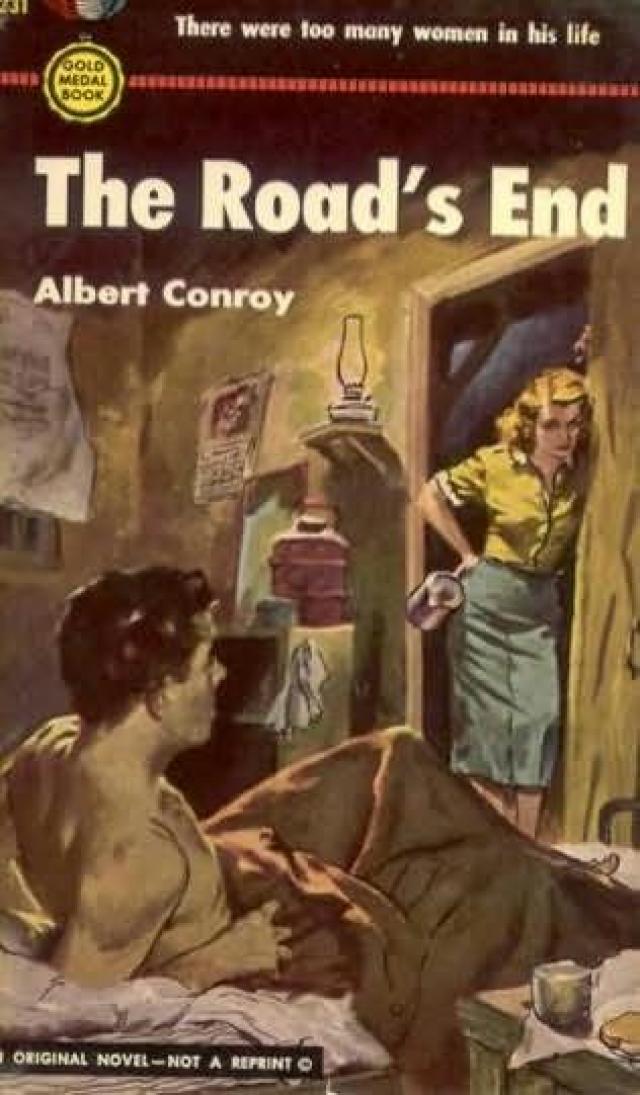
Marvin H. Albert (Albert Conroy)
The Road's End
***
B. (scanning and OCR) and P. (formatting and proofing) edition.
***
CHAPTER ONE
It was dark. Too dark to see her. But I could feel her, all of her, against my skin like a warm, creamy-smooth animal. I could feel her body and hands, but I couldn't move to touch her, to know if she were real or a dream. So I lay there passively, and after a while she left and I too drifted away. I awoke. I had awakened many times before, and I remembered vague shapes moving over me, and food and water fed into my open mouth while a hand held my head up. And I remembered the girl. But none of those awakenings had been complete. They had been too full of pain and fever that trembled through me in knife-edged waves.
Now the fever was gone. I lay for a while with my eyes closed, taking a mental check on myself. My arms and legs were no longer tired. They sprawled lazily, pleasantly. There was a slight edge of pain behind my eyes, and an ache at the back of my neck where it joined my head. I felt hungry.
My eyes opened. I was in a tiny, bare, plank-walled room with one dusty, cracked window through which I could see the blue of a clear afternoon sky. I lay on an army cot with a thin, hard mattress. There was a chair in the room, and a battered, unpainted bureau. A torn rag doll sprawled on the bureau top against the only shiny thing in the room: a big, round wall mirror.
I pulled away the patched army blanket that covered me and sat up, and discovered that I wasn't wearing any clothes. I placed my feet gingerly on the rough wooden floor. Sitting there on the edge of the bed, I didn't feel too shaky. The pain behind my eyes ebbed slowly away. But my neck felt cramped and I became aware that my nose hurt. I touched it. The bridge was twisted. It was broken and I had a little difficulty breathing through it.
The door to the room opened on squeaky hinges, and a girl of about seventeen or eighteen walked through it. She stopped abruptly when she saw me sitting up. Her blue eyes traveled over me leisurely, and her full, pouting mouth smiled dreamily.
I stared back at her, guessing she was the girl of the dark. She was a petite girl with a figure taut with youth, newly ripening. Her face, framed by her long, fluffy hair, was packed with latent sensuality that belied its snubnosed, shiny-cheeked newness. She wore only a long, faded man's denim shirt belted around her waist. It came down halfway over her smooth, tanned, hard-muscled thighs.
Looking at her thighs, I suddenly remembered that I wore nothing at all. I pulled the army blanket around me. She laughed, shut the door behind her, and sat on the chair by the cot.
"How you feelin'?" she asked in a soft, curiously stilted voice.
"Much better," I said, trying not to stare at her legs, or the breasts that pointed through the shirt.
"Where am I?" I asked.
"You're upstairs," she said softly, and her teeth were small, square, and white. "This is my room. We raise chickens downstairs. It used to be a little barn."
I wanted to ask her about her being beside me in the dark, but I knew somehow that neither of us would mention that. Another question nagged at my mind. "How did I get here?"
"Pop brought you home a day and a half ago. He saw some man drop you off a bridge into the river outside Bridesport, when he was comin' home in his motorboat." Her eyes searched me with a lazy curiosity. "You know who you are yet?"
That startled me. "What?" I said.
"You didn't know who you were or what happened to you when Pop pulled you out of the river. Pop said whoever dropped you in the river musta thought you was dead."
I sat on the cot and clutched the blanket against my sudden chill. I began thinking. But as soon as I did I had to fight a surge of terror. I could find nothing to think about. There was no place to begin. I remembered gaining consciousness in dark, night-shrouded, swirling water. I remembered hands pulling me up into the bottom of an open boat. And a lean, lined man's face asking me who I was and my being unable to answer just before losing consciousness again. My memory stopped there… an utter blank.
"I don't know anything!" Fright gripped my voice.
"Not even your name?" Her eyes gleamed with interest.
"No," I said miserably. I shook myself free from my fright and looked around the room and back to her.
"Who are you?" I asked, hoping that would jog my memory.
"My name's Carol. My pop's Jim Brill. He fishes and hunts a little and we raise chickens and eggs."
She got up and sat on the cot beside me and put her strong arm around me. "Don't worry," she said protectively. "You'll be all right soon."
I put my arm around her waist and drew comfort from her firm warmth.
"I know," I said. "Thanks." But I didn't sound convincing.
"Pop said you musta lost your memory from being hit on the head with somethin'. Pop says that can happen, lots of times." Her hand touched my damaged nose, carefully, then held my hand.
"Where's your father now?" I asked her, feeling life stirring in me, feeling her arm and body, and remembering her in the dark.
"He went back into Bridesport in the boat," she said. "To find out what happened to you. He'll be back tonight. It's only 'bout twenty miles away, down by the coast. Hey," she said abruptly, losing her dreamy look. "You must be hungry."
"I am," I said, and I grinned slightly, for the first time. It hurt.
"Sure you are," she agreed happily. She stood up and looked down at me. "I'll get Ma to scramble a buncha eggs and bacon for you and you'll feel betta."
Her legs were pressed against mine. I let the blanket slip onto my lap and around my hips. I put my hands around her strong waist and moved them up slowly and held her firm breasts and looked up at her. I'd started to do that out of a fuzzy need for her comfort, but that wasn't the way I felt after I did it.
She didn't feel that way either. She looked dreamy again. She put her hands on my shoulders and bent down and kissed my mouth carefully, awkwardly. My palms tingled. I let go of her and she stepped back. She was smiling softly. She laughed, a short, merry laugh, and went to the door.
"Mom'll get some food goin'," she said, "and I'll find you some clothes."
She looked at me a moment, and went out.
CHAPTER TWO
After Carol Brill left, I got off the cot and tried to stand. My legs were weak, especially inside the knees. I thought of the girl who had just left. I wondered if I was married, and that started my mind searching around again for my identity.
It was like searching in a dim, rounded chamber with drawers on the walls that were the inside of my head. There had to be something in the drawers. Yet they were all empty, all except one with a few small memories of the past two days scattered in the bottom.
I looked at myself in the round wall mirror. It was a stranger that I saw. Yet I knew the stranger.
I had a solid, rounded head with a lot of lank, dark hair on top. I was fairly tall, with a heavy, muscular frame on big bones. There were dark yellow and blue bruises on my chest and shoulders and my right bicep. I touched some of them. They didn't hurt too much.
I leaned my elbows on the bureau and looked closely at my roundish face. I was probably around thirty. My face was smooth, unlined, with narrow green eyes, one of them still partially closed and badly bruised. My long, thin nose had broken neatly, inside, not breaking the skin. It gave a slightly twisted, quizzical look that went with my highly arched, dark eyebrows. My mouth was thin and looked mean. I didn't like that. A gash was beginning to heal along the entire length of my right cheek, and there were long, vicious bruise lines running down my forehead. Not pretty at all. I looked lousy.
I began testing my face bruises, but I soon stopped. They all hurt terribly, and the top of my head and the back of my neck hurt worse.
Someone had certainly tried to beat me to death with something hard and heavy. He must have thought he'd succeeded. I thought of the man on the bridge. Who was he? Why did he want to kill me?
I got off that merry-go-round fast. I picked up the torn rag doll from the bureau and looked at it. The girl had probably had it a long time. I thought about Carol Brill for a moment and felt better all over again. What the hell did it matter who I was, after all? Once I started remembering, I'd have to go back into my past life. Perhaps it wasn't a very enjoyable life. Here was a chance to start a new life, just like a newborn baby, only with all my senses and emotions fully tuned up. I thought of Carol Brill again, having nothing else to think about, and I liked the new-life idea better and better.
I went to the one cracked window and looked out. The sun was shining hotly from a cloudless blue sky down on the lush green forest that surrounded the flat green clearing around the house, except on one side where the brown-earth clearing reached to a wide, muddy river. Three small boys in patched trousers were down there near the river, playing with two dogs almost as big as they. All three boys were towheads, like Carol. The sun glinted off the tops of their shiny crops, making their hair look almost white.
As I leaned my hands on the rough wooden sill, the door behind me opened again. I whirled, suddenly conscious of my nudity. It was the girl in that belted shirt again. She closed the door behind her and stared at me happily. I leaped for the bed and grabbed the blanket, holding it up in front of me. She laughed, shaking her blonde head derisively, and I thought of the feel of her in the dark again.
"Damn it," I growled, to hide the thought, "why don't you warn me before you sneak up on me like that?"
"Then I couldn't sneak up on you," she laugh
She held out a shirt and a pair of pants, both a worn and faded blue. "Here. These are my pop's. He's about your size."
Still holding the blanket in one hand, I grabbed the clothes held out to me. She let me have the clothes. She put her small hands behind her and leaned back against the door. When she got that dreamy look in those big blue eyes her small ripe lips pouted out, slightly parted- and I wanted to grab her and squeeze her. She was so tiny, her blonde head at the level of my chest, but she had everything she should have had for her age. And she looked strong enough, despite her smallness, to handle farm work without a tremor.
We stood there for a long moment like that, she with her beautiful face tilted up to mine, and something happened to us, something electric that leaped between our eyes, that jerked an invisible wire connecting us. I had no past, and she had a very short one, but in that moment we were able to speak to each other without words. I wondered if there was anything in a life that memory would bring back to me to match it.
"Look," I said at last, and my voice sounded big and tense in my own ears, "you go down and see how my meal is coming along while I get into these things. O.K.?"
The dreamy look stayed in her eyes, as though she hadn't heard me. But she nodded and opened the door behind her.
"I like you," she said earnestly. "I like you a lot." And then she was gone.
***
By the time I got down to the big, wood-walled room that served the Brills as kitchen, dining room, and parlor, the whole clan was waiting for me, including the two dogs. Carol and her mother were setting out food for us all on a long, pine-board table. The three boys, ranging roughly from eight to twelve, were already seated. They eyed me solemnly as I came in and said nothing. Carol's mother was as tiny as her daughter, with a tough, sinewy body and a smooth, kindly face. She wiped her hands abruptly on her apron and shook my hand with a tight, sure grip. You could see she'd led a tough life and enjoyed every moment of it thoroughly.
"I'm Norma Brill," she said, eying me carefully. "How're ya?"
"Pretty well," I told her. "My head still hurts a little."
"My husband'll be back by dark. He said it's a wonder you ain't dead." She looked me over critically. "Jim's clothes fit you fine, I see. Well, so long as you're not dead, sit down and fill up."
She heaped food on a plate in front of me and nodded at her sons. "These are my boys. That's Timmy. And that's Somerset, and the big one's Isaac." The boys jerked nods at me, their eyes wide and intent upon me. Then they dug into their food, still staring furtively in my direction. Carol and her mother filled their plates and sat on either side of me. From what I had seen of the rude house, Norma Brill was a rather sloppy housekeeper, but she certainly was a fine cook.
Carol and her brothers were silent ones, but their mother made up for them. I realized later that the kids all took after their father when it came to talking.
"It's terrible," Norma Brill said between forkfuls, "the way you can't remember anything, isn't it?"
I nodded and went on eating, overconscious of Carol beside me and embarrassed about her in front of her mother.
But Norma Brill didn't seem to notice. She went right on talking.
And so by the time Jim Brill showed up that night I'd learned a lot about the Brills. They weren't poverty-stricken farmers, by any means. They lived on bare necessities because Jim Brill liked living up there on the river with a minimum of neighbors and work. The chickens and eggs they raised and hatched in the back part of the Brill house-barn, plus some fishing by Brill, earned all they needed for their type of existence. The way Norma Brill told it, it sounded like an ideal way of life. I wondered how I lived, in that other, hidden life.
I learned also that the bridge from which I was thrown was just outside Bridesport, a small community down the river on the Gulf coast. It served as a shopping center for the farmlands around it, and as a deep-sea fishing terminal. If Jim Brill hadn't fished me out of the river, I'd have been swept out to sea and probably never found.
I walked out of the big Brill house with the rest of the family to meet Jim Brill as he got out of his boat on the riverbank fifty yards away that night. I was wearing his pants, shirt, and shoes, the pants a bit tight on me, the shirt a little loose.
Jim Brill was carrying some packages under his arm. "Here's the stuff I forgot last time, Norma." He handed all but a small paper bag to his wife and looked me over. "How're ya feelin'?"
"Good enough, thanks to you." He was about my height, in his forties, and looked as strong as a stallion in his tight overalls.
"Come on into the house," he said. "We got something to talk about."
Brill and I sat down at the scarred table in the big kitchen. Carol followed us, carrying a jug and two glasses. She set them on the table and leaned against the back of my chair. Brill poured out two big portions of the whisky and looked up at his daughter. I could feel her arm touching my shoulder. One side of Brill's thin mouth twisted in amusement. "Scat," he growled. Carol let go of my chair and walked out, slowly.
"She's a lovely girl," I said sheepishly.
"Yeah," Brill nodded. "She's small for eighteen, but she's gettin' man-hungry." He picked up the paper bag and fixed me with steely eyes. "But you're married." The muscles of my stomach twisted. I held myself calm while I watched his hard, calloused hands take a newspaper out of the bag. "Have the drink," he said, and pushed the paper at me across the scarred table top.
There was my picture, smack on the front page, minus the broken nose and bruises. My name was Dan Ginger.
The paper told me that I was thirty-one, an ex-merchant seaman who'd been living in Bridesport for a year and a half. I ran a barroom in partnership with Jeff Hull, a native of Bridesport who had known me in the merchant marine. Six months after hitting town, I'd married Patrice Vandergrift, the daughter of one of Bridesport's wealthiest men. The paper said I'd disappeared, and the police were searching for me.
There was another picture beside mine. It was the face of a pretty, provocative-looking girl named Elsie Daniels. The paper said she'd been named prettiest girl in her class when she'd graduated from high school recently. It also said that she'd been rumored messing around with Dan Ginger… me.
Elsie had been found in her car, outside town, on the night I disappeared from Bridesport. She was naked, and she had been beaten to death.
Dan Ginger was wanted for the murder of Elsie Daniels.
CHAPTER THREE
Jim Brill went with me the next day to see Bridesport's sheriff. I'd shaved that morning with Brill's straight razor, but my bruised face had turned it into a painful and patchy job. We came down the river in the old motorboat. Before reaching town we went under the high, short bridge from which Brill said I'd been dropped. It didn't jog my memory at all.
"Snake River winds around the edge of town and into the ocean," Brill informed me after we passed the bridge. "You see how straight and steep those banks are? They're that way from here on. No shallow spots along the edge. And the current runs out damn strong. The guy that dropped you musta known there was no place for your body to wash up and be found. You'da just gone out to sea if I hadn't been there. Never woulda found you, most likely. Strong Gulf current at the mouth of the river, too."
Bridesport was a nice, clean little town. Except that most of its low buildings needed a paint job. It was easy to feel how the sun worked on the paint there on that wet-hot June afternoon.
The sheriff's office was in one of the town's bigger buildings, a solid, red-brick place that served as both a jail and the municipal center.
The sheriff's office was at the end of a long, dark, cool hall. A small wooden sign hung on the open door: "MACK FISHER, SHERIFF." Inside was a big, many-windowed room packed with files and office furniture. Six chairs were arranged in a semicircle in front of a big metal desk. The most impressive thing in the room was the man sitting behind the desk. He got up suddenly when he saw us, then stood where he was, not moving.





