

Driven: Rush in the '90s and In the End , page 1


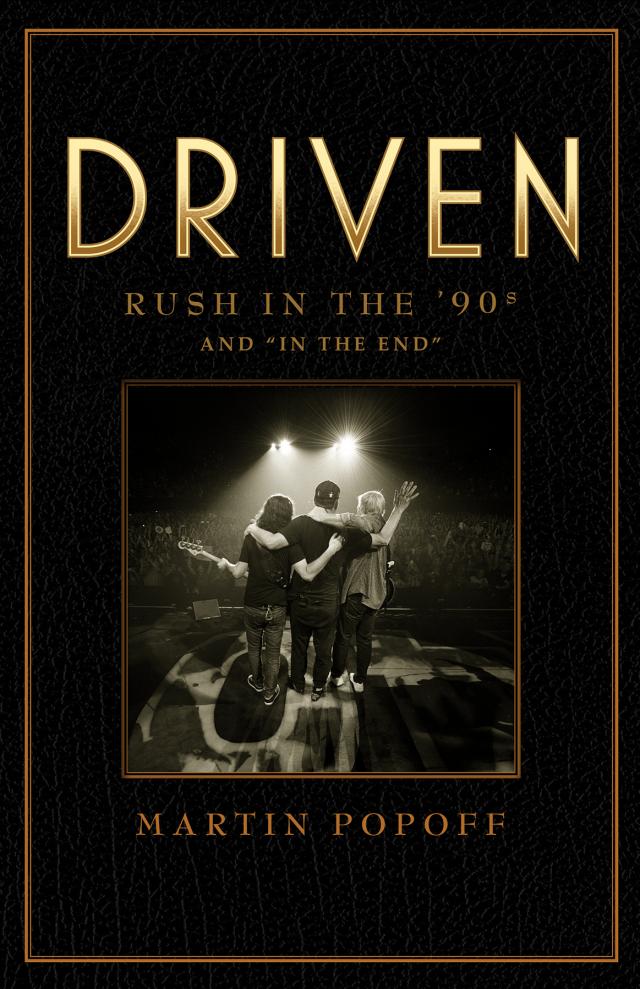
DrivenRush in the ’90s and “In the End”
Martin Popoff
Contents
Introduction
Chapter 1: Roll the Bones
Chapter 2: Counterparts
Chapter 3: Test for Echo
Chapter 4: Different Stages
Chapter 5: Vapor Trails
Chapter 6: Rush in Rio
Chapter 7: Snakes & Arrows
Chapter 8: Clockwork Angels
Chapter 9: “In the End”
Photos
Discography
Credits
About the Author
Martin Popoff — A Complete Bibliography
Copyright
Introduction
The book you now hold in your hands marks the conclusion of a trilogy, a long journey down the path of progressive metal greatness. It started with Anthem: Rush in the ’70s and was perpetuated and provoked by Limelight: Rush in the ’80s, and it concludes now, beyond bittersweet, after the death of Neil Peart from brain cancer on January 7, 2020.
The dark news came to light near the end of the production process for Anthem and Limelight, so in those books Neil remains forever alive and disseminating his wisdoms as “the Professor.” But the tragic end to one of rock’s towering greats can’t be avoided any longer, and so it is part of this story.
For now, however, some background for you, on the subject of this book. If you are wondering why — or indeed how — this book exists, let me explain, quoting more or less verbatim from the intro of the first book from way, way back, Anthem, if I may.
There I wrote:
As you may be aware, this is my fourth Rush book, following Contents Under Pressure: 30 Years of Rush at Home & Away, Rush: The Illustrated History and Rush: Album by Album. And since those, there have been a number of interesting developments that made me want to write this one. To start, only one of those three books, Contents, was a traditional biography — an authorized one at that — but it was quite short, and given that it came out in 2004 before Rush was officially retired, it was in need of an update. I thought about it, but I wasn’t feeling it, not without some vigorous additions.
That, fortunately, took care of itself. In the early 2010s, I found myself working with Sam Dunn and Scot McFadyen at Banger Films on the award-winning documentary Rush: Beyond the Lighted Stage. Anybody who works in docs will tell you that between the different speakers and non-talk footage that has to get into what might end up a ninety-minute film, only a tiny percentage of the interview footage ever gets used, the rest just sits in archive, rarely seen or heard by anyone. Long and short of it, I arranged to use that archive, along with more interviews I’d done over the years, plus the odd quote from the available press, to get this book to the point where I felt it was bringing something new and significant to the table of Rush books.
So there you have it, thanks in large part to those guys — as well as the kind consent of Pegi Cecconi at the Rush office — the book you hold in your hands more than ably supplants Contents Under Pressure and stands as the most strident and detailed analysis of the Rush catalogue in existence.
Now, to the present tome, what to make of Rush in the ’90s and “in the end,” so to speak, the 2000s and the 2010s, right up until the band’s retirement in 2015 and the great loss to family and friends resulting from Neil’s being taken from us in 2020?
Obviously, we’ll get to that, but this is the place for a spot of personal reflection, so here goes. As an angry metalhead more excited by what Pantera was doing to music now that they had Phil and a major label deal, the twee tones of Roll the Bones had me casting that record aside pretty quick. Sure, there’s always excitement around a Rush album, and this one for some reason generated a bit more than usual, but still, I wasn’t happy.
When Counterparts launched, to my mind, Rush was back — the music was full-bodied, the writing not appreciably different, but it wasn’t hobbled by a lightness that brought the already underpopulated trio down to what seemed like 2.5 or 2.25 members. I loved the record, loved the resonance of the bass, the boom of the drums, the authority howling out of the guitars. Test for Echo left me cold, like the album cover, and then right after, we all had to deal with the shock of the horror that was Neil’s personal life after the death of his daughter, Selena, and then his common-law wife, Jackie. Maybe it was the end of Rush: Alex and Geddy both had solo albums (that sounded like Rush in the ’90s), and there were a hundred other flavors. Yes, maybe this was the end.
Fortunately, it was not to be. Neil mended as best as could be expected under the circumstances, and the band returned with a masterful new record, Vapor Trails. I don’t know what it is about this record, but putting aside the dark wisdom of its lyrics, it’s arguably the best of a top-shelf canon thus far. I felt like this was the first time since Grace Under Pressure that the band had created a whole new style of music, and it was art at the same time. I loved the record — still do — old mix, remix. I’ve always got time for Vapor Trails.
So then a weird thing happens. I do the Contents Under Pressure book and then work at Banger on the movie. Add another couple of Rush books later on, get interviewed for a couple of Rush docs, and suddenly, Rush reminds me of work. I imagine that’s where I am any time I even think to put a Rush record on (this reticence fades, fortunately). But yes, here I am living in Toronto, and it’s all Rush all the time and I’m full up. But then — God love the guys — Snakes & Arrows is issued, and it’s all fresh again. Something has shifted since Vapor Trails. Whether it’s new producer Nick Raskulinecz or just the band’s typical rapid growth, suddenly there’s a new sound, if I can generalize, one characterized by warmth along with acoustic guitars massaged in with electrics.
Next came Clockwork Angels and little did we know it would be the last. Not only was this a record that lived lively like its predecessor, but there was an additional heaviness due to the subtraction of the acoustics. What’s more, Rush delivered their first concept album proper after stopping at a full side in the past. Here they barreled on through a somewhat befuddling plot, but one brimming with rich imagery with the addition of steampunk to the stew, which was stressed more through the stage sets of the tour.
Then it was all over with a languid goodbye, the band touring the record proper and then embarking on something called R40, a fortieth anniversary tour that found the band playing songs from their catalogue in reverse chronological order, making progressively modest their stage set in tandem, until there they were, three kids rocking songs from 1974.
Four years and five months after the band’s last show, the shocking news reverberated through the rock community that Neil had died, and it was horribly clear to all that the soft retirement of Rush was final. More, unfortunately, on this later, but there you go. That’s where Rush ends and that’s where we can end this set of three books, this particular tome celebrating the biggest expanse of years and the worst news imaginable, but on the happy side, there is a raft of records similar to those covered in both Anthem and Limelight. In any event, thanks for reading along. Whether you parachuted in here with modern Rush or have been following the bouncing ball since the first book, I’m glad to share my deep appreciation of Rush with you. Without further ado, in the immortal words of the Professor, “Why are we here? Because we’re here. Roll the bones.”
Martin Popoff
Chapter 1
Roll the Bones
“We keep looking for the better version of Rush.”
Here’s how the ’90s started for Rush.
One week after Geddy, Alex and Neil would propose an austere something-or-other called Roll the Bones, Guns N’ Roses would drop two near-double albums, Use Your Illusion I and Use Your Illusion II.
Another week goes by and on September 24, 1991, Nirvana offered for your consideration their second album, Nevermind, led by a little something called “Smells Like Teen Spirit.”
Roll the Bones did not sound like Guns N’ Roses or Nirvana, nor did it sound like really anything out there (and that’s not necessarily a good thing), other than Presto, Rush’s similarly thin, mild and modest record from two years previous when the band was facing the same realities: hair metal, grunge and thrash at the fore, Rush’s brand of progressive bonsai tree and origami pop — a curious thing — but let’s go see Rush anyway.
But credit to the guys in one sense: they were believing in the stark and odd and oddball evolutionary path they were on and damn the torpedoes. Rupert Hine returned as producer, signifying that they thought they got it right on Presto. Rupert was in a sort of fourth member role in the Rush cabal, which helps underscore the identity of any given project.
“We felt we were missing something,” figures Geddy, on the importance of these strong outside voices. “We felt we weren’t learning enough. It’s like going into a fantastic restaurant and seeing all these great dishes and wanting to try all of them; that’s how we were. We felt like we had this great start. We had this great upbringing, and we learned a hell of a lot about making records. We were born into this rock world, and we had some tools and we wanted to refine those tools. And the only way to do that was to work with more people, different people.
“Because of the style of music we played, there was a real bias against kind of progressive heavy metal, and we found it diffi
cult to work with all the producers we wanted to work with. And so every time out, we had a new list of people. We came into this whole mode of unearthing producers that maybe would be unlikely people for us to work with, but we felt had some real heart as producers. And that started the whole thing. It’s like, when it’s time to make a record, let’s dig up the names, let’s pick up the lists. Who can we find? Who is out there? Who is just coming into his own as a producer? And can we grab some of that excitement?
“In the early days of doing that, it was experience we were after. I think now, and especially with Nick, it’s youthful energy and a different attitude toward making records, and that’s a way for us to stay current. We can’t help being who we are, and we’re not going to work with anybody else. There’s the three of us, and we’re dedicated to that, so what’s the easiest thing to change? It’s the people around you when you make a record. That’s the easiest way — and for me the smartest way — of bringing new energy, new ideas, into an old idea — Rush — you know? A forty-year-old idea.”
Reflects Rupert: “At the time, because of the urge to keep things fresh, you are looking for all kinds of ways of moving the parts around, and some input, some random input. That just marks them as wanting to stay in the world of making records together, because they could have split up, they could have formed three independent bands based on each other and done a million things with the kind of fan base they had, and still had a pretty good living. But they were never tempted to do that, and the odd solo record is always very much a sidebar project.
“There’s the absolute will to stay together and find out just how far these three people in each other’s pockets can travel. And I don’t think it’s ever a scramble, I don’t think it’s ever desperate, I think it’s always willful, it’s always thought about in advance, it’s always to a degree calculated, in terms of the moment they ask this random input to come into their world. It’s a calculated decision about a point that’s been well thought out by them. They’re in masterful control of their lives and the band’s direction. That in itself is so unique — it’s one of the many truly unique things about this band.”
Typical of the civilized men of letters that they were, Rush went on a writing retreat in advance of making the new record, holing up at Chalet Studio in Claremont, Ontario, for two and a half months to write, each in their longstanding roles. When not birdwatching and repairing birdfeeders, Geddy and Alex would put music to Alex’s rudimentary drum machine patterns, the two convening with Neil in the evening to see what they could cook up together. As with Presto, writing centered around guitar, bass and drums and not keyboards, with a heavy emphasis on vocal melodies as well — common parlance would eventually position the Rupert Hine years as the singing era, where Geddy would shift the attention he was placing on keyboards over to the making of memorable vocal melodies, or melodies that played a stronger role in the song, almost as a fourth instrumental narrative.
“It felt to me very much like a part two,” agrees Rupert. “But the second part built on how they felt about part one, meaning Geddy liked that his voice was in these different registers. He understood why I thought it had made a difference, and he liked it. And I think they were encouraged by the three-piece idea again and minimalizing the keyboards. We carried on doing that, and so there’s probably even less keyboards on that record, and there weren’t many on Presto, certainly not compared with the previous two albums.
“But I find it hard not to think of them as one piece. I’m not sure I went into the second album with anything like the objectives we had for the first because it had seemed like the objectives had made sufficient change — and the band had themselves compounded on that change. I would say things were amplified. There was no real ‘Well, the one thing we got wrong with Presto was blah, blah, blah, so this time we’ll try this.’ I think everything was compounded, which was encouraging from my perspective. It seemed to be starting off with an enthusiastic kick up the bum.”
In other words, the guys were happy with what they had done on Presto. Even if there were less keyboards, no one at this time was concerned with heavy, rocking Rush. Alex was exploring texture, color, atmosphere, funk and acoustic guitar, and all five of those descriptives tend to put the guitar in a supportive role. In support of what? Well, vocals, and thus almost automatically, lyrics. Bass would and could be moderately busy in that wee and twee box, drums slightly less so, pretty much on par with guitar. All of this adds up to a hermetically sealed bubble of Rush’s own making, a contrivance even, albeit one that moves along an evolutionary path. Forget what’s happening with surging wider tidal musical gyres; there’s this thing we are doing, and we’d like you to hear it.
“I don’t recall ever having a discussion with individual Rush members about any other band or music,” muses Rupert. “Of course I was only too happy to keep any sonic interference out of the way and just look at the purity of what the band can do. That’s not strictly true, because you’ve just rung a bell: I do remember talking to Neil about Living Colour, but I imagine with respect to some relatively ideological stance, nothing directly affecting the band. I mean, I delighted in the fact that not once did Alex ever say to me, ‘You know for this track, I sort of thought the sound of the guitar could be a bit like . . .’ Never went there.
“And almost every band, it’s like, ‘You know that sound of that part on so-and-so’s track? When they do that?’ And you work from there. I always love the idea that you have an absolutely blank page for everything, for every song, for every album, for every part. You just start with, ‘Well, I wonder what we could do to make this part really sing, really work, you know?’ And not to jump outside of any frame of reference, other than your own, so you can dig into some mad little demo that you did on a matchbox ten years ago and say, ‘Here, look, I love this’ and, ‘Oh, yeah, let’s take that.’ That will just be more intensely them. Just borrow from your own oeuvre.
“I can’t say that Roll the Bones is part of the era when the Seattle sound was out. It feels to me like we were in absolute isolation of it, but I wouldn’t really encourage them in any other way than to be aware. You can’t not be aware if you’re musical. I’m not suggesting people go and live on an island and listen to nothing — you’ve got to soak in the musicality of the planet without a doubt — but you’re going to do that anyway, if your eyes are open and you’re musical.”
“I don’t think I’ve ever known where Rush is in the musical landscape, to be quite honest,” chuckles Geddy. “I don’t think any of us do. And that’s a blessing because we go in and do what we think is fun to do and what is cool to do. Yeah, we listen to other things and we try to bring new things in. At that time, it was kind of the beginning of rap and hip-hop and all this, and Neil wrote this really funny kind of piss-take on this whole thing, and we thought, why don’t we throw that in the song? And that’s how that whole middle section of ‘Roll the Bones’ came to be. It was just us having fun playing this goofy background kind of rhythmic track and then rapping on it.
“So we basically have no plan. I think a lot of bands do have a grand plan, master plan, and we don’t really have that. At the start of a record, we just don’t know what’s going to happen. We just let it happen. Certainly, I wanted to improve the songwriting on the Roll the Bones album, because I had that feeling we were more style than content on Presto. That was kind of the residue that was left with me from Presto. ‘The Pass’ was really strong, but a lot of the other songs on that album didn’t really stay with me from a song resonance point of view. And so we really focused on the songwriting, and I think we nailed that. I think a lot of the songs on Roll the Bones are really strong.
“But we’re always experimenting,” continues Geddy. “I mean, just because we got successful doesn’t mean we’re going to stop. That’s the way I look at it. We could’ve gone in and done Moving Pictures all over again, but we’re not really well built for that. We’re too curious; we’re too dissatisfied with where we’re at, so we feel we have to keep moving. We have to find the better Rush, you know. We keep looking for the better version of Rush.


