

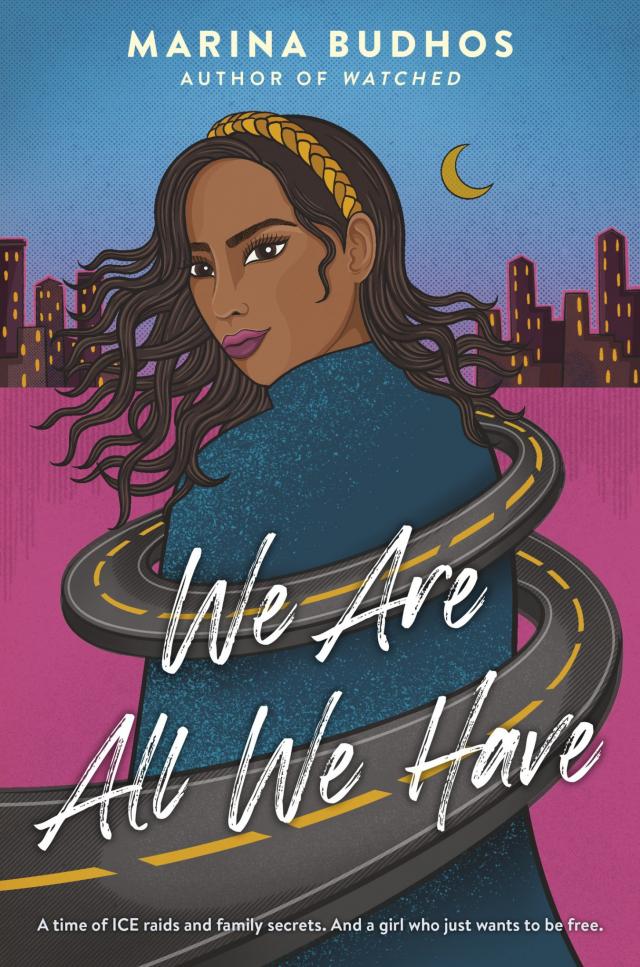
We Are All We Have, page 1


ALSO BY MARINA BUDHOS
The Long Ride
Watched
This is a work of fiction. Names, characters, places, and incidents either are the product of the author’s imagination or are used fictitiously. Any resemblance to actual persons, living or dead, events, or locales is entirely coincidental.
Text copyright © 2022 by Marina Budhos
Cover art copyright © 2022 by Samya Arif
All rights reserved. Published in the United States by Wendy Lamb Books, an imprint of Random House Children’s Books, a division of Penguin Random House LLC, New York.
Wendy Lamb Books and the colophon are trademarks of Penguin Random House LLC.
Permissions for ghazals appear on pages 239–241.
Permission for the quote on page vii courtesy of the Southern Poverty Law Center (SPLC).
Visit us on the Web! GetUnderlined.com
Educators and librarians, for a variety of teaching tools, visit us at RHTeachersLibrarians.com
Library of Congress Cataloging-in-Publication Data is available upon request.
ISBN 978-0-593-12020-0 (hardcover) — ISBN 978-0-593-12021-7 (lib. bdg.) — ISBN 978-0-593-12022-4 (ebook)
Random House Children’s Books supports the First Amendment and celebrates the right to read.
Penguin Random House LLC supports copyright. Copyright fuels creativity, encourages diverse voices, promotes free speech, and creates a vibrant culture. Thank you for buying an authorized edition of this book and for complying with copyright laws by not reproducing, scanning, or distributing any part in any form without permission. You are supporting writers and allowing Penguin Random House to publish books for every reader.
ep_prh_6.0_141656613_c0_r0
Contents
Cover
Other Titles
Title Page
Copyright
Dedication
Epigraph
Part 1: Brooklyn, New York, 2019
Chapter One
Chapter Two
Chapter Three
Chapter Four
Chapter Five
Chapter Six
Chapter Seven
Part 2: Manhattan, NYC
Chapter Eight
Chapter Nine
Part 3: Connecticut
Chapter Ten
Chapter Eleven
Part 4: On the Road
Chapter Twelve
Chapter Thirteen
Chapter Fourteen
Chapter Fifteen
Chapter Sixteen
Part 5: Exits North
Chapter Seventeen
Chapter Eighteen
Part 6: The Road Back
Chapter Nineteen
Author’s Note
Acknowledgments
About the Author
To those seeking safety—may their stories be heard.
On May 7, 2018, the US Department of Justice (DOJ) announced it had implemented a “zero tolerance” policy, dictating that all migrants who cross the border without permission, including those seeking asylum, be referred to the DOJ for prosecution. Undocumented asylum seekers were imprisoned, and any accompanying children under the age of eighteen were handed over to the US Department of Health and Human Services (HHS), which shipped them miles away from their parents and scattered them among one hundred Office of Refugee Resettlement (ORR) shelters and other care arrangements across the country. Hundreds of these children, including infants and toddlers, were under the age of five.
—Southern Poverty Law Center (SPLC)
Their faces assumed the awful craftiness of children listening for sounds from the grown-up world.
—J. M. Barrie, Peter Pan
Chapter One
They’re coming.
It takes a second for the words to drip into the thick soup of my sleep.
They’re here.
The words make ripples in my half dreams. A lamp switches on and a bright band of light stings my lids. “Rania! They’re here.”
I wrench up from the quilt, my heart quivering. “Who?”
“Just come.” Ammi nods to the other bed, where my little brother, Kamal, is sleeping. “Don’t wake him.”
“Of course,” I grumble. I punch my pillow and force myself to get up. Kamal is protected. He’s sensitive. Don’t let him hear. With me, her voice is flat, practical.
I follow her out of the bedroom; she’s still in her jacket from work—a black windbreaker that makes a rubbing noise as she walks. The keys are still in the open door. She hasn’t even pulled out her sofa bed.
Several people are crowded outside our apartment. The fizzing, garbled sound of a walkie-talkie from the hall cuts through our living room. My heart speeds up. They’re in black quilted vests with POLICE on the back.
No. Not us.
A woman turns to me, the one with the walkie-talkie. “Hold,” she says, and clicks off. “And this is?”
“My daughter.”
“Any other children in the apartment?”
“My son.”
“And your daughter is how old?”
A hesitation. “Eighteen.”
“Ammi—” I start, but she flashes me a cool, forbidding look.
That’s a lie! I want to yell. I’m not eighteen for seven months—December. I’m tall, very tall, taking after my dad, so most people think I’m older than I am. I get away with a lot: the teachers who don’t say a word when I come to pick up my little brother; the kids who hit on me to buy them beer at the liquor store. Me and Ammi both stretch the truth when we have to.
The woman looks up at me. “We’ll have to see some ID, then.”
Ammi gives her one of her charming smiles. “Can you wait just a moment?” She takes my arm and draws me into the foyer.
“Ammi!” I whisper. “My ID says I’m seventeen! Why did you—”
“Hush.” She sets her hands on my shoulders. Ammi is so short, she has to lift her chin to meet my gaze, but she can still terrify me with one firm look. “No time for panic or baby stuff.”
“I’m not a baby!”
Her eyes dart in a dozen directions. “There’s a plan—”
“What plan?” I yank up my sweatpants, worrying the string.
“I tried to call Maria Auntie but she’s not home. She’s on a shift.”
“Why did you say I was eighteen?”
“Rania!” She shakes me lightly. “You’re minors. You can’t be left on your own.”
On our own? My eyes swing around the foyer. Wait. Panic starts up in my chest. Ammi can’t go.
She’s fumbling inside a table drawer, taking out an envelope. Ammi once showed me the paper inside, explaining, “If anything happens, this is what you need. It’s a standby guardianship form. Maria Auntie will take care of you.”
Maria Auntie lives down the hall and is our surrogate aunt since we don’t have any family in this country. She brings us foil dishes of arepas and tamales and we keep our extra keys with her. Maria Auntie is a lot like Ammi—she’s got hustles and side hustles to keep her family going.
“Everything okay over there?” the officer calls over to us.
Ammi pulls me back to the doorway. “My mistake. My daughter is eighteen in a few months.”
The woman gives us a skeptical look. “So you’ve appointed a standby guardian?”
“Yes, yes.” She thrusts the folded paper at the officer, who reads it.
“And where is Maria Alvarez?”
My mother’s voice fades. “Working.”
The woman squints at the form. “And who is this—Lucia Alvarez?”
“Lucia!” my mother says brightly. “Yes, yes! She is home. Maria’s daughter.”
Oh great, I think. Lucia. The biggest mess-up around. She dropped out of LaGuardia College and got in trouble with some creepy boyfriend.
The officer goes down the hall and presses, hard, on Maria Auntie’s buzzer. A few other doors in the hall crack open, some still with the chain attached, worried faces peering out. I feel a humiliating burn around my ears. We have seen this before. Men and women in these same jackets swarming up the stairs. Calling through the door. Crying and pleading and then our neighbors were gone.
“Who is it?”
Before the officer can speak, Ammi calls out, “It’s us! Sadia and Rania!”
The door swings open. Lucia’s makeup is smeary, one side of her curly hair flattened. “Yeah?”
When the officer explains the situation, she rolls her eyes, as if to say, You guys are always a pain. I’ve heard her complain to Maria Auntie that they shouldn’t get involved with other people’s problems.
There’s a footfall behind me. Turning, I see Kamal in his rumpled pajamas, rubbing his eyes. “Ammi?” he mumbles.
My mother looks crushed. Everything she does is to never let Kamal know this could happen. Me, I’m always supposed to go along with her, even if it makes no sense.
“Take him back in,” the walkie-talkie woman says to Ammi, firm.
“May I say goodbye?”
The woman sighs. “This isn’t a good idea.â€
My whole body clenches. Every part of me wants to scream: Then don’t take my mother.
Ammi kneels down. She’s in slacks and a crisp shirt, as if for an office, even though she’s been driving all night for Uber. Kamal stretches his thin arms around her neck and nestles in her hair. She’s murmuring to him calmly. I’m furious—and scared. Then Ammi wipes her eyes.
“Ma’am?”
“Just a minute.”
“Ma’am, don’t make this harder.”
She stands. She puts something in my palm—cool and bumpy—it’s her keys, to the car, to everything else. She draws me close. I smell sandalwood and a trace of coconut oil in her hair, the stuff that I use for my unruly waves. My mother is so young, it’s as if we’re sisters, not mother and daughter. “You can drive,” she whispers. “Remember that.”
True. Ammi made sure I took driver’s ed, even though I use buses and the subway everywhere. She never lets me drive the car. But she’s always ready to flee. We keep a suitcase packed with a set of overnight clothes and toothbrushes in the bottom of our closet; we never buy too much for the apartment—one wok, one tawa pan, silverware for four, so we always have to wash our forks and knives after eating. The story of our life, for so long.
But this time, it’s not the three of us, packed up, sprung and ready to go. Just her. I call out, “Wait! It’s a mistake!”
Ammi pulls back. Her face has gone hard. “Not now, Rania.”
I whimper.
“In the morning, call Lidia. She knows what to do.” That’s our lawyer.
My mother and I stare at each other. A staticky voice comes through the walkie-talkie. “We need you down here. Another group. A van.”
“Roger that,” the woman says. “I’ve got some collateral here too.”
Collateral.
Ammi.
The woman gestures to Lucia, who grudgingly comes and stands by our door. “You’re over eighteen?”
Lucia looks defiant. “Just turned the big twenty.”
“Can I see ID?”
Here Lucia’s bravado falters. She’s undocumented. The whole family is. She fishes out an ID, the woman scribbles down the information, then gives it back. “Okay, you’ll need to stay with them. We’ll send someone to make sure your mother is serving as standby.”
The officer gently takes my mother’s elbow and guides her past half-opened doors and frightened faces. Kamal flings his arms around me, presses his head into my stomach.
Lucia nervously picks at her fingers. Behind her toughness, she’s scared. Just like us. She puts her hand on Kamal’s back. “Thanks,” I whisper.
And then we are watching, stunned, as Ammi disappears down the stairwell, swallowed up in a mound of heads and shoulders. It’s only after she leaves that it sinks in.
This was a raid. An ICE raid.
I wrench Kamal into our apartment, slam the door, and push down a sob. No. I can’t break down in front of Kamal. Back in our bedroom, I nudge him into bed. Even though he’s trembling and confused, he slides his bare feet under the blanket and turns his back to me. I rush to the window. Down below, several ICE agents mill in the hot glare of lights. One puts a palm on Ammi’s head, steering her toward the back of the van. She glances up at me, to our window. I see her mouth move.
Run, I’m sure she’s saying. Run.
Chapter Two
Two months ago I was running around for fun.
It was early April, one of those hot days where sweat pricks the back of your neck the minute you step outside. I had just dropped off Kamal at school and was heading over to the subway to meet my best friend, Fatima. This was our routine every day since we met at the beginning of ninth grade in gym class. On that day, I was groaning and cursing my thick hair falling in my face when a girl handed me a gold-braided tie, saying, “Take it. I’ve made fifty more.” She had the same wild waves as me, but she looked way more chic with her gray-green eyes, her drab uniform shorts rolled into neat cuffs. I snapped the band into place and felt sleek and cool.
Now, by spring of senior year, it’s like there’s a wind under our sneakers. Fatima and I glide and slide through the Brooklyn streets—my neighborhood, Sunset Park; hers in Bay Ridge. Our shoulders loosened back, not bowed with textbooks. All that counted is behind us. Sure, we’ve got our Regents exams but I’m not too worried. We’re in the fourth quarter, our grades stacking up fine. I’ve got my admission to Hunter College in Manhattan; after lots of family drama, Fatima’s going to Brooklyn College.
On that day we were wearing matching FREEDOM T-shirts that Fatima designed, showing a silhouette of two girls before a sunset. Our little reward to ourselves for four years of manic work and pushing for grades, while taking care of our siblings and remembering to pull the meat out of the freezer for dinner—so what if we declared ourselves free a little early? We deserve it.
Self-care, Fatima calls it. She’s always posting pics on Instagram on how to give yourself a spa day or light scented candles to soothe your spirit. Blissful pictures of windows looking out on the Mediterranean Sea or of us lounging in Sunset Park, showing off our pedis. Fatima’s something fierce about fashion and self-love. I’m sure it’s because of her mother, who got married at sixteen. Mrs. Elawady is always in the same long housedress, day in, day out, too busy with taking care of Fatima and her three brothers. Fatima gets furious at her mother for letting her roots grow out; now and then she drags her into the bathroom, packs her hair with her grandmother’s recipe of henna and yogurt. I think Mrs. Elawady likes it, actually. “My daughter, the bossy general. I always obey.”
That’s the biggest thing we have in common: our moms. Young-old, we say. We’ll never be like them. We’ll fly fast before life tugs us by the ankles. Isn’t that the whole reason they came to America? Fatima’s mother thought she was going to go to university in Cairo to be a nurse, until her parents told her about a great match: a young man who already owned a business in the US. After many cups of mint tea, talking about the two young people, the matter was settled between the families. “No way that’s how my life’s decided!” Fatima often declares.
Now, on this warm spring morning, I found Fatima waiting by the subway entrance. She had on a denim jacket to hide how tight her T-shirt pulled across her chest. I’m sure her mom wasn’t too thrilled about that. “I got the afternoon off,” she told me.
“Me too. Kamal is going to a friend’s place.”
“Wanna go downtown after school?”
“Oh yeah.”
“Freedom!” We laughed, bumped fists. She hooked her arm through mine, and we raced onto the platform, ignoring the people who frowned at us. We grabbed a couple of seats while the train rumbled underground for a few stops and then suddenly we were up, aboveground, sunlight shooting through the glass. We stared out at the blinding morning light, slashing across the Brooklyn rooftops. Everyone else was lost in their phones or staring down at their shoes. They didn’t even notice the view! That’s what me and Fatima wanted: to live full on, taking in everything.
Our FREEDOM T-shirts came from when we were studying the Beats with Mr. D junior year and reading Jack Kerouac’s On the Road. I complained that the main characters are just a bunch of sexist white dudes who get to do whatever they want, and all the women are called girls and get dumped. “Go ahead, rewrite it,” he told us.
So I did. We performed our feminist version for Mr. D’s Beat Café Night. Brooklyn Ra-Ra and Fa-Fa, we called ourselves. We sat on folding chairs, in black felt berets, on our own wild road trip to find America. At the end I got up and gave my last riff:
The road is a licorice whip sliding down my throat
red-bean buns in Sunset Park, watching the sky blush pink.
West, go West, the Beats told us.
What if the road isn’t yours because the guys got there first?


