

Some Maintenance Required, page 1


Also by Marie-Renée Lavoie (in translation)
Mister Roger and Me
Autopsy of a Boring Wife
A Boring Wife Settles the Score
Titre original: Les chars meurent aussi par Marie-Renée Lavoie
Copyright © 2018, Les Éditions XYZ inc.
English translation copyright © 2022 Arielle Aaronson
* * *
First published as Les chars meurent aussi in 2018 by Les Éditions XYZ
First published in English in 2022 by House of Anansi Press Inc.
www.houseofanansi.com
* * *
All rights reserved. No part of this publication may be reproduced or transmitted in any form or by any means, electronic or mechanical, including photocopying, recording, or any information storage and retrieval system, without permission in writing from the publisher.
* * *
House of Anansi Press is a Global Certified Accessible™ (GCA by Benetech) publisher. The ebook version of this book meets stringent accessibility standards and is available to students and readers with print disabilities.
* * *
26 25 24 23 22 1 2 3 4 5
Library and Archives Canada Cataloguing in Publication
Title: Some maintenance required / Marie-Renée Lavoie; translated by Arielle Aaronson.
Other titles: Chars meurent aussi. English
Names: Lavoie, Marie-Renée, 1974- author. | Aaronson, Arielle, translator.
Description: Translation of: Les chars meurent aussi.
Identifiers: Canadiana (print) 2022016102X | Canadiana (ebook) 20220161038 |
ISBN 9781487007737 (softcover) | ISBN 9781487007744 (EPUB)
Classification: LCC PS8623.A8518 C5213 2022 | DDC C843/.6—dc23
* * *
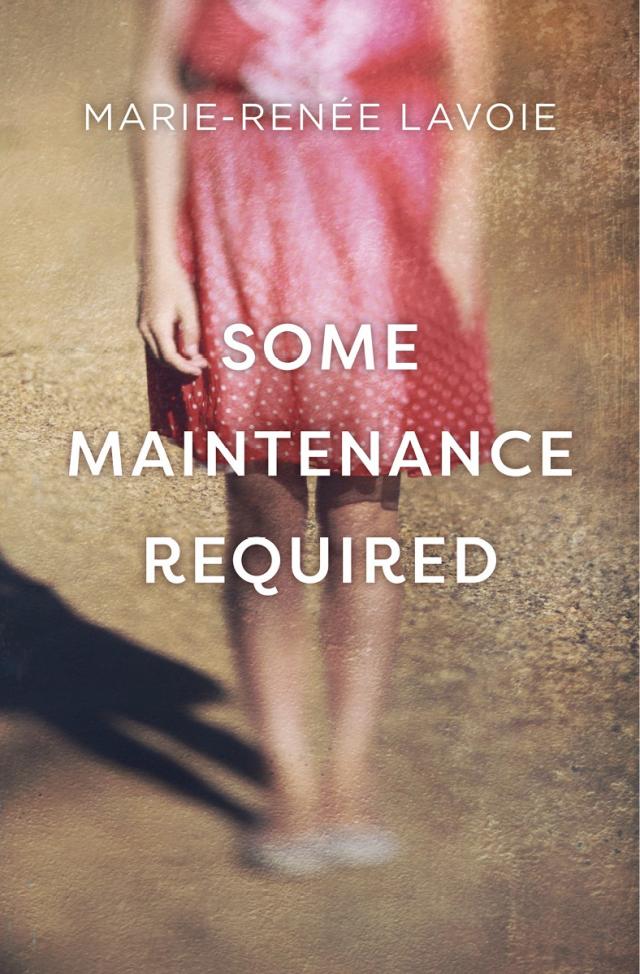
Cover image: Katy Lemay / Trevillion Images
Text design and typesetting: Marijke Friesen
* * *
House of Anansi Press respectfully acknowledges that the land on which we operate is the Traditional Territory of many Nations, including the Anishinabeg, the Wendat, and the Haudenosaunee. It is also the Treaty Lands of the Mississaugas of the Credit.
We acknowledge the financial support of the Government of Canada through the National Translation Program for Book Publishing, an initiative of the Action Plan for Official
Languages — 2018–2023: Investing in Our Future, for our translation activities.
1
“My dad died.”
It wasn’t possible. I’d seen him just two days earlier. Surely a death this sudden had to come in the form of crumpled metal, an explosion of runaway tumours, or a stray bullet. It had to be some long, complicated story, not a few hushed words spoken through a doorway one beautiful summer morning.
“I don’t understand . . .”
“Heart attack. He was out on a boat.”
Tickers often stop without warning, so I guess it was possible after all. Just like in books, death in real life can strike lightning-quick and tidy.
The authorities had already repatriated Sonia’s dad’s remains, stuffed like a sausage into a body bag before he even got a taste of the legendary wild beauty of Anticosti Island. Ten years of scrimping to save up for the fishing trip of a lifetime had come to an abrupt end in the oblong hull of a rowboat. No one ever warns you about the dangers of an overdose of beauty.
“Sonia’s staying home today!” barked an aunt who had rushed over to manage the crisis. My friend was yanked back inside, and the door slammed on my eagerness to know more. Only a puff of cigarette smoke slipped outside, like a toxic ellipsis hanging in the air.
I wound my way through the back alleys that led to the hospital parking lot, where I knew my mother would still be at work inside her little shoebox. As I walked towards her, the notion of such an unexpected, merciless death expanded in my mind, like those tiny grow-in-water foam dinosaurs. I sped up to keep the idea from swallowing me whole.
Suzanne smiled at me from across the lot as if we hadn’t seen each other in weeks, though we’d eaten breakfast together two hours earlier. From the moment I was born, I’ve been a source of perpetual wonder to my mother. If I so much as breathe, she’ll start gushing over my amazing talent for living. A casual smile can smooth anything over and cheer her up for hours. From the beginning, she forgave me for everything I was not and would never be; in the distorting mirror of her heart, I’d mastered whatever I tried before I’d made so much as an attempt.
In the seventeen square feet where she’d spent her days for almost as many years, a ray of sunlight shone through the small round window my father had cut into the southeast wall of her parking booth, a porthole overlooking a sea of cars whose shimmer was lost in all the grime.
“You got here just in time, sweetheart. I really need to pee!”
“Okay, you can go now.”
“Why the long face, kiddo?”
“Go pee first.”
“What happened?”
“Mom, just go to the bathroom.”
Whoosh! She slid the main window of the booth closed, cutting us off from everything — cars, her need to pee, my urge to beat back the tragedy. That was the magic of her booth: when the window was closed, it was a fully soundproof wooden cube that existed beyond the laws of time and the outside world.
“Out with it!”
“It’s Sonia . . .”
“What’s wrong with Sonia?”
“Her dad died.”
There was a momentary pause as she opened her eyes wide.
“He didn’t! He didn’t! I don’t believe it . . . Wasn’t he going out fishing?”
“He had a heart attack.”
“Dear Lord!”
“On the boat.”
“Goodness! Who told you?”
“Sonia.”
Her arms sagged like deflated balloons. Big, hot tears slid down my cheeks, joined paths under my chin, and splattered the tip of my shoe. She held me close to shoulder some of my pain.
I wasn’t mourning Sonia’s dad, of course. I’d only known him as the tip of the head that stuck up past the armchair in the living room. I was crying for my now half-orphaned friend. And because it dawned on me that my father was old, too, and that his heart could give out at any moment. Death has a way of making us selfish.
Outside, cars forced to wait in a single-file line by the barrier blocking the exit had begun a chorus of honking. People don’t like hospitals and hate parking lots; they utterly despise hospital parking lots.
“Go pee, Mom.”
“Okay. Go ahead and collect from this bunch, they’re getting antsy. I’ll be quick.”
I was just a little girl the first time I took over the booth. There was no one to guard the lot in my mother’s absence, so she became a prisoner of the four walls. It never bothered her that much; she kept a chamber pot under the counter for emergencies. But as soon as I was old enough to make the trip from our apartment on my own, her working conditions vastly improved: she let me hold down the fort while she ran in to use the hospital bathrooms. I’d developed a habit of coming by whenever I could, more than once a day if possible, to chase away the image of my mother squatting over a porcelain vase inside her wooden box at the parking lot entrance.
As a girl, I’d had to lean halfway out through the window to grab the parking vouchers and cash and to give change. Now, I was big enough to sit on the padded barstool and stick my grownup arm out to collect from customers. It was more of a stretch than an effort. But my mother was shorter, and reaching out for each transaction strained her back.
From the outside, no one could have guessed the tiny refuge sitting in a field of cracked concrete was the paradise my mother had made of it. The booth no longer looked anything like the handful of boards the hospital had originally thrown together. It had been well insulated, thanks to my father’s handiwork, and two space heaters maintained a pleasant temperature in winter (as long as the door wasn’t opened too often). The walls were covered in pictures of exotic landscapes torn from Club Med magazines, and she’d brought in spider plants and African violets to brighten up the place and purify the air and the view. My mother especially loved the violets; she said the word African gave them a tropical feel. A fold-up seat taken from the Montreal metro — long story — had been screwed into the wall opposite the window, allowing for visitors. Well, a visitor. And a big glass jar full of the stuff of children’s dreams sat next to the register, ready to offer bursts of delight in the form of chewy caramels.
The hospital administration hadn’t balked at her price tag once they’d realized that the other employees’ issues seemed to resolve themselves whenever my mother was at her post. The one time she thought she’d lost a ticket, it was found a few days later in an abandoned car that had to be towed. After that, they’d created a permanent position for her.
It would be a mistake to think that, just because she was shut up year-round in her snug little nest, my mother never went anywhere. She read novels, heaps of novels. So many novels that the moment she opened one she could gauge with surgical precision how long it would take her to finish. “This one’s forty pages an hour, so it’ll take me . . . eight hours and forty-five minutes. I’ll be done by tomorrow afternoon if you want it.” She read enough novels to unabashedly discuss travel with anyone, convinced that her literary experience
Five minutes later I’d cleared the line and rewarded myself with a piece of black licorice. I was eyeing my mother’s most recent library loans when she came running back.
“Okay, now, spill! What a crazy story — I still can’t get over it. How could he just up and kick the bucket like that?”
“I dunno, that’s all she said.”
“No details?”
“No, there were people over. She couldn’t leave.”
“Poor kid. It’s tough, losing your dad at eighteen.”
“Yeah. He was pretty old though.”
“Couldn’t have been that old.”
“Sonia’s brother is twenty-five.”
“He was probably in his fifties, like me.”
“Older than that.”
“Doubt it.”
My mother’s notion of one’s fifties was quite elastic, spilling generously over into the next decade. It was like she was trying to make up for the forty-three years she’d spent waiting for me.
“Weren’t you supposed to work at the bakery today?”
“No, I switched shifts with Isabelle. Sonia and I were gonna hang out at the Old Port.”
“You could go without her?”
“Meh.”
“With a book to take your mind off things.”
“I don’t feel like it.”
“I understand. But take this one anyway, I just finished. It takes place in Santa Barbara. Can’t go wrong with California. Six and a half hours.”
I might have taken it if the cover hadn’t been so hideous. The hazy outline of a girl reaching for some sort of glittering stream was set against a psychedelic backdrop in a failed attempt at magical undertones. Far too new-agey for my taste. A small line of cars had formed behind the gate in the few seconds we’d been talking.
“I’m gonna head out, Mom. You’re busy, it’s the lunch rush.”
“That’s some news! I still can’t get over it.”
“Want me to bring you something to eat?”
“Thanks, doll, but I made a sandwich. Until I see her next, give my condolences to Sonia. I’ll check the newspaper for the viewing and the funeral.”
As she spoke, she took tickets, punched them, calculated the amount owed, communicated this to the driver by a show of fingers — one, two, three, four, five dollars — and put away both the ticket and the money. Someone had been smart enough to adapt the parking fare to the number of fingers on the human hand.
“Viewing of what?”
“The body.”
“Why?”
“So people can see it.”
“Yuck! Why would they want to do that?”
“The family needs to see the body. Helps with the grieving process.”
“But that’s gross. He’s dead!”
“The morticians will do him up nicely. He won’t even look dead.”
“How’ll they do that?”
“By pumping out all the blood, I think. Maybe the guts, too.”
“Ugh, that’s so gross . . .”
“They fill the veins with something else, so you can’t tell. The casket stays closed if the body’s too banged up. But he had a heart attack so he should be okay, unless he was out there a while before they found him. Sometimes, when you’re exposed to the elements like that . . .”
“He was in a boat.”
“Yeah, but the birds could’ve gotten to him. They like pecking at the eyes . . .”
“MOM!”
“Sorry. It was in a movie I saw.”
“Okay, I’m leaving.”
“See you later. Oh, hang on! Tell your dad about Sonia. I think he’d just found a car, actually.”
“For Sonia?”
“No, for her dad.”
“What do you mean?”
“I dunno, he wanted a car. But tell your dad so he doesn’t hold on to it. Here one day, gone the next. I just can’t believe it . . .”
I knew I’d find my dad at home, since he always came back for a quick nap on his lunch break. Before dozing off, Serge would shovel down a few pieces of “toast” smeared with butter and mustard (he never actually bothered with the toaster, but I guess calling them slices of bread sounded less like a meal). Since my mother often remarked that this was more of a quick fix than a lunch, he’d come to believe it and told anyone who’d listen that he owed his health to a preventive approach to nutrition.
I rounded the bend in the alley and spotted Cindy, the ragtag little girl who’d recently moved into the neighbourhood. She was perched on an outlandish pair of high heels that must have belonged to her mother. With her hair in tangles and a filthy dress falling off her shoulders, she was sticking one grubby hand into a bag of ketchup-flavoured chips and furrowing the dirt behind her like a miserable little tractor, sending up clouds of dust. Before dipping her hand back into the bag, she made sure to wipe both sides of it on her dress, cleaning it up for the next round of chips.
The first time my mom brought Cindy home it was to give her socks. She’d been walking around, sockless, in the middle of winter, and the powdery snow that had fallen overnight slipped silently into her unlaced sneakers. She couldn’t have weighed more than a sack of onions. My mother lured her in with some red licorice, and she scarcely hesitated. It was that easy. She tried to get Cindy to talk as she slipped on socks, a scarf, mittens, and a toque, but the feral child dodged her questions with grunts, as if the words scratched her throat on their way up. Cindy just stood there, transfixed by the bowl of fruit sitting on the counter, until my mother handed her an apple. Then she ran off with her spoils, feet dragging in the snow.
Over the next few days, Cindy came back and stuck her dirty little nose right up against the kitchen window. We’d let her in to peruse the selection of fruit, and she’d choose the one she wanted. After a few weeks, she even managed to sit down to eat it. Convincing her to wash her hands took a lot longer. I had a hard time checking the dark thoughts I harboured for her parents.
“Our hands are tied, sweetheart. You want to call the DYP, but what would that do? They’re up to their eyeballs in worse cases, lemme tell you. She’d get carted around from foster family to foster family, and for what? We’ve both seen her dad. Not a bad guy, just not the sharpest tool in the shed . . .”
Her father pumped gas at the Sunoco down the block. Any attempts by the chain to impose a well-groomed aesthetic by way of a uniform were utterly thwarted by the man’s ungainly proportions. His bowling pin‒shaped body defied all standards of beauty and all styles of dress; summer or winter, no outfit could ever quite cover the bulge of his woolly abdomen and the milky white of his lower back. He was so doughy it was tough to pick out his shoulders in the mountain of flesh that served as a torso. And you could easily get lost in the fathomless void of his haunted gaze. In my dad’s words, a case of wet spark plugs. I’d only ever gotten an okay by me when I went to their apartment to see if Cindy could come over.
Her mother? She was like a wild animal holed up in her den. A complete mystery to us. Our best guess was that she just didn’t know where the door was.
“They don’t take care of her, but at least they don’t beat her. And if we call the cops, they’ll just move. People like them are shifty, they avoid neighbours like the plague. Nah, it wouldn’t help a thing. I hate to say it, but the kid’s gotta save herself. She trusts us, and that’s not a bad start. I mean, she isn’t coming here for the fruit . . .”
I made a slow approach, one day at a time. Whenever Cindy was around, I would develop a sudden craving for fruit. I treated her like a house of cards, resisting the urge to touch her, to ask the slew of questions that was eating me up inside. Instead, I watched and waited until she was ready. The nervous tics that wracked her body calmed as her grimy fingernails tore through peels to release the fruit’s sweetness. I laid down paper towels to contain the carnage. It was through a drizzle of blood orange that she announced she wanted to go to “Messico.”


