

The Wharton Plot, page 24


She read it over.
And was satisfied.
AUTHOR’S NOTE
A great book, full of almost all the qualities I most admire in a novelist.… [T]here is far too much unnecessary moralizing and lecturing. But the tremendous vitality of the book survives even this drawback, and it remains, on the whole, the most remarkable novel I have read in a long time.
—EDITH WHARTON to Rutger Bleecker Jewett on Susan Lenox
In his shockingly stupid essay in The New Yorker, Jonathan Franzen asserts that it is hard to feel sympathy with Edith Wharton because she was rich. Not nobly so like Tolstoy, but conservative, appalled by socialism, and fully at ease with the bigotries of her caste. She had one “potentially redeeming disadvantage: she wasn’t pretty.” He seems to suggest that the only valid reason to read her is, well, one ought to read the occasional woman.
To me, what Franzen fails to do is what Wharton herself does so well: take deep pleasure in human nature, especially when it is flawed. As a writer, she is warmly sympathetic and endlessly curious. Who else could have created Mrs. Manstey, a New Yorker who burns down a house that threatens to block her view and dies joyfully gazing upon its charred ruins?
Like most people, my introduction to Wharton occurred in high school when I read The House of Mirth, as well as The Portrait of a Lady. The ambitious, compromised Lily Bart felt more real to me than the tediously ideal Isabel Archer. At that time, my vision of Wharton was the female artist as invalid, a woman held captive by society who took to her bed and lived in the mind. That vision was later displaced by something closer to Franzen’s: a harridan draped in furs and tiny dogs. But neither of those images matched the mind and spirit behind The House of Mirth.
It wasn’t until my research for one of the Jane Prescott novels brought me to Wharton’s letters that I finally heard Mrs. Wharton speak for herself. Bestowing a parrot on a child for his birthday, she writes: “As you know, parrots talk, and I have asked this one to give you my love and wish you many happy returns of the day. If … he is noisy and vulgar, as I am told parrots sometimes are, you had better have him cooked and give him to Beguin to eat.”
She battled with her editor, advocated for friends, adored and despaired of her caddish lover, and critiqued her own work. Privileged, yes, but intensely engaged, witty, determined to venture beyond what was deemed suitable for a woman. Here was the author of Mrs. Manstey’s View, a chronicler who dared to depict morally imperfect, even unlikable, women.
So when I proposed a novel about the 1911 murder of David Graham Phillips—a writer who would have loved Franzen’s essay—and my editor asked if a woman could anchor the story, I knew exactly who that woman should be.
When Edith Wharton solves a murder, the reader is on notice that we are not in the realm of strict fact. The Wharton Plot combines two historical events, both of which are true. The first is Phillip’s murder by a mentally ill man named Fitzhugh Coyle Goldsborough. Phillips was shot on the twenty-third of January, dying the next day, on Wharton’s birthday.
The second event is the famous dinner that occurred when Wharton was stranded at the Belmont Hotel. She met with Henry James, Walter Berry, and Morton Fullerton, seeking their advice on the state of her marriage. As Wharton fans know, that meeting occurred on October 17, 1910, three months shy of the murder. But the temptation to put Wharton and Phillips in conversation was too strong to worry about a few months. The murder—a writer shot by a stranger outraged by his novel—feels disturbingly modern, while the setting of Gramercy Park is classic Gilded Age. Wharton, as she contemplates the shocking step of divorce, seems perfectly poised between the past and the future. She and Phillips were strong personalities, each writing about women and the transactional aspect of love and marriage.
Goldsborough believed Phillips had satirized him and his family, an act of “literary vampirism.” He took rooms in the building opposite Phillips’s; both buildings still stand today. Goldsborough sent Phillips many notes, including the one that said, “This is your last day,” signing it David Graham Phillips. (In my book it reads “Tomorrow is your last day” to avoid confusion in the timeline.)
In reality, Goldsborough shot himself immediately after killing Phillips. He did not work at Appleton. But a whodunnit demands fair play—not to mention a living murderer. The diary excerpts are accurate, although dates have been changed. One of the notes Edith receives is based on Goldsborough’s epigrams: “A man in this world who does just about what he wishes.” Phillips reported the harassment to the police. His pronouncement that he could die tomorrow and be ahead of the game is accurate, and all the quotes of his work are genuine.
The broad facts of Wharton’s life as presented here are true. She was present for the Vanderbilt events, such as the Breakers fire and Christmas at Biltmore in 1905. The depiction of her writing habits is accurate, although her process of writing The Custom of the Country and Ethan Frome is altered. I have included several of her comments, such as “Words fail to express how completely I don’t like it,” throughout. Her declaration to Fullerton that “Nothing else lives in me but you” are her words, and “I love you so much Dear that I want only what you want” are his. He never returned her letters; it seems he sold them. Wildly desirable in his own time, Fullerton now reads as the archetypal toxic boyfriend. His complicated relationship with his adopted sister is factual, although it’s unclear what Wharton knew of it. James’s advice to her to “live in the day” is genuine, as are his statements about Oscar Wilde. Town Topics reported Wharton’s relationship with Berry, but the article quoted here did not appear until later.
Most of the people who appear in the book are real: Brownell, the Freverts, the Wallings, the Vanderbilts, and Senator Depew and his son. I have no evidence that an affair occurred between Phillips and Anna Walling. After his death, she wrote a passionate appreciation of him; some of her dialogue is drawn from that piece. William Walling’s activism was more substantive than depicted here. A woman did sue him for breach of promise. The Walling marriage ended due to the husband and wife having differing views of World War I. Fortune’s Children reports that Reggie Vanderbilt did kill three people while driving.
Another key character who is part-real, part-invention is Choumai. The Whartons were passionate dog lovers. But the experts at The Mount informed me that the dog Wharton traveled with on this trip was Nicette. She had a Pekingese named Choumai, but a 1929 photo of him shows him to be a much smaller, less hirsute dog, and it’s unlikely he would have been alive in 1911.
Carolyn Frevert lived apart from her husband and inherited her brother’s estate, but she had nothing to do with his murder. She died in 1930, a wealthy woman.
After the events of this book, Wharton left Scribner’s for Appleton. She left Teddy in 1913, settling permanently in Paris. She went on to publish two of her greatest books, Ethan Frome and The Age of Innocence. During the First World War, she chose to remain in France. She raised funds for refugees and visited the front to report the ravages of war to apathetic Americans. France awarded her with the Chevalier of the Legion of Honor. In 1921, she was the first woman to win the Pulitzer Prize for fiction. In 1937, on a working visit to Ogden Codman, she had a heart attack. As she was lifted into the ambulance, she told Codman, “This will teach you not to ask decrepit old ladies to stay.”
Wharton was a product of her class and time; her views seemed to grow narrower over the years, her prejudices stronger. As biographer Hermione Lee says, “the casual remarks and jokes … must form part of our sense of her.” But unlike a character in my last book, she cheered the election of FDR and was clear-eyed about Hitler.
Poor Ethan Frome never escapes, nor does Newland Archer. Lily Bart is free only in death. But in her own life, Wharton refused to remain stranded. She pursued new challenges to the end with a joyous greed. As Franzen, who finally reveals himself a fan, says, Wharton depicts people “so clearly and completely that they emerge … as what they really are.… In so doing, she denies the modern reader the easy comfort of condemning an antiquated arrangement. What you get instead … is sympathy.”
MAJOR WORKS REFERENCED FOR THIS BOOK
Edith Wharton by Hermione Lee
No Gifts from Chance by Shari Benstock
The Letters of Edith Wharton, edited by R.W.B. Lewis and Nancy Lewis
Edith Wharton: A Woman in Her Time by Louis Auchincloss
The Sexual Education of Edith Wharton by Gloria C. Erlich
A Backward Glance by Edith Wharton
Henry James: A Life by Leon Edel
The letters of Henry James and Walter Berry
The Master by Colm Tóibín
The Typewriter’s Tale by Michiel Heyns
The Treason of the Senate by David Graham Phillips
Susan Lenox: Her Fall and Rise by David Graham Phillips
The Fashionable Adventures of Joshua Craig by David Graham Phillips
David Graham Phillips and His Times by Isaac Frederick Marcosson
David Graham Phillips by Abe C. Ravitz
Mysteries of Paris: The Quest for Morton Fullerton by Marion Mainwaring
Fortune’s Children: The Fall of the House of Vanderbilt by Arthur T. Vanderbilt II
“The ‘Bitter Taste’ of Naturalism: Edith Wharton’s House of Mirth and David Graham Phillips’s Susan Lenox” by Donna M. Campbell (in Twisted from the Ordinary, edited by Mary Papke)
“Discretion and Self Censorship in Wharton’s Fiction” by Jessica Levine (in Edith Wharton Review)
ACKNOWLEDGMENTS
First, I am thankful to Edith Wharton for the example of her art and her vigorous defense of herself as a writer who deserved to get paid. I hope she forgives me for what I assume she would regard as a hideous invasion of her privacy and the presumption to know how she thought and felt about anything.
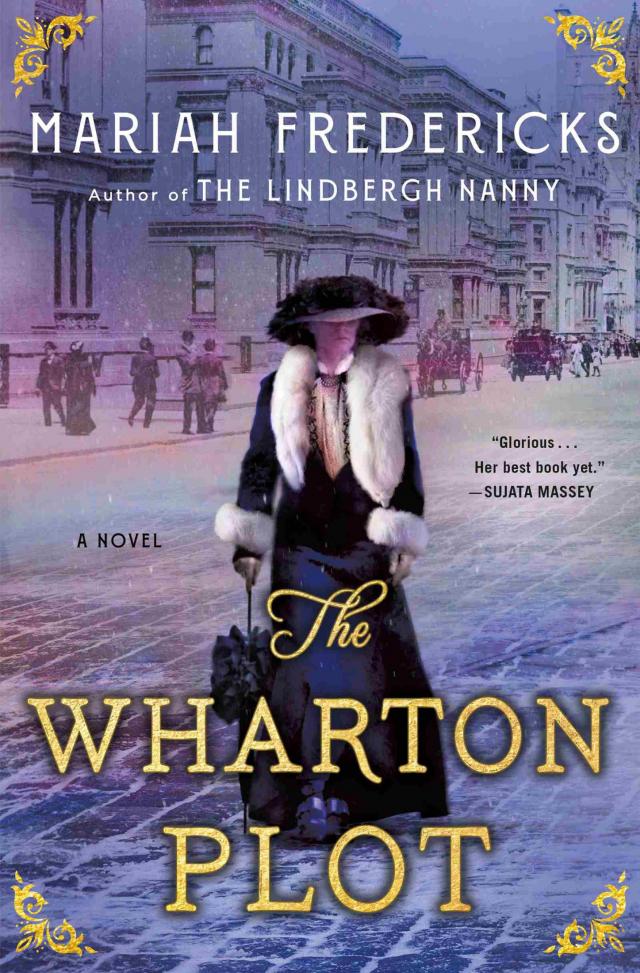
When I sent the rough draft of this manuscript to my editor, Catherine Richards, I assured her that the bitterness against publishers in the book did not reflect my personal feelings. She wrote back, “Ha!” For her sense of humor as well as many other gifts, I thank her. My gratitude to Kayla Janas and Allison Ziegler for their unflagging efforts to make the public aware that my books exist. The beautiful cover was designed by David Rotstein. Huge thanks to copy editor Mary Beth Constant, who caught some truly embarrassing mistakes, and production editor Ginny Perrin for her thoughtful handling of the manuscript.
As always, an enormous thank-you to my agent, Victoria Skurnick, who makes the dreaded business side of things fun and comprehensible. Whether the news is good or bad, I always feel I have her support.
I am especially indebted to Patricia Pin at The Mount, who read an early draft of the manuscript, catching several mistakes and making excellent suggestions for improvement.
At the end of this book, Wharton asks, “Who else do writers have but other writers?” Writing this book put me in mind of the writers who have offered their friendship, time, and effort to support my career. They are many, but this time, in honor of Wharton, I’m going to thank the women: Anna Quindlen, Meg Cabot, Susan Elia MacNeal, Karen Odden, Carol Goodman, Joanna Schaffhausen, Sharon Short, Ellen Byron, Sujata Massey, E. R. Frank, Carolyn Mackler, Rachel Vail, Alyssa Maxwell, Elizabeth Kerri Mahon, Jean Hanff Korelitz, and many more. I am also very grateful to the Orso/Joe Allen dining companions (you know who you are) and the stalwart mystery writers of Queens (and Brooklyn).
A special thank-you to Ellen E. Mason, a book lover who always shows up to support writers!
The Wharton Plot is dedicated to my son, Griffin. It is way past time that I dedicated a book to him. At first, I wasn’t sure a novel about Edith Wharton was the best choice. But there is no reason a young man about to leave home to embark on the next exhilarating stage of life can’t take inspiration from a middle-aged woman who does exactly that. I hope he sees that bold new beginnings are something that happen throughout life, not just when you’re eighteen.
Thank you to my husband who, despite a year full of challenges, always made time to read my work and, even more importantly, was always honest in his feedback. If you enjoy my work, thank him. He makes it possible.
Finally, I am thankful for the tight deadline that required I get writing as fast as possible; had I had more time to think about writing a novel about Edith Wharton, I would have lost my nerve.
Also by Mariah Fredericks
STANDALONE NOVELS
The Lindbergh Nanny
THE JANE PRESCOTT SERIES
A Death of No Importance
Death of a New American
Death of an American Beauty
Death of a Showman
YA NOVELS
The True Meaning of Cleavage
Head Games
Crunch Time
The Girl in the Park
ABOUT THE AUTHOR
MARIAH FREDERICKS (she/her) was born, raised, and still lives in New York City. She graduated from Vassar College with a degree in history. She is the author of the Jane Prescott mystery series, which has twice been nominated for the Mary Higgins Clark Award, as well as several YA novels. The Lindbergh Nanny was her first standalone novel. You can sign up for email updates here.
Thank you for buying this
St. Martin’s Publishing Group ebook.
To receive special offers, bonus content,
and info on new releases and other great reads,
sign up for our newsletters.
Or visit us online at
us.macmillan.com/newslettersignup
For email updates on the author, click here.
CONTENTS
Title Page
Copyright Notice
Dedication
Chapter One
Chapter Two
Chapter Three
Chapter Four
Chapter Five
Chapter Six
Chapter Seven
Chapter Eight
Chapter Nine
Chapter Ten
Chapter Eleven
Chapter Twelve
Chapter Thirteen
Chapter Fourteen
Chapter Fifteen
Chapter Sixteen
Chapter Seventeen
Chapter Eighteen
Chapter Nineteen
Chapter Twenty
Chapter Twenty-One
Chapter Twenty-Two
Chapter Twenty-Three
Chapter Twenty-Four
Chapter Twenty-Five
Chapter Twenty-Six
Chapter Twenty-Seven
Chapter Twenty-Eight
Chapter Twenty-Nine
Chapter Thirty
Chapter Thirty-One
Chapter Thirty-Two
Author’s Note
Acknowledgments
Also by Mariah Fredericks
About the Author
Copyright
This is a work of fiction. All of the characters, organizations, and events portrayed in this novel are either products of the author’s imagination or are used fictitiously.
First published in the United States by Minotaur Books, an imprint of St. Martin’s Publishing Group
THE WHARTON PLOT. Copyright © 2023 by Mariah Fredericks. All rights reserved. For information, address St. Martin’s Publishing Group, 120 Broadway, New York, NY 10271.
www.minotaurbooks.com
Cover design by David Baldeosingh Rotstein
Cover art: woman on cobblestone street © Lee Avison/Arcangel; Vanderbilt residence and other buildings on New York’s Fifth Avenue © Everett Collection/Shutterstock.com; snow-covered cobblestones © Orini/Shutterstock.com; corner embellishments © Tartila/Shutterstock.com; paper texture © Lana Veshta/Shutterstock.com
eISBN 9781250827432
Our ebooks may be purchased in bulk for promotional, educational, or business use. Please contact the Macmillan Corporate and Premium Sales Department at 1-800-221-7945, extension 5442, or by email at MacmillanSpecialMarkets@macmillan.com.
First Edition: 2024
Mariah Fredericks, The Wharton Plot





