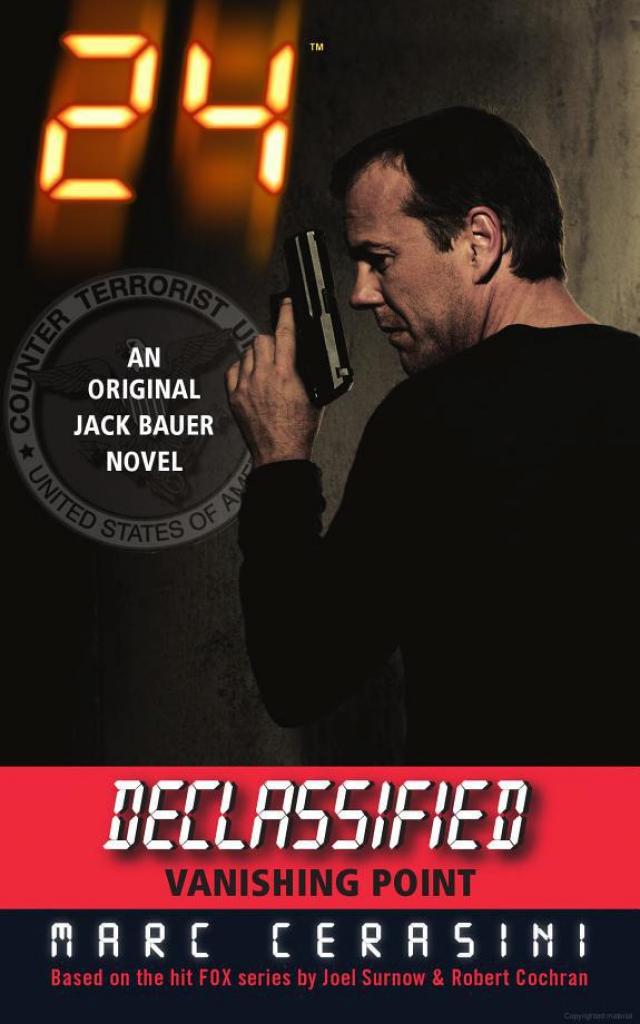
24 Declassified: 05 - Vanishing Point, page 1


* * *
Title Page
Dedication Page
Contents Prologue
Chapter One
Chapter Two
Chapter Three
Chapter Four
Chapter Five
Chapter Six
Chapter Seven
Chapter Eight
Chapter Nine
Chapter Ten
Chapter Eleven
Chapter Twelve
Chapter Thirteen
Chapter Fourteen
Chapter Fifteen
Chapter Sixteen
Chapter Seventeen
Chapter Eighteen
Chapter Nineteen
Chapter Twenty
Chapter Twenty-One
Chapter Twenty-Two
Chapter Twenty-Three
Chapter Twenty-Four
Acknowledgments
About the Author
24 Declassified Books
Copyright Notice
About the Publisher
VANISHING POINT
Based on the hit FOX series by Joel Surnow & Robert Cochran
To Chuck Hoffman and Bob Langer, who were instrumental in the creation of this novel. And to my brother, Vance, who helped me out of a couple of technical dilemmas I’d written myself into. But most of all to my wife, Alice Alfonsi, who helped immeasurably with the preparation of this complex and diffi cult manuscript.
After the 1993 World Trade Center attack, a division of the Central Intelligence Agency established a domestic unit tasked with protecting America from the threat of terrorism. Headquartered in Washington, DC, the Counter Terrorist Unit established fi eld offices in several American cities. From its inception, CTU faced hostility and skepticism from other Federal law enforcement agencies. Despite bureaucratic resistance, within a few years CTU had become a major force in the war against terror. After the events of 9/11, a number of early CTU missions were declassifi ed. The following is one of them. . .
Contents
PROLOGUE 1
1 THE FOLLOWING TAKES PLACE BETWEEN THE HOURS OF 12 P.M. AND 1 P.M. PACIFIC DAYLIGHT TIME 28
2 THE FOLLOWING TAKES PLACE BETWEEN THE HOURS OF 1 P.M. AND 2 P.M. PACIFIC DAYLIGHT TIME 57
3 THE FOLLOWING TAKES PLACE BETWEEN THE HOURS OF 2 P.M. AND 3 P.M. PACIFIC DAYLIGHT TIME 76
4 THE FOLLOWING TAKES PLACE BETWEEN THE HOURS OF 3 P.M. AND 4 P.M. PACIFIC DAYLIGHT TIME 91
5 THE FOLLOWING TAKES PLACE BETWEEN THE HOURS OF 4 P.M. AND 5 P.M. PACIFIC DAYLIGHT TIME 108
6 THE FOLLOWING TAKES PLACE BETWEEN THE HOURS OF 5 P.M. AND 6 P.M. PACIFIC DAYLIGHT TIME 125
7 THE FOLLOWING TAKES PLACE BETWEEN THE HOURS OF 6 P.M. AND 7 P.M. PACIFICDAYLIGHT TIME 145
8 THE FOLLOWING TAKES PLACE BETWEEN THE HOURS OF 7 P.M. AND 8 P.M. PACIFIC DAYLIGHT TIME 161
9 THE FOLLOWING TAKES PLACE BETWEEN THE HOURS OF 8 P.M. AND 9 P.M. PACIFIC DAYLIGHT TIME 178
10 THE FOLLOWING TAKES PLACE BETWEEN THE HOURS OF 9 P.M. AND 10 P.M. PACIFIC DAYLIGHT TIME 192
11 THE FOLLOWING TAKES PLACE BETWEEN THE HOURS OF 10 P.M. AND 11 P.M. PACIFIC DAYLIGHT TIME 208
12 THE FOLLOWING TAKES PLACE BETWEEN THE HOURS OF 11 P.M. AND 12 A.M. PACIFIC DAYLIGHT TIME 228
13 THE FOLLOWING TAKES PLACE BETWEEN THE HOURS OF 12 A.M. AND 1 A.M. PACIFIC DAYLIGHT TIME 240
14 THE FOLLOWING TAKES PLACE BETWEEN THE HOURS OF 1 A.M. AND 2 A.M. PACIFIC DAYLIGHT TIME 246
15 THE FOLLOWING TAKES PLACE BETWEEN THE HOURS OF 2 A.M. AND 3 A.M. PACIFIC DAYLIGHT TIME 252
16 THE FOLLOWING TAKES PLACE BETWEEN THE HOURS OF 3 A.M. AND 4 A.M. PACIFIC DAYLIGHT TIME 258
17 THE FOLLOWING TAKES PLACE BETWEEN THE HOURS OF 4 A.M. AND 5 A.M. PACIFIC DAYLIGHT TIME 265
18 THE FOLLOWING TAKES PLACE BETWEEN THE HOURS OF 5 A.M. AND 6 A.M. PACIFIC DAYLIGHT TIME 271
19 THE FOLLOWING TAKES PLACE BETWEEN THE HOURS OF 6 A.M. AND 7 A.M. PACIFIC DAYLIGHT TIME 277
20 THE FOLLOWING TAKES PLACE BETWEEN THE HOURS OF 7 A.M. AND 8 A.M. PACIFIC DAYLIGHT TIME 283
21
THE FOLLOWING TAKES PLACE BETWEEN
THE HOURS OF 8 A.M. AND 9 A.M.
PACIFIC DAYLIGHT TIME 291
22
THE FOLLOWING TAKES PLACE BETWEEN
THE HOURS OF 9 A.M. AND 10 A.M.
PACIFIC DAYLIGHT TIME 298
23
THE FOLLOWING TAKES PLACE BETWEEN
THE HOURS OF 10 A.M. AND 11 A.M.
PACIFIC DAYLIGHT TIME 308
24
THE FOLLOWING TAKES PLACE BETWEEN
THE HOURS OF 11 A.M. AND 12 A.M.
PACIFIC DAYLIGHT TIME 315
ACKNOWLEDGMENTS
ABOUT THE AUTHOR
OTHER SERIES OF 24 DECLASSIFIED BOOKS
COVER
COPYRIGHT
ABOUT THE PUBLISHER
prologue
CTU Headquarters, Los Angeles Four months ago
The door opened without a knock. Jack Bauer looked up from the daily threat assessment file to fi nd his former boss standing over his desk.
“Busy, Jack?”
Christopher Henderson hadn’t been on this coast in over a year, not since he’d become CTU’s Director of Covert Operations. The promotion required a temporary move east, to CIA headquarters in Virginia.
Jack rose and shook the man’s hand. “Christopher. How are things at Langley?”
His old mentor had arrived sans jacket. The sleeves of his starched white shirt were rolled up to expose sinewy biceps. A platinum Rolex glittered on his knobby wrist.
Outwardly the man hadn’t changed much since being cast into Washington’s bureaucratic vortex. Still tall and lanky with dead gray eyes, he’d obviously staved off an administrator’s bulge by making use of the Company’s gym. Then again, his early years in the Agency had earned him the nickname “Preying Mantis”—although that had as much to do with his rangy physique as his ability to convert vulnerable hard targets into Agency assets.
“I read about the biological threat you neutralized in New York,” Henderson said. “Exposing a renegade FBI agent didn’t endear you with the boys in the Bureau.”
Jack tensed, still chafing over the lack of follow up on his recommendations. “Frank Hensley was more than a renegade. He was a mole with ties to—”
“I’m not here to talk about Operation Hell Gate or Hensley’s Middle Eastern puppet master—although the official assessment is that your conclusions are shaky at best, your theories unsubstantiated.”
“Unsubstantiated? But the evidence we gathered—”
Henderson raised a hand. “I came here on another matter. I have a critical situation down in Colombia, and I need a favor . . .”
Jack’s momentary defensiveness dissolved into curiosity. He studied Henderson’s expression, even though there wasn’t much to read beyond a relaxed confi dence, which was typical Henderson.
“Go on,” Jack said, settling back behind his desk.
Henderson pulled up a chair. “Three days ago, one of my agents, Gordon Harrow y Guiterrez, went missing. For the past six months, he’s been posing as a gadget guy for the Rojas brothers.”
The Rojas family—a father and three sons—ran cocaine out of South America. They were a successful and ruthless gang, but not yet the top of the food chain among Colombia’s many drug cartels.
“I don’t understand,” Jack said. “Guiterrez didn’t call in a code red? Request emergency extraction?”
Henderson shook his head. “He just vanished. Went black without warning, ditching the false identity Central Cover created for him. We only learned he’d gone missing through intercepts. From what we gleaned eavesdropping on cartel chatter, Guiterrez had stolen something the Rojas family feared he would sell on the black market.”
Jack’s eyes narrowed. “And is that what really happened?”
“I wasn’t sure at first. Within twenty-four hours, all chatter ceased inside the cartel. Even the loquacious Señora Rojas stopped calling her mother in Bogotá, so we knew something was up. After forty-eight hours, Guiterrez still hadn’t made an appearance at the CTU safe house in Cartegena. So we assumed the worst.”
“Was Guiterrez executed?”
“He’s alive and for a very good reason. He knew something we didn’t. The Cartegena safe house had been compromised. Yesterday it was attacked.”
Jack frowned. “I saw the alert on that. Six dead, one wounded. . . . but Intel said the attack was a reprisal for a raid on a cartel factory last month.”
“A cover story. The raid was staged by the Rojas family. They knew about our safe house, how many agents and staffers worked out of the facility, the daily schedule . . . the works.”
“I see.” Jack exhaled, knowing the implications for a hit like that. “I assume the attack compromised more of the Agency’s operations in Colombia?”
Henderson nodded. “You’ll see the reports soon
enough.”
“Reports of . . . ?”
“The hits, Jack.” Henderson’s easygoing mask
momentarily slipped. “CIA and DEA operations in Cartegena, in Medellin, in Cali and in Barranquilla . . . They’ve all been quietly taken out in the past several hours,” he said.
Jack took a few seconds to process this. He leaned forward, resting his forearms over the threat assessment file. “Christopher, that can’t be the work of the Rojas gang. They’re too small time to hold sway in Cali, Bogotá, or Barranquilla. They couldnâ
Henderson nodded but hesitated before saying more.
“What do you know?” Jack pressed. “I need all the facts before I can help. Are the Rojas consolidating power? Going national? International? Is this a political situation?”
Henderson moved to the edge of his chair. “The target of these raids was my agent. The Rojas family and its rivals are desperate to find him. They’re trying to recover what Gordon stole from them.”
“But you don’t know what he has,” Jack assumed.
“That’s not . . . precisely . . . true.” Henderson stared at Jack, unblinking. The mask was back. “Guiterrez contacted me again last night, through a . . . back channel connection.”
Jack didn’t care for Henderson’s sudden vagueness of wording. It smacked of legalese. “What kind of ‘back channel’ connection?”
Henderson lowered his voice. “He called me on a sat phone I maintain privately.”
Jack didn’t know why Henderson was sidestepping Agency monitoring, but he didn’t ask. If anyone understood the occasional need to violate protocol, Jack did.
“Gordon told me what he’d grabbed, and I understood why he had to get out, and take it with him. He snatched a prototype of a portable electronics device that can render an airplane virtually invisible to conventional radar.”
Jack blinked. “Is that possible? I thought an aircraft’s stealthy characteristics came from its shape . . . along with the composite materials used in its construction?”
Jack knew all about the Hopeless Diamond configuration of the F–117 Stealth fighter, and the fl at-surfaces, angular design and non-refl ective fuselage of the Raptor. The shape and materials of both aircraft were engineered to defl ect radar, rendering them practically invisible.
Henderson nodded. “Our advanced fighters do rely on materials and shape, but they also have electronic sub-systems that can generate a field around the aircraft. This fi eld effectively absorbs, deflects, or dissipates radar waves. Guiterrez claims the prototype he snatched can make any aircraft appear to vanish— even one without the stealthy materials or shape.”
“My god . . .” Jack rubbed his neck as he considered the possible uses of a handy little package like that one. “If smugglers can use this technology to fl y across America’s borders undetected, then so can terrorists. Only they’ll be delivering weapons of mass destruction, not nose candy.”
“That’s affi rmative.”
“No cartel could have invented something like that.” Jack stared at Henderson, waiting for him to say more, but he simply shrugged. “Where did it come from, Christopher? The Pentagon? A foreign defense lab?”
“We’ll know more once we get hold of the device. We can take it apart, analyze its components, reverse engineer the little sucker if necessary—”
Jack considered pressing harder, but instead took another tack. “Do you know where Gordon Guiterrez is now?”
Henderson shook his head. “On the run, somewhere in Colombia . . . I had to come up with an extraction plan on the fly. Guiterrez is paranoid—not that I blame him—but he gave me less than fi ve minutes before he broke off communication and went dark, this time for good.”
“A rural extraction would be best,” Jack noted. “Far away from the urban areas a strike team could move without detection. We wouldn’t need much.
A Delta squad, a Pave Low helicopter, a Little Bird, maybe a reconnaissance team on the ground to secure the perimeter—”
Henderson waved aside Jack’s suggestions. “No can do. Security all over Colombia has been compromised. Half our agents are dead or on the run, the rest we can’t trust for fear they’re under surveillance—or on the cartel’s payroll.”
Jack released a breath. He wanted to help his old mentor, but . . . “This is a job for Delta, Christopher.”
“If we send a big team into Colombia—or anywhere down there for that matter—word will get out in a minute. Anyway, Guiterrez isn’t prepared to hump the boonies like you and me. He spent his childhood in Colombia, but he was educated at Princeton before coming to us. Nineteen years ago he won a collegiate fencing title, and he’s had our standard weapons training, but that’s the extent of his martial arts skills. In other words, Gordon Harrow y Guiterrez wouldn’t last two days in the jungle.”
“What did you tell him?”
“He claimed he had a safe way to get out of Colombia, so I told him to go to Nicaragua, to the capital. There’s a construction site on the corner of Bolivar Avenue and Calle De Verde in Managua. The site is managed by Fuqua Construction, which is really a CIA shell company.”
“Why Nicaragua?”
“It’s a quiet assignment since the Sandinistas were tossed out of office in 1990. I doubt the Colombian cartels have a reach long enough to touch someone in Managua.” Henderson paused, leveled his gaze. “I want you to go down there and bring Guiterrez back. I’ve already cleared it with Walsh.”
Nodding, Jack reached toward the keyboard of his computer. “I’ll assemble a team immediately—”
“No team. I told you, a large group will attract unwanted attention. Take one agent besides yourself— someone you trust. But don’t mention the stealth device. Let your partner think your mission is a simple extraction from hostile territory.”
“What do I tell the case offi cers in Managua?”
“Concoct some cover story as the reason for your visit. You’ll think of something. But, again, I can’t stress this enough. Don’t mention the device—not even to other Agency personnel. It’s small enough to hide in a suitcase or backpack. Chances are nobody will even notice Guiterrez has it with him when you bring him in.”
Managua, Nicaragua Three days later
Even before he opened the dented cab’s squeaking door, Gordon Harrow y Guiterrez sensed he was being watched. He clutched the attaché case just a little bit tighter. Under the sweat-stained band of a worn baseball cap, perspiration painted his forehead.
More than anything, Guiterrez wanted to shift his gaze and check his six. That would, of course, be a fatal error. If he really was being tailed, turning around would alert his pursuers that he was on to them— which would no doubt force their hand. They’d take him out right then and there, before he had a chance to get near the CIA safe house.
Feigning indifference, the undercover agent paid the driver with a fi stful of córdobas, exited the vehicle and melted into a loud and festive lunchtime crowd. Among the throng of Nicaraguan offi ce workers, Guiterrez began to wonder.
Am I really being tailed?
His senses were jangling from the amphetamines he’d been swallowing like candy for far too many days, and Guiterrez realized he could no longer trust his judgment. Lifting his bloodshot eyes, he squinted at the hazy blue sky. Strong sunlight shimmered above the ten- and twelve-story structures that fl anked this commercial street. Almost all of Managua had been rebuilt since the mid ’70s, after an earthquake killed tens of thousands and leveled ninety percent of the Nicaraguan capital. Unfortunately, the graceful precolonial buildings were replaced by boxy, utilitarian structures that made much of the city resemble a particularly decrepit American strip mall.
Even worse, this time of year Managua’s air was hot and sticky under a scorching sun. Moving through the crush of office workers, food vendors and street merchants was painfully slow—made worse by blue-gray puffs of car exhaust fumes, and clouds of charcoal smoke, redolent with the scent of charred meat.
On busy Bolivar Avenue, a long thoroughfare between Lake Managua and the muddy Ticapa Lagoon, the humidity was especially thick and uncomfortable. Buffeted by the crowd that hemmed him in, Guiterrez had trouble catching his breath. His grimy, unshaven neck itched, and the cotton shirt clung to sweat that trickled down the small of his back. Perspiration dampened his scalp as well, but Guiterrez dared not take off his cap.
His Anglo features had helped him with the Rojas family. They’d more willingly bought his cover story—that he was a pissed off software engineer who’d gotten sick of his American company passing him over for promotion. But he was on the run now, and his shock of light blond hair would stick out in this homogenous crowd like a sabana in a Mexican prison. At least his deep tan disguised his fair skin and helped him blend with the environment.
Sun glare blazed off a shop window. Guiterrez’s eyebrow twitched uncontrollably. The simmering heat, his lack of sleep, the drugs, days of constant movement and ceaseless vigilance were fi nally taking their toll on the overweight agent. Even worse, the amphetamines no longer kept Guiterrez alert or focused—only twitchy and paranoid