

Night Train to Paris, page 1


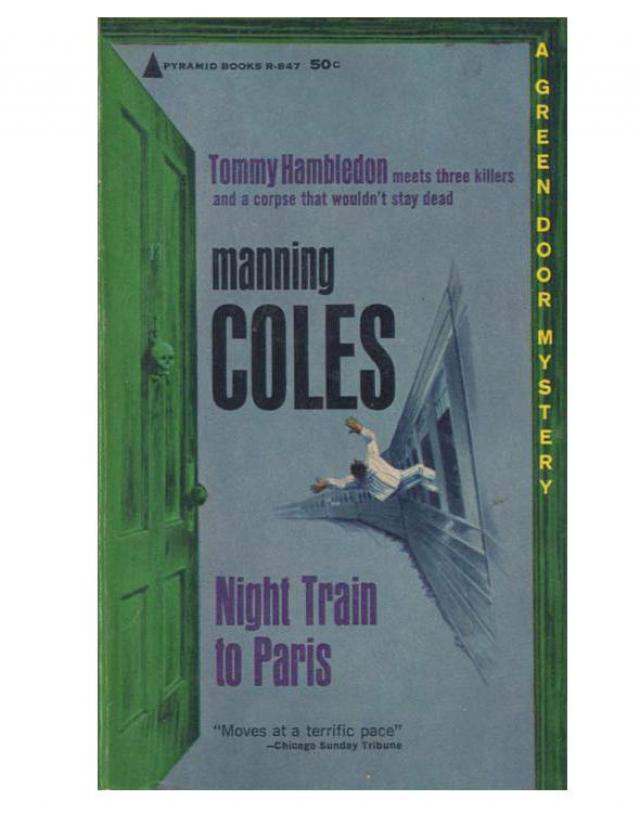
Night Train To Paris
Manning Coles
1952
WHY DID THE VICTIM REFUSE TO STAY DEAD?
The three assassins had been very thorough. They’d strangled Edward Logan, made sure he was no longer breathing, thrown him under the wheels of a passing freight, ano settled back to enjoy the rest of the trip to Paris.
Then, on a Paris street, they met ... EDWARD LOGAN. Desperately, they set out to kill him again. But as the hunters went hunting the hunted, the hunted started hunting the hunters—
That’s when Tommy Hambledon, crack British Intelligence agent, followed a trail of bodies into the action—and took a long chance with his life.
Espionage and intrigue combine to make a chill-a-minute story of too many killers and too many corpses, “all chalked up in Coles’ best style.”
—San Francisco Chronicle
By Manning Coles
Novels:
Come and Go
The Far Traveller
Happy Returns
Brief Candles
This Fortress
Intrigue and Adventure:
Concrete Crime
The Exploits of Tommy Hambledon
Duty Free
No Entry
Death of an Ambassador
Birdwatcher’s Quarry
The Basle Express
The Man In The Green Hat
All That Glitters
Alias Uncle Hugo
Night Train To Paris
Now Or Never
Dangerous By Nature
Diamonds To Amsterdam
Not Negotiable
Among Those Absent
Let The Tiger Die
With Intent To Deceive
The Fifth Man
Green Hazard
Without Lawful Authority
They Tell No Tales
Toast To Tomorrow
Drink To Yesterday
Books for Boys:
Great Caesar’s Ghost
To Jimmy Russell, of Cook’s
“The vagabond, when rich, is called a tourist.”
—P. Richard
Contents
1. At Sea
2. Pepper And Spice
3. Heirons
4. Half A Million Dollars
5. Train Ferry
6. Monsieur Logan
7. Feet In The Fender
8. The Marble Gentleman
9. Much-Publicized Number
10. Metro To Montparnasse
11. Private Enquiry Agent
12. Prayers For The Sergeant Major
13. Quiet Funeral
14. Quai Des Orfevres
15. Remittance Man
16. Receipt For The Body
17. The Kitchen Sink
18. The Photographer
19. Barrel Organ
20. Next Of Kin
1. At Sea
the big cabin cruiser rushed on through the darkness, the faint glimmer from the binnacle lamp showing nothing but the face of the man at the wheel like a mask hung upon a black wall. The sky was overcast though occasionally a rent in the clouds showed for a moment a few stars covered again at once as the hurrying rack streamed across. The sea was getting up; the steady hiss of the bows cutting through the water was more and more frequently interrupted by the heavy spatter of spray upon the deck.
A second man entered the small wheelhouse and bent over the binnacle to see the time by his wrist watch.
“No sign of her yet?” said the helmsman.
“Of course not. Much too early.”
“Sea’s going up. What was the last weather report?”
“More gale warnings,” said the man with the wrist watch.
“Going to be a real blow, Alton.”
“What did you call me?”
“Sir.”
“That’s better,” said Alton smoothly, and walked away.
“Thinks he’s still in the ruddy Navy,” said the helmsman to the floating compass which immediately slewed several points to port as a vicious cross sea caught the little ship abeam. “Come up, you cow. Glad it isn’t me goin’ to be picked off a ship on a night like this.”
Nearly an hour later he saw a distant light and opened his mouth to shout, but before he could speak a strong light awoke in the bows of the cabin cruiser as Alton switched on the searchlight and swung it vertically upwards. He shouted down to the second engineer to come on deck and then came himself to take the wheel.
“Go and lend Dick a hand, Johnny. Fender’s out on the portside,”
The ship came on, showing first the green starboard light and then a row of lighted portholes. She was visibly slowing down; the cabin cruiser turned to meet her and then swung round in a wide circle to starboard. Dick at the searchlight brought it down until the side of the ship was bright in the glare of it; faces looked over the rail and a long rope ladder fell down the ship’s side, unrolling as it came. The ship was rolling heavily; the end of the rope ladder was dipped in the sea, snatched out and dipped again and again. The cabin cruiser, slowed down till she had only just steerageway, was being thrown about like a toy. They drew nearer together, a rope was flung from the steamer, missed, and flung again. This time Johnny caught it.
A short stout figure began to climb slowly down the ladder with occasional stops to look down at the sea. The ladder swung out from the ship’s side and smacked back again while the man clung frantically and shouted something.
“Come on!” bellowed Alton. “Come on!” He brought the cabin cruiser close alongside and Dick ran to the foot of the ladder, but it was snatched from him by a roll of the ship.
The man on the ladder came down almost to the end and hesitated, as well he might. The roll swung him out towards the waiting boat and Alton yelled to him to let go and jump. He left it just too late, let go as the return roll started and fell headlong into the sea between the ship’s side and the hull of the cabin cruiser.
He was dragged out gasping, crowing and spitting sea water; Johnny brought him to the wheelhouse while the line was cast off, the cabin cruiser turned away from the ship and the engine revolutions speeded up. The searchlight clicked out, the ship’s lights retired into the darkness of the night and were surprisingly soon lost to view.
The passenger, sea water pouring off him, clung to the side of the wheelhouse and said in English with a strong German accent that he was wet, very wet. And cold. He was also, rather unexpectedly, clutching the sort of brief case which businessmen carry to the office.
“Take the wheel, Johnny,” said Alton, and gave him his course. “You come below and have a drink,” he added, addressing the passenger, “you’ll be all right. Sea water never hurt anybody except by drowning. This way.”
The small saloon was warm and stuffy; merely to be out of the tearing wind was a relief, and the lines of strain began to fade out on the passenger’s face. Alton poured out a handsome tot of rum, the stranger drank it straight off and managed to smile.
“Now that my teeth stop chattering,” He said, “I introduce myself. Doctor of Physics Ignatius Muntz, formerly of the University of Heidelberg.” He bowed.
“My name is Alton and I am in command of this large ship,” said Alton, with a friendly smile. “You want to get those wet clothes off. Just a minute.”
He called up the companion ladder and the second engineer came running down, a young man in the very early twenties with sandy hair and eyebrows and a freckled face always ready to grin. It was his first trip with Alton and he was very anxious to please; he was an odd contrast to his black-haired skipper whose lean frame and sallow skin with deep creases running from nostrils to mouth made him look older than his twenty-eight years. His eyes were dark, deep-set under heavy brows and a little too near together, and his mouth shut into a thin line with the lower lip slightly protruding. Dr. Muntz looked from one to the other.
“Dick,” said Alton, “Dr. Muntz is soaked to the skin and I think you are the only man with a spare suit on board,’
“Certainly, I’ll get it. And vest and shirt. Anything I can do—” He opened a door at the far end of the saloon and went out.
“Have some rum,” said Alton. “Finest thing in the world to stop a chill from developing.” He poured out a second tot and Muntz drank a little of it.
“Strong,” he said. “Very strong. Ah! Now I remember something, something most important—”
Ho put his brief case upon the table; it was attached to his left wrist by a short length of cord which he began to untie.
“In case I drop it coming down that ladder,” he explained.
“I did wonder how you had managed to keep hold of it,” said Alton.
“If I had not, if it had gone away in the sea, I might as well have gone with it.”
“So important as that,” said Alton.
“So important as that,” agreed Muntz, opening the case. There was a little water in it which he tipped out on the floor and then drew out a flat package wrapped in oil silk with rubber bands round it. He slipped them off and opened the package, which contained several sheets of paper closely folded; he unfolded them carefully. There were scale drawings of some long cylindrical object, so much was obvious at a glance, but there were also immensely detailed drawings of complicated mechanisms and fittings which conveyed nothing whatever to Alton.
The second engineer returned with an armful of clothes.
“Sorry to have been so long, sir. Couldn’t find any socks.”
Muntz was too busy examining his papers
“They will soon dry down here,” said Alton. “Let’s get those wet clothes off you. Finish your rum first, you’re shivering.”
Muntz drank it off and submitted like a child to having his soaked clothes pulled off him, being rubbed down with a rough towel and dressed again in Dick’s dry garments. The process was awkward in the extreme as the space in the saloon was very cramped, the cabin cruiser was apparently trying to stand on her head and roll at the same time like a dog which has just been bathed, and Muntz seemed to have lost any sea !egs he ever had. Evidently the rum was taking hold upon him, for his face became flushed and he talked without ceasing.
“I am obliged to you so very much for all your kind acts,” he said. “I knew if I to England could get I should among good friends be, and it was true, for here I am on an English ship and the so-kind friends are here before me. Also the papers, my impossible-to-be-overestimated papers. I thank you from the bottom of my heart. Others also. Your Mr. Churchill will thank you. Your Government will thank you. Your people, when they of it come to know, will selephade—salunade—” He abandoned his English and continued in a flood of German which was only terminated when, at the awkward moment of putting him into Dick’s trousers, a salmon-like leap of the cabin cruiser hurled all three men into a heap by the door.
The shock seemed to sober Muntz temporarily and he helped to dress himself in a thick jersey and a coat. He sat down at the table, folded up the papers which were not really damp enough to hurt them, and wrapped them again in their oil-silk cover. He slipped on the rubber bands and patted the packet affectionately, while the other two men stood round the table watching him.
“Better lie down for a bit,” suggested Alton. “You might be badly hurt falling about.”
Muntz looked up and his eyes were glassy.
“This packet,” he said thickly, “the Russians would give one million pounds sterling for this packet. One million pounds. Sterling. But they shan’t have it.” His eyes focussed with difficulty upon the second engineer.
“That’s right,” said Dick consolingly. “They shan’t have it, then. You take it to London and give it to Winston Churchill yourself.”
Some other thought took possession of Muntz, an overpowering and unpleasant thought. He yawned suddenly, changed colour, and sweat broke out upon his forehead.
“Hot in here,” he said, “very hot.” He rose slowly to his feet, holding the edge of the table.
“He’s going to be sick,” said the second engineer, and dived into the next cabin for a suitable vessel. But Muntz did not wait; he staggered towards the door with the packet still in his hand.
“Fresh air,” he said. “Be all right on deck,” He opened the door and in doing so dropped the packet, which Alton picked up for him.
“Give it to me,” said Muntz.
“I’ve put it in your pocket,” said Alton, pushing his hand well down into the pocket so that Muntz could feel it. “That’s quite safe. Up you go; hold on with both hands, I’ll help you,”
With Alton pushing behind they arrived at the top of the companion ladder and the wild night sprang at them like an animal. Muntz was whirled, staggering, to the lee rail; Alton, at the head of the companion, could just distinguish the bent and shuddering form. Alton laughed shortly and went below again.
“He seemed to prefer being alone,” he said, “so I left him.”
“May be all right in a few minutes,” said Dick, busily collecting sodden garments from the floor, “Takes ’em like that sometimes. He’ll get the sea water out of his system anyway.”
“Probably that was what did it,” said Alton, “I’m just going up to the wheelhouse, I won’t be a minute.”
“Very good, sir,” said Dick professionally. He piled the soaking clothes in a heap and lay down on a bunk to read an Edgar Wallace till it should be time to go on duty.
Alton went out on deck; there were none of the crew about except the man in the wheelhouse for’ard and he had his back turned. His head and shoulders were faintly silhouetted against the binnacle light and he was plainly fighting with the kicking wheel, he would not look round. Muntz was an indistinct heap of misery near the stern, crouched over the rail. Alton took three silent strides towards him, grasped his ankles and with one strong lift heaved him overboard where a rising wave received him before he had time to cry out.
Alton turned almost in the same motion and went forward along the deck, walking heavily; to Dick in the saloon below it seemed as though his captain had but paused at the head of the ladder before going forward. Alton spoke to Johnny at the wheel for a few minutes and then returned to the saloon.
“Passenger all right, sir?” asked Dick, looking up from his book.
“He seemed to be busily occupied,” said Alton. “I didn’t interrupt.”
He lit a cigarette, picked a book out of a rack on the wall and lay down upon, the other bunk. Some little time passed before Dick swung his legs to the floor and sat up. Alton looked across at him with raised eyebrows.
“I was wondering, sir, if the old chap was all right He’s been up there some time and it’s pretty cold.”
“I was beginning to wonder myself,” said Alton. “Better bring him down.”
The second engineer nodded and went out. Alton waited while the door was shut and steps sounded upon the companion ladder, then he sat up sharply, took Muntz’s waterproof packet out of his coat pocket and, pulling up his jersey, stowed it away inside his shirt. Hasty steps sounded overhead; he buttoned up his shirt, pulled down his jersey and was lying at ease once more as the door burst open and Dick rushed in.
“He’s not on deck, sir, Johnny hasn’t seen him, he’s not in the engine room—”
Alton sat up slowly, staring. “Good lord, he must have—”
“Must have gone overboard, sir—”
“I’ll come myself.”
They searched the cabin cruiser thoroughly but, rather naturally, did not find Muntz anywhere.
“He must have hung too far over the rail and gone in,” said Dick. “It’s easily done and she has been rolling all ends
«P”
‘I ought to have brought him down myself, when I went up to speak to Johnny,” said Alton, sitting down heavily. “I did think of it, but—”
“Bad business, sir,” said Dick sympathetically. “Will there be trouble over this?”
“Oh, I expect so,” said Alton wearily. “There’s one bright spot, we can carry straight on now and come in by daylight; I didn’t fancy putting him ashore in the dinghy in this weather. You’ve lost your clothes, Dick,”
“Oh, that,” said Dick indifferently.
Eight hours later Stephen Alton landed at Wapping and came up a side street from the stairs he generally used. At the corner where the side street joined the main road he paused, debating whether to travel by tram or walk to the station and go by train.
Twenty yards from Alton’s corner a constable upon his beat anda police sergeant upon his rounds were standing together, talking. The sergeant noticed Alton as he paused at the corner and said: “See that man there?”
To reach the station Alton would have to pass them; he decided against it. A tram came clattering along the road; Alton, signalled it, swung himself on board as it slowed down, and turned his back to the police as he was borne past them.
“Who is he?” asked the constable.
“Name of Alton, Stephen Alton. You’ll know him when you see him again. Notice what he does when you do see him, where he goes and who he’s with. We’ll get him one of these days,”
“What’s he been up to?”
“We can’t prove it, but the Inspector’s pretty sure he’s in all or some of these dock robberies we’ve had lately. Particularly the robberies from lighters; they’re done by someone who knows the river well and he does. Someone who even knows which lighter to pick out of a string of ’em.”
“There was all those cases of cigarettes went last week,” said the constable.
“Ah. And lots of other things too. Been going on a long time, before you came here. He’s got away with it so far, but one of these days he’ll slip up and we’ll get him, my lad, we’ll get him. He’s got something on his conscience now; he was coming this way and changed his mind when he saw us, you saw that yourself.”


