

Lone Pine London, page 1


Contents
Foreword
The Lone Pine Club
1. Fog
2. The Old Papers
3. Enter James Wilson
4. Holloway Hill
5. The Picture Plot
6. London Town
7. Harriet on Her Own
8. Another Clue
9. Mr. Sparrow in Action
10. The Penthouse
11. "It's Ballinger!"
12. Pursuit
13. Wilson's Story
Lone Pine London
Malcolm Saville
© Malcolm Saville 1957
Lone Pine London was first published in the U.K. by George Newnes Ltd, London. This edition was published in 1965 by May Fair Books Ltd, 14 St James's Place, London, S.W.1, and was printed in Great Britain by Love & Malcomson Ltd, Brighton Road, Redhill, Surrey, England
CONDITIONS OF SALE
This book is sold subject to the condition that it shall not, by way of trade or otherwise, be lent, re-sold, hired out or otherwise circulated without the publisher's prior consent in any form of binding or cover other than that in which it is published and without a similar condition being imposed on the subsequent purchaser.
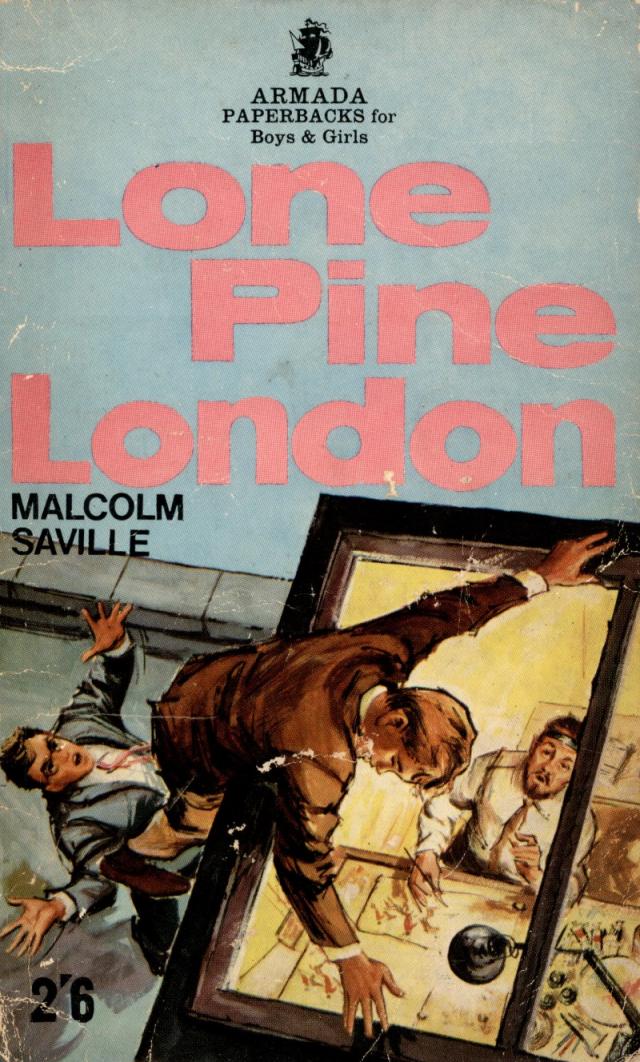
COVER ILLUSTRATION BY PETER ARCHER
ARMADA PAPERBACKS
Foreword
This is the tenth adventure of the members of the Lone Pine Club and, for the first time, the mystery which they help to solve is centred in London.
Although some real places are mentioned by name, please understand that so far as I know there is no Brownlow Square or Holloway Hill in north London, nor an Arcadia Street nor South Tenby Street in the West End. I hope there is no smart dress shop called "Christabel" either in London or in Guildford where the Lone Piners dash at the end of the story.
All the people in this story are imaginary and although if you come to London you can certainly explore Chelsea and Fleet Street and the Tottenham High Road, none of the antique shops I have described really exist, and if there are any like them that is only a coincidence. The street map at the beginning of the book won't help you to find your way about, but I hope they will enable you to see where the Lone Piners played out their desperate game against an old enemy.
M. S
The Lone Pine Club
Although this story is complete in itself it is about some members of the Lone Pine Club who have had many previous adventures described in this series. You may enjoy this book more if you know something about these boys and girls before you begin, although not all of them appear in this story.
The club was founded at a lonely house called Witchend in the heart of the Shropshire hills.
The rules of the Lone Pine Club are still kept hidden under the solitary pine tree in their first secret camp. They are very simple and are set out in full in Mystery at Witchend, which is the first story about the Lone Piners. The most important of these rules is really the oath which each member signed in his or her own blood - Every member of the Lone Pine Club signed below swears to keep the rules and to be true to each other whatever happens always.
It is true that the Lone Piners have the happy knack of finding adventures, but as they live many miles apart and go to different schools they are only able to meet in the holidays. The exception is Tom Ingles, who works on his uncle's farm near Witchend which belongs to the Mortons who live in London. The original headquarters of the club is still the old camp, with its sentinel pine tree on the slope of the hill above the house, but other camps have been established as necessity arose - one in the barn at a lonely farmhouse called Seven Gates, near the rugged range of hills called the Stiperstones, and another at the ruined castle of Clun farther south, near the Welsh border.
Although they don't have much opportunity of using it in this story the Lone Piners' secret signal to each other is a whistled imitation of the peewit's plaintive call.
THE MEMBERS
DAVID MORTON is sixteen. He was elected captain of the club when it was first founded. He goes to boarding school and used to live on the outskirts of London. Just before this story opens the Morton family moved into Brownlow Square in north London. David has made a good leader for, although he is not very impetuous, he never loses his head in a crisis and the others trust him. He is not particularly brainy but above the average at school work and games, and never really happier than when he is in the country and at Witchend in particular.
RICHARD ("DICKIE") MORTON AND MARY MORTON are ten-year-old twins. They now go to different boarding schools, but are inseparable out of term. Although they are the youngest members of the club and sometimes extremely irritating to the others, they have proved their worth in all the Lone Piners' adventures. They are astonishingly alike in looks and speech and if Mary's hair was cut as short as her twin's even their mother would find it difficult to tell them apart. They have a maddening trick of pretending to be younger than they are and when in action together they annoy most grown-ups. They get their own way too often, but they are warm-hearted, loyal and courageous and will tackle anything to justify themselves to the other members of the club who forgive them much for David's sake.
JONATHAN WARRENDER is a few months older than David. He is tall and bespectacled and one of those boys who find exams easy. Like most clever boys, he has not very much to say. He has no father, is still at boarding school, and lives in the holidays with his mother, who owns the Gay Dolphin hotel in the little town of Rye, where he first met the Mortons and had an adventure with them. It is not much wonder that he sometimes wearies of the twins for he is the oldest member of the club. One of the very nicest things about him is that he never suggests in any way to the others that he's too old for the Lone Pine Club. Even if sometimes he treats it with tolerant amusement he values the friendship of the other members and revels in adventure.
PENELOPE ("PENNY") WARRENDER is Jon's cousin and nearly one year younger. Her parents are abroad and she lives at the Gay Dolphin in the holidays. She is grey-eyed and red-headed, with all the qualities and defects that go with red hair - affectionate and impetuous, loyal and independent and a rare fighter for her friends and for what she believes to be right. Penny could never be described as a scholar, but she is quick-witted and intelligent and a splendid companion. In many ways she is old for her years, and for as long as she can remember the most important person in her short and exciting life, after her parents she so rarely sees, has been her cousin Jonathan. She teases and often infuriates him, but although she has not yet admitted it to herself she would follow him to the end of the world.
The other members of the club do not appear in this story, but you may like to know something about them.
PETRONELLA ("PETER") STERLING is the vice-captain of the Lone Piners. She is sixteen and has no mother, brothers or sisters. She lives with her father, who is in charge of a reservoir in the Shropshire hills in a tiny house called Hatchholt, near Witchend. She has been to London once and hated it, for she is happiest when roaming her beloved hills on her pony, Sally. Imagine her as tall and slim with two fair plaits which she refuses to cut off, blue eyes and a clear brown skin. She is loved and admired by everyone who knows her. David Morton is her special friend.
JENNY HARMAN is nearly fifteen. She is a native of Shropshire and lives in a lonely village in the hills so the others do not see her very often. Peter befriended Jenny when she was in great trouble, but although the others tease her a little, she has plenty of pluck and does not mind what anyone else says or does so long as Tom will stand by her.
TOM INGLES is nearly sixteen. He is a Cockney, but is now settled for good on his uncle's farm quite close to Witchend. Everybody likes Tom, who is intensely proud of his membership of the club although he will never admit it. He will always stand by Jenny.
1. Fog
Jonathan Warrender first noticed the man with the light-coloured, belted coat and the checked cap when the latter lit a little black cigar. He puffed out the strong-smelling smoke so that it blew across Jon's face and made him cough. There wasn't much that Jon could do about it because he couldn't move his elbows or his feet. He was, in fact, a very insignificant unit in a swaying, expectant crowd of nearly fifty thousand football fans crammed into one of the most famous arenas in north London. Jon was crushed against a horizontal bar on the concrete terraces above the playing pitch and he wasn't enjoying himself very much.
At sixteen and a half Jon was the sort of boy who is willing to try anything once. He had an enquiring mind, liked to find out things for himself and would go to a lot of trouble and inconvenience to do so. He was at White Hart Lane, London, on this cold, dull Saturday afternoon just after Christmas because of an argument with David Morton. With his red-headed cousin Penny, Jon was staying with the Mortons who had just moved from the suburbs to an old house in shabby Brownlow Square, somewhere between Islington and Finsbury Park. David, who preferred cricket, had said that professional football wasn't really a game but only an entertainment. Jon, much more cautious and in a rather superior way, had replied that as he lived at Rye, on the edge of Romney Marsh, he had never seen a first-class professional match and wasn't prepared to give an opinion until he had. And that was why, rather reluctantly, he found himself wedged in an enormous crowd waiting for the game to start.
Everything would have been much more amusing if David had been with him, but as he had promised to help his father, Jon had been persuaded to take this opportunity of seeing the mighty Spurs play before their own supporters. No sooner had he decided to go than Penny asked him t
Then the ten-year-old Morton twins, Richard and Mary had offered to come with him. Mary had added that she was sure they would be able to cheer his weary journey. When he had declined this offer the twins said that they had always known how much he hated them, and that ever since Penny and he had arrived two days ago, they had been wondering why their parents' invitation had included Jon.
Jon was tall for his age, with a thatch of untidy, fair hair and spectacles. Although lanky, he was tough enough, but had been realizing for the last half-hour that he did not like crowds. This afternoon's experience was new to him. He rarely came to London and although he had stayed with the Mortons once before, he knew nothing about the sprawling maze of streets stretching out towards the northern heights in which his friends now lived.
A band was playing in front of the big stand on the opposite side of the ground. The pitch was not very green and there wasn't much grass round the goal posts, shining so clean and white against the background of more roofed terraces which by now were nothing but a misty blur of faces.
Jon rammed his hands into the pockets of his duffle coat and was just wondering whether Penny had gone to the pictures by herself when the man directly in front of him lit his nasty little cigar. A cheerful Cockney in a cap and muffler wedged against Jon sniffed loudly and said, "Watcher burning, mate? Bit of ole sock?"
The man turned and snapped something about minding his own business. For a second he caught Jon's eye and the boy glimpsed a sallow, mean, clean-shaven face under the cap with a big brim.
The band retired and another, greater clamour rose to the sullen, wintry sky as the home team in their white shirts and black shorts came out and practised with another yellow ball. Bells rang, rattles clacked and with yells of "Up the Lilywhites" the crowd swayed forward again, and Jon was pressed hard against the crush-bar. After that he forgot the passing of time, for this match was a great one. Here, between two well-matched teams of experts, was real artistry and Jon had never before seen football of this quality. The red and whites seemed bigger and more robust and at first they were faster, too. After twenty minutes they scored the first goal. An almost uncanny silence followed and then as the Spurs kicked off the great crowd began to shout its encouragement.
This was the famous Tottenham roar, which grew and grew in volume as their favourites swept to the attack. The equalizing goal came soon afterwards and the roar from the crowd was now continuous. Jon shouted, too. These Spurs were wonderful for they had made an art as well as a science of football, and when the whistle went for half-time he could hardly find his voice to answer the cheery little Cockney beside him when he said, "Not so bad today are they, mate...? Don't like the look of the wevver... Fog's coming down."
Jon nodded and croaked a reply. He looked round in vain for the little man in the light coat with his evil-smelling cigar and supposed that he had managed to move farther away. Then he glanced across the pitch and realized with a shock that the light was going fast and that a yellow fog was settling slowly down over the arena.
He sniffed and then coughed as the fog took him by the throat. Under the flood-lights the players now made patterns almost like dancers on a stage, but still came the roar from the terraces until the Spurs equalized again and scored the winning goal in the last five minutes, by which time the sky had been blotted out
"Cheerio, mate," the Cockney grinned as the final whistle blew. "Be seeing you," and then Jon found himself swept away from the protection of the crush-bar as the crowd surged towards the exits.
He didn't like this, and when he was pushed hard in the back and turned to protest, a big man with a dirty choker round his neck sneered, "Pick your feet up, smarty. Keep moving." Suddenly he hated the crowd and all the drab clothes and pale faces with drooping cigarettes and shuffling feet as they pressed round him and hemmed him in. There was no way for him to go except the crowd's way, and in a panic he realized that he had never before experienced such a feeling of helplessness. The swirling fog and the tang of tobacco smoke made him cough and his feet were still numb with cold as the crowd carried him out into a narrow street which he did not recognize. He wondered for a moment whether he had come out of the other side of the ground by mistake.
The street lamps were on now and he stopped under one and felt in his pocket for the scrap of paper which David had given him. The instructions were written in pencil and as Jon held the paper under the light he was jostled so that he stumbled forward and banged his head on the lamp-post. In sudden anger he turned and found himself staring at the mean face of the little man in the light-coloured coat.
"Steady on," Jon said, as he rubbed his forehead. "No need to shove like that, is there?" But after a quick glance at him the man hurried on and Jon peered at his precious paper again.
"Coming back, walk half a mile up the High Road to the Eagle and Child and pick up bus 366 marked Finsbury Park," he read with difficulty. There were more directions after that but finding the Eagle and Child would be enough to keep him busy for a while. He didn't know where the High Road was, but with any luck this street would lead him into it. His luck held. An orange glow in the fog ahead and the muffled roar of traffic were very welcome as the crowd slowed down at the road junction. A long queue of red buses held up by a policeman loomed through the fog. Bright lights from shop windows spilled on to the crowded pavements, and Jon was shoved and buffeted as the crowd rushed for the buses.
In bewilderment, Jon backed across the pavement towards a greengrocer's shop, stumbled over the threshold against a crate of oranges and clutched at a woman with a scarf over her head.
"Now then, young man, what's all this in aid of?" she said, and then laughed when she saw his worried face.
Jon apologized. "I'm sorry. Somebody shoved me. Truth is, I'm lost. Can you tell me how to get to the Eagle and Child, please. I want a 366 bus."
"Never heard of it, lad. But Mr. Collins will know. Ask him," and she nodded towards the big, red-faced man who was weighing out potatoes for another customer at the back of the shop.
"Been to the match, son?" Mr. Collins said as he wiped his hands on his apron. "Good game, I hear. What can I do for you?"
Jon explained again. 'I've never been here before and I don't know where I am. It's the Eagle and Child I want. I've got to catch a bus there."
Mr. Collins stroked a magnificent moustache thoughtfully and Jon's heart sank. Perhaps David had made a mistake? But that was silly because he had got off there on the way to the ground.
"Eagle and Child, eh?"
"About half a mile up the High Road, I believe, but I don't know whether to turn left or right now. I'm sure it was the Eagle and Child."
A happy smile creased Mr. Collin's genial face. "Bless you, boy! You mean the Dithering Duck. O' course you do. Joe Martin's place. There's nobody round here calls old Joe's the Eagle and Child. Bless my soul! Eagle and Child, indeed!"
"Thank you very much, but how do I get there?"
"Turn left outside and keep walking. If this fog gets any worse you'll have a job to find it... Decent game, wasn't it? Lucky they could finish it."
So Jon went out into the cold again, turned left and found himself still jostled by the home-going crowd that was mingling with the Saturday afternoon shoppers. The noise of the passing traffic and the hoots of impatient drivers were muffled by the fog and as Jon hurried on with his chilled hands deep in the pockets of his coat he thought longingly of the Mortons' untidy, cosy sitting-room at 7, Brownlow Square, where perhaps they were all now sitting round the fire munching toast.
He was just dodging a worried mother hurrying home with a pram when he suddenly smelled the strong scent of a cigar, and in the glaring light from the windows of a radio shop he saw again the slim, sallow little man a few paces ahead. He, too, had his hands in his pockets and looked neither to right nor left as he hurried forward as if he knew where he was going.
For no particular reason Jon felt uneasy about this man. It wasn't that he recognized him, nor even that the man reminded him particularly of anybody, but he felt that he didn't want to pass him. There had been something odd about the way in which this stranger had looked at him at the match and Jon couldn't forget it. The frenzied hooting of cars suggested that they were near traffic lights. The pavements were not so crowded now and Jon looked up to see a garish public house. It was the Eagle and Child and just round the corner he saw a long queue at the bus stop. As he stood behind a fat woman with a basket he noticed that the sallow man was four paces ahead in the queue. He was still smoking. Jon could smell him.


