A Sacrifice of Pawns, page 1


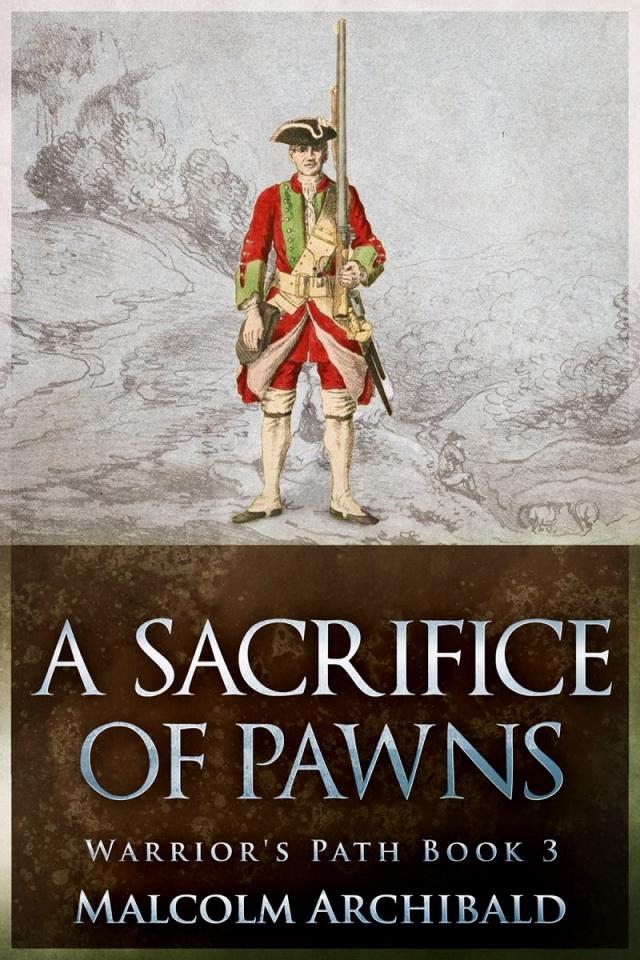
A SACRIFICE OF PAWNS
Warrior's Path Book 3
MALCOLM ARCHIBALD
CONTENTS
Prelude
Chapter 1
Chapter 2
Chapter 3
Chapter 4
Chapter 5
Chapter 6
Chapter 7
Chapter 8
Chapter 9
Chapter 10
Chapter 11
Chapter 12
Chapter 13
Chapter 14
Chapter 15
Chapter 16
Chapter 17
Chapter 18
Chapter 19
Chapter 20
Chapter 21
Chapter 22
Chapter 23
Chapter 24
Chapter 25
Chapter 26
Chapter 27
Chapter 28
Chapter 29
Chapter 30
Chapter 31
Chapter 32
Thematic Note
You may also like
About the Author
Notes
Copyright (C) 2021 Malcolm Archibald
Layout design and Copyright (C) 2021 by Next Chapter
Published 2021 by Next Chapter
Edited by Chelsey Heller
Cover art by CoverMint
This book is a work of fiction. Names, characters, places, and incidents are the product of the author’s imagination or are used fictitiously. Any resemblance to actual events, locales, or persons, living or dead, is purely coincidental.
All rights reserved. No part of this book may be reproduced or transmitted in any form or by any means, electronic or mechanical, including photocopying, recording, or by any information storage and retrieval system, without the author’s permission.
For Cathy
PRELUDE
THE ISLAND OF MARTINICO, CARIBBEAN SEA
June 1761
With her flag of truce limp under the brassy sun, HMS Temple sat off Fort St Pierre, Martinico. As the heat bubbled the pitch between the pristine planking, Temple’s crew stood on deck, studying the fort with its batteries of cannon and white-uniformed garrison. It was seldom that a British ship came so close to a French stronghold without firing, and the officers and men of Temple resolved to record every last detail of the enemy fort.
It was June 1761, and the war between His Britannic Majesty, King George III of Great Britain and Ireland, and King Louis XV, Louis le Bien-Aimé, the Beloved of France, had dragged on since 1754. What had started as a minor Colonial dispute in the backwoods of North America had spread across the globe to Europe, the East Indies, and the Caribbean.
“There’s the captain going ashore,” said Foretopman Harry Squire, tipping back his straw hat as the captain’s barge eased from the stern. Captain O’Brien sat erect in the stern beside a smart young midshipman.
“I don’t trust these Frenchies!” Daniel Tait was a native Jamaican, a free black man who had joined Temple when the warship berthed at Kingston earlier that year. “They are too friendly with the Spanish for me.” He shook his head. “I hope the captain is safe.”
Squire nodded at the ranked cannon on Temple’s main deck, with the gun crews standing ready. “The captain is under a flag of truce to negotiate an exchange of prisoners. Not even the Frenchies will break a truce.”
“I don’t trust the Frenchies,” Tait repeated.
“La Touché, the governor of Martinico, is a gentleman,” Squire insisted. “He’ll keep his word.”
Both men wore the ubiquitous clothes of the British seaman, the white cotton shirt with horizontal coloured stripes—red in Squire’s case, blue in Tait’s—a dark blue neckerchief, and white canvas trousers. While Tait wore low shoes—“purser’s crabs”—Squire was barefoot, and both had seamen’s knives attached to their belts.
“Ship ahoy!”
The hail came from aloft, where a lookout was permanently on watch.
“Where away?” the lieutenant of the watch bellowed.
“Just breaking the horizon to the west, sir!” the lookout replied. “Two vessels! One is Bienfaisant, and I don’t know the other!”
Grabbing the telescope from its bracket on the mizzenmast, the lieutenant scrambled up the ratlines to join the lookout. Perched eighty dizzying feet above the deck, he extended the telescope and focussed on the distant sails.
“That’s Bienfaisant, right enough,” the lieutenant said. “I think she’s captured a French prize, the lucky bugger!”
“Is that lucky?” Tait was not yet fully cognisant of the ways of the Royal Navy.
“Yes, Taity,” Squire said. “If you capture a ship, it can be sold, and the captain and crew get a share of the profit after the admiral takes his whack.”
“Lucky bugger,” Tait agreed.
They watched as HMS Bienfaisant escorted in her prize, a wave-battered sloop with patched sails and a deck packed with artillery. At her stern, the Union flag hung above the white-cross-on-blue ensign of France, a sure sign she was a prize of war.
“She’s a privateer or I’m a Dutchman, although she wears a merchantman’s flag,” Squire said. “She carries too many guns for an honest merchantman.”
Tait studied the captured vessel with calm eyes. “In Jamaica, we call the privateers freebooters,” he said. “Or pirates.”
“You won’t be far wrong, Taity.” Squire produced a wad of tobacco, bit off a chunk, and handed the rest to Tait. “Pirates and privateers are much the same in these waters.”
Both men knew that privateers were privately owned vessels with an official licence that empowered them to attack the enemy shipping. Fighting for profit more than patriotism, privateers often crossed the border into piracy, attacking even neutral vessels. Some had earned an unenviable reputation for violence and cruelty.
As Tait and Squire watched, an eager lieutenant on the prize ship ushered half a dozen prisoners onto a yawl. Grinning Royal Navy seamen shoved them into the centre of the boat and manned the oars. Within a minute, the yawl was powering towards Temple, with the prisoners scowling at the British warship.
“Here come the first of the Frenchies,” Squire said.
“All hands!” the first lieutenant of Temple roared, and Squire and Tait joined the others in mustering on the main deck. In response to bellowed orders, a file of Marines waited to escort the prisoners below decks until they could be exchanged for British seamen held by the French.
Squire nodded at one of the Frenchmen, a tall, handsome man in an ornate coat. “A golden guinea to an Irish sixpence that’s the captain.”
Tait looked and stepped back. “That’s a bad man,” he said, shaking his head.
“He looks very debonair in his fancy coat,” Squire said, still chewing on his tobacco.
“The devil is in that man,” Tait said.
As the French boarded Temple, the tall Frenchman stopped at the entry port with its elaborate carvings of Neptune. He looked across at his sloop, now a sad sight, and at the flag of truce drooping from Temple’s stern.
“Flag of truce!” he shouted the words in high passion, and although he spoke in broken English, Squire understood the meaning.
“The British took me in a flag of truce!” He drew a small knife from his belt and, with a dramatic gesture, he carved a cross in his forehead.
“What the devil?” Squire made to step forward until the second lieutenant ordered him back to his place.
The French captain stood still, ignoring the shouts and pointing bayonets of the scarlet-coated Marines. Blood from his cut seeped down his nose to drip onto the deck.
“You took me under a flag of truce!” the Frenchman shouted. “You broke the rules of war. For that, I will wage raw war on you and your ships. There will be no quarter!” He raised his voice to a near scream. “No quarter!”
When the Marines ushered him forward, the Frenchman replaced his knife, bowed to the first lieutenant, and followed his men.
“Who was that?” Squire asked.
“Captain René Roberval,” one of the escorting seamen replied.
The name seemed to strike a chill across Temple’s main deck, and not only Tait stepped back in nearly superstitious awe.1
1
ST LAWRENCE RIVER, CANADA
November 1761
“We’re iced in!” Lundey, the mate, swore. “We should have left Quebec a week ago. Now the ice will hold us until the spring thaw.”
Captain Stringer looked forward, where the St Lawrence River eased away into the cold distance. “Get the hands forward with poles,” he ordered, “and use these damned Rangers as well. It’s time they earned their keep.”
“Come on, men!” Lieutenant Kennedy hurried forward, with Sergeant Hugh MacKim and the other Rangers only a few steps behind.
The Boston-registered brig, Martha, had left Quebec only the previous day, hoping to reach the open sea before the river completely froze over. Now, as the ice closed in, Lundey was not alone in believing they had lingered too long in the British-garrisoned city.
“Can we break through?” Private Dickert asked as he viewed the barrier of ice that stretched from bank to bank of the river.
“We’ll give it a bloody good try,” Lundey replied.
“Smash the ice with the poles, you men!” Stringer ordered. “It’s not too thick yet.”
As Dickert lifted his pole, Private Duncan MacRae joined him in the bow of the ship. Both hammered the ends of their staffs onto the ice.
“Break, you bastard!” Dickert said, lifting his pole above his head and smashing the end down on the crack.
“We’re winning!” MacRae said as the crack widened and water bubbled through to the surface of the ice.
“Less talk! More sweat!” Lundey shouted. “Get working, you men!”
Martha inched forward, with her weight, the current, and a fortuitous wind combining to ease her slowly downstream.
“We are winning,” Private Parnell agreed. “We’re moving one tree at a time.” He indicated the thick forest on the bank, where rank after rank of trees marched into the limitless interior. “Another six months, and we’ll nearly be halfway to the sea.”
“We’re making poor progress,” Captain Stringer said. “Can’t you work harder, Rangers? The frost is early this year.”
Lieutenant Kennedy nodded. “We’ll do what we can.” He changed the men in the bow, giving them half-hour shifts at ice-breaking to ensure nobody was overtired.
“At this rate,” Private Oxford fretted, “we’ll never join with the fleet at New York.” He looked around at the snow-covered forests. “We might walk there quicker, sir.”
“It’s hundreds of miles of bad territory.” Kennedy looked over his Rangers, the twenty-five green-clad forest fighters, mostly veterans of the campaigns around Quebec. Only two of them, Privates Oxford and Danskin, were untried replacements.
MacKim read Kennedy’s thoughts. “You two,” he indicated the new men. “Go forward and help smash the ice.”
“Sergeant?” Oxford looked up with a quizzical expression on his face.
“Go and help smash the ice!”
While Danskin hurried forward, Oxford hesitated before moving. MacKim frowned; there was no room for shirkers in Kennedy’s Rangers.
“Keep at it, Danskin,” MacKim called. “Think how proud your sweetheart will be when you relate your adventures.”
Danskin gave a weak smile as he leaned forward with his pole.
“We’ll have to watch Oxford, sir,” MacKim warned Kennedy as Oxford poked reluctantly at the ice.
“I’ll keep my eye on him,” Kennedy promised.
MacKim glanced upwards, where the white-tinged sky threatened further snow. “Come on, Oxford, or we’ll be stuck on this blasted river until the thaw.”
Parnell spat into the wind. “If we are, sergeant, we’ll avoid the fighting.”
“Aye, and we don’t want that, do we?” MacKim said. “We can’t let others think we’re scared.”
“They can think what they like,” Parnell retorted. “We’ll be alive, and they’ll be dead.”
“Here!” MacKim tossed over a long pole. “Save your energy for the ice!” He lifted one for himself. “Watch me and learn.”
Leaning forward on the sharp prow of Martha, thrusting at the ice, MacKim soon found he was sweating, despite the sub-zero temperatures.
“We’re slowing down,” Kennedy said, half an hour later.
“Rock the ship!” Lundey ordered. “I sailed on the whaling ships. Run from side to side!” Within a few moments, he had all the Rangers and crew not otherwise occupied, racing from port to starboard and back. The motion cracked the ice around Martha, so she eased forward another few feet.
“This is the strangest voyage I’ve ever been on,” Dickert said as he ran across the ship. “Join the Army, and play children’s games.”
“It’s working,” MacKim pointed out. “We’re moving.”
“Do we have to rock the boat for the next thousand miles?”
“If we have to,” Kennedy replied. “King George needs us.”
Parnell grunted. “He should come here then. He can balance his crown on his arse and run around the boat all day long.”
“All we need is for the French to fire on us while we’re stuck here,” Dickert said.
“They’ve surrendered,” MacKim reminded. “Canada is ours now.”
“Until the Frenchies change their minds,” Parnell said cynically.
Martha continued downstream, sometimes sailing in nearly clear water and occasional spells of ice. On one occasion, when the ice proved particularly stubborn, the captain had the ship’s boat brought forward and dropped over the bows. The resulting shock cracked the ice sufficiently for Martha to ease through.
“Every delay is costing us time,” Kennedy fretted.
“We can’t help the climate, sir.” MacKim tried to be philosophical, although he thought of Claudette, left behind in Quebec.
“I’m well aware of that, sergeant!” Kennedy’s snapped retort proved his tension.
“Yes, sir.” MacKim retired to the rail, leaving Kennedy to his worrying. Canada closed on all sides, vast and winter-cloaked in white. MacKim felt inside his coat and pulled out the letter Claudette had placed there when he left Quebec. She had written in French, so MacKim automatically translated the words as he read.
“My dear Hugh,
I have enjoyed our companionship together these last few months, with all your strange Scottish ways and expressions. I sometimes hoped that our friendship might develop into something more. However, it seemed that you were satisfied only with what we have.
Notwithstanding our religious differences, with me a Roman Catholic and you a Presbyterian, and our emotional contradictions, I felt that we formed a bond. My son Hugo also enjoyed your company, and, Hugh, now you have left, I can say this in safety; Hugo often expressed a wish that you would stay, either as a friend or as something more.
I know that I could never follow the drum, as the saying is, and I would never presume to persuade you to leave your military calling, so I allowed our friendship to continue without depth.
I wish it had been otherwise.
Now that you are leaving on another campaign, probably never to return to Canada again, I will say that you take a piece of my heart with you that can never be replaced.
Take care of yourself, dear Hugh, and never forget your friend here in Quebec.
I am always your
Claudette.”
MacKim reread the letter, poring over every word before folding it neatly and returning it inside his coat. Why didn’t you say, you distant woman? Why did you hide your feelings from me?
Martha sailed down the St Lawrence, with every tree they passed taking MacKim further from Claudette and closer to the French and the war.
“The fleet’s sailed.”
The news travelled around Martha in seconds as men stared at the vast anchorage and the neat little city of New York.
“They’ve sailed without us.”
“That damned ice slowed us down!”
MacKim saw Kennedy’s mouth tighten as he heard the news.
Captain Stringer swore. “Damn the bloody Army,” he said. “I have a cargo to deliver to the fleet.” He raised his voice to a bellow. “Rangers! You’ll be with us a good bit longer.”
“I thought we were joining a transport in New York!” Oxford was not yet tested in battle, so he tried to prove his masculinity by tough talk and an eagerness for action.
“That was the idea, Oxford,” MacKim explained patiently. “But the fleet’s sailed without us.”
“So, what do we do now, sergeant?” Oxford asked.
“Now we follow the fleet and hope to catch them before we reach the Caribbean,” Captain Stringer joined in.
“Where about in the Caribbean?” Kennedy asked. “My orders said to join Admiral Rodney’s fleet at New York. I know nothing beyond that.”
Stringer gave a small smile. “The Army keeps you in ignorance. Well, Lieutenant Kennedy, the fleet has sailed for Barbados, and so must we.”