

Neon Jane, page 1


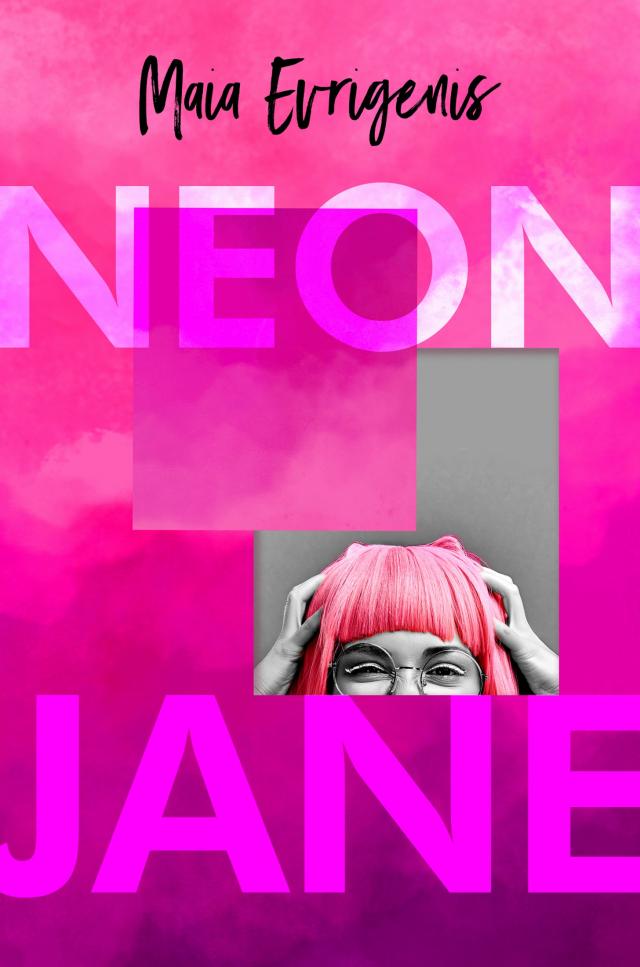
NEON
JANE
MAIA EVRIGENIS
Neon Jane
By Maia Evrigenis
© Copyright 2022 Maia Evrigenis
ISBN 978-1-64663-659-4
All rights reserved. No part of this publication may be reproduced, stored in a retrieval system, or transmitted in any form or by any means—electronic, mechanical, photocopy, recording, or any other—except for brief quotations in printed reviews, without the prior written permission of the author.
This is a work of fiction. The characters are both actual and fictitious. With the exception of verified historical events and persons, all incidents, descriptions, dialogue and opinions expressed are the products of the author’s imagination and are not to be construed as real.
Published by
3705 Shore Drive
Virginia Beach, VA 23455
800–435–4811
www.koehlerbooks.com
For Jean Danaë
Table of Contents
Chapter 1: Cancer Hippie
Chapter 2: Take
Chapter 3: Central Line
Chapter 4: New Body
Chapter 5: Hair Is Youthful
Chapter 6: Photograph
Chapter 7: Tachycardia
Chapter 8: Engraftment
Chapter 9: Automobile
Chapter 10: Neon Jane
CHAPTER 1
Cancer Hippie
I am waiting for a copy of my heart, but there’s only junk in the mailbox. Dr. Peters called four days ago to tell me I’m fine like last year and all the years before, but I need to see this for myself. I need to see my pumping heart, my heart that refuses to be anything other than average.
Anthracyclines were the last and most powerful chemotherapies I was given to rid my body of blood cancer at thirteen, specifically acute myeloid leukemia. Anthracyclines are shown to produce long-term heart defects (leading to heart failure) and are the reason for my yearly echocardiograms. I remember one of my anthracyclines beautifully. It was smooth and blue, in a thick plastic bag hanging above me on an IV pole, so exposed and sparkling in liquid form. It was a dripping venom disguised as a melted blue Otter Pop, pushing down through the tiny tube in my chest.
When the copy of my current heart arrives, I will put it in the black binder with the others, cataloging every year since 2007. I call this creation my Little Heart Book. I flip through it when I’ve gone multiple days without thinking of cancer at all, because I’m twenty-four now, and my life is very different. My Little Heart Book forces me to remember—and reminds me to live life the way a cancer survivor should. I’m supposed to be forever grateful and love my life for one reason and one reason alone: I don’t have cancer anymore.
But I originally made my Little Heart Book for another reason, to show that a therapy so determined to make me different, to change my heart forever due to cardiotoxicity, has failed. Instead, anthracycline has left my heart quite boring, and I love to see myself as somebody plain.
Closing the mailbox, I hear running on the street. I turn around, and there’s Jane right in the middle of it, but I’m not worried. Cars don’t have any effect on her.
“Maia, hey, Maia!”
Jane really bothers me but she’s hard to get mad at. She’s so cute running toward me with her lanky, tween-aged body, lack of eyebrows, and neon-pink wig covering her bald head. The pink bob stops bouncing as she slows to a walk. I hear her panting change to deep, long breaths, just like we practiced.
“Jane, you’re tired. Where’s your IV pole?”
“Oh yeah, Maia! I’ll get it so you can push me.”
She wants to stand on the metal over the wheels while I run and roll her down the sidewalk.
I stare at Neon Jane and shake my head.
“I don’t think so. Not right now.”
I go back inside to make tea, feeling guilty for hoping that’s the last I’ll see of her for the day. I want to be alone in this one-bedroom house I rent in my hometown, Sacramento—me, just me and my family photos from before and after cancer, my animal figurines, my Greek tapestry of a donkey, my turtle soap dish, my orange bedspread, my pour-over coffee maker, my two hermit crabs, my John Coltrane poster, Two Kinds of Decay on the coffee table, my sharp cacti in the yard. It’s the perfect world I’ve created for myself, and I make sure to keep things tidy. I’ve found the city and space to fight the feelings that I must become something better, that for cancer’s sake, I must greatly succeed.
When the water is boiling, I choose the Canada mug and ginger tea bag from the cabinet and pour. I lie on the big orange love seat and close my eyes while it cools next to the sunflowers on the table. I breathe and remind myself, as I often have to do, that Jane is a positive force on my life. I remind myself that I am choosing her.
I will never let my Neon Jane go.
Through my thin windows, I can hear her walking back down the street. I know it’s Jane by the sound. She’s found her IV pole again, which she probably stashed in some bushes. She reconnected herself to it like she so smartly figured out how to do. She’s pushing the pole down the street slowly. I hear its little wheels bump and crackle against the outside world they weren’t made for and don’t quite know how to touch.
In the morning, Jane’s there with an old diary of mine. It’s the green diary, when I was a sophomore in high school, about two years into remission.
She clears her throat dramatically at the kitchen table and reads out loud, “October 7th, 2009. Dear Diary, When I see a picture of myself from 2007, I realize I used to be one of those kids on a St. Jude’s commercial. I feel different than those kids on the commercial. When people watch them, they think this: ‘Those kids aren’t real to me.’ That’s how I used to be, and still am a little. We see our own life as reality.”
I roll my eyes.
“I was so dramatic,” I say.
“You totally were.”
But we both know nothing’s changed.
Jane reads on.
“It’s not fun going through life trying to focus on not getting sick again—when you have absolutely no control over it. Today, I pretended, like I do every day, that everything is totally fine. I’m comforted by thoughts of doing good for the world.”
Jane has always wanted me to go work in a lab, or go to medical school. She thinks I’d be a good doctor because I know what fighting cancer is like.
“You’d be able to relate to the kids,” she says.
But I would need at least twenty years of psychotherapy (plus private tutoring) before I became a doctor, because I get weird and jealous of new discoveries in oncology. When I was still living in New York, a friend sent me the first article I’d seen on gene therapy. I skimmed it on my shattered phone while I was out walking and stopped and cried in the middle of a sidewalk in the Village.
When I was fourteen, I’d let go of the neon pink wig. I was back in town after my cancer treatment at the Lucile Packard Children’s Hospital three hours away, and my hair was growing back. It was only a centimeter long and looked even shorter because it grew in curly. That first day back at my 1200-person public middle school was scarier than a lot of the days I had during cancer. To go back to a school I’d randomly disappeared from the year before, and this time without hair, caused me a disgusting amount of anxiety.
Jane has trouble understanding this. I try to tell her what 2008 was like, that it wasn’t cool or sexy to be alternative, hipster, or different in middle school. This was before Cara Delevingne and Emma Watson cut their hair. At Sutter Middle School, in 2008, your jeans had to be low-rise skinnies from Abercrombie & Fitch. Girls woke up at 5 AM to wash and straighten their twelve-inch hair, every single morning.
Surviving cancer as a child did not teach me not to care what other people thought of me. It did the opposite. During treatment, my body was constantly evaluated, checked, changed, tested, eyed, cared about. Talked about. Walking my middle school hallways, all I could think was I have the shortest hair out of all the girls in this school, and everyone notices. Because of my non-hair, I was ugly to myself, and I would have no chance at a boyfriend until it at least hit my shoulders. Later, because of the closed-mindedness of my school when it came to hairstyles, this mindset changed. I would have no chance at a boyfriend until my appearance accurately displayed my interest in one.
“Is she like, a lesbian?”—boy at lockers
“I don’t think so. She just has cancer.”—girl at lockers
For a few weeks, after overhearing this conversation, I deeply contemplated my sexuality for the first time. But the truth was I wasn’t a lesbian, and I got bored of this self-questioning.
I didn’t have cancer anymore, and saying I still did was the worst possible rumor someone could spread about me. To say that I still had cancer meant that everything my family and I had gone through the year before was meaningless, that I had never overcome what Dr. Davis considered “the most powerful chemotherapy in the world,” that none of it ever stopped, that I was still constantly fighting this thing, that I would never grow up, that I would have childhood cancer forever.
But all these thoughts are pathetic to Jane. “None of this even matters,” she says now, reading my mind from across the table. “You can be so petty. You need to be stronger.”
“I know. I’m sorry.”
“You should move back to New York and go to NYU Langon
“That’s not true.”
“You’re getting your life together post-college, and writing that biography of your uncle—yeah, yeah.”
Our uncle, I want to say. But for someone so “strong,” Jane is pretty damn slow. She can’t admit, or rather just can’t believe, that I am all she turns out to be.
“At least get your old job back, Maia.”
“I didn’t quit last week for no reason. I don’t want to work at the Delta King anymore. I can’t work in customer service anymore—hotel management. I just can’t. It’s so fake.”
“Well, it’s what you’re good at. And that hotel was cool, right on the river. I mean, it’s not what I want you to do, but it was better than nothing.”
“The biography is important, Jane. What if there’s something I find out about Uncle Jason’s past?”
“Leukemia is genetic, not hereditary,” she says. “I googled it recently, for myself in like ten years, for when I’ve grown up and beat cancer and want to have kids of my own.”
“Genetic not hereditary doesn’t make any sense, Jane. Everyone knows that’s BS.”
“Well, that’s what they say. They’re smart; they’re doctors.”
“You can’t believe everything doctors say. You need to think about your body for yourself.”
“Ughhh. I hate when you go all cancer hippie.”
I want to tell Jane that our uncle Jason could be the only answer to cancer we’ll ever have. I want to tell her that his tragic drowning at age twenty-nine could’ve been due to undiagnosed leukemia, that he could’ve been sick and passed out in the water. I want to tell Jane that if I find this in his story, our answer to why will be so simple—it was in our blood. We’ll never have to think about the power lines above our elementary school anymore, the Wi-Fi router in our bedroom, the pesticides we ate. But I don’t tell Jane any of these things, because I don’t actually believe them. I write about Uncle Jason for a different reason, for what he represents in our family, for something else he explains. I write to understand an artist with a shortened timeline, and the aftermath of that. I write so I may know what it means to not come up for air.
There are so many other things I want to tell Jane, mostly about life and how I’ve learned to live it in this cancer-surviving body. I want to tell her she’s going to get tired of living so hard, so seriously. I want to tell her that, in a way, the girl from middle school was right; I will always have cancer, and it will always have me. Even if I did tell Jane, she wouldn’t believe me. She only believes in herself and what inspires her. She must, in order to survive. But when she does and grows and gets older, she’ll realize that cancer is the only thing she truly knows in this world. Once she’s given permission to talk about it forever, she’ll see she can do nothing else but tell it, and speak it over, again and again.
CHAPTER 2
Take
Jane takes things to make her body go. She takes blood when her cheeks turn white, when she can’t walk somewhere without thinking about the next place she’ll get to sit down. She takes platelets when she bleeds from a rub against a door, a packaged sandwich wrapper, a nothing. These are not cuts, but clumps of red dots—blood trying to seep out of her skin. Jane’s skin is like a coffee filter.
Jane never wanted to be dangerous. When she was in kindergarten, she told her teacher she wanted to be a cat when she grew up. Now Jane is a vampire, sucking other people’s blood. But Jane needs it to make her body go . . . go . . . Go. Go, Jane. Team Jane. We love you, Jane. Our Neon Jane.
Jane gets her first period in a children’s hospital. It lasts fifteen days and only stops because of what she takes. She is a thirteen-year-old on birth control pills, skipping the placebo days. Jane takes cytarabine, etoposide, daunorubicin, mitoxantrone, and methotrexate. Jane takes everything else she takes (plus her neon-pink wig) because she takes the cytarabine, etoposide, daunorubicin, mitoxantrone, and methotrexate. These are words Jane pronounces perfectly.
Everyone back home is worried about Jane, spending time on Jane, crying again about Jane. Other people take Jane’s sisters to school and to horseback riding lessons. Other people cook them meals covered in tinfoil, with instructions for reheating on the top in twisty sharpie. Other people drive Jane’s youngest sister to the San Juan Bautista mission so she can take photos, build a model, and write a report. The parents are busy caring for Jane three hours away, all because Jane must take what she takes—so that her whole life can come up, so that Jane’s blood will stay inside.
I woke up in my orange bed and remembered a dream from the night before. I was in the pool at my parents’ house (only twenty minutes from mine now), but I wasn’t a kid. My dad was there, but he said he didn’t want to swim. He sat on the edge with his feet in.
There was a central line in his chest.
“Dad, where did you get that?”
“Oh, this? I got it today actually. It’s just like yours. It really makes life so much easier. You know, yours is probably gonna get infected with the water.”
I looked down. I felt a central line break through the scar in my chest—and saw its outline on my swimsuit.
A central line is a five-millimeter-wide tube inserted near the heart that connects to a large vein below your left collarbone. It’s what they give you when you have a disease like leukemia and need long-term care, so you don’t have to do something uncomfortable and stupid, like take chemotherapy through a needle in your forearm. There’s blue stitching where the tube goes through you to hold it in place, and a clear bandage that covers it. The stitches get crusty—and fighting infection with a white blood cell count like yours could destroy you—so the central line is cleaned every two to three days. First, it’s cleaned by the nurses, and then they’ll train your mom. The disinfectant smells like oranges. To clean the tube, they use heparin and saline solution through one of the two-way spouts at the end of the line. Your dad nicknamed heparin “hep,” and whenever he says it in front of the nurses you get embarrassed.
This time the nurse is using the red spout. It feels cold below your collarbone when they push the saline through the spout and into your vein. You get a chill, but you laugh and smile. The nurse says, “Feels cold, honey?” You say, “Just a bit.” She connects a syringe to the cleaned spout and fills four vials with your shit blood to send to the lab.
There is a right way to wear a central line, but no one can do it, not even Jane. This is it: stand straight up with arms high in the air, tall, strong, chest puffed out, like one of those inspirational wooden angels everyone kept giving me when I was in the hospital. (I still have one of them. It doesn’t match my place, it’s corny, but I had to keep one.) I take the wooden angel off the shelf above the kitchen sink.
I choose a pen from the messy drawer and draw a central line through the chest of the wooden angel. I draw a tube pushing through her honored body. Finally, I’ve grown up to be a “cancer doctor but for kids,” like Jane wants me to be. I must choose something powerful for the angel, something that will work—anthracycline, the blue kind. I watch her stand there strong while it flows through her veins on the kill. I watch her keep her arms up in the air like that, chest out, proud, unbreakable—because I want to see if she can actually carry herself like that. I want to see if she can actually stay proud with a line straight through her heart. I put her back on the shelf and wait for her to crumble, to feel embarrassed and weak. But she doesn’t. She’s a wooden angel. There is no limit to what she can take.
I only took drugs for fun once in my life. My senior year of college, I was at a party at Lori Baker’s on East 10th and 3rd Avenue. It was May and hot outside. I walked to the party by myself with my heels in my purse. I was sick of getting ready for parties with other girls who knew nothing about me, rushing to get places in groups. I was sick of running everywhere in New York City, running away. I wanted to walk slowly, to look in the eyes of others, to reflect on the past. I wanted to be okay with myself, to not strive for the future. I wanted to be slow. I considered my walk a physical statement. But I could never master it. It’s hard to walk slowly when you’re done running in New York.


