

Welcome Me to the Kingdom, page 1


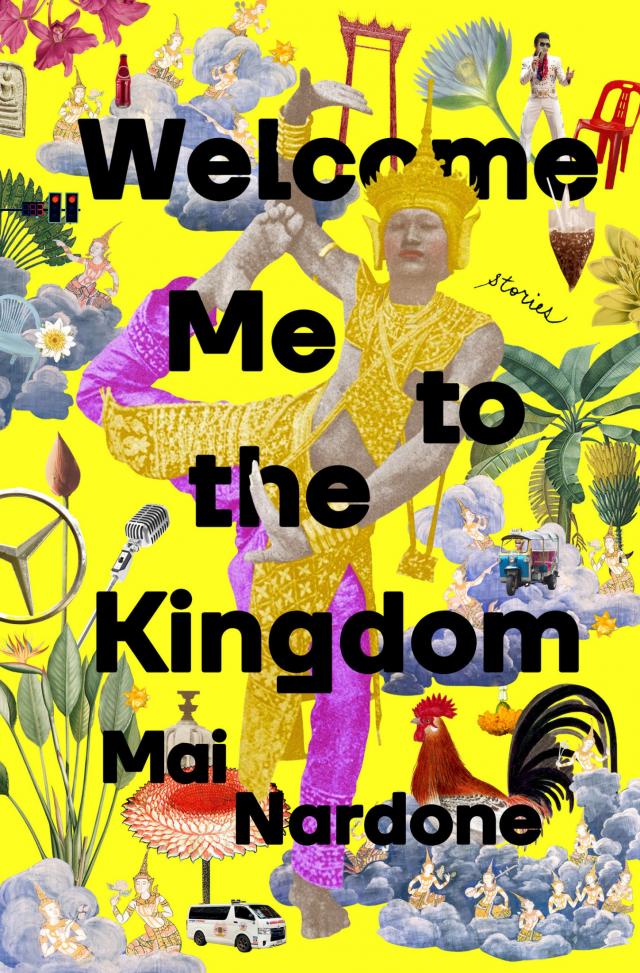
Welcome Me to the Kingdom is a work of fiction. Names, characters, places, and incidents are the products of the author’s imagination or are used fictitiously. Any resemblance to actual events, locales, or persons, living or dead, is entirely coincidental.
Copyright © 2023 by Mai Nardone
All rights reserved.
Published in the United States by Random House, an imprint and division of Penguin Random House LLC, New York.
Random House and the House colophon are registered trademarks of Penguin Random House LLC.
Some stories are previously published: “Stomping Ground” in American Short Fiction, “Like Us for a Whiter You” in Apogee, “English!” in The Bridport Prize Anthology 2013, “Easy” (as “Only You Farang Are So Easy to Come and Leave”) in Catapult, “Exit Father” in Granta, “Captain Q is Dead” in Guernica, “What You Bargained For” in Kenyon Review Online, “The Tum-boon Brigade” in McSweeney’s Quarterly, “Welcome Me to the Kingdom” in Ploughshares, and “Goodbye, Big E Bar” in Vol. 1 Brooklyn.
Library of Congress Cataloging-in-Publication Data
Names: Nardone, Mai, 1989- author.
Title: Welcome me to the kingdom: stories / Mai Nardone.
Other titles: Welcome me to the kingdom (Compilation)
Description: First edition. | New York: Random House, 2023
Identifiers: LCCN 2022006887 (print) | LCCN 2022006888 (ebook) | ISBN 9780593498187 (hardcover) | ISBN 9780593498194 (ebook)
Subjects: LCSH: Bangkok (Thailand)—Fiction. | LCGFT: Linked stories.
Classification: LCC PR9570.T53 N37 2023 (print) | LCC PR9570.T53 (ebook) | DDC 823/.92—dc23/eng/20220418
LC record available at https://lccn.loc.gov/2022006887
LC ebook record available at https://lccn.loc.gov/2022006888
Ebook ISBN 9780593498194
randomhousebooks.com
Title-page and chapter-opening ornaments: chartgraphic/stock.adobe.com
Cover design: Rachel Ake Kuech
Cover collage: Nakrob Moonmanas
ep_prh_6.0_142459018_c0_r0
Contents
Cover
Title Page
Copyright
Prologue
Labor: Pea & Nam (1980)
What You Bargained For: Rick, Nam & Pea (1980)
Pink Youth: Hasmah & Nam (1982)
Exit Father: Ping (1985–)
Parade: Lara, Nam & Rick (1991)
Stomping Ground: Benz, Tintin & Pradit (1993)
Goodbye, Big E Bar: Pinky & Pradit (1996)
Easy: Lara, Nam & Rick (1997)
Feasts: Ping, Pinky & Pradit (1999)
Captain Q Is Dead: Benz & Tintin (2000)
Make-Believe: Pinky (2010)
Like Us for a Whiter You: Lara & Nam (2010)
Handsome Red: Tintin (2011)
Welcome Me to the Kingdom: Lara & Benz (2013)
City of Brass: Jimmy & Ping (2016)
English!: Pea & Nam (1974)
The Tum-Boon Brigade: Benz, Tintin & Lara (2014)
Acknowledgments
About the Author
_142459018_
We came with the drought. From the window of the train, the rich brown of the Chao Phraya River marked the turn from the northeast into the central plains. We came for Bangkok on the delta. The thin tributaries that laced the provinces found full current at the capital. And in the city, we’d heard, the wealth was wide and deep.
The train arrived alongside trucks hauling into the outskirts, flames painted on their fenders, bumpers lined with Michelin Man dolls. The fanfare of a conquering army. And the city received us with familiar faces, celebrities we knew from Channel 7 smiling from the gauntlet of signs, promising the best in soda, soap, and gold.
We came with our own talismans—jade, bronze—protections against a city that didn’t live up to our expectation: just this? In the station, no one seemed to be boarding the trains. They sat waiting, surrounded by the tourism banners. Take Home a Thousand Smiles. This, too, we read as a promise.
The coins Pea wouldn’t spend had worried a hole through his pocket, so he was jingling them in his fist as he passed the pawn shop that sold foreign liquor by the shot. The bottles were dusty, proof of another life in some formerly rich man’s cabinet.
“Always the last to go, the liquor,” the old pawnbroker said to Pea. “You know when they bring the whiskey they’ve hit the bottom. Sell their wives first, most of them.”
“This is the real stuff, right?” Pea asked. “You’re not just reusing the bottles? I know the taste of Mekhong.”
“You tell me.”
Pea drank. “Fucking gasoline.”
“It’s from Kentucky, USA,” the old man said, holding the indecipherable label out to Pea.
“Well, in Kentucky, USA, they must use this to run cars.” Pea spread the rest of his money on the glass cabinet. “Another?”
* * *
—
Nam had given him a deadline: thirty days. That was how long he had to make them a living. Tucked in Pea’s breast pocket was a page from a free Chinese calendar, the numbers smudged by sweat. Sixteen inky days already blued away by his thumb. Sixteen days since he and Nam had come down on the train together, down from the northeast to Bangkok. Since then, Nam had been staying with her last living kin, a cousin, while Pea roomed at a boardinghouse apartment with other men from the provinces, what counted to him now as family. They worked security, gardening, driving—all of it better than the wet suck of the rice paddies in the northeast, the shining white flats of the salt pans along the coast, the hot pools of the shrimp farms across the central plains. The men had traded that work for slow days and shade, for nights sharing food on the plastic mat, talking women and money, pooling their daydreams. Pea contributed what he could, except his worry for Nam. He needed her to himself. Sixteen days spent.
“Nothing, kid?” the other men asked daily of Pea, the newest among the six that shared the main room. The landlord had the bedroom, which was air-conditioned, and standing at the door Pea could feel the cool air gracing his toes. He had never seen the room, but in two weeks had come to know the life of its sounds, the frequent ding! of the microwave and enduring patter of a TV, which during the day ran Chinese soaps and at night porn that kept the other men awake with longing.
“He updates the video monthly,” one boarder had told Pea. “But this month it’s a squealer.”
Pea could hear it wasn’t Thai.
“French,” the man said. “He likes the farang women.” His hands cupped imaginary breasts. “Bigger, you know?”
For two weeks Pea had listened nightly to the same movie, counting down the VHS’s two-hour capacity. And when he couldn’t bear another performance, he forced himself outside.
Which is how he found himself, on night sixteen, hovering by a flower market, drawn there by its fluorescent sting, by the ant line of laborers shuttling huge cane baskets. There was a buyer, too, marked by his good shoes, the way he skirted puddles. Pea looked for a foreman. He was looking for work.
The market was busiest after sundown, without the daytime heat on those neat flowers in foam boxes, petals spritzed, glistening like first-world candy. Not the thorny, twisted sentinels of the up-country temple where Pea was fostered, here was something imported from a lush planet.
“China,” a laborer told him. He said the blue anchan and white jasmine buds were local, but the roses and orchids came from abroad.
Pea said he needed work. Anything.
The man gestured. “That’s the boss in the blue.”
Soon after, Pea began a hard night lugging flowers by the kilo and basket from truck bed to stalls, bearing supplies for the wreath-makers—two lines of women with pincers for fingers threading jasmine buds onto long needles. When he finished that, the foreman had him packing ice. He was the only worker without a cart to trundle the weight, so Pea managed on his back alone.
At the end of the night he stood at attention before the boss, heels together. He wanted to look tidy, fresh, but his hands were blue from the iceboxes, left shoulder soaked where it had borne the ice sacks. The man counted out Pea’s pay twice, rubbed each bill between his fingers and splayed them on the table.
Pea picked up the bills and made a show of looking around the room. “How much are you paying these men?” he asked, gesturing.
“Don’t worry, boy. You’re all paid the same.”
Pea divided his money and laid half of it back on the table. “Yeah, well, I’ll work twice as hard as them for half the pay if you’ll hire me full-time.”
“How old are you?”
“Twenty,” Pea lied. He could barely pass for the eighteen he actually was, but the man gave him the work anyway.
On his way out of the warehouse Pea saluted the laborer who had first ushered him in. Then he tucked a vine of bougainvillea under his shirt for Nam. Only, by the time he got them to her, the papery flowers had turned to pulp in his palms. She liked them, she assured him.
“Let’s have breakfast at that stall you like,” he said. “My treat.”
The sun had risen by now, but the city buildings, wreathed in smog, eclipsed the s
She twined the bougainvillea in her fingers and picked at her porridge.
Pea shook white pepper into his, then vinegar and soy sauce. He offered her the condiments. “No? You want it plain like that?”
She wasn’t hungry.
“But eat the egg at least.” He didn’t want to remind her of the price of food. Three weeks into the monsoon season and still no rain. Even in Bangkok people looked hopefully at the clear skies.
“You look tired,” he said.
She had been dragging this mood around ever since they arrived, by turn worried or distant. She asked about his fellow boarders and he passed her details, never mentioning the landlord. Not that Nam wasn’t used to him relaying sex talk. The lives of temple boys back in the northeast was sex talk. Nightly the boys paraded past the one sex bar on their side of town, a karaoke place with tinted windows and an English sign: Happy 2 You. Thumping and hooting, the boys would romp by, tripping one another in front of the door, hoping it might swing in as they passed. But that was different. Those women were locals. The landlord’s taped women were white, and Pea couldn’t say why, but the videos were to him somehow a violation.
“Is it your cousin?” Pea asked. “You staying up to watch TV with him?”
“There’s a job he wants me to take. It’s good money.”
Pea swallowed. He pulled the calendar page from his pocket. “You promised thirty days.” He circled the number with his finger. “I can take care of us.”
“It’s not enough, though, is it? It’s not enough to live in this city.”
“It will be. See how fast this place is changing?”
He took Nam’s bowl from her and stacked it over his empty one. “If you’re just going to waste this, I’ll eat it. Look, just give me time with the job. Who knows what kind of work that cousin wants to find you.”
“I know,” she said.
“Except you don’t. You don’t understand.” His job was a beginning for them, and he wanted her to see that it was good.
That night he brought her to the flower market.
“Hey!” Pea gestured over to his coworker. “This is my girlfriend.”
Nam was distant; she wouldn’t enter the warehouse.
“I don’t know.” She held his arm but pulled away. “I’ll get you in trouble.”
“I’m not even on duty yet. Look at these.” They were flanked by the red eyes of a hundred roses. “Just buds, see, but soon they’ll bloom.” He pulled one free of its newspaper bunch. “Here. For you! Oh, watch the thorns, ha ha!”
“Are these from China?”
“I think so. Take it home. Or take a whole bunch for your cousin. Here—”
“No, don’t waste the money.”
“It’s free. Don’t worry. The boss likes me and he lets me take things home. These will wilt soon, anyway. And then they’ll just throw them away. Isn’t that funny? They come all this way just to live a few days.”
Every morning that week, returning from the warehouse at sunrise, Pea brought Nam stolen flowers. Like a bird adding strips of cotton, foam, twigs, and newspaper to a nest, Pea made his best effort to construct their new life.
Every morning he counted his pay and turned the number in his head, waiting for Nam’s cousin to leave for work. The man didn’t know about Pea. The cousin was unmarried, but the young maid Nam shared the back room with was loyal, and she reported everything back to him.
The next day Pea brought the maid an attar of roses to perfume her clothes. She liked that, this maid who didn’t seem to work but spent her days reclined on her bunk. She was gone most nights.
“A boyfriend?” Pea had asked Nam once, but she didn’t say.
Pea cut the noses from plastic soda bottles to make suitable vases for his gifts: hibiscus, gardenia, a jasmine wreath. “Aren’t they beautiful?” he asked, and the maid said yes, beautiful. Nam said nothing. She picked at the Pepsi label.
Didn’t she like them?
“I think it’s romantic,” the maid said.
Nam let the plants accumulate and then decay, as if to prove a point. What point, though? Soon the bedroom was looking like a carnival, twisted creatures crusting across the dresser, curling on shelves and, in the warped and cracked mirror, multiplying into a kaleidoscope of faded, darkened color. The vase water thickened awfully. The room was behind the kitchen, and in the heat the scent invaded the cooking area, infusing the food. The steam rising from the rice cooker had the fragrance of decayed vanilla orchids, and the smell of old needle flowers clung to the dishware like a dank nectar.
Nam’s cousin complained. But Pea did not need to be told to stop. By the end of the week, on their twenty-second day in Bangkok, he was out of work.
So, Pea, what have you done now? Nam would say. It’s your attitude, she would tell him.
“That boy’s temper,” the elders back home had bemoaned again and again. “He’d better grow out of it.” The temple’s older foster boys had even tried to beat it out of him.
“How about we fill that big mouth of yours.” They scooped manure from the mounds of fertilizer and came after him.
Or they would pin him at the shower bucket and take turns holding him under, saying, “All you have to do is cry ‘Bingo!’ Got, it? What’s that? Want us to stop? Bingo!” Pea writhed and coughed, but never pleaded. One night they came at him while he toyed with his new cigarette lighter, an American Zippo. Before they could grab his wrists, Pea used the hot metal to brand a boy’s cheek.
“Who the fuck does that?” They backed away.
“Bingo,” Pea said.
The head monk laughed when he heard about it. “Too much Die Hard.”
The monk beat the boy but let him keep the lighter. Pea had seen the wrong lesson in his prize: fight.
* * *
—
The other men were asleep when Pea returned to the shared room the night he lost his job. He drummed his fingers on the water kettle, thirsty, wanting a clean drink now.
His inky fingerprints seemed to collect everywhere these days. Blue on the bathroom tap, blue on the hem of his shirt. An absent stain on his lip. When one boarder complained, Pea held himself back from marring that man’s face, too. Now he had marked the kettle.
The apartment window faced a narrow soi where the dawn vendors were already setting up. Below, a woman was preparing the first batch of fried dough, and the sound of the batter striking the hot oil carried up to Pea, reminding him of eating at the stalls back home. Why had he even come to this city?
The foreman’s words echoed in his head. “I don’t think we have room for you, after all.” He said he didn’t need a boy who couldn’t keep his mouth shut. There were others waiting for work, still coming off the trains and buses, brought in by the drought. But Pea hadn’t come because of the drought; he’d come for Nam.
He hadn’t hesitated in following her to the city after her father, her only immediate family, had died. Both Pea and Nam came from small families. A house was never meant to be held up by a single pillar, and when Nam’s father died, everything had quickly come down.
He went to find her, walking by way of a fresh market. It wasn’t quite dawn. Men were unloading the day’s produce: fish in green baskets that leaked over the sidewalk, sagging pork already being sliced for the first customers. He bought a bag of soy milk and approached the flower vendor.
“You have any old stuff?” he asked.
The woman didn’t seem to understand him. He often had to repeat himself with these Bangkok people, their bland way of speaking utterly unlike his own.
“Anything? Any scraps?”
She didn’t.
“Well, how about this bunch?” He gestured to a small display of flowers. “These are local, right?” Not that he could afford them. When he said it was his aunt’s funeral, that he wouldn’t show up empty-handed, she relented and gave him a pair of lilies.





