

Highway Men, page 1
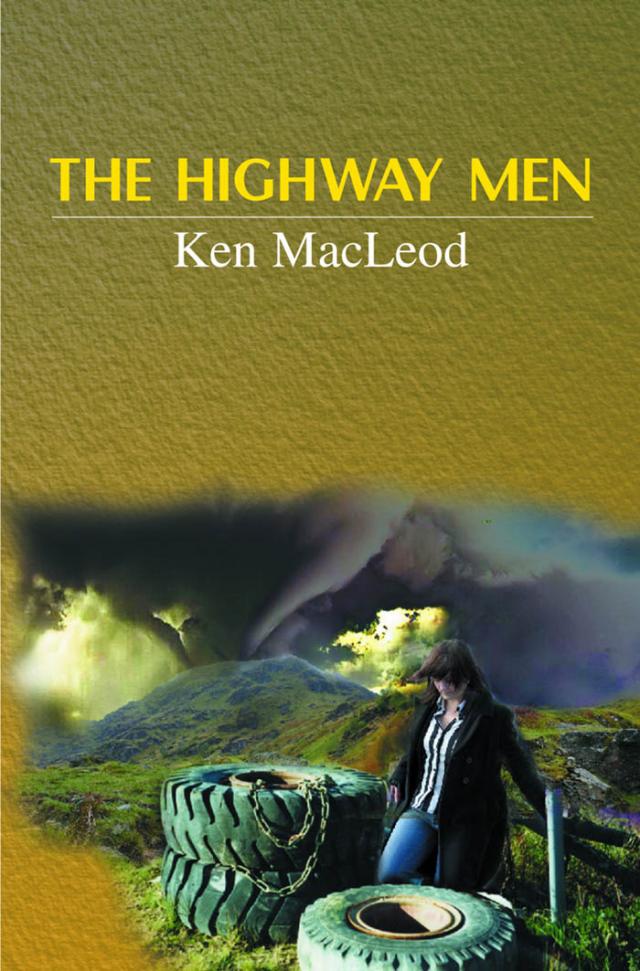


THE HIGHWAY MEN
Ken MacLeod
The weather has gone crazy and the war has spread to China.
Jase, Euan and Murdo are laggers: forced workers in a future Scotland. The laggers are helping to lay a new power line in the Highlands. Ailiss, a young woman from a secret settlement in the frozen hills, is going to strain their loyalties to breaking point – and beyond.
Ken MacLeod was born in Stornoway in 1954 and grew up in Greenock. He has worked at many jobs, from road-mending to computer programming. He is now a full-time writer and has written nine science fiction novels. He is married with two children and lives in West Lothian.
By the same author
Novels
The Star Fraction
The Stone Canal
The Cassini Division
The Sky Road
Cosmonaut Keep
Dark Light
Engine City
Newton’s Wake
Learning the World
Novellas
The Web: Cydonia
The Human Front
THE HIGHWAY MEN
Ken MacLeod
The Sandstone Vista Series
The Highway Men
First published 2006 in Great Britain by Sandstone Press Ltd
PO Box 5725, Dingwall, Ross-shire, IV15 9WJ, Scotland
Sandstone Press gratefully acknowledges the ongoing support of Highland Council, Highland Adult Literacy Partnership, and Essex County Council Libraries.
Copyright © 2006 Ken MacLeod
The moral right of the author has been asserted in accordance with the Copyright, Designs and Patents Act 1988.
ISBN-epub: 978-1-905207-41-1
The Sandstone Vista Series of books has been written and skilfully edited for the enjoyment of readers with differing levels of reading skills, from the emergent to the accomplished.
Designed and typeset by Edward Garden Graphic Design, Dingwall, Ross-shire, Scotland.
www.sandstonepress.com
To Michael
1. DIAMOND CUTTING
It was Murdo Mac who noticed it first. He was riding shotgun. So he could see farther ahead. I had to keep my eye on the road. First I know of it, Murdo bangs on the cab roof. Signal to stop. I braked gently. The early morning road was icy and treacherous. We were about half a kilometre outside a village a bit out from Dingwall. More a thin straggle of houses, really, like most villages in the Highlands. And like most, it was empty. We knew that.
I rolled down the window. Cold air came in. Murdo poked his head into the cab. His face was red inside the furry parka hood.
‘What’s up?’ I asked.
‘There’s something no right about yon houses,’ he said. ‘Can’t for the life of me see what it is, though.’
I looked sideways at Euan Campbell. He handed me the binoculars. I propped my elbows on the steering wheel and got the glasses into focus. The five or six houses were on a curve of the road up ahead. I could see all of them. They had that Highland look of being out of place. Like suburban houses stuck down on the moors. Gardens overgrown, sheds falling apart, big bay windows black and empty.
That was it.
‘Nae glass in the windows,’ I said. ‘In any of the windows. And it’s not broken, either. Just missing.’ I passed the binoculars out to Murdo. ‘See for yourself.’
He fiddled with the focus wheel. Clumsy in thick gloves. He drew in a sharp breath as he looked.
‘That’s it,’ he said, as he handed the glasses back.
‘Not much to go on,’ said Euan.
‘Doesn’t look right,’ said Murdo.
‘Hunker down,’ I said. ‘We’ll take it slow.’
Murdo’s head disappeared from the window. Checking the wing mirror I could see he had ducked back into the lookout’s bucket. Shaped like an oil drum, it was bolted to the back of the cab, right behind the driver. It had a low seat, and a roll of armour padding wrapped around the inside. Not very comfortable. We used to take turns.
I eased into first gear and the big Highway truck rolled forward. Three hundred metres. Two hundred. One hundred. The first house had a pair of tall rowans growing at the gap where the gate had been. Couldn’t say they had brought much luck. I braked and turned off the engine.
No sound but a blackbird’s song and the croak of a hoodie crow up on the hill.
‘I’ll have a look,’ I said. I jumped out of the cab with a thud of wellies and a crackle of oilskins. ‘Keep me covered, Murdo.’ Even to myself it sounded a bit corny.
‘Are we in China or what?’ Murdo scoffed.
‘It’s you that’s got us twitchy,’ I pointed out.
‘Whatever you say, Jase.’ Murdo pushed back his parka hood and planted a helmet on his head. The end of the shotgun barrel poked over the rim of the bucket.
I walked up the grassy strip where the path had been. A plastic tricycle, its colours faded, lay in the weeds to one side. I kicked a flat football out of the way and stepped over a broken plant-pot to look at the big window to the right of the door. I glanced inside the room behind the empty window, just to check. A rotting sofa against the far wall, a coffee jar, a mouldy mug. No dangers there. I looked down at the window frame. Above the cracked wood and blistered paint there was maybe half an inch of glass. It was the same all around the frame. The glass had been cut out. I moved to the window on the other side – another empty room, with a plastic chair in the middle of the floor – and found the same. Farther around the house was the wee window of the downstairs toilet. Half an inch of frosted glass along all four sides of it.
I crunched through frosty bracken and nettles, put my foot on the sagging wire of the fence, and hopped into the next empty house. Same deal with the windows.
‘Someone’s cut out all the glass with a glass cutter,’ I said, back at the lorry.
‘“With a glass cutter!”’ Euan mocked. ‘Whatever next?’
‘Why would anybody bother?’ I asked. ‘They could buy all the glass they wanted in Inverness.’
‘To save themselves the drive to Inverness,’ said Murdo.
‘We’re wasting our time here,’ said Euan.
‘We can spare a minute,’ I said. I turned and walked to the fifth house along. It was smaller than the others and had no garden. The front room window was cut out just like the others. In the room was a bedstead up against the back wall. It didn’t look like it had been a bedroom. I imagined a sick person lying there, gazing out.
Gazing out. Suddenly it hit me that I’d been looking at this the wrong way. Really looking the wrong way. I stepped to the door and pushed. It swung open. Inside I found a narrow hallway with stairs a few steps ahead. There were a lot of scratches on the walls and the banister, and on the floor leading into the room. When I looked through, I saw that the scratches led straight to the legs of the bedstead.
The bedstead had been dragged in. When the floor was bare after the carpets and everything else had been taken from the house.
I sat down on the creaking springs and looked out the empty window. I could see the road and a low dry-stone wall. A patch of overgrown grass on the other side. Then the moor behind it and the hills in the far distance. Long shadows of short fence-posts. That frozen yellow grass across the way would be a sweet green meadow in the spring and summer. The wild sheep would come down from the hills and eat it. Them or the deer. The deer would be way down the hills now, off the moors and into the glens.
‘Got ya!’ I said to myself. I was out the door and across the road in a minute. I jumped the ditch and the wall into the meadow and searched along the foot of the wall at the far side. I knew what I was looking for, but it was pure luck that I spotted it: a gleam of steel. I bent over and picked up a six-inch bolt with a blunt point at one end. The other end was tapered with four narrow raised bits like low fins along it. It looked like a toy rocket.
A cross-bow bolt.
‘The house is a hide,’ I said to Euan and Murdo, back at the lorry. ‘For maybe a dozen people. They took the windows out, dragged up chairs and couches or whatever and made themselves comfortable, and just sat there waiting for a herd of deer or maybe a flock of sheep to go and eat the grass. The beasts wouldn’t see them, wouldn’t even smell them. They just had to wait and then let fly with cross-bolts. You could bring down ten at one go that way. Maybe more.’
‘Very nice,’ said Murdo. I couldn’t tell whether he meant my detective work or the killing I had detected.
‘Why not just smash out the windows?’ said Euan.
‘To keep it quiet,’ said Murdo.
‘From who? The deer?’ said Euan.
‘Maybe,’ I said. I wasn’t so sure about that.
‘Not much sport in the shooting,’ said Euan.
‘This was not for sport,’ I said.
‘Aye,’ said Murdo. ‘And speaking of food, my breakfast’s in Lochcarron, and that’s two hours away if we’re lucky.’
‘Breakfast? What do you call the bacon roll you had in Dingwall?’
‘A snack.’
‘A midnight feast,’ said Euan. ‘It was that dark I was expecting to feel my wife.’
‘That was just me,’ I said. ‘You had me worried.’
2. SMOKING GUN
Euan smoked a roll-up before we got back into the cab. Nobody complained. We’d all got kind of easier on him and his bad habit since the big story came out. Maybe it’s all been forgotten now, when you’re reading this. But you surely must remember the name of Jin Yang.
Jin Yang, right. The guy who started the whole thing. H
So the Chinese guy goes down, and they’re all kind of looking at each other. There’s blood and bits of bone and brains splattered everywhere. Kids screaming. Adults screaming. Total shock and panic. And the sky marshall sees, right there sticking out of the pocket of the late Mr Yang’s seat, a couple of books. They’re in Chinese, but they have the titles in English inside. One of them is the Koran. The other is the Selected Speeches of some Chinese leader.
The sky marshall’s telling all this to his bosses on the ground, using the plane’s own radio. Everybody’s hearing him. Then another Chinese passenger a few seats back jumps up and starts yelling. The sky marshall turns to him, with his gun levelled. By this time, half the passengers are telling their folks, using their own mobile phones. They all think they’re about to die, and they’re right.
Because the wee sign that used to warn you not to use mobiles and so on while the plane was taking off or landing was there for a reason. Your gadgets really can interfere with the aircraft’s controls. Well, they did this time anyway. The plane’s been called back, obviously. But something goes wrong on its approach. There was a heavy fog that day over the Firth of Forth. Pilot’s flying blind. Flying by instruments. Instruments that have been knocked out of kilter by some computer geek’s fancy new mobile phone, while he’s telling his girlfriend he loves her or what have you.
Controlled flight into terrain, it’s called. In this case, the terrain is the naval dockyard at Rosyth. Where Britain’s top aircraft carrier is in dock for a refit before a mission to the South China Sea. And in the South China Sea there’s been a bit of bother over Taiwan – a breakaway big island that the Chinese are very touchy about.
Kaboom.
A headline the next day says CHINESE AL QAEDA NUKES ROSYTH. And that was The Guardian, man. The Record just said BOMB REDS NOW.
Most of the British Army was in Iran already. China wasn’t exactly a long march away. The Yanks took care of the heavy stuff, as usual. Japan got stuck in too, for no better reason I can see than from force of habit.
Two years into the war our boys were up to their eyebrows in shit. Not knowing where the next attack’s coming from – Communists, Muslims, Japanese, you name it.
Meanwhile, the official machinery is grinding away. Government inquiry sifts through the wreckage of the Rosyth incident. Plods through every surviving witness. Brings out a report.
It tells us three important things about Jin Yang.
One – he’s from China’s Muslim minority. Hence the Koran in the seat.
Two – he’s a businessman and a member of the Party. Hence the book of speeches by a Communist official. All about how building up business and getting rich is the way to the glorious future. Jin Yang has to swot up on that sort of thing, and parrot it every now and again to keep his bosses happy.
Three – Jin Yang was a heavy smoker, like lots of Chinese men are. On his first visit to the Festival Fringe, he had had a very nice time. Deals in smoke-filled rooms and all that. At the airport he got through half a pack of cigarettes in the departure lounge to calm his nerves. There was a special booth for that very purpose. All’s well. Second time, a good few years later, the smoking ban had come in. He had a much less fun visit. He did a lot of his deals in doorways. On his way home, he’s through security and stuck in aeroplane land when he finds that the smoking booth has long since been ripped out. His flight’s delayed. Nobody knows just when it’ll be ready. Even if he could get back through security, he’s afraid he’ll miss his flight, and then he’ll miss his connection. So he’s stuck.
For three and a half hours.
It wasn’t a hijack. There was no Al Qaeda connection. No Chinese government connection either.
It was just air rage.
So that’s how the war started.
And that’s why we all stood around quite patient like and waited for Euan to finish his roll-up before we got back in the truck for the long drive to Lochcarron.
3. FRANKENFOLK
We pulled into Lochcarron a couple of hours later. The journey hadn’t been bad. The sun glared on the snow when we were up high on the hillsides, but I had good shades. The black ice was murder down in the hollows, but the truck had good tyres. Some new kind of carbon fibre stuff. Their grip was magic. And we didn’t run into any bandits or wolves.
‘When I was wee the snow would have melted long ago by now,’ said Euan. ‘Snowline at fifty metres in March! It used to be nearer two hundred.’
Lochcarron was a mile or two out of our way. We passed the end of the road that led away to where we were going to work. That road cut across the head of the sea-loch, towards the old railway line. A mile along it you could see the bright yellow work cabins, and the big black reel that held the cable that snaked out of the water. Lochcarron is a kilometre of houses along the northern shore. This morning the loch was like glass. The long ranges of hills that rose from both shores were mirrored in it like two wavy blades. The hillsides were black with the stumps of trees that had been nipped dead in the Big Freeze and then burned in the forest fires of the next summer. Tall windmills stood along the hills’ snow-covered tops. If any of the blades were turning at all it was too slow to see. Some of the windmill pylons were leaning over. Others lay flat on their sides. I remember when wind-power farms were the next big thing. The wind had other ideas.
I slowed the big truck as we came in, past the grassy patch that used to be a golf course and the walled patch that’s still a cemetery. Around the side of a hill to the village proper. The brown stones and grey pebble-dash of the old houses were mixed in with the bright colours of the new ones. Blue, pink, yellow, green. They looked more like machines than buildings. Pipes and aerials sprouted from them. Thick insulating mats covered their walls. Steep roofs jutted up like witches’ hats. The roofs of the old houses were covered with solar-power tarps.
The hotel was one of the old buildings. Crumbling concrete patched with insulating mats. Not much of a hotel now. More of a coffee shop and pit-stop. A couple of supply trucks and two or three small cars were filling up, with red power cables and green bio-fuel lines plugged into their sides. Behind the thick plastic of the front window the cafe was busy. I parked around the side – our fuel cells were still well charged and the bio-fuel tank was half full. The three of us trooped in. Warm air smelling of coffee steam and frying bacon. About a dozen people sat around the tables. As usual everybody stared at us. It’s these big yellow boiler suits with HIGHWAY on front and back that does it. Dead giveaway. I was still throwing back my hood and unzipping the front of my overall when I heard the first nasty remark. One of the guys whose lorry was recharging outside – I could see that by the Tesco jacket on the back of his chair – leaned over and said to the Fed-Ex driver he shared the table with:
‘Laggers. Too dumb tae draft.’
Coming from a trucker, that was a bit rich. I ignored it. I didn’t retort with: ‘Truckers. Too feart tae fight.’ I just strolled to the counter and ordered a pot of java and six bacon rolls.
Thing is, it would have been true. You can dodge the draft by being a truck driver. But the trucker was right and all. Except that we are drafted. Only not for the Army. The Army needs people who can handle high tech. Just the same as civilian industries, all that Carbon Glen stuff. People who were good at school. The rest of us – those who can’t or won’t hack it as soldiers or high tech workers – get swept up by the Highway. There’s no going on the dole or the sick these days. It’s my way or the Highway, like the First Minister used to say.





