Trample an Empire Down, page 1


Scanned by Highroller.
Proofed more or less by Highroller.
Made prettier by use of EBook Design Group Stylesheet.
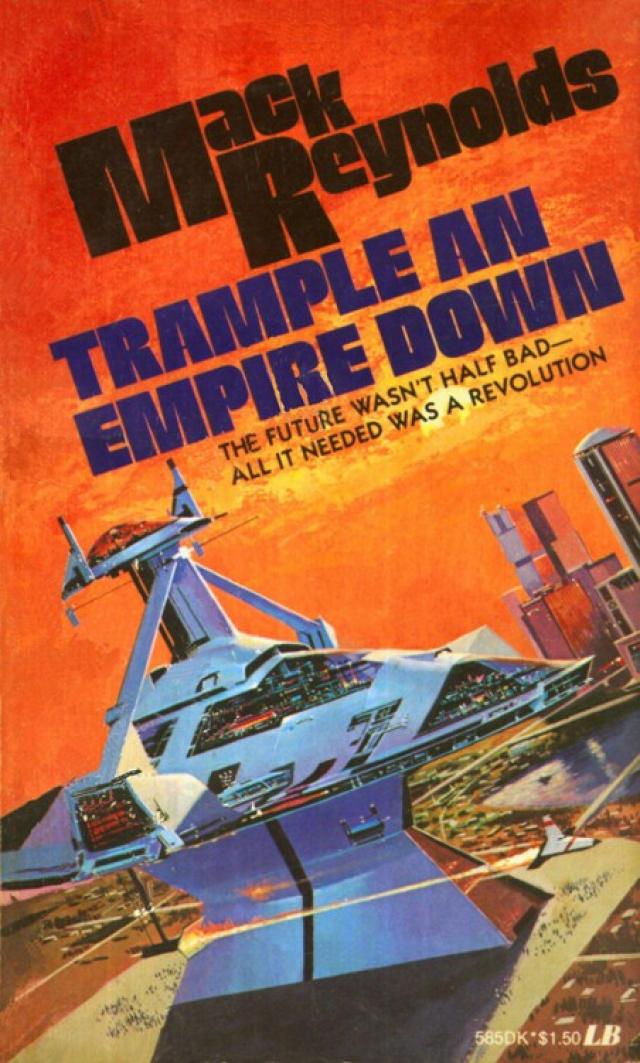
Trample An Empire Down by Mack Reynolds
Chapter One
Morris Malone was unhappy. His latest attempt to get a job had fallen flat on its face, as always. He had educated himself to teach history, and while still in school the profession was automated—ultra-mated, they were beginning to call it these days—out from under him. With the coming of television and Tri-Di, and of the National Data Banks, the old form of teaching, was passe. No more, a teacher sitting before a few dozen students in a school classroom.
He didn't deny that the new system was more practical. In the past, the teacher had to address himself to the average pupil in the class. Those that were slow failed to understand, and those who were bright were bored. Today, in his own home, the pupil could go as fast or as slowly as he wished, consulting by phone screen, when necessary, the tutor who had been assigned him in that particular subject. It didn't apply to some subjects of course, such as laboratory sciences or physical education, but it applied with a vengeance to history. There were tens of thousands of canned lectures, on every level, and hundreds of thousands of books, in the National Data Banks teaching section. Only a handful of history teachers held down jobs, and they were selected by the computers on the basis of their ability quotients.
He sighed and stared out the window of his small suburban house. As far as the eye could see there were almost identical houses. A somewhat ant-like existence, he thought. But at least it was better than living in a high-rise apartment house in a pseudo-city.
Morris Malone was in his early thirties and he had never heard of the other, but he strikingly resembled Henry Fonda at the same age. Right now, he was on the disgruntled side because he couldn't think of anything he wanted to do that fitted in with his financial situation. He was tired of reading, just recently having got off his binge of cramming in hopes of getting a job specializing in the Napoleonic Period of French history. He felt he could recite the whole life story of the Little Corsican. Not that it had done him any good. The computers had passed him by with great elan.
He could have watched Tri-Di but he hated canned entertainment.
Jack Zieglar, hands in pockets, came sauntering down the street and up the walk. Morris Malone went over to the door and let him in.
If Morris Malone resembled Henry Fonda, then Jack Zieglar was the image of Marlon Brando in his earlier days. Marlon Brando playing one of his easier-going parts. Zieglar took life slow and philosophically, and a bit drunkenly.
He said, "Cheers, Mo. What spins?"
"Not a damn thing," Malone said, leading the way back to the living room. "What spins with you?" He slumped down onto the couch.
His friend sank into a chair and said, "I came over to see if you've got enough pseudo-dollars left this month to spring me a drink or two."
Morris Malone came back to his feet and went over to the autobar, pulling his Universal Credit Card from an inner pocket.
"Beer?"
"Yeah."
"I'll have one too, I guess." He put the credit card in the bar's payment slot, put his thumb print on the identification screen and dialed two dark beers. When they came he returned to his guest.
Jack said, "How'd you do with Napoleon?"
"I met my Waterloo."
The identity screen on the door buzzed and Morris looked up. It was his other close buddy, Jed Kleiser. Morris was too lazy to get up. He touched a button on the phone screen and the door opened.
Jed came in and looked at them. He said, "Who in hell's still got enough credit left to buy beer? It's three days before the monthly Guaranteed Annual Income payment."
Morris Malone let martyrdom come into his face but he got up again and went over to his autobar and put his credit card in the slot, his thumbprint on the tiny identification screen and dialed another beer.
A metallic computer voice said, "You have insufficient credit for this order."
Morris stared down at the bar in disgust. "I didn't know I was that broke," he said. He went back to the couch, where the newcomer had already taken a seat at the far end from where Mo had been sitting. "Sorry, Jed."
Jed shrugged. He was a tallish type, somewhat gangling, and, though less than handsome, had that boy-next-door look that an amazing number of women liked. He was roughly the same age as the others.
Jack said, "This is a helluva world for an aspiring alcoholic to live in. The ultra-welfare state, People's Capitalism. Ha! Guaranteed Annual Income. Just enough not to starve on, but not enough to enjoy yourself."
Jed said mildly, "It's not so bad. We all three ought to get married. Then we'd have three mopsies also getting their GAI Share the cost of a house and so forth."
"Yeah," Jack said, without interest. "And then have a couple of kids and they'd both get half a monthly payment until eighteen. The only trouble is, I'm a satyr and like to play the field. Having only one woman would send me around the bend."
"People's Capitalism," Morris said, sipping carefully at his beer, since it was going to have to last. "Actually, what it amounts to is charity for the majority, but the powers that be still control the country, and the rich get richer but the poor stay about the same. The businessmen, the politicians, the churches, in short, the Establishment, do fine, but it's tough titty for the rest of us."
"So what can you do about it, Mo?" Jed shrugged.
Out of a clear sky, Morris Malone took the first step. He said sourly, "What this country needs is a revolution."
The other two took that in.
He said definitely, "The country's gone flat. No more wars, no more depressions, and with ultramation and computerization, practically nobody works. Practically everybody's on Guaranteed Annual Income. Even the space program has gotten into a rut, with nothing exciting going on. Practically everybody just sits around taking trank or drinking beer and watching Tri-Di like a bunch of idiots. The whole country's in a mental slump."
"And?" the other two said in unison.
"We need a revolution, that's what. There hasn't been a revolution in this country for well over two hundred years. The nation's ripe for it."
Jack said, just for the sake of saying something, "What kind of a revolution?"
Morris looked at him as though the question was foolish. "What'd'ya mean what kind of a revolution? One that'd wind up with us three on top of the heap. The leaders of revolutions that win always wind up in the catbird seat. Look at Mussolini, look at Franco, Tito, Chiang Kai-shek, Lenin, Hitler's gang, Napoleon, even Mao in China. And most of the leaders of the American revolution started off rich to begin with, but wound up richer."
"Oh, great. Wizard," Jack said, working away at his own beer, though noting sadly that it was already two-thirds gone. "But the trouble is, most of these revolutionist types wind up getting clobbered."
"I don't know," Morris argued. "They always start off telling the people, usually the poor people, how dedicated they are, how altruistic. Their hearts bleed for the downtrodden. But then, when they come to power, they start living it up like kings, and, as often as not, the man in the street is at least as bad off as he ever was."
"Yeah, but usually your revolutionist leaders, even the successful ones, wind up getting nailed," Jack said.
"Oh, I don't know. Stalin, Tito, Franco, Mao, Salazar, of Portugal, all died in bed at ripe old ages."
"So did most of the American revolutionists, except Burr and Hamilton. Napoleon died in bed, for that matter, although he was in exile. But take even those who were clobbered, like Mussolini. He started off as a poor editor of a third rate, so-called socialist newspaper. He came to power as a fascist in the early 1920s and stayed in, living in luxury, exerting power, until 1945. Hell, he had almost a quarter of a century living it up. When he was finally killed he was an old man. Do you think if he had his druthers, that he would have switched lives?"
Jed yawned and said, "Well, it's a wizard of an idea, but three men can't start a revolution."
Morris Malone finished his beer. He said, argumentatively, "Why not? How many does it take to start? I sometimes think that Voltaire started the French Revolution all by his lonesome. All right, by the time it came along, he was dead, but he started the ball rolling."
Jed said thoughtfully, "The American Revolution really got started by only about three men; Sam Adams, Patrick Henry, James Otis."
Jack said, "I thought it was George Washington, Benjamin Franklin, those guys."
"They came in later. Got on the bandwagon because they had to. Hell, that old bastard Franklin didn't come in until almost the end, when the fat was already in the fire. He wanted to compromise with the king. The patriots should have shot him."
Jack said to Morris, "You've got to have some kind of program to get the people stirred up. You just can't come out and say we three are going to take over the country, so that we can live it up."
Morris thought about that. He said finally, "We've got to put it on a high moral level. And something really different to wow them. Something radically opposite from what we have now."
"Yeah", Jed said, "But what, Mo?"
Morris snapped his fingers in inspiration and said, "How's this for a basic slogan: Less Production! Lower the Gross National Product!"
The other two eyed him as though he had just left the world of reason.
"Have you gone drivel-happy?" Jack snorted. "The demand for the past century and more has been to up the Gross National Product, the Per Capita National Income. Avoid a depression. Cut down on unemployment."
"It's a lot of curd," Morris said. "Unemployment isn't a problem, it's a way of life. We're using up half of the world's raw materials and flushing about two thirds of it down the drain. Just take one item, advertising. We'd advocate eliminating it. It doesn't produce a damn worthwhile thing."
"Every newspaper and magazine in the country would go broke," Jed protested.
"Great. Let 'em go broke. At the rate they're publishing tripe, we won't have a tree left in the country in a few years. Let people get their news on Tri-Di or on their library booster screens from the National Data Banks. So far as magazines are concerned, who'd miss 'em? There's only a dozen in the country worth reading anyway and most of them not dependent upon advertising. Think of all the wood pulp and man hours of labor you'd save if you kicked out advertising." He considered it. "Let all signs go at the same time, especially neon signs and billboards. What the hell good are signs? They're the most garish thing in our culture."
Jack protested mildly. "If you want to buy something, they tell you where it is."
"Curd. If you're in your own neighborhood you know where the stores are with the things you want. If you're somewhere else, you can ask the locals, or look it up in the phone book."
The other two considered it.
"Holy Jumping Zoroaster," Jed said. "It'd save a lot of paper and a lot of other material. And it'd save a lot of power, turning all those damned signs off."
"That's just the beginning on this Produce Less program," Morris said. "We're going to end planned obsolescence. Take cars. American hovercars are designed to start falling apart, or being out of style, after 30,000 miles, or about three years. After that length of time, any driver who can afford it begins to think in terms of a new car. His hovers are going, repairs needed, an engine job, there are dents and scratches in the finish. And he looks like a bum driving a vehicle that's out of style. As far back as the Model T and Model A Fords, a car was built to last at least ten years. A German Volkswagen, when they first came out, was expected to last 150,000 miles and a Mercedes 300,000. And the styles didn't change enough to make any difference. And both of them got better mileage than American cars. I won't even mention the Jap cars. Now, what we'd do is prohibit any car that weighed more than a ton. No cars could have more than four cylinders and all would have to give at least forty miles to the gallon. No power steering, no power brakes, no power windows. What the hell good are they? And we wouldn't allow batteries that were deliberately designed to wear out in a year or eighteen months. Lead is too damned valuable. Any scientist or engineer who came up with some scheme for planned obsolescence, we'd toss in the slammer.
"And that's just the beginning," Morris continued, in full voice now. "Take electric light bulbs. They're manufactured now with the built-in expectation of lasting approximately one thousand hours. Hell, they've got the knowhow to make light bulbs that would last the life of the house. It applies all the way down the line. In our grandfathers' day a man would buy a suit, and when he died, they'd alter it a bit and his son would take it over. How long does a suit last now? Two or three years?"
Jack said, thoughtfully, "Yeah. You could go on with a lot of examples. Take packaging. What the hell good is most of it? My grandfather once told me that when he was a kid, soap used to sit on the shelves of a store without even a wrapper. Now it comes wrapped in tissue paper, then in a heavier wrapper, all fancied up, and then in a cardboard carton, along with a couple score other bars of soap. Look at all the paper used."
Jed said, also thoughtfully, "Yeah. And all the artists, and layout men, and printers and so forth. All turning out something of no use."
Jack said, "What'd we call this party?"
And Morris said, "The Subversive Party."
"Are you completely around the bend? The IB I would have us before the day was out."
"No, no. I told you, we'd have to wow them. Shock 'em. Something really different. There's nothing wrong with subversion. All it means is to overthrow something in existence. To change. There's nothing in the American Constitution against subversion. Just so you do it legally. No force and violence. You have to get the majority of the people to vote for it. For instance, in the old days, before the Republicans and Democrats merged, when they had an election, if the Republicans were in, then when the election came, by definition the Democrats were trying to subvert the Republicans. But the word became kind of a taboo. So-called socialists, like Norman Thomas, never referred to themselves as subversives, not even the more radical Socialist Labor Party. Hell, not even the Commies or the Trotskyites. But we'll come right out and call ourselves the Subversive Party. However, we'll advocate coming to power by democratic procedure. We'll vote ourselves in, and once in we'll dump the present version of democracy."
"We will?" Jed said.
"Sure, it doesn't work. Democracy is the ideal government, admittedly. But it only works among peers. When you have a situation where any semi-literate, moron can arrive at age eighteen and have as good a vote as an Einstein, then it's nonsense. Democracy, in America, became a farce more than a century ago. Even presidents were elected because of their TV image, or some such. The candidate with the most dollars to spend for TV appearances, newspaper ads and so on, made it. The voters, on average, conducted themselves like idiots. Do you realize that even Nixon, at the nadir of his disaster, had something like a quarter of the country pulling for him? If some of those people had caught him with his hand in their pocket, they still would have voted for him."
Morris Malone came suddenly to his feet and began pacing up and down the room. The other two watched him, frowning their puzzlement.
He stopped suddenly and looked at them He said, surprise in his voice, "You know, we've just been horsing around. Just kidding. But you know I in beginning to think it might work "
Chapter Two
Jack snorted a laugh. "No. I mean it," Morris said. Jed said, "Holy Zoroaster, Mo, you can't start a political party without money. And we're all three on Guaranteed Annual Income."
"Yes, you can. You can start it on peanuts, if you've got a program that fits the needs of the country. Or, at least, you can convince the people you have. Look at Lenin's gang, a few months before they came to power. Half of them were in exile or prison in Siberia, the rest were on their uppers in Switzerland or somewhere else abroad. Trotsky was half starving in New York cadging meals."
"Well," Jack argued, "how would we start?"
"In a few days, we get our monthly GAI payments. We'll all three tighten our belts and put fifty pseudo-dollars into the kitty, the treasury of the Subversive Party. With it we'll buy stationary, print up membership application blanks, and rent a post office box."
"Then what?" Jed said grudgingly. "Then we start writing letters, under a dozen different pseudonyms, to every newspaper and magazine in the country that prints a Letters to the Editor column. And we send out press releases to every paper and Tri-Di news commentator on the air telling them about the formation of the new party."
"Hell," Jack growled. "They wouldn't give us any publicity."
"Sure they will. All of those characters grasp at straws when it comes to news. They're short of it. There hasn't been a war for a coon's age. The space program is routine now. Most crime has disappeared with the Universal Credit Card and all banking being taken care of by the National Data Banks' banking section. Without money, most crime is impractical. At any rate, we'll be news. After a time, we'll probably have chances to appear on Tri-Di programs. Guest speakers, debates, interviews, that sort of thing. After we get going as a political party, we'll demand equal time every occasion a Democratic Republican gives a speech."
Jack said, "That's great. But it's hardly a beginning. You've got to have pseudo-dollars on hand to print leaflets, pamphlets, maybe bring out a newspaper, rent halls for meetings. Where do we raise money?"
"A lot of ways," Morris told him. "We'll charge five pseudo-dollars to join the Party, and five dollars dues each month. We'll announce ourselves a legal party and demand credit exchangers from the National Data Banks banking section so that we can transfer dues and donations into an account for the Subversive Party. It'll be in our names. We're the National Executive Committee, the Triumvirate that heads the Party and makes all decisions."