Perchance to Dream (UC), page 1


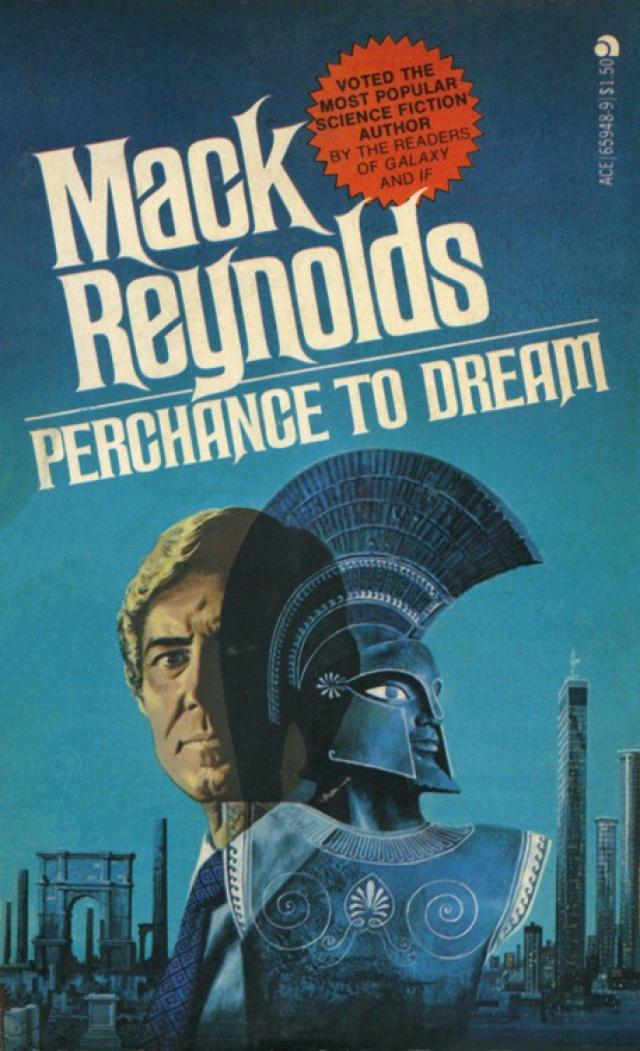
Lars Porsenna of Clusium
By the nine gods he swore
That the great house of Tarquin Should suffer wrong no more.
Shame on the false Etruscan Who lingers in his home,
When Porsenna of Clusium Is on the march for Rome.
To eastward and to westward
Have spread the Tuscan bands; Nor house, nor fence, nor dovecot
In Crustumerium stands. Verbenna down to Ostia
Hath wasted all the plain; Astur has stormed Janiculum,
And the stout guards are slain.
Up spoke the consul roundly,
"The bridge must strait go down;
For if they once may win the bridge, What hope to save the town?"
Then out spake brave Horatius, The Captain of the Gate:
"To every man upon this earth Death cometh soon or late.
"Hew down the bridge, Sir Consul,
With all the speed ye may; I with two more to help me,
Will hold the foe in play. In yon strait path a thousand
May well be stopped by three. Now who will stand on either hand,
And keep the bridge with me?"
Meanwhile the Tuscan army,
Right glorious to behold, Came flashing back the noonday light, Rank behind rank, like surges bright
On a broad sea of gold.
And forth three chiefs came spurring
Before that deep array;
To earth they sprang, their swords they drew, And lifted high their shields, and flew
To win the narrow way.
Then Ocnus of Falerü
Rushed on the Roman three, And Lausulus of Urgo,
The rover of the sea; And Aruns of Volsinium
Who slew the great wild boar…
But hark! the cry is Astur:
And lo! the ranks divide; And the great Lord of Luna
Comes with his stately stride. Quoth he, "The she wolf's litter
Stands savagely at bay: But will ye dare to follow,
If Astur clears the way?"
"And see," cried brave Horatius, "the welcome,
Fair guests, that waits you here! What noble Lucumo comes next
To taste our Roman cheer?"
Was none who would be foremost
To lead such dire attack: But those behind cried, "Forward!"
And those before cried, "Back!"
"Come back, come back, Horatius!" Loud cried the Fathers all.
"Back Lartius! back, Herminius! Back ere the ruin fall!"
Back darted Spurius Lartius;
Herminius darted back: And as they passed, beneath their feet
They felt the timbers crack. But when they turned their faces,
And on the further shore Saw brave Horatius stand alone,
They would have crossed once more.
Alone stood brave Horatius,
But constant still in mind; Thrice thirty thousand foes before,
And the broad flood behind.
"Oh, Tiber! father Tiber!
To whom the Romans pray, A Roman's life, A Roman's arms,
Take thou in charge this day!"
So he spake and speaking sheathed the god sword by his side, And with his harness on his back,
Plunged headlong in the tide.
And when above the surges
They saw his crest appear, All Rome sent forth a rapturous cry, And even the ranks of Tuscany
Could scarce forbear to cheer.
"Heaven help him!" quoth Lars Porsenna, "And bring him safe to shore;
For such a gallant feat of arms Was never seen before."
The Lays of Ancient Rome by Lord Macau lay
Chapter One
Yucatan/Princeton—Kingsley Cusack
Dr. Kingsley Cusack was somewhere in the vicinity of forty, though he didn't look it. He had an open, boyish face, thick blondish hair, and a wiry figure that showed no signs of middle-age spread. Now he was taking a farewell look at the so-called House of the Nuns, in Uxmal, Yucatan. Cusack had spent a good deal of time with the building and he hoped that the paper he had written on it would cause a stir in academic circles, particularly among archeologists and anthropologists, possibly even to the point of his winning his academician's degree, which might give him a chance at a teaching job.
His contention was that the building had nothing whatsoever to do with the Mayan version of nuns—if there had ever been such a thing. It was his claim that the Mayans and that the seventy-six apartments had once housed a gens and had no connection with religion. Such community houses, or their ruins, were to be found stretched from Taos, New Mexico, and Zuni, Arizona, all the way through Mexico proper and down into Central America.
Itw*
It wasn't going to be a popular view, this suggesting that the Mayans practiced primitive communism in their manner of living, but he was stuck with it, because he believed it.
He turned and retraced his way to his electrosteamer hover-car, piled in, activated it, and dropped the lift lever. Driving manually, since the roads weren't automated in Yucatan, he put his foot on the accelerator and started off for Merida, fifty-eight miles to the north.
Kingsley Cusack was both glad and sad to be leaving Yucatan. Eight years in one vicinity was enough, no matter how devoted you were to your project. He suspected that currently he knew as much about the Mayans as anyone living, and his book, The Way of the Mayans, with any luck at all, should become the definitive work on that people. But he didn't mind getting back to civilization and to the desirable aspects of the scholarly life in a university city.
He already had his bags and things in the car. The bulky collection of books and other papers he had shipped. He dropped the car off at the car pool from which he had rented it and took public transportation to the shuttleport near Progresso. He took the shuttle rocket to the shuttleport in what had once been northern New Jersey, and then public transportation in the underground to the Princeton University City, where he had made his permanent home since he had gone there seeking his master's as a young man.
At the university's transportation center, he disembarked and took one of the metros to the Longfellow Building. He got out on the basement level which housed the car pool as well as public transportation facilities and took an elevator to the 132nd floor of the high-rise.
The Longfellow Building, one of the dozen high-rises of the university city, was a two-tower affair and in all could accommodate as many as twenty thousand persons in its some five thousand apartments. It could, but it seldom did. Many of the suites were occupied by no more than a single person, as was Kingsley Cusack's. The building was a small city in itself, containing entertainment facilities, restaurants, a large supermarket-cum-department-store, and even a well-staffed hospital. The size of the total staff can be imagined when it is considered that there were a hundred security employees alone.
Kingsley Cusack's automated apartment was moderate sized since he was a solo. Not that he minded. His field trips were so lengthy that he had lived here comparatively little since he had taken his doctorate. In the past eight years he doubted if he had spent more than two or three months in the university city. But it was gratifying to have a place for your books, your art objects, the artifacts you had gathered on your expeditions .
He entered his home now feeling very pleased to be back. If he never saw another mosquito in his life, and never had another case of heat rash, and never got scared by another snake, it was all right with him. And he was tired of Mayan food. The archeology authorities who dominated the area made a fetish of keeping it primitive and uncontaminated. He was all set for some gourmet meals from the automated kitchens of the Longfellow Building, down in the bowels of the high-rise.
In fact, he decided to have a quick drink before unpacking, and then to dial for lunch. But that wasn't to be. The phone screen on his desk buzzed and he went to answer it, rather surprised to get a call this soon after his arrival.
The screen lit up and the beaming face of Academician BryceNorman was there. He was about five years older than Kingsley and for a long time had been his best friend as well as his mentor. The years hadn't dealt with him quite so kindly as with Kingsley, in view of his sedentary life, and he was a bit heavy of jowls, a bit rounded of paunch, though his eyes were shone bright and pierced deep.
He said, "King! I heard on the news that you were scheduled to return today. Come on up!"
As a matter of fact, Kingsley Cusack would just as well have taken a rain check, but Norman was important to him beyond the friendship. He was the head of the archeology department and threw a lot of weight.
"Be right up," Kingsley said. "Have a drink ready for me, and don't dare make it tequila or mescal."
He flicked off the phone and headed for the door. He hoped Norman was having him for lunch. He hadn't eaten since that morning when he'd been in Yucatan.
Academician Bryce Norman lived in one of the more rarified apartments of the building. Rank had its privileges even in a University City, and, the higher your rank, the higher your apartment. Kingsley had always claimed that on a clear day you could see New York from Bryce Norman's digs.
He took the elevator and was met by the academician at his door, two pleasantly chilled highball glasses in hand.
Bryce Norman smiled and handed one of them over. "No tequila," he said. "Stone Age Scotch imported directly from the land of peat and heather, bagpipes and lassies."
Kingsley tried to look soulful and followed the other back to his escape sanctum,
When they were seated, Academician Norman said, "Damn, but it's been a long time, King. How long were you on that Yucatan expedition? I haven't seen you more than briefly for years."
"Almost eight years. It's a bag of mine that I expect to retain. I like to saturate myself in one period, devoting my time to nothing else and remaining on the scene. When I finally finish my research and my book, I completely drop the period and never dip into it again. Then I take up another period."
The academician said, "I read your The Way of the Mayan. It's already in the data banks." He held up his ■glass. "Cheers, cheers."
"Cheers," Kingsley said, taking back a slug of the Scotch and water. The other had been right. It was Stone Age and undoubtedly the pure stuff, rather than the usual blend the Scots exported. He said cautiously, "What did you think of it, Bryce?"
The other considered, before saying, "I think it's a bit on the controversial side."
K"ino
Kingsley Cusack was unhappy. "You don't think there's any chance of my taking my academician's degree on the strength of it? Good God, eight years of concentrated research. No wonder it's controversial: Most of the former material is tripe."
Norman said unhappily, "Your Montezuma Myth was along the same line, King. Controversial. Perhaps that's why the powers-that-be, here at the university, give you the silent treatment. Older men, in positions of authority and wishing to retain them, are inclined to be conservative. There are far too few teaching jobs to go around. I've been bucking for you, of course, but others are involved." Then he said, after taking a pull at the drink. "So your eight years with the Mayans are up and you put them completely behind you. What's your next period to be, King?"
Kingsley was unhappy still about what his friend had said about his first two books, but he answered, "I think I'll go on over to Rome and its area and spend the next six or eight years working on the period when the Etruscan reges were expelled from Rome and the Republic was instituted."
His friend sipped at his whisky again. He hesitated for a moment, then said, "There's no need to go to Italy."
Kingsley shook his head. "That's the way I work," he told the other. "On the scene. When I did my book on the Aztecs, I stayed in Mexico City and its vicinity. With the Mayans, of course, I stayed in Yucatan, though I made a few side trips to Guatamala."
"Ummm," the academician nodded. "But there have been some changes."
"What changes?" Kingsley said, frowning.
The academician smiled at him, somewhat slyly. "You were gone eight years, eh, and stayed in a remote area? King, haven't you heard about the knowledge explosion? That human knowledge is doubling every eight or ten years?"
Kingsley scoffed and drank more of the excellent Scotch. He said, "Yes, and no doubt it applies to such sciences as physics, chemistry, biology. But it's another thing when you get to such slow-paced fields as archeology and anthropology. You don't get spectacular breakthroughs in our sciences."
His host was still smiling, his former hesitation evidently forgotten. He said, "What would you say the last really big breakthrough in archeology was?"
Kingsley Cusack thought about it. He snorted before saying, "In actuality, the last really big breakthrough was probably carbon dating, and that happened long before I was even born. You just don't have breakthroughs in the social sciences."
His friend laughed softly and pointed. "Meet the most recent major breakthrough in the fields of anthropology, history, and archeology, King." He was pointing at something which looked remarkably like a sterile, cold metalic coffin, with the lid off.
Kingsley had noted the thing when he had first entered the room but had refrained from saying anything about it. The oblong box, which lay on a heavy table, was about seven feet in length. Now that he took a closer look at it, he could make out some dials and switches built into its side, and next to it was what looked like a microphone.
"What in the world are you talking about?" he asked.
"The dream programmer."
Kingsley Cusack looked at his friend, waiting for him to go on. The academician got up and took Kings-ley's nearly empty glass from his hand and went over to the autobar to dial fresh drinks.
"It's something the computer technicians and the biologists hit up on a short time ago. It's been kept hush-hush. And for good reason. There is only the one in the whole University City."
"Dream programmer? That doesn't make too much sense. You mean it can give you canned dreams?"
The other frowned slightly. He said, "Well, in a way, but not exactly. The term 'dream' is actually a misnomer. We should call the device something else. Actually, what it does is imprint something on your mind, an experience that you've never had. But once imprinted, it becomes part of your memory, as valid a memory as any others you might have."
Kingsley was still at sea. He said, "That sounds fascinating and undoubtedly opens up a whole new frontier for entertainment. I would think it would play havoc with such entertainment fields as tri-di, or even novels. But what in the world has it got to do with history, archeology, and anthropology?"
The academician smiled again and said, "You have, of course, read the account of the Crucifixion and Resurrection?"
"There are three accounts in the Synoptic Gospels and they all differ."
The academician nodded. "Indeed they do. How would you like to, ah, 'dream' that you were the disciple Peter and witness the whole thing?"
Kingsley scowled at the other again and said, "What would that have to do with the study of history?"
The academician nodded before saying, "The dream programmer is hooked into the International Data Banks, which by now, of course, contain every bit of knowledge available. Every bit. Your supposed dream contains everything that is known about the Crucifixion. Not only the material in the three Gospels, but every scrap of information, from every part of the world, that would add to the authenticity of your dream. As a scholar, you realize that there are Apocrypha existing on the early Christians ranging from a few lines in some remote town such as Timbuktu, to whole books of the Bible in such lands as Ethiopia with its Coptic Christianity. All this the computers consult before working such material as is most valid into your programmed dream."
Kingsley had taken the new drink from his host and took a sip from it while the other was reseating himself. He said, "I still don't get it. Receiving such a dream wouldn't add anything to currently known data. All the material that could possibly be included in the dream is already in the data banks and a scholar can seek it out. The mystery of what really happened to Jesus would still be a mystery."
His friend beamed at him, characteristically, and asked, "King, what do you know about intuition?"
"Intuition? You mean direct perception of truths, facts, and so forth, independently of any reasoning process… pure, untaught, noninferential knowl-edge? I don't know anything about it, except that it evidently exists. Does anybody know anything about it?"
The academician put his glass down and placed his fingertips together. "It works something like this," he said. "Suppose you have a problem, the answer to which contains ten elements. You have only some of these elements at your disposal. You examine the first, second, third, fourth and fifth. Possibly, as you are examining the sixth, intuition comes to you. You have the answer. Why? We're not sure, but one explanation is that buried in your subconscious was more information on the subject than you knew you had. Your brain is a computer and its data banks contain a great deal of material, some of which you are not aware you possess. When some of this is utilized, bingo, we call it intuition."
"All right," Kingsley said. "But what has all this got to do with programmed dreams?"
Norman nodded. "We now get to the nitty-gritty. While you were in Yucatan, some computer chaps came up with a new model which is quite astounding. They call it an Intuition Computer. It is, of course, hooked into the International Data Banks. Take that example I just used of the ten-element problem. A human brain might come up with the ultimate answer after contemplating five or six of the elements. The Intuitive Computer needs as few as three."
"Holy smokes."
* 'Yes. Holy smokes. So this is what happens. In your dream of the Crucifixion, the Intuitive Computer is at work. We have only a few valid elements of the Crucifixion story, but they are probably enough for the programmed dream to give you the accurate story. And, in your dream, you witness it."