

The Whiskey Tide, page 1


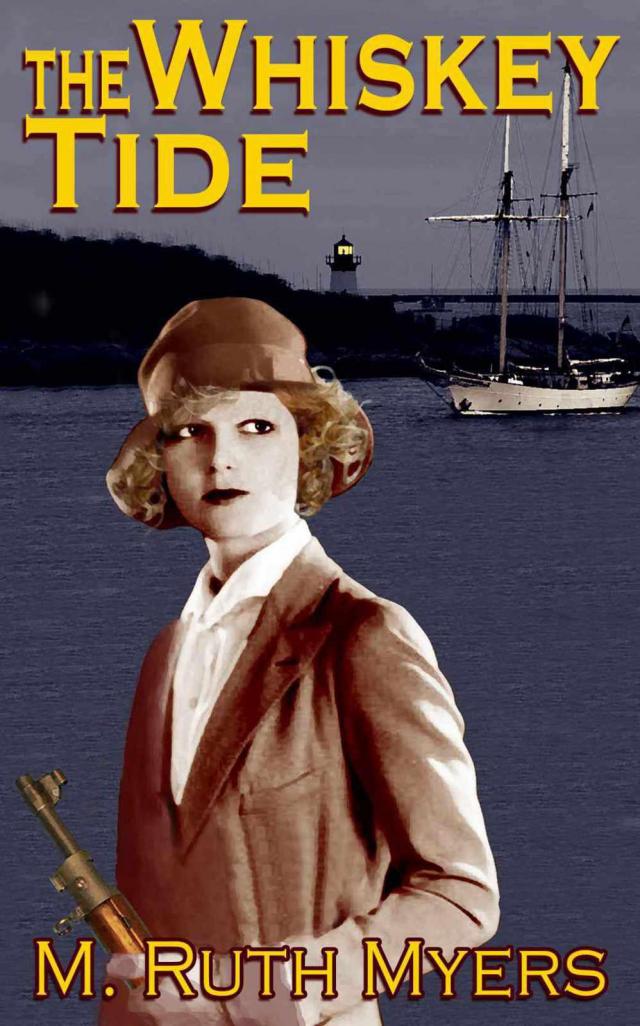
The
Whiskey Tide
M. Ruth Myers
Copyright © 2013 Mary Ruth Myers
All rights reserved. No part of this book may be used or reproduced in any manner whatsoever without written permission from the author, except in the case of brief quotations embodied in critical articles and reviews. Contact www.mruthmyers.com.
Published by Tuesday House
This book is a work of fiction. Names, characters and incidents are products of the author’s imagination or are used fictitiously. Any resemblance to actual events or persons, living or dead, is entirely coincidental.
Cover design by Alan Raney
For Vincent
in hopes he will one day
know the magic
of the
Flying Horses
Part I
Tide
One
On the night she stood up to the man who broke bones for a living, Kate Hinshaw was hiding. Noiseless as fog, she glided through back rooms of the large white house on Salem’s Neck, escaping the social chit-chat of her sister’s engagement party and berating herself for not speaking more forcefully when the pompous wife of an equally pompous judge labeled all female college teachers ‘daughters of Lesbos’. The memory fueled Kate’s anger as her hip nudged the swinging door into the kitchen. Slipping through, she felt the room’s humidity mingle with the hot August night to melt her voile dress onto her body.
Peg looked up, knobby elbows dancing above a silver platter she was refilling with lobster puffs and tiny tea sandwiches.
"Here, now. You get back in and be sociable!"
"I have been the very soul of sociability, Peg."
Kate pushed back golden hair that was fashionably frizzled. The cook scowled.
"Let you out on your own for a few years and you think you know everything. If you ask me, your pa's—"
"—wasting good money sending me to that college when it hasn't improved my manners a bit," Kate finished. "I could be like Aggie and her friends," she suggested evilly.
A click of the tongue conveyed Peg's disapproval of Kate's younger sister. Kate laughed and gave her a quick hug, then began to dab pimento cheese onto circles of toast. Peg, for all her grumbling, would be glad of help. The wiry Irishwoman had ruled the kitchen of the rambling old house since before Kate's older sister was born. Tonight's festivities were burying her in quickly depleted trays and mountains of empty champagne bottles.
No matter that the Volstead Act had been in force two years, or that Rosalie's fiancé was in his final year at Harvard Divinity. You had to celebrate an engagement in style, Pa said.
Ethel, the day girl, was supposed to be helping this evening. As Kate opened her mouth to ask her whereabouts, the girl scurried in with frightened eyes.
"There's a man at the door," she told Peg breathlessly. "Right unpleasant. Says he wants a word with Mr. Hinshaw. When I told him Mr. Hinshaw was entertaining and he should see him downtown tomorrow, he tried to stick his foot in the door — but I slammed it. Now he's out there pounding!"
Kate felt Peg slide her a glance and was startled to realize the cook was waiting for her to take the lead. Apparently living away from home for most of the year gave her some new status in spite of Peg's lectures.
"I'll see what he wants." Kate stuck the spoon into the bowl of cheese with more confidence than she felt.
It was probably one of Pa's charity cases, some working-class man who couldn't afford a lawyer but whose plight appealed to Pa's sense of justice. They showed up afterwards sometimes with gifts, or even a small payment. Ethel scurried out, relieved to return to gathering dishes.
"He makes enemies, your pa does," Peg cautioned. "Maybe we should call the coppers."
Kate hesitated. The last thing she wanted was for anything to spoil this evening for Rosalie. Her older sister was as proper as she was sweet-natured and pretty, and her fiancé's family was positively stuffy. As Kate debated, the screen door into the kitchen crashed. She whirled to see a thick-shouldered man standing not three steps away. He wasn't roughly dressed as she had expected, but there was menace in the sharp lines of his face.
"Tell Hinshaw I've got a message for him," he demanded.
Kate's throat felt too tight for speech. "You'll have to see him tomorrow."
"You'd be the middle daughter, wouldn't you?"
The stranger's knowledge chilled her. At the edge of her vision she saw Peg eying a distant drawer where butcher knives were kept. Without warning the stranger sprang, catching Kate's wrist and jerking her almost off her feet.
"Why don't we just find him together?"
His smile was the insolent smile of a bully who liked to intimidate. And tucked in his belt was a small black leather sap. Her father had pointed one out once; whispered to her they were used for breaking bones.
Her free hand flew behind her seeking anchorage. It found only empty champagne bottles piled on a work table. As the bottles crashed to the floor, she fumbled for the neck of one, and with a breath of hesitation brought it around to crack hard against the wall by the stranger's head.
He jerked back at the shower of glass, but didn't release her. Kate thrust the jagged edge of the bottle toward him with slashing motions. Swearing nastily he retreated, and she found herself free.
"There are... I don't know how many judges and a police commissioner in the other room." Her words were harsh with fear. She wondered when her knees would collapse.
The intruder's eyes had narrowed in his pockmarked face.
"Tell your old man it ain't healthy defending union troublemakers." The screen door banged again and he was gone.
Then Peg was beside her prying the bottle from her nerveless fingers. Kate looked at the broken glass that seemed to be everywhere. Legs unconnected to her carried her to the kitchen counter. She hoisted herself to the spot where she'd sat when she was in pigtails and drew her hair back with a trembling hand as she struggled for breath.
"We both deserve a drink," she said in the silence swallowing them. "Gin and tonic for me." She laughed weakly at Peg's startled look.
Peg returned from the serving pantry bearing a glass filled with clear liquid and another with brown. Kate took a large swallow, then raised her glass. "Class of '23, Peg. That's what we say at school when we have a drink. Can you believe by this time next year I'll be graduated?" She knew she was chattering. If she didn't, she would start to shake.
Tension seeped from Peg's face as she sipped whiskey.
"And where in the name of St. Pete did you learn a trick like that?"
"Oh...." Kate was embarrassed to confess her folly just when Peg was regarding her as an adult. She laughed unsteadily and gulped a little more gin. "A school chum and I went to a socialist meeting — just to see for ourselves what they were about. When it was letting out, some men ran out of an alley and started a fight with the speakers. One was taking a terrible beating when he picked up a bottle and broke it like that. The bullies backed off."
Peg unhooked an upper lip like a snapping turtle's.
"Like father like daughter. And just see what thanks it gets when your pa puts himself out for riffraff instead of tending to gents of his own class!"
"Justice shouldn't depend on your pocketbook," Kate said lightly. Words she'd grown up with. Sliding from the counter she gave Peg a quick hug, unsure which one of them she was reassuring, then headed for the dining room as if to be sociable.
From the dining room door she could see Rosalie's party was going perfectly well without her. Her sister's face was flushed with happiness as she stood beside her fiancé, who in another year would be the Rev. Dr. Arthur Kent. Rosalie looked dainty as fine lace as they talked with well-wishers. Mama and Pa were surrounded by their friends as well. Even her nine-year-old brother Woodrow was being well entertained, what with Nathan Welles squatting beside his wheelchair and drawing cartoons.
Only her step-cousin Theodore seemed to stand on the edge of things, scarcely hearing when anyone talked to him, scarcely speaking. His golden head seemed perpetually bowed. His tall and once-graceful figure leaned, void of spirit, on the cane which had supported him since the War To End Wars. Grief ate at Kate seeing him so changed and so wasted. Yet whenever his eyes sought her out and the haunted look in them gave way to brightness, panic filled her. They were the eyes of a drowning man reaching desperately for a life preserver.
She felt guilty turning away from this gentle companion of her childhood. She loved Theo, but not in the way he wanted. It was torture to see him drifting, taking interest in almost nothing. It was equal torture to become the focus of that interest.
His pale head raised and Kate dodged back. She slipped up the back stairs to her room. On her dresser lay the letter from Scotland that had arrived that afternoon. The letter that could carry her into company as rare and wonderful as that of the Round Table. Filled with the thought of it, she went to the open window. Night breezes wrapped their arms around her, bearing the scent of adventure from Salem Harbor, connecting her with all who had breathed it before her: captains on the vanished ships of the China Trade, runaway cabin boys, pirates, even the small boats rumored to bobble in almost nightly now with bootleg hooch.
The episode in the kitchen had shaken her more than she'd let on. Cheek pillowed on her arms, she looked into darkness toward Hospital Point and the waves she had loved since earliest memory. She thought about days when she and her sisters and cousins were a single tangle of children running barefoot through the sand without distinguishing boys
"It's a hell of a pressure to put on a relative, Oliver!"
She jumped at the nearby voice. The window to her left turned yellow as a light went on in her father's study. It had been her Uncle Phinneas who spoke, but with a belligerence she'd never heard.
"I'm only asking that you repay half right now," her father reasoned.
Kate cocked her head, vaguely guilty at eavesdropping but too interested to do otherwise.
"Half of fifteen thousand dollars is still an unreasonable request!" Uncle Finney sputtered. "I'd have to sell stocks. I'd take a terrible loss."
"You made quite a profit when I lent you the money, as I recall." Her father sighed. "I do hate to press the matter, Phinneas, but it's been three years. Frankly, I'm strapped. Woody's last round of medical bills were horrendous, and the ones before that had all but eaten our savings."
"You'd be in fine shape if you hadn't bought that damn boat."
Anger flickered in Kate at the comment. Pa's Folly was the only indulgence she could remember her father ever allowing himself. Her parents hadn't dragged the whole family through Europe like Uncle Finney and Aunt Helène had done before the war. Her parents didn't go to New York and stay in the best hotels and see all the new plays twice a year.
"As a matter of fact, I accepted the boat in settlement of a bill," her father said mildly.
She never had known the circumstances behind the two-masted topsail schooner, only that her father, who spent his days in courtrooms, hungered for such a craft when he watched them in the harbor. Six years ago he had simply sailed home in one and announced it was theirs.
"You see, you've always been a poor businessman. That's why you're in a pickle now," pronounced Uncle Finney.
"Please do be reasonable. When you asked to borrow money so you could take advantage of an opportunity, I said yes. All I'm asking is that you start to repay. How about five thousand for now, the rest when it's more convenient?"
Uncle Finney made an indignant sound. Kate pictured his fly-swatter jowls reddening.
"Never let it be said I don't repay debts," he sniffed. "I'll see my broker tomorrow."
"And not a word to Genevieve about the bills of course," Pa said. "I wouldn't want her to worry."
The light went out. Silence returned. Kate lay with heart thumping. She never had imagined her family having unpaid bills. It became a magnet for other disturbing thoughts: Theo's pleading looks. A man scared away with a bottle.
Around the shore at Salem Willows, the brassy music of the Flying Horses faded as the carousel stopped and the park closed its gates. Below the cliff, she could hear the soothing whisper of ocean. She yawned, wondering how it would be to ride waves in darkness. She'd hoisted and lowered sail and raised her face to the sea breeze only by day.
***
The light of the small fishing skiff flirted through the night like a barmaid with her skirt hitched up, daring anyone to ignore her. Joe Santayna, his hand on the tiller, grinned at the possibilities.
"You don't think this is crazy?" ventured the freckle-faced boy who rode in the bow seat.
"Oh, yeah. It's crazy all right," Joe answered.
He wasn't sure how old Billy McCarthy was. Thirteen, maybe fourteen. Old enough to keep his wits about him. Joe tried to remember whether he'd have been scared at that age, or merely excited by an adventure like this. But that had been eleven years ago. Before the war. Another life.
"It's so crazy the cops'll never think it's anything but the truth if they happen to be there," he explained. "I'll tell my tale. You'll whine. I'll box your ears. And that's that." He'd feel bad if he had to hit the kid. But Barlow was paying Joe forty dollars and the kid ten to make this trip. "I'll see Barlow gives you another five if I have to clip you," he added.
Billy McCarthy lifted thin shoulders. "Don't matter. My pa punched me plenty for free before he left."
Joe shook a mass of dark curls. His own dad had been as gentle a man as ever walked. The Santaynas were a rough lot, dock hands and fishermen. They liked to curse as much as they liked to drink; liked to quarrel best of all. But though voices were often raised, fists seldom were, and never against kids.
"So what happens if the cops're there and the others can't bring the booze in?" Billy asked.
"Then they'll stow it under the Flying Horses out at the Willows."
It sounded so outlandish he knew the kid wouldn't believe it. Otherwise he'd never risk telling. He heard Billy snort.
"Don't tell me then."
Twin dimples that were the scourge of Joe Santayna's life — and the downfall of many a girl who'd caught his eye — made inch long creases in his cheeks.
"I won't. The less you can spill, the less risk to you."
He knew nothing about Billy McCarthy. Only that he swept up at Brennan's pub and kept to himself and wiped his nose on a handkerchief instead of his sleeve.
Joe felt his lips twitch in the dark. Wouldn't his Irish aunties be proud to know the manners they'd drummed into him had some effect? They'd helped him pick a kid for bootlegging.
Not that Joe himself was a regular practitioner. But when someone you trusted came along with an offer of money, why say no? It relieved the restlessness he'd felt more and more since he'd come home from France. Odd how in those flat, distant fields with no sight of a shoreline he'd kept himself alive by summoning memories of the smells and sounds of Salem. Yet now he'd been back going on two years, his uncles' fishing boat sometimes seemed as stifling to him as the rat-filled trenches.
Drawing a breath of the salt tang which always made problems seem smaller, he admired the shapes of houses revealed here and there by late-lighted windows on cliffs above the rocky shoreline they were approaching. He couldn't see details, but their mere size, and their privacy, spoke of an ordered existence unlike any he knew.
"There's where money lives for sure," he said.
It was an easy thing, adjusting your eyes to darkness. He saw Billy's nod.
"I work up at one of those houses we just passed. Running errands and such," the boy said shyly.
"Yeah?" Joe felt the same curiosity he'd felt when he saw a castle, or chateau as they called them there, on a hill in France. "What's it like?"
Billy shrugged. "The house next to where I work, there's two crazy old women. Peg — she's the cook — says one of 'em dresses up like a Chinaman. Where I work they're just regular folks, though, except they dress up every day. Have a little sick boy what's in a wheelchair."
"Money enough for doctors, though," Joe said under his breath. He thought of his cousin Opal, whose toddler had weakened and died because there was no way to pay for the operation that could have saved him.
He was starting to speak again when he felt a prickling between his shoulder blades. It had warned him a time or two in the Argonne. There was someone there on the beach.
"Time to pay attention," he murmured to Billy. He raised his voice. "Dan! Hey, Danny! You there?" He gave it a minute, then bellowed again. "Put some light on, for Christ’s sake! I found the little bugger."
From behind a boulder the sudden spotlight of a police launch blinded him.
"Cut your motor and float to shore. Keep your hands on your head," a voice ordered over a megaphone.
Joe grinned. That burst of light would be all it took to warn Barlow to take his cargo of rye a bit farther up coast. If there was a welcoming party here, they almost certainly wouldn't have men a mile away.
"Hey! I got a kid with me. Don't do anything crazy!"
He'd obeyed the megaphone order. Now, squinting past the spotlight, he could make out a circle of faces. Five or more boys in blue keeping the precinct safe from rum runners while the Coast Guard laid in wait at the three mile limit and half the local citizens nipped at smuggled bottles behind closed curtains. As he nosed to shore the police launch swung behind to block his escape by water. At the head of the group of cops he recognized Colin O'Malley, newly promoted to sergeant and rumored to have his hands in a couple of tills.
"Evening, boys." Joe leaped lightly into the sand with hands raised.


